


















Blogs:

What is psychological safety?

Why is it so important, how can you encourage it in the workplace and what role do leaders play?

What is psychological safety

    A quick insight: Psychological safety shapes how comfortable people feel speaking up, sharing ideas and admitting mistakes without fear of negative consequences. When it is strong, teams innovate more, collaborate better and solve problems faster because people trust they will be heard and respected. This guide explains what psychological safety looks like in practice and how to build it through clearer communication, stronger leadership and better employee listening.

    Business owners, leaders and HR teams are always looking for ways to help employees feel more engaged, supported and able to do their best work. We want people to bring ideas forward, ask questions, challenge poor thinking and solve difficult problems together. But none of that happens consistently unless psychological safety is part of the culture.

    Psychological safety plays a major role in how teams communicate, learn and perform. It affects whether employees feel able to speak honestly, whether managers hear what they need to hear and whether organisations create the conditions for trust, innovation and wellbeing.

    At People Insight, this is closely tied to Sharper listening. Smarter action, our approach to insightful, proactive employee listening and turning that insight into meaningful action. Listening becomes sharper when employees feel safe enough to say what they really think. Action becomes smarter when leaders take that feedback seriously and respond in visible, credible ways.

    Related: How does radical candour support psychological safety?

    What is psychological safety?

    Psychological safety is the belief that you can express yourself without fear of negative consequences.

    In a psychologically safe workplace, employees feel more comfortable:

    • sharing ideas
    • asking questions
    • raising concerns
    • admitting mistakes
    • challenging decisions respectfully
    • contributing different perspectives

    In simple terms, psychological safety means employees do not feel they will be judged, humiliated or penalised for speaking up.

    Silence is rarely a sign that everything is fine. More often, it is a sign that employees do not feel safe enough to say what they really think.

    Why psychological safety matters in the workplace

    Psychological safety is not a soft extr, but a practical condition that affects how well people work together.

    When psychological safety is strong, teams are more likely to:

    • communicate openly
    • collaborate more effectively
    • learn from mistakes
    • raise risks earlier
    • try new ideas
    • support one another under pressure

    When it is weak, people tend to hold back. They stay quiet in meetings, avoid difficult conversations, keep concerns to themselves and prioritise self-protection over contribution.

    That has real consequences for culture, decision-making and performance.

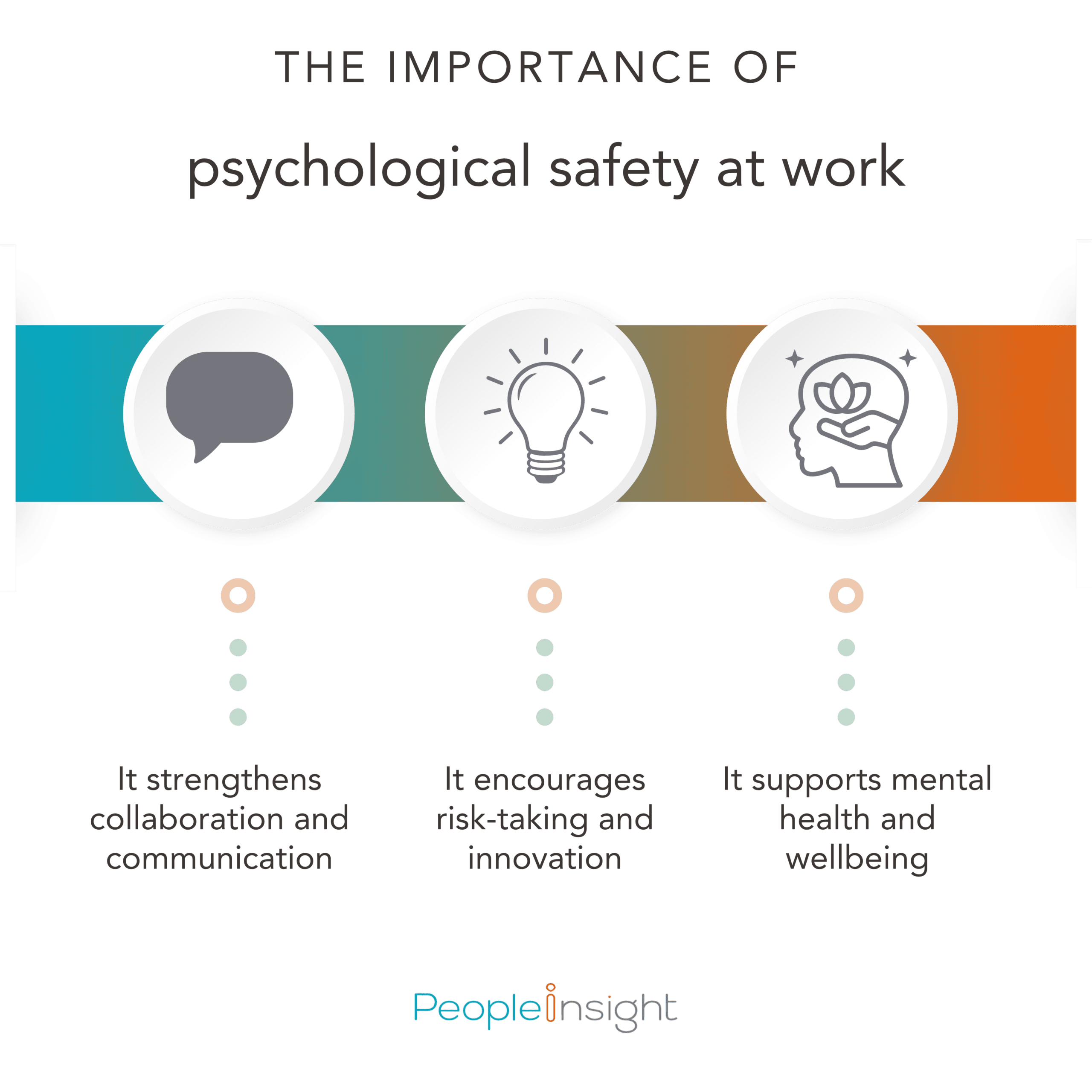
    The importance of psychological safety at work

    Let’s take a look at why psychological safety is so important in the workplace. It boils down to three big things…

    The importance of psychological safety at work

    1. It strengthens collaboration and communication

    Psychological safety helps employees feel more comfortable contributing in front of others. That makes collaboration easier and improves the quality of team discussion.

    This is especially important in environments where people need to work across teams, functions or specialisms. If employees worry they will be criticised or ignored, they are much less likely to speak up.

    People Insight’s benchmark data shows there is work to do here:

    • only 46% of employees say communication is good between teams
    • only 53% say people communicate openly regardless of position or level

    Those figures point to a workplace reality where many employees still do not experience communication as open or easy. Psychological safety helps address exactly that.

    The University of Manchester’s listening at scale work is a strong example of this. Their approach helped create more opportunities for people to speak up and helped leaders listen in a way that supported local action, not just central reporting.

    2. It encourages risk-taking and innovation

    Psychological safety creates the conditions for people to try things, test ideas and speak honestly when something is not working.

    If employees believe mistakes will be treated as failures rather than learning opportunities, they are much less likely to take considered risks. Innovation becomes harder because people stay in the safe middle ground.

    Healthy risk-taking depends on people knowing they can bring forward ideas that are not perfect yet, raise concerns before they become serious problems and admit when something has gone wrong.

    3. It supports mental health and wellbeing

    When employees constantly feel watched, judged or worried about how they will be perceived, the pressure builds.

    People Insight’s benchmark data shows:

    • 64% of employees say they can comfortably cope with their workload
    • 65% say their organisation does enough to support health and wellbeing at work

    That means a sizeable minority of employees still feel under pressure or under-supported. Psychological safety matters here because it makes it easier for people to say when they are struggling, ask for help and be honest about what is and is not sustainable.

    A psychologically safe culture helps reduce unnecessary stress because people do not have to spend energy managing fear on top of their work.

    Related: Signs of stress at work

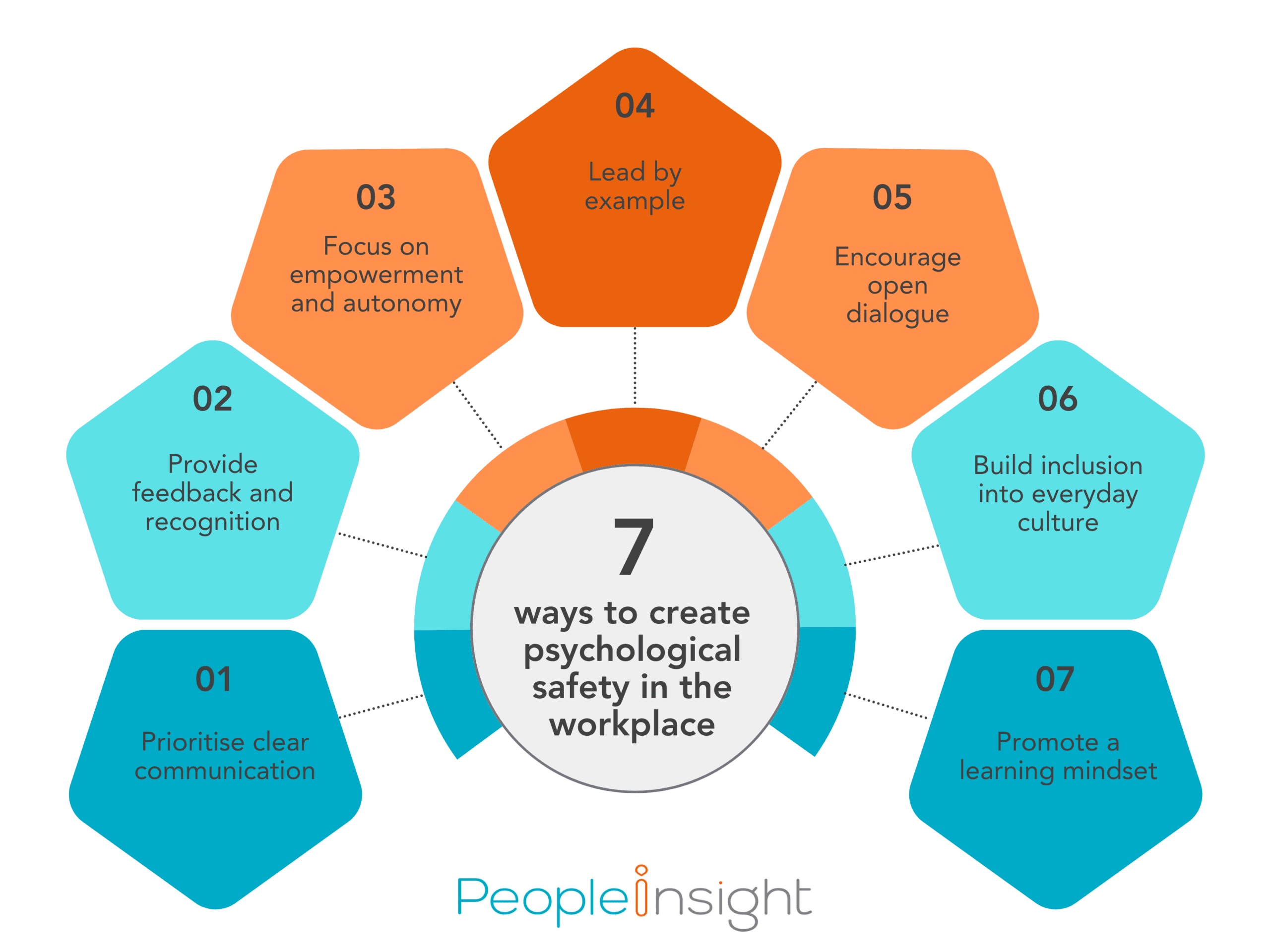
    How to create psychological safety in the workplace

    Psychological safety does not appear overnight. It is built through repeated behaviours, leadership signals and everyday experiences. 

    Below are the most effective ways to strengthen it at work.

    How to create psychological safety in the workplace

    1. Prioritise clear communication

    Transparent communication is one of the strongest foundations of psychological safety.

    When employees understand what is happening, why it matters and how decisions are being made, they are more likely to trust the environment around them. That trust makes it easier to speak up.

    Clear communication includes:

    • honest updates from leaders
    • team conversations that allow questions
    • clarity around priorities and expectations
    • room for disagreement without defensiveness

    At King’s College London, stronger survey communications and clearer manager guidance helped teams understand results more effectively and made it easier for people to engage in meaningful conversations about what needed to change. That kind of structure supports psychological safety because it reduces confusion and creates space for more honest dialogue.

    2. Provide feedback and recognition

    Constructive feedback and regular recognition help people feel seen and supported. They also reduce the sense that every conversation is a threat.

    People Insight’s benchmark data shows:

    • only 61% of employees say they have received thanks or praise in the last week
    • only 63% say they feel valued and recognised for the work they do
    • only 69% say their line manager gives regular feedback

    That tells a clear story. Many employees are still not getting regular enough feedback or recognition to feel consistently supported.

    Recognition builds confidence. Constructive feedback, when done well, helps people improve without feeling diminished. Both are important if you want employees to contribute more openly.

    Related: Employee Appreciation Day ideas

    3. Focus on empowerment and autonomy

    Psychological safety grows when employees feel trusted to use their judgement.

    People are more likely to contribute ideas and take ownership when they have some freedom in how they do their work. That is why autonomy is so closely linked to both psychological safety and engagement.

    People Insight’s benchmark data shows:

    • 80% of employees say they have the freedom they need to get on with their job
    • 64% say their opinion is sought on decisions that affect their work

    That gap matters. Employees may have some operational freedom, but not always feel genuinely involved in decisions that shape their work.

    Catalyst IT Europe is a useful example here. Their approach to autonomy, open communication and workload conversations helped create a culture where people trusted that their views would be considered, not ignored.

    4. Lead by example

    Leaders play a defining role in psychological safety.

    If leaders react badly to challenge, become defensive under pressure or shut down difficult conversations, employees notice. If leaders admit mistakes, ask questions, invite input and respond thoughtfully, employees notice that too.

    Employees are much more likely to feel psychologically safe when they see leaders:

    • acknowledging what they do not know
    • treating mistakes as learning opportunities
    • asking for views from different people
    • responding without blame or ridicule
    • following through on concerns raised

    People Insight’s benchmark data shows only 60% of employees say senior leaders make the effort to listen to staff. That suggests there is still a substantial credibility gap in many organisations. Psychological safety improves when leaders are seen to listen, not just when they say they do.

    5. Encourage open dialogue

    Workplaces are stronger when all voices can be heard, not just the loudest ones.

    Encouraging open dialogue means creating space for discussion, questions and difference of opinion. That might happen through team meetings, check-ins, listening sessions or more structured channels for feedback.

    The goal is not just to let people speak. It is to create a culture where people believe it is worth speaking.

    That is one reason the employee feedback loop matters. Employees are far more likely to keep contributing if they can see that what they say leads to action.

    6. Build inclusion into everyday culture

    Psychological safety and inclusion are deeply connected.

    A workplace cannot benefit fully from different backgrounds, perspectives and experiences unless people feel safe enough to share them. Inclusion is not just about representation. It is also about whether employees feel able to contribute without fear of bias, dismissal or embarrassment.

    That is why it helps to strengthen:

    • inclusive meeting habits
    • fair access to opportunities
    • respectful day-to-day interactions
    • visible support for difference
    • openness to challenge and perspective
    7. Promote a learning mindset

    Psychological safety gets stronger when mistakes are treated as part of learning rather than evidence of failure.

    That does not mean lowering standards. It means creating an environment where people can reflect, adapt and improve without fear that every mistake will be punished or remembered against them.

    A learning mindset supports:

    • experimentation
    • resilience
    • honest reflection
    • better problem-solving
    • stronger team learning

    This is especially important in fast-moving environments where teams need to adjust quickly and learn openly.

    Measuring and monitoring psychological safety

    If you want to improve psychological safety, you need a way to understand where it stands today and whether it is changing over time.

    Use surveys and feedback loops

    Regular employee surveys are one of the best ways to assess psychological safety.

    Questions might explore:

    • whether employees feel safe speaking up
    • whether leaders listen
    • whether concerns are taken seriously
    • whether employees feel comfortable challenging decisions
    • whether mistakes are handled fairly

    What matters just as much as the survey itself is what happens next. If employees give honest feedback and do not see visible follow-through, trust weakens. That is why psychological safety and action planning are closely connected.

    Use anonymous reporting channels where needed

    Anonymous channels can be useful where employees may not yet feel ready to speak openly. These should not replace direct dialogue, but they can help surface issues that might otherwise stay hidden.

    Track engagement, retention and comments over time

    Psychological safety often shows up indirectly in other measures too.

    You may see it reflected in:

    • engagement trends
    • retention patterns
    • employee comments
    • communication scores
    • wellbeing indicators
    • confidence in leadership

    It is rarely one question alone that tells the full story. The clearest picture comes when you look across multiple signals.

    What good psychological safety looks like in practice

    A psychologically safe workplace usually includes:

    • leaders who listen visibly
    • colleagues who respect one another’s input
    • space to ask questions and challenge ideas
    • fair responses to mistakes
    • feedback that is constructive rather than punitive
    • visible action after people speak up

    That kind of culture is not passive. It is designed, reinforced and maintained through everyday leadership and communication.

    Derbyshire Fire and Rescue is a useful example of this broader principle. Their work on culture, values and listening created a stronger environment for openness and follow-through, showing how safer cultures are often built through visible action rather than one-off statements.

    Improve psychological safety with People Insight

    Psychological safety is a practical condition for better communication, stronger wellbeing, healthier cultures and more effective teams.

    If employees do not feel safe enough to speak honestly, organisations lose insight they need. If they do feel safe, leaders get a much clearer view of what is working, what is getting in the way and what needs attention.

    At People Insight, we help organisations measure and improve psychological safety through employee surveys, Prism-powered insight and practical support that helps leaders turn feedback into meaningful action.

    Want to understand and strengthen psychological safety in your organisation? Get in touch to learn how People Insight can help.

    FAQs about psychological safety

    A quick run down on all you need to know

    What is psychological safety at work?

    Psychological safety at work is the belief that you can speak up, ask questions, share ideas and admit mistakes without fear of humiliation, blame or negative consequences.

    Why is psychological safety important?

    Psychological safety is important because it improves communication, collaboration, learning, wellbeing and innovation. It helps people contribute more openly and confidently.

    How do you build psychological safety in a team?

    You build psychological safety through clear communication, supportive leadership, constructive feedback, visible listening, autonomy and a culture where mistakes are treated as learning opportunities.

    What are signs of low psychological safety?

    Signs of low psychological safety include silence in meetings, reluctance to challenge decisions, fear of making mistakes, low openness, weak communication and a tendency for people to hold concerns back.

    How can leaders improve psychological safety?

    Leaders can improve psychological safety by asking for input, responding without blame, admitting mistakes, recognising contributions and following through visibly on concerns raised.

    How do you measure psychological safety?

    Psychological safety can be measured through employee surveys, open comments, engagement trends, communication scores, wellbeing indicators and retention patterns.

    How can People Insight help with psychological safety?

    People Insight helps organisations understand and improve psychological safety through employee surveys, Prism-powered analysis and practical consultancy support that turns feedback into meaningful action.