















Blogs:

How to align employee surveys with strategic planning

How timing surveys with your planning cycle helps employee feedback shape real decisions.

Aligning employee surveys with strategic planning

    A quick insight: Strategic planning for employee surveys ensures listening is purposeful and aligned to organisational goals. When questions are chosen with clear intent and connected to business priorities, the insight you get becomes more meaningful and easier to act on. A well-planned survey strategy helps organisations prioritise effort, increase relevance for respondents and turn feedback into confident, targeted action.

    You run your employee survey, gather the results and then the moment passes. By the time leaders have reviewed the data, budget decisions have already been made, strategic goals are locked in and it is too late to act on what people actually said. But that does not have to be the case.

    When you time your survey to support strategic planning, something shifts. You create space for employee feedback to influence priorities while they are still being shaped. It sends a clear message that what employees say matters, and not just after the fact.

    At People Insight, we help organisations design and time actionable surveys that feed directly into planning, so insight becomes part of the decision-making process rather than an afterthought. That is a big part of what we mean by Sharper listening. Smarter action. It is our approach to insightful, proactive employee listening and turning that insight into meaningful action. Listening becomes sharper when surveys are designed and timed with clear intent. Action becomes smarter when that insight feeds directly into strategic priorities, budgets and follow-through.

    Related: Watch our webinar with Medivet on how employee feedback can fuel social good

    What does it mean to align employee surveys with strategic planning?

    Aligning employee surveys with strategic planning means timing your survey so the insight arrives while decisions are still being made, not after they have already been finalised.

    In practice, that means your survey results can help shape:

    • strategic priorities
    • people plans
    • budgets
    • communications
    • leadership focus areas
    • local action plans

    A well-timed survey helps organisations move from reactive listening to proactive decision-making. Instead of using employee voice to explain what has already happened, you use it to influence what happens next.

    Why survey timing shapes real outcomes

    Timing plays a bigger role than many organisations realise. When surveys are scheduled without reference to business planning, the insight often arrives too late. By the time results are analysed, discussed and cascaded, the window for shaping budgets and strategy has closed.

    When surveys are aligned with annual or quarterly planning, decisions are informed by fresh, relevant feedback. It also shows employees that their voices have a seat at the table, which can build trust and improve future response rates.

    Global benchmark snapshot

    Your 2025 benchmark data points to a useful gap that makes the case for better alignment.

    • 87% of employees say they know how the work they do helps their organisation achieve its aims
    • but only 60% say they know how well their organisation is doing against its objectives
    • and only 53% believe action will be taken as a result of the survey

    That tells an important story. Many employees understand their role in principle, but far fewer feel clear on progress against wider goals or confident that feedback will lead to visible action. Aligning employee surveys with strategic planning helps close that gap by making employee feedback more relevant to decision-making and more clearly connected to what happens next.

    Strategic planning is not just for leadership

    When organisations treat employee feedback as an isolated activity, they miss a valuable opportunity. Strategic planning does not happen in a vacuum, and neither should employee surveys. When timed well, surveys become an input that helps shape direction, not just measure sentiment.

    That is exactly what Medivet did when they repositioned their employee engagement survey to land alongside their financial year planning. Instead of reviewing employee sentiment long after planning had wrapped up, they used survey data as a live input into decisions about priorities, budgets and operational focus. It was a small shift with a big outcome: employee feedback helped to actively shape the future.

    Related: Marrying data competency with real human conversations

    Case study: how Medivet timed their survey to drive progress

    Medivet, a leading veterinary care provider with more than 3,500 colleagues across 400 practices, shifted their employee survey to March so it aligned with their April-to-April financial year.

    The change was deliberate. Surveys had previously landed at points that did not feed into planning conversations. Results felt disconnected from action and employees did not always see progress as a result of their feedback. By adjusting the employee survey window to precede strategic decisions, Medivet created a stronger feedback loop with real influence.

    Survey findings were then used to identify priority areas such as wellbeing, development and communication. Those themes fed directly into strategic focus for the year, making the survey more than a measure of sentiment. It became a foundation for meaningful change.

    How to build employee surveys into your planning calendar

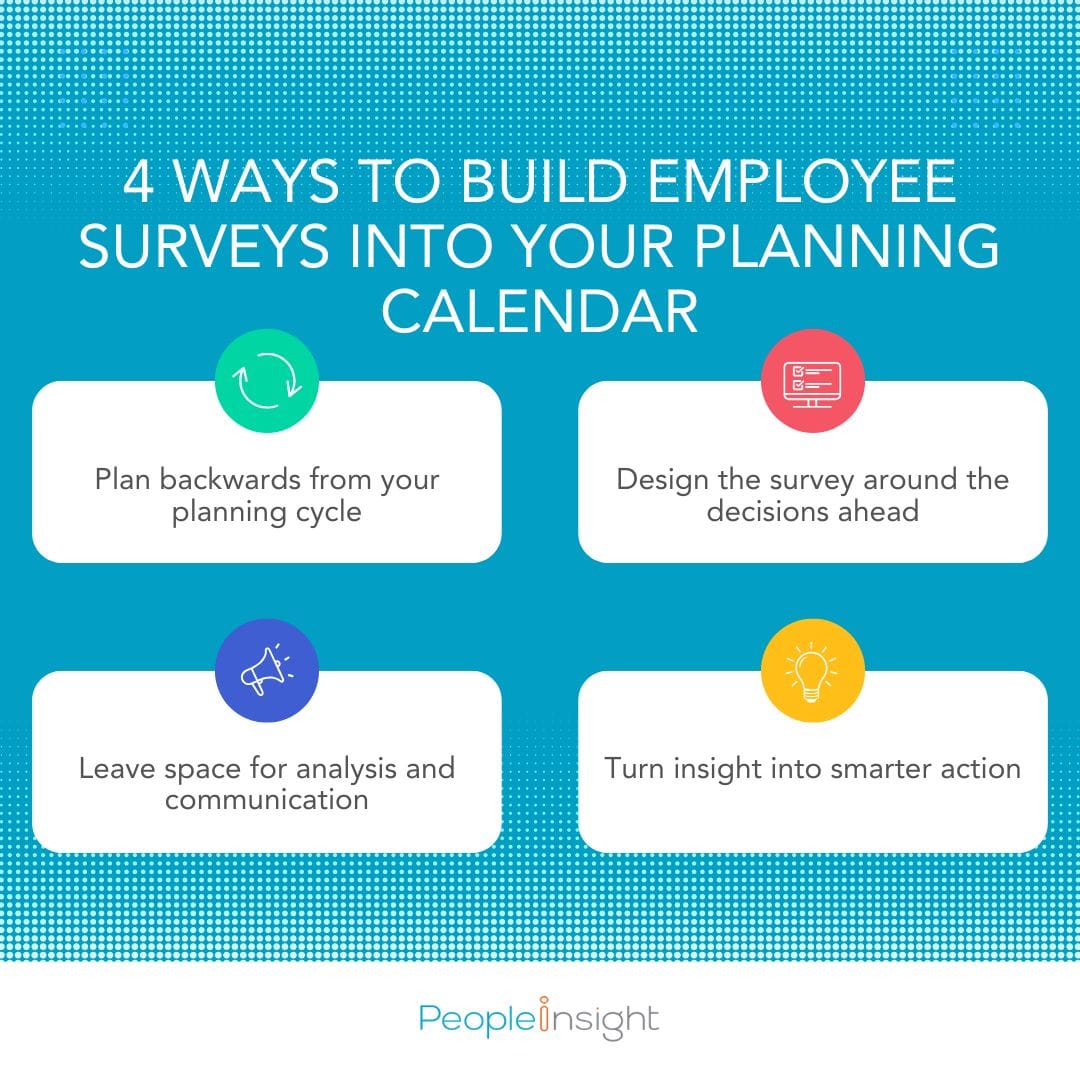
    To align survey cycles with strategic planning, organisations need a practical approach. These four steps are a good place to start.

    4 ways to build employee surveys into your planning calendar

    1. Plan backwards from your planning cycle

    If your strategic planning starts in Q4, schedule your survey in early Q4 or late Q3. This gives you enough time to gather and analyse the data while it is still relevant to decisions.

    Too often, organisations collect feedback only to realise budgets, people plans and communications strategies have already been locked down. That leaves little room for meaningful change and signals to employees that their views are optional rather than influential.

    2. Design the survey around the decisions ahead

    A strong survey should not just ask generic questions. It should help leaders understand what they need to know before priorities are set.

    That means designing questions around the themes most likely to shape your next planning cycle, whether that is wellbeing, leadership, communication, career development, workload or something more specific to your context.

    This is also where a more strategic listening approach matters. The strongest surveys are designed with the planning process in mind, not simply repeated because it is that time of year again.

    If you are reviewing your survey design, it can also help to revisit how to write your own employee survey questions.

    3. Leave space for analysis and communication

    Survey timing should not only align with planning. It should also leave enough space for analysis, discussion and decision-making. Build in time to share results and agree next steps before strategies are finalised.

    This is where communications can make a major difference. At Croydon College, pre-survey communication, visible backing and healthy competition between departments helped lift participation, while fast, tailored result-sharing supported the transparent and involving culture they were trying to build. At King’s College London, managers were supported with clearer guidance, dashboard prompts and practical next-step resources so results could be understood and discussed more effectively.

    That kind of structure helps organisations move more confidently from feedback to decision-making. It also reduces the risk of the say-do gap, where leaders ask for feedback but fail to show how it shaped priorities.

    4. Turn insight into smarter action

    Speed matters when timing surveys around planning. An actionable employee survey platform makes it easier to move from data to insight.

    With the People Insight Platform, survey findings can be themed, benchmarked and visualised quickly, helping leaders focus on what matters most while planning conversations are still live. Prism strengthens this further by helping organisations surface clearer priorities, summarise comments at scale and move more confidently from results to action.

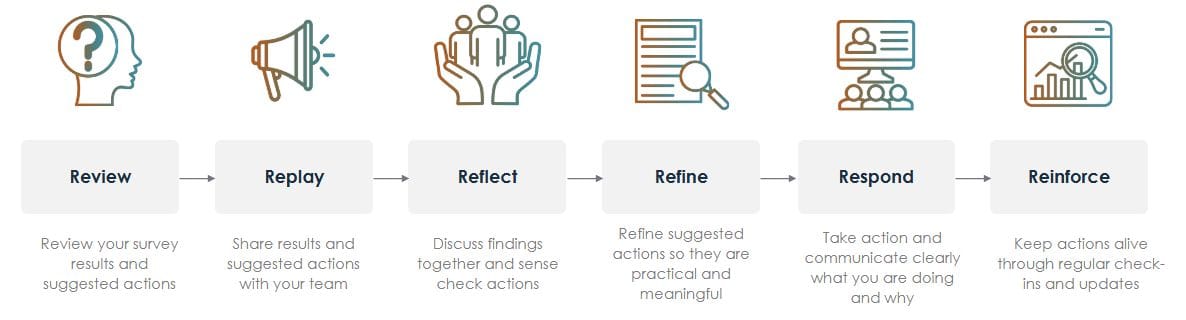
    This is also where our 6 Rs framework comes in:

    6 Rs action planning

    • Review
    • Replay
    • Reflect
    • Refine
    • Respond
    • Reinforce

    The 6 Rs gives organisations a more structured way to move from survey results to visible progress. In the context of strategic planning, that matters because the goal is not just to gather feedback at the right time. It is to make sure that insight is acted on clearly and reinforced over time.

    Strategic planning works better with employee input

    The best strategies are grounded in how people feel at work, what gets in their way and what helps them do their best work. Surveys, when timed and used properly, give access to that insight.

    This is not just true for Medivet. At London South Bank University, survey results were used to support local accountability and action, with line manager development, stronger communication and visible leadership helping improve both response rate and engagement. Strategy only becomes meaningful when it can be translated into changes employees actually experience.

    Clarion offers a useful lesson here too. Their employee feedback was turned into a structured strategy with clear actions, intended outcomes and ways of measuring success, supported by visible ownership at board level. That kind of discipline helps make sure employee insight does not stay vague or aspirational. It becomes part of how the organisation moves forward.

    Regular feedback supports better strategic decisions

    While annual surveys can support yearly strategic planning, more regular listening creates even greater value. Pulse surveys, 360 feedback and other listening moments help organisations keep employee experience visible throughout the year rather than in one isolated window.

    That does not mean surveying constantly. It means creating the right rhythm of listening so leaders can respond while change is still possible.

    This is where people analytics can also help. The more clearly organisations can see patterns over time, the easier it becomes to align employee insight with planning cycles and strategic goals.

    Communicating survey impact matters

    It is not enough to time surveys well. Organisations also need to show employees how their feedback has influenced direction. That means being transparent about the results, sharing next steps quickly and committing to follow-up.

    At Medivet, results were cascaded shortly after the survey closed, with clear messaging around what would change and why. This gave employees confidence that their feedback mattered. It also helped improve trust in the process and encouraged stronger participation in follow-up surveys.

    A clear local action plan can help here too, especially when organisations want to connect strategic priorities with visible team-level action.

    Why this matters even more now

    Strategic planning is under more pressure than ever. Budgets are tighter, priorities are shifting faster and employees expect more visible follow-through.

    That is why timing matters so much. If survey insights arrive too late, they struggle to influence real decisions. If they arrive at the right moment, they can shape focus, strengthen confidence and make strategy more grounded in what employees are actually experiencing.

    This is especially important when your own benchmark data shows a gap between employees understanding what their organisation is trying to achieve and understanding how well it is actually doing. Aligning employee surveys with strategic planning helps bring those two things closer together.

    Improve strategic planning with People Insight

    Strategic planning works better when employee insight is part of it from the start.

    That means timing your survey so it informs real decisions, designing it around the issues that matter most and making sure the results can be turned into visible action before priorities are locked in.

    At People Insight, we help organisations do exactly that through stronger survey design, clearer communications, Prism-powered analysis and practical action planning support.

    Want to align your employee surveys with strategic planning? Contact us to learn how our actionable employee survey platform helps you collect feedback at the right time, shape real decisions and drive meaningful change.

    FAQs about aligning employee surveys with strategic planning

    A quick run down on all you need to know

    What does it mean to align employee surveys with strategic planning?

    It means timing and designing your survey so the feedback can inform priorities, budgets and decisions while they are still being shaped.

    Why does survey timing matter?

    Survey timing matters because results are much more useful when they arrive before strategic decisions have been finalised. That gives leaders time to interpret the feedback and act on it while change is still possible.

    How can employee surveys support strategic planning?

    Employee surveys support strategic planning by giving leaders insight into what employees are experiencing, where barriers exist and what priorities may need more focus or investment.

    When should an employee survey be run to support planning?

    In most cases, the survey should run before the main planning cycle begins, leaving enough time for analysis, discussion and communication before key decisions are locked in.

    What should an employee survey include if it is meant to support planning?

    It should include questions that help leaders understand the themes most relevant to the upcoming planning cycle, such as leadership, communication, development, wellbeing or workload.

    How does Prism help with strategic planning?

    Prism helps organisations move faster from survey results to priorities by surfacing patterns, summarising comments and helping leaders focus on the themes most likely to matter in planning discussions.

    What role does action planning play after the survey?

    Action planning ensures that insight does not stop at reporting. It helps organisations turn results into clear priorities, agreed actions and visible follow-through.

    How can People Insight help align surveys with strategic planning?

    People Insight helps organisations align surveys with strategic planning through better timing, stronger survey design, clearer communications, Prism-powered analysis and structured action planning support.