



















Blogs:

How to improve your survey response rate

10 practical ways to improve your survey response rate and get more reliable, actionable employee feedback.

How to improve your survey response rate

    A quick insight: Improving your survey response rate helps you collect feedback that is more reliable, representative and useful. The strongest response rates come from clear communication, visible leadership support, a simple survey experience and credible follow-through once results are shared. When employees believe their voice matters, they are much more likely to take part.

    Running an employee survey is an important step in understanding how your people are feeling. But if your survey response rate is too low, the value of that effort drops quickly.

    A low response rate can leave you with incomplete data, weaker confidence in the results and less ability to act at team or organisational level. A stronger survey response rate gives you a more reliable picture of what employees are actually experiencing and makes it easier to prioritise action with confidence.

    At People Insight, this is closely linked to our philosophy of Sharper listening. Smarter action. It reflects our approach to more insightful, proactive employee listening and turning that insight into meaningful action. Listening becomes sharper when enough employees take part for the data to be representative. Action becomes smarter when leaders can trust what the results are telling them and respond visibly afterwards.

    In this guide, we explain:

    • what a good survey response rate looks like
    • why survey participation matters
    • the main barriers that reduce participation
    • how to improve your survey response rate in practical ways

    Related: 7 ways to improve your HE survey participation rate

    What is a good survey response rate?

    A good survey response rate usually falls between 70% and 80%, while 90% or more is excellent.

    Those benchmarks are based on People Insight’s all-sector experience and provide a useful rule of thumb for organisations that want a reliable, representative result. If your survey response rate falls below 70%, that may suggest reluctance, disengagement, mistrust or practical barriers that need attention.

    A lower response rate does not automatically make a survey useless, but it does make interpretation more difficult. It can also reduce your ability to break results down by team, location or demographic with confidence.

    Why improving your survey response rate should be a priority

    Improving your survey response rate matters because it improves the quality of the insight you get back.

    When more employees respond, you are more likely to gain:

    • more reliable organisation-wide findings
    • stronger team and demographic-level insight
    • clearer patterns in the data
    • more confidence in the next steps
    • greater trust in the process

    Low participation makes it much harder to act confidently on employee feedback. It can also signal deeper issues in your culture or listening approach, especially if employees do not believe the process is worth their time.

    Our recent benchmark data highlights this challenge clearly. While 79% of employees say working for their organisation makes them want to do the best work they can, only 53% believe action will be taken as a result of the survey. That gap highlights the reality that when employees doubt follow-through, participation is much harder to sustain.

    What gets in the way of a strong survey response rate?

    Before looking at how to improve your survey response rate, it helps to understand what tends to affect participation in the first place.

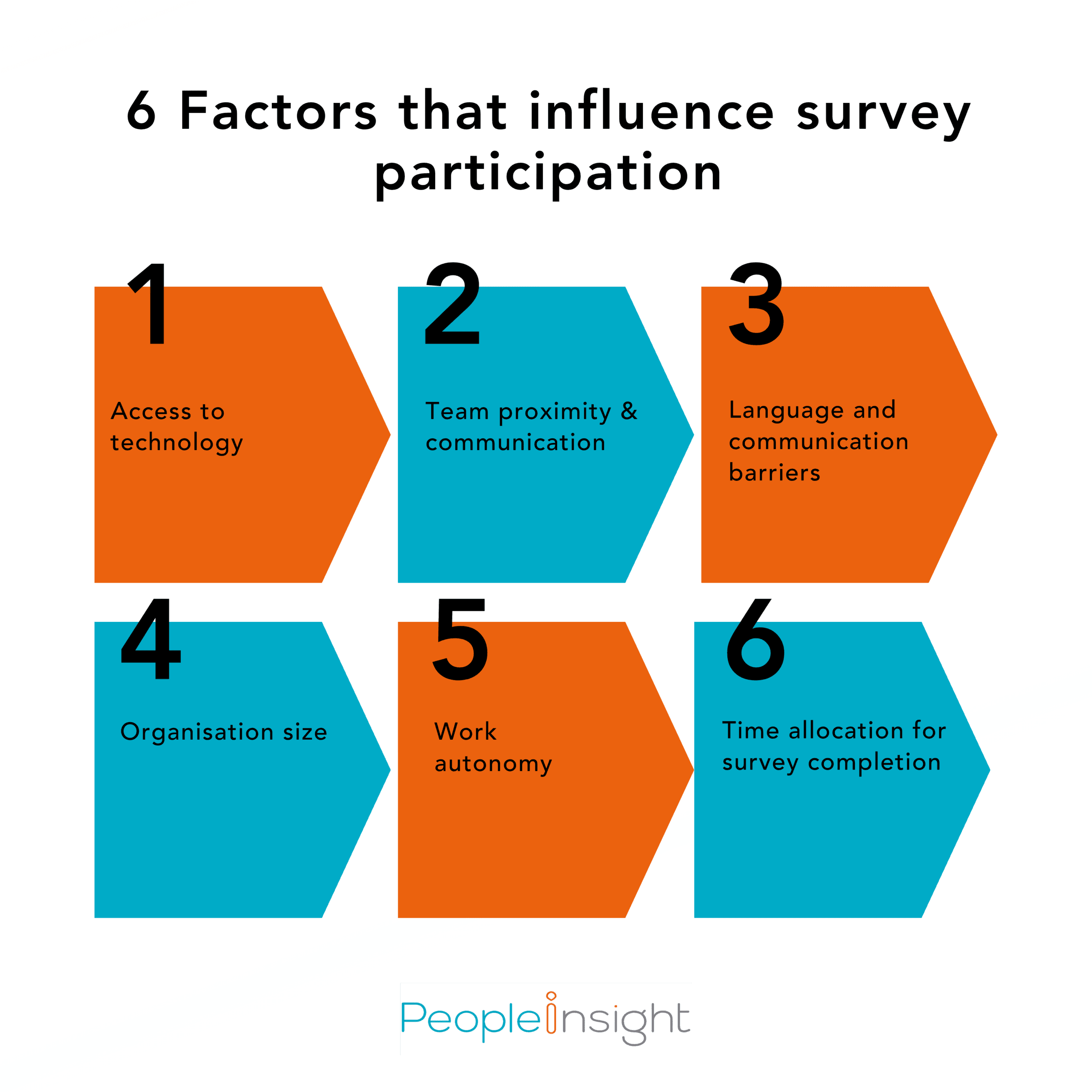
    6 Factors that influence survey participation (1)

    1. Access to technology

    Office-based employees often find it easier to complete surveys because they have reliable access to laptops, desktops or mobile devices. Field-based, frontline or mobile staff may not.

    If employees cannot easily access the survey, participation will suffer. Mobile-friendly surveys, QR codes and shared devices can make a big difference here.

    2. Team proximity and communication

    Teams that work closely together, physically or virtually, often have better visibility of internal initiatives. More dispersed teams may need extra communication and more deliberate reminders.

    3. Language and communication barriers

    Where the survey language does not match how employees normally communicate, participation can fall. Translated surveys and translated communications can help people feel included and reduce unnecessary friction.

    4. Organisation size and complexity

    Smaller organisations often find it easier to coordinate consistent messaging. Larger organisations may have more communication layers, more locations and more varied employee groups, which can dilute the campaign if it is not carefully planned.

    5. Work autonomy

    Employees with greater control over their schedules often find it easier to take part. Those in tightly structured roles may need dedicated time set aside if you want participation to rise.

    6. Time allocation during work

    One of the clearest differentiators is whether employees are expected to complete the survey during paid work time or in their own time. If people are asked to complete it outside work, participation often drops.

    10 ways to improve your survey response rate

    Below are 10 practical ways to improve your survey response rate, drawn from what our employee listening specialists see working in organisations across different sectors.

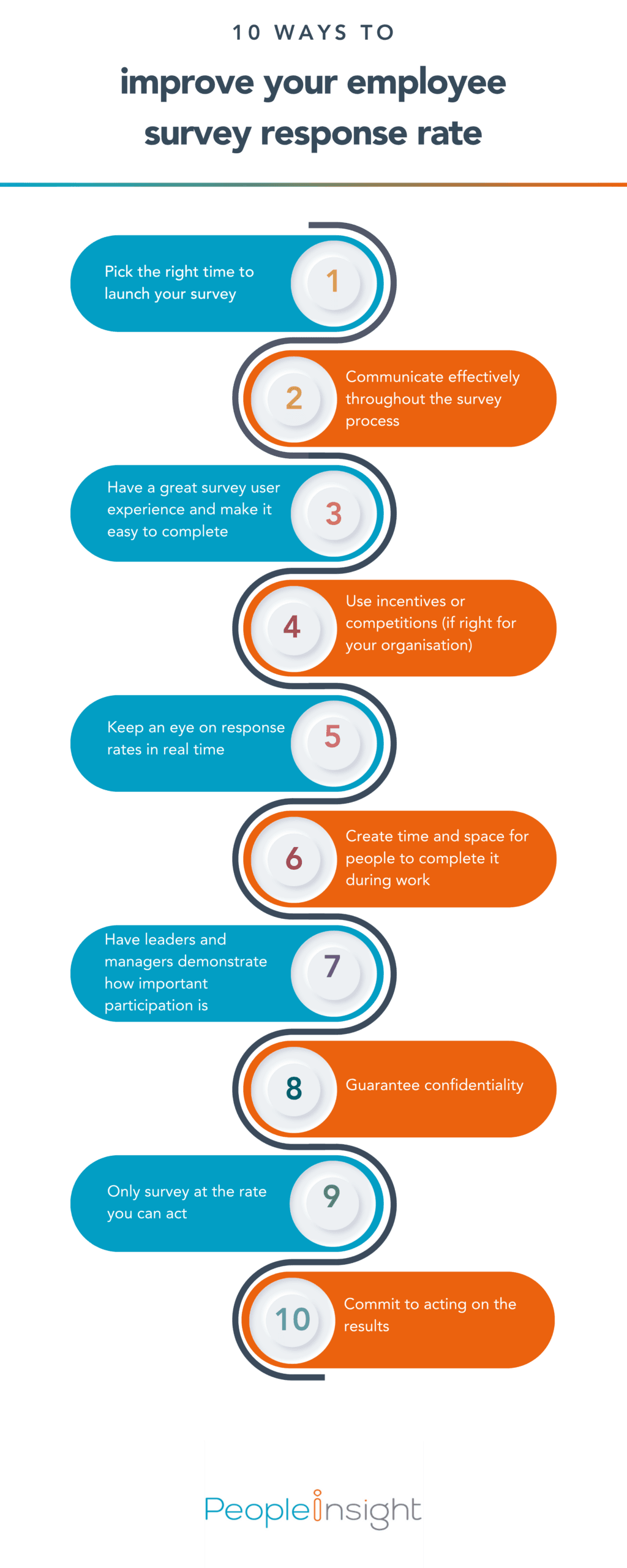
    10 ways to improve your employee survey response rate (1)

    1. Choose the right time to launch

    Timing has a major effect on participation.

    If your survey launches when staff are on leave, in training, dealing with peak workloads or already overwhelmed by other internal activity, it is much easier for it to be ignored.

    To improve your survey response rate, choose a period when:

    • employees are more likely to notice the launch
    • managers have time to reinforce participation
    • there is enough space in the calendar for reminders
    • the results can still feed into planning and action afterwards

    A well-timed survey is easier to communicate and more likely to receive attention.

    2. Communicate clearly before, during and after the survey

    Survey communication needs to be visible, clear and sustained.

    A strong communication plan should explain:

    • why the survey matters
    • what employees are being asked to do
    • how long it will take
    • when it closes
    • how confidentiality is protected
    • what will happen after the survey

    Use multiple channels wherever possible, such as email, intranet, posters, line manager briefings, QR codes and internal messaging tools.

    Repeated reminders matter too. Most people do not respond the first time they hear about the survey. A few well-timed nudges can significantly improve your survey response rate.

    This is one reason many organisations benefit from stronger survey communications support.

    3. Make the survey easy to complete

    The user experience matters.

    If the survey is clunky, too long or difficult to access, some employees will drop out before they finish and others may never start.

    To improve your survey response rate:

    • keep the design simple and intuitive
    • make sure the survey works well on mobile
    • avoid unnecessary complexity
    • use clear, neutral questions
    • keep the time commitment realistic

    For a full employee engagement survey, around 35 questions and roughly 15 minutes is usually a reasonable guide. A shorter pulse survey might include 10 to 20 questions.

    4. Use incentives carefully, if they fit your culture

    Incentives can help raise awareness and encourage participation, but they need to be handled carefully.

    Some organisations use:

    • prize draws
    • small gifts
    • team-based recognition
    • charitable donations linked to completions

    The University of Surrey used a tree-planting message linked to each survey response, which helped make participation feel positive and purposeful.

    The important thing is to make sure incentives do not undermine trust in confidentiality or make the process feel transactional.

    5. Track response rates in real time

    Real-time visibility helps you act quickly while the survey is still live.

    If you can see which teams, locations or groups are falling behind, you can adjust your communication, involve managers or remove barriers before the survey closes.

    This is especially useful where participation may vary across:

    • departments
    • job types
    • geographies
    • working patterns
    • offline versus office-based groups

    A good employee survey platform should make this easier to monitor.

    6. Create time and space during work

    A lack of time is one of the biggest practical barriers to participation.

    If employees need to squeeze the survey into an already full day, it may keep slipping down the list. If they are expected to do it in their own time, participation will often be lower still.

    To improve your survey response rate:

    • build dedicated survey time into shifts
    • create drop-in completion sessions
    • provide shared devices where needed
    • ask managers to make participation possible, not just encouraged

    Allowing employees to complete the survey during work hours sends a strong message that their feedback matters.

    7. Make leadership and manager support visible

    Leadership support can make or break participation.

    When senior leaders and line managers are visible, clear and supportive, employees are more likely to believe the survey matters. If leaders appear indifferent, participation often falls.

    People Insight’s benchmark data helps explain why this matters:

    • only 60% of employees say senior leaders make the effort to listen to staff
    • only 69% say their line manager gives regular feedback

    That means many organisations still have work to do in building visible listening and follow-through. Survey participation improves when leaders show that listening is a real priority, not just an HR exercise.

    8. Reassure people about confidentiality

    One of the most common reasons employees do not take part is concern about anonymity.

    If employees worry that responses can be traced back to them, they may avoid the survey altogether or give guarded answers.

    To improve your survey response rate, reassure employees consistently that:

    • responses are confidential
    • minimum reporting thresholds are used where appropriate
    • results will be grouped rather than shown individually
    • feedback is handled responsibly and securely

    Trust is essential here. Without it, response rates and candour both suffer.

    9. Only survey at the rate you can act

    This is one of the most important points on the page.

    Low participation is not always caused by too many surveys. Often, it is caused by too little visible action after previous surveys. That is why survey fatigue matters so much.

    If employees believe they will be asked for feedback repeatedly without seeing any meaningful response, participation is likely to fall.

    Only survey at the rate your organisation can realistically:

    • analyse
    • communicate
    • prioritise
    • act on
    • follow up

    Surveying more often does not improve listening if the action is not there to support it.

    10. Commit to acting on the results

    The best way to improve your survey response rate over time is to show that employee feedback leads to visible change.

    Employees are far more likely to participate again if they can see:

    • what was heard
    • what is being prioritised
    • who owns the action
    • what progress has been made

    This is where a visible post-survey action plan matters. It helps organisations move from listening to credible follow-through.

    If the statement “I believe action will be taken as a result of this survey” has scored poorly before, that should be treated as a serious priority. Trust in action is often one of the clearest drivers of future participation.

    How to tell if your survey response rate strategy is working

    A stronger survey response rate strategy should lead to more than just a higher percentage on the dashboard.

    It should also lead to:

    • more balanced participation across groups
    • better representation of hard-to-reach teams
    • more employee confidence in the process
    • stronger quality of comments and responses
    • better follow-through after the survey

    Higher participation matters, but what matters most is whether employees are engaging in a way that gives you more useful, more trustworthy insight.

    Improve your survey response rate with People Insight

    Improving your survey response rate takes more than reminders. It takes good timing, strong communication, a simple user experience, visible leadership support and credible follow-through.

    At People Insight, we help organisations improve survey response rate through better survey design, stronger communications, clearer reporting and practical action planning support. That helps employees feel more confident in the process and gives leaders more reliable insight to work with.

    Want to improve your survey response rate and get more value from your employee listening? Get in touch to learn how People Insight can help.

    FAQs about survey response rate

    A quick run down on all you need to know

    What is a good survey response rate?

    A good survey response rate is typically between 70% and 80%, while 90% or more is excellent.

    Why is survey response rate important?

    Survey response rate is important because it affects how reliable, representative and actionable your survey results are.

    What causes a low survey response rate?

    Common causes include poor timing, weak communication, lack of trust in confidentiality, survey fatigue, limited access to technology and low confidence that feedback will lead to action.

    How can you improve your survey response rate?

    You can improve your survey response rate by choosing the right timing, communicating clearly, making the survey easy to complete, creating time during work hours, showing leadership support and acting visibly on results.

    Does confidentiality affect survey response rate?

    Yes. If employees do not trust that their responses will remain confidential, they are much less likely to participate honestly or at all.

    Can incentives improve survey response rate?

    They can, if used carefully. Incentives can help raise awareness and interest, but they should never undermine trust in confidentiality.

    How does acting on survey results affect future response rates?

    Visible action helps build trust that the process is worthwhile. When employees can see that feedback leads to change, they are much more likely to take part in future surveys.

    How can People Insight help improve survey response rate?

    People Insight helps organisations improve survey response rate through better survey design, stronger communications, clear reporting and action planning that strengthens trust in employee listening.