



















Blogs:

How do you improve company culture?

10 proven strategies for success, shared by HR experts

How do you improve company culture

    A quick insight: Improving company culture means focusing on shared values, open communication and leadership behaviours that employees experience consistently. The strongest cultures are built deliberately, not left to chance. They grow when organisations listen well, act visibly and create an environment where people feel valued, supported and clear on what the organisation stands for.

    A strong company culture is shaped over time by leadership, communication and the everyday experiences people have at work. A positive culture can support stronger performance, better retention and higher levels of employee engagement. A weak or unhealthy culture tends to do the opposite, leading to disengagement, lower trust and more avoidable turnover.

    So, how do you improve company culture in a way that makes a lasting impact?

    At People Insight, our consultants, coaches and employee experience specialists work with organisations around the world to improve company culture, strengthen the employee experience and support better outcomes such as retention, wellbeing and productivity. That practical experience has shaped the advice below.

    This is also where Sharper listening. Smarter action. comes in. It is People Insight’s approach to insightful, proactive employee listening and turning that insight into meaningful action. Listening becomes sharper when organisations understand what employees are really experiencing. Action becomes smarter when that insight is turned into clear priorities, visible decisions and better day-to-day experiences.

    Related: What is organisational culture? (Discover yours in our quiz!)

    Why company culture matters

    Company culture affects how people feel at work, how they behave and whether they want to stay.

    It shapes:

    • how people communicate
    • how leaders show up
    • how safe employees feel to speak up
    • how recognised and supported people feel
    • how strongly employees connect with the organisation’s values and purpose

    Culture also has a direct effect on experience and performance. When people feel included, listened to and clear on what matters, they are more likely to contribute well and stay committed.

    Global benchmark snapshot

    Your 2025 benchmark data highlights a useful pattern:

    • 77% of employees say people help and support each other here
    • 53% say people communicate openly regardless of position or level
    • 60% say senior leaders make the effort to listen to staff
    • 61% say they have received thanks or praise in the last week
    • 65% say their organisation does enough to support health and wellbeing at work

    That combination tells an important story. Many organisations have strong peer support, but weaker openness, recognition and visible listening from leaders. Those are all culture issues, not just communication issues.

    What gets in the way of improving company culture?

    Many organisations want to improve company culture, but a few common barriers tend to get in the way:

    • inconsistent leadership behaviour
    • poor or unclear communication
    • weak follow-through after feedback
    • low recognition
    • overload and burnout
    • initiatives that feel disconnected from daily work

    This is why culture cannot be improved through perks alone. It improves when employees experience fairness, trust, support and clarity in the everyday reality of work.

    10 expert tips to improve company culture

    We gathered our top People Insight experts to identify the most effective ways to improve company culture. These are the approaches we see make the biggest difference in practice.

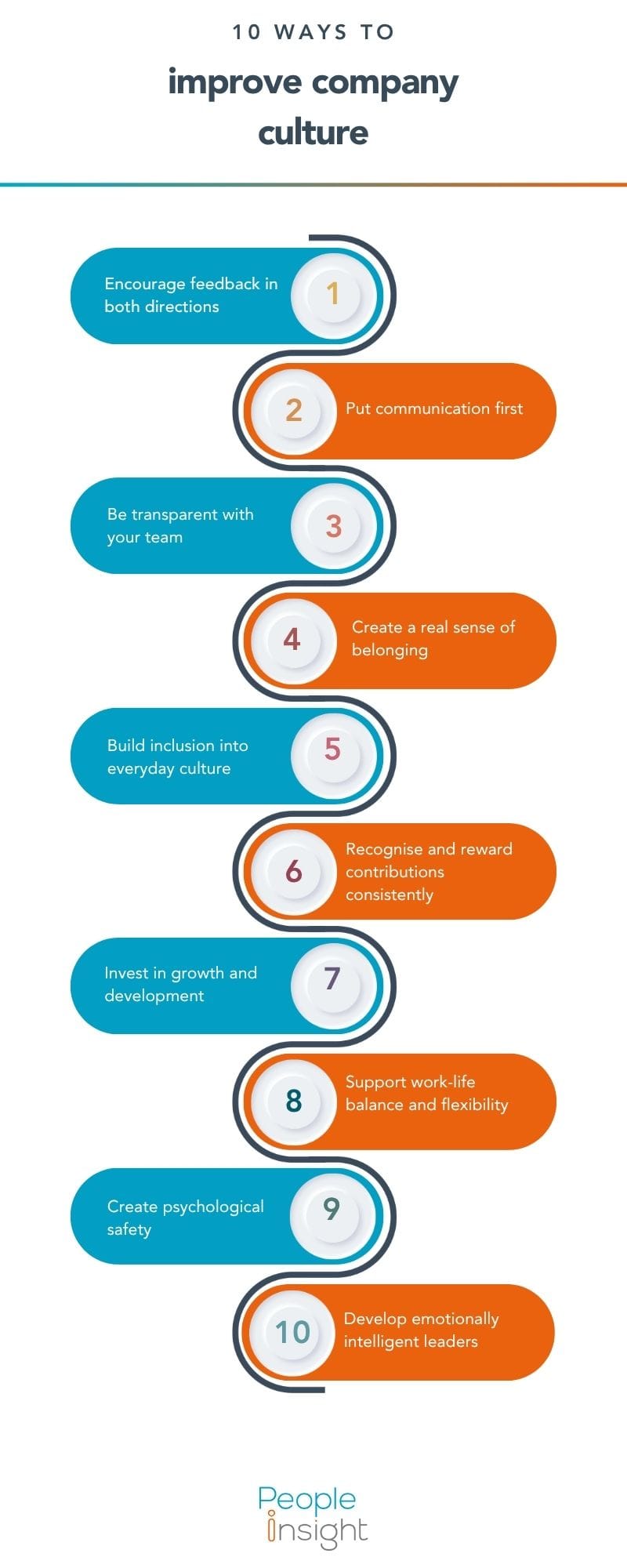
    10 ways to improve company culture

    1. Encourage feedback in both directions

    Company culture improves when employees feel their voices matter.

    If employees do not believe their opinions are valued, they are less likely to engage, share ideas or feel invested in the organisation’s success. Organisations that listen to employee feedback and act on it are much more likely to build trust and commitment over time.

    But healthy feedback should go both ways. Employees should feel comfortable raising concerns or making suggestions, and managers should provide regular, constructive feedback that helps people improve and feel supported.

    This is one reason the employee feedback loop matters so much. Culture gets stronger when listening is followed by visible action and communication, not silence.

    The University of Manchester’s listening-at-scale work shows how powerful this can be. Their approach helped build a more connected and responsive culture by making employee voice visible at scale and supporting local action, rather than treating listening as a one-off exercise.

    2. Put communication first

    Poor communication can create uncertainty, mistrust and confusion. Good communication helps people understand what is happening, why it matters and how their work contributes.

    Employees need to understand the company’s mission, your company’s values and your wider goals if they are going to feel aligned with the organisation.

    Your benchmark data shows there is room for improvement here:

    • only 53% of employees say people communicate openly regardless of position or level
    • only 46% say communication is good between different teams
    • only 60% say they know how well their organisation is doing against its objectives

    Those figures suggest that many employees still experience communication as patchy or incomplete.

    Regular town halls, leadership updates and transparent conversations about business changes all help. So does two-way communication, where employees can ask questions and get honest answers.

    Related: How to improve unclear communication in the workplace
    3. Be transparent with your team

    Holding back information may seem harmless, but over time it can create distance between leadership and employees.

    When people are left in the dark about decisions, performance or direction, they are more likely to feel excluded or distrustful. Transparency helps employees feel more invested in the organisation’s success and more confident in its leadership.

    This also helps strengthen accountability. When leaders discuss challenges openly, employees are more likely to trust them and contribute to solutions.

    At Derbyshire Fire and Rescue, culture and values were strongly aligned because people could see that leaders listened, responded and improved the employee experience accordingly. Their people strategy treated the survey as a critical measurement tool, with outcomes feeding directly into action planning and wider priorities.

    4. Create a real sense of belonging

    Employees who feel that they belong are more likely to be engaged, motivated and committed.

    Belonging is not just about being included in social activities. It is about feeling recognised, respected and able to contribute meaningfully. It also means being able to see yourself in the organisation’s values, decisions and leadership behaviours.

    Creating a sense of belonging often involves:

    • recognising individual contributions
    • celebrating diversity
    • making inclusion visible
    • strengthening social connection
    • helping people feel part of something bigger than their role

    Related: Company culture and employee engagement: why you need both

    5. Build inclusion into everyday culture

    Diversity and inclusion do not sit off to one side of culture. They shape culture directly.

    An inclusive workplace makes sure employees have fair access to opportunities, feel respected in everyday interactions and can contribute without unnecessary barriers. That means inclusion needs to show up in how decisions are made, how people are developed and how leaders behave.

    This is where good listening matters too. Inclusion is often felt in small, everyday experiences. A diversity and inclusion survey can help organisations understand where those experiences differ and what needs to change.

    6. Recognise and reward contributions consistently

    People want to know that their work is appreciated.

    Recognition does not always need to be financial. Public praise, meaningful thank-yous, development opportunities and personalised acknowledgement can all make a real difference. What matters most is that recognition feels timely, genuine and consistent.

    Your benchmark data suggests this is still a gap:

    • only 61% say they received thanks or praise in the last week
    • only 63% feel valued and recognised for the work they do
    • only 50% say rewards are linked to performance and contribution

    That means many employees are still doing good work without feeling properly noticed.

    The National Gallery is a useful example here. They used employee feedback to improve rewards and benefits in a way employees could clearly see, showing how visible follow-through can strengthen culture and reinforce the idea that contributions matter.

    There are also plenty of non-financial incentives that can help employees feel appreciated and motivated.

    7. Invest in growth and development

    Employees are more engaged when they can see a future in the organisation.

    Offering growth opportunities through mentoring, training, stretch assignments or leadership development helps people feel valued and gives them a reason to stay.

    Again, your benchmark data points to a common weakness:

    • 63% say they have the right opportunities to learn and grow at work
    • only 59% say their career development aspirations are being met

    That leaves a large proportion of employees who may not feel supported in their long-term development.

    Culture gets stronger when development feels real, visible and achievable, not just something mentioned in principle.

    8. Support work-life balance and flexibility

    Burnout and overload damage culture quickly.

    Companies that support flexibility, manageable workloads and respect for personal time create healthier, more sustainable cultures. That improves both wellbeing and performance.

    Your benchmark data supports this too:

    • 74% say they can strike the right balance between work and home life
    • only 64% say they can comfortably cope with their workload
    • 65% say their organisation does enough to support health and wellbeing at work

    So while work-life balance looks relatively stronger, workload pressure and wellbeing support are still real issues.

    Catalyst IT Europe is a good example of how this can work well. Their approach to autonomy, open communication and workload discussions helped support strong scores around both balance and workload management, showing how trust and flexibility can strengthen culture in practical ways.

    9. Create psychological safety

    Employees should feel safe to speak up, ask questions, share ideas and admit mistakes without fear of blame or unreasonable consequences.

    That is what psychological safety looks like in practice. It supports innovation, better problem-solving and more open collaboration.

    Psychological safety is often one of the clearest markers of culture. If people stay quiet because they are afraid of how others will react, the culture will struggle no matter how good the formal values sound.

    10. Develop emotionally intelligent leaders

    Leaders play a huge role in shaping culture.

    Employees pay close attention to how leaders communicate, respond under pressure, make decisions and treat people. Leaders with empathy, self-awareness and emotional intelligence are much more likely to build trust and consistency in the culture around them.

    This is why leadership development matters so much. Culture is not only shaped by what leaders say. It is shaped by how they behave every day.

    Related: Emotional intelligence in leadership: Why is it so important?

    What good company culture looks like in practice

    Strong company culture is not about slogans on the wall. It is about what employees experience every day.

    That often includes:

    • clear and open communication
    • leadership that listens and follows through
    • visible recognition
    • support for wellbeing
    • realistic development opportunities
    • trust, fairness and respect
    • a strong sense of belonging

    Camelot is a strong example of this. Their leaders describe engagement as part of everyday language, with managers held accountable for engagement scores and survey results actively shaping the people plan and wider strategy. They also linked culture, wellbeing and action over time, showing how sustained effort can move scores across multiple areas.

    How to know if company culture is improving

    If you want to improve company culture, it helps to know how you will recognise progress.

    Useful signs include:

    • stronger employee engagement
    • better feedback on communication and leadership
    • more employees feeling recognised and supported
    • healthier retention trends
    • stronger wellbeing scores
    • more positive employee comments over time
    • clearer belief that feedback leads to action

    This is where regular listening becomes valuable. Culture improves more reliably when you can measure changes over time and see whether the employee experience is becoming healthier, clearer and more consistent.

    How employee surveys help improve company culture

    If you want to improve company culture, you need a clear picture of what employees are actually experiencing.

    That is where surveys become so useful. They help organisations understand what is working, where there are gaps and which parts of the culture need the most attention.

    A strong employee engagement survey can help you measure themes such as:

    • trust in leadership
    • communication
    • recognition
    • wellbeing
    • development
    • inclusion
    • autonomy

    Surveys also help turn culture from something vague into something measurable and discussable. That gives leaders a much stronger foundation for action.

    If you want to turn those findings into visible progress, a clear survey action plan helps connect feedback to meaningful change.

    Improve company culture with People Insight

    Improving company culture takes more than good intentions. It takes clear listening, thoughtful leadership and visible action over time.

    At People Insight, our experienced team works with organisations around the world to improve company culture, strengthen employee experience and support better outcomes such as retention, wellbeing and productivity. Through employee surveys, Prism-powered insight and practical consultancy support, we help organisations understand their culture more clearly and act on what matters most.

    That is what Sharper listening. Smarter action. looks like in practice.

    Want to improve company culture in a way that is measurable, meaningful and sustainable? Contact us to learn how People Insight can help.

    FAQs about improving company culture

    A quick run down on all you need to know

    How do you improve company culture?

    You improve company culture by listening to employees, strengthening communication, building trust, supporting belonging, recognising contributions and making leadership behaviours more consistent.

    What is the fastest way to improve company culture?

    There is rarely one quick fix, but visible improvements often start with better communication, clearer recognition and stronger follow-through on employee feedback.

    Why is company culture important?

    Company culture shapes how employees feel at work, how well they collaborate and whether they want to stay. It affects engagement, retention, wellbeing and performance.

    How do employee surveys help improve company culture?

    Employee surveys help organisations understand what employees are experiencing, what is working well and where culture needs attention, so leaders can act more confidently.

    What are the signs of a strong company culture?

    Signs of a strong company culture include trust, openness, belonging, consistent leadership behaviour, visible recognition and a clear connection between employee feedback and action.

    How does leadership affect company culture?

    Leadership affects company culture through communication, visibility, decision-making and everyday behaviour. Employees often look to leaders to understand what the culture really values.

    How can People Insight help improve company culture?

    People Insight helps organisations improve company culture through employee surveys, Prism-powered insight and consultancy support that turns feedback into meaningful action.