


















Case studies:

National Gallery: Transforming rewards at work 

How to act on pay feedback via employee surveys and make an impact without breaking the bank

National Gallery case study

    Watch the case study

    How smarter benefits reshaped perceptions of reward at work

    Ask employees what matters most at work and pay and rewards will almost always be near the top of the list. But for many organisations, especially public sector bodies, charities and cultural institutions, direct salary increases are not always simple or immediately possible.

    That creates a difficult challenge. How do you respond meaningfully to feedback about pay and reward when pay itself is constrained?

    Too often, organisations stop at listening. Employee surveys highlight concerns about reward, but leaders hesitate to act because they assume the only meaningful response is a salary increase.

    The National Gallery shows why that does not have to be the case.

    With support from People Insight, the Gallery used employee survey feedback to understand what mattered most to employees, identify where action could make a visible difference and communicate changes clearly. The result was a more creative, employee-centred approach to rewards at work.

    By combining clear survey insight, focused action planning and visible communication, the National Gallery improved perceptions of benefits and reward, strengthened trust and showed employees their feedback had led to meaningful change.

    Related: 10 non financial incentives that really motivate employees

    Understanding the challenge of workplace rewards

    Rewards are one of the most sensitive areas of the employee experience. People compare pay, benefits and recognition not only with colleagues, but also with the wider market. When employees feel reward is unfair, unclear or out of step with their needs, it can affect engagement, motivation and trust.

    But feedback about reward is also one of the biggest opportunities for employers.

    Employees do not always expect every issue to be solved immediately. What they do expect is honesty, fairness and evidence that their feedback has been taken seriously. Transparent communication about what can and cannot change can be powerful in itself.

    That is where People Insight’s combination of survey technology and expert guidance helps. Our employee survey platform helps organisations capture and analyse feedback, while our consultants help leaders interpret what the results mean and decide where action is most likely to make a difference.

    For organisations facing reward challenges, the aim is not simply to collect opinions. It is to understand employee sentiment, identify practical levers for improvement and show progress in a way employees can recognise.

    Using surveys to shape rewards at work

    Employee surveys provide the foundation for a smarter approach to rewards at work.

    With People Insight, organisations can identify the specific reward issues employees are experiencing, understand how perceptions vary across different groups and track whether action improves sentiment over time.

    Tools like Prism help surface key themes, add context and turn employee feedback into clearer, more practical next steps. This is especially useful when the issue is complex, emotional or difficult to resolve through one simple action.

    Crucially, reward insight must be followed by action planning and visible communication. A “you said, we did” approach helps employees connect their feedback with the changes that follow. Without that connection, even good actions can go unnoticed and survey fatigue can set in.

    In this way, rewards at work are about more than money. They are about whether employees feel heard, valued and treated fairly.

    Transforming rewards at work at the National Gallery

    The National Gallery is a strong example of how organisations can use employee feedback to rethink reward, even when budgets are constrained.

    In 2023, the Gallery ran its first ever staff survey with People Insight. The survey gave leaders a clearer understanding of employee sentiment and highlighted reward as an area that needed visible attention.

    Rather than treating the results as a problem they could not solve, the Gallery used the insight as a starting point for practical action.

    With People Insight’s survey data, reporting and action-focused support, the Gallery was able to move from broad concern to targeted response. The focus became clear: understand what employees needed, identify benefits that could make everyday working life easier and communicate those changes in a way that showed feedback had been heard.

    Be sure to check out our webinar with The National Gallery for more detail.

    The challenge

    The National Gallery’s 2023 staff survey highlighted concerns about rewards at work, especially pay. Leadership understood the importance of the feedback, but there was understandable uncertainty about what could be done when direct salary change was limited.

    This is a common challenge. Employee surveys often uncover themes that feel too big, too sensitive or too expensive to address quickly. But doing nothing can damage trust, particularly when employees have taken the time to share honest feedback.

    The Gallery needed to show employees that their voice mattered. That meant looking beyond pay alone and exploring other forms of reward, recognition and support that could improve the employee experience.

    People Insight’s role was to help make the feedback clear, usable and action-focused. The survey gave the Gallery a strong evidence base, helping leaders understand where concerns were concentrated and where action could have the greatest impact.

    The actions

    Rather than focusing solely on salaries, the Gallery introduced a series of targeted benefits designed around employee needs.

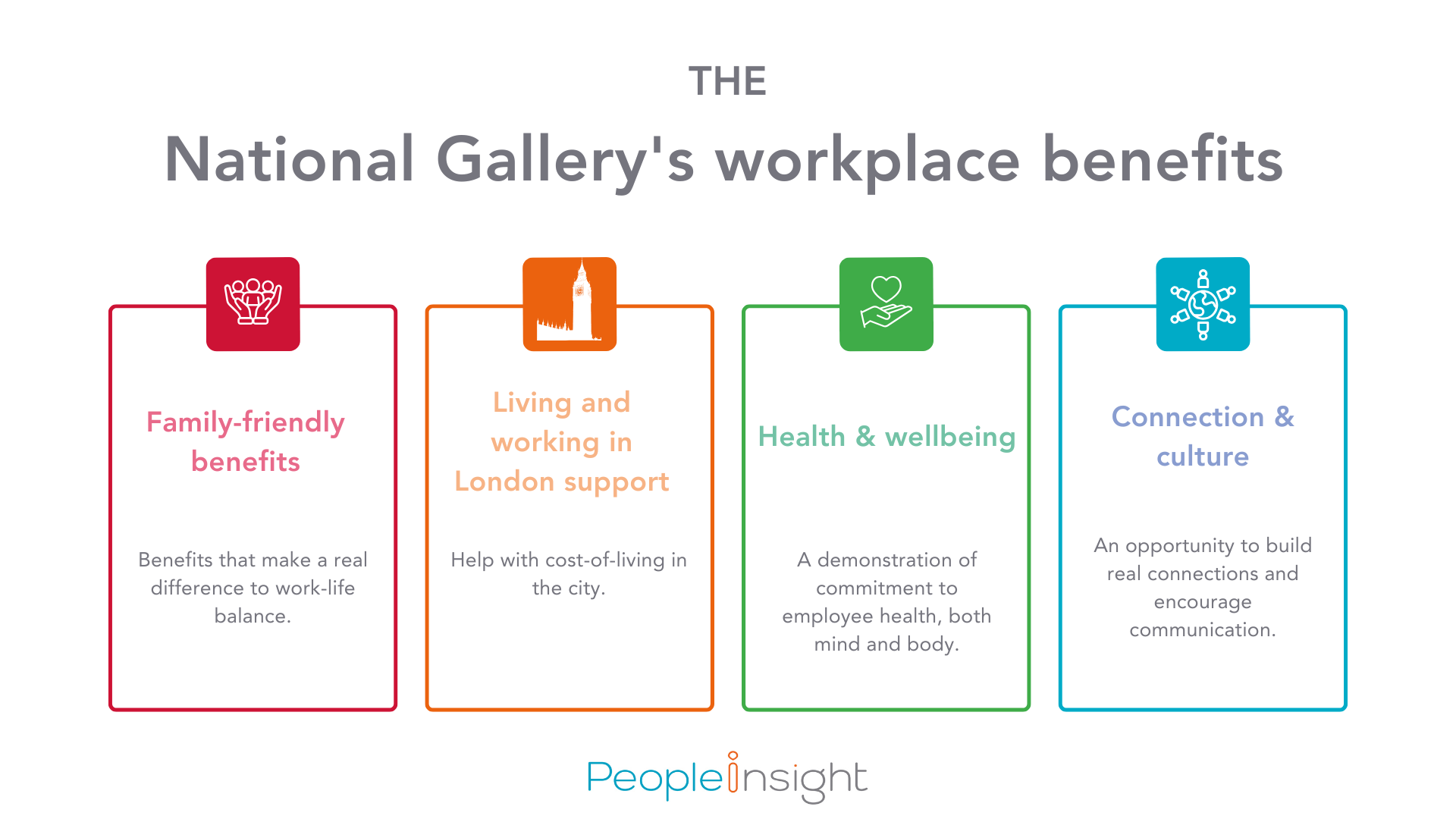
    The National Gallery's workplace benefits

    These actions were not generic perks. They were practical responses to real issues employees had raised through the survey process.


    • Family-friendly benefits. Employees gained access to Bubble for Work, offering 30 hours of childcare, elder care or pet care per year. Paternity leave was improved, and a Parents and Carers Network was launched to create peer support.
    • Living and working in London support. Recognising the pressures of city living, the Gallery introduced a rental deposit loan scheme, doubled the cycle-to-work loan limit to cover e-bikes and reinforced existing travel support such as season ticket loans.
    • Health and wellbeing. Employees received a new MediCash Level 3 healthcare plan, free sanitary products across staff and public areas, fruit baskets, yoga classes and massage sessions. Monthly wellbeing activities such as flu jabs and workshops were also added.
    • Connection and culture. “Coffee Roulette” was launched, creating randomised coffee meetups supported with vouchers, now including senior leaders. These informal moments helped build cross-team connections and made leadership feel more approachable.

    What made these actions powerful was not only the benefits themselves. It was the connection back to employee feedback.

    The Gallery was able to show that it had listened, understood the pressures employees were facing and taken practical steps to respond. That visibility is essential when trying to build trust after a survey.

    The results

    The outcomes were striking. The benefits score rose by 29% to 81%, well above the sector benchmark. Perceptions of rewards at work also improved, even though salaries themselves had not changed.

    Employee engagement scores also rose as employees became more confident that survey results would lead to action.

    This is the real strength of a well-run employee survey programme. The survey did not simply identify a problem. It created the evidence base for action, helped leaders focus their response and gave the Gallery a clear story to communicate back to employees.

    The Gallery built credibility, improved trust and showed that meaningful change is possible even without direct pay rises.

    Their efforts were also recognised externally, with the Gallery being awarded Outstanding Workplace status.

    For People Insight, this case study shows the value of combining employee survey technology with expert support. The platform helps organisations understand what employees are saying. The consultancy and action-planning support helps them decide what to do next. The communication support helps make sure employees see the progress being made.

    6 lessons for improving workplace rewards

    The National Gallery example demonstrates that rewards at work are about more than money.

    For other organisations, the lessons are clear:

    1. You do not always need pay rises. Creative, well-targeted benefits can improve perceptions of reward, especially when they respond to employees’ real needs.
    2. Visibility matters. Employees need to understand what has changed and how those changes connect to their feedback.
    3. Quality beats quantity. A small number of relevant actions can have more impact than a long list of generic initiatives.
    4. Peer networks add credibility. Staff-led groups, such as the Parents and Carers Network, help make change feel more authentic and grounded in lived experience.
    5. Context is everything. Benefits that respond directly to employees’ day-to-day realities, such as commuting, family care, wellbeing or cost-of-living pressure, are more likely to resonate.
    6. Follow-up matters. Tracking results over time helps organisations understand whether action is working and where further improvement is needed.

    This is why employee listening needs to go beyond the survey itself. Organisations need clear reporting, expert interpretation and practical action planning if they want feedback to lead to visible improvement.

    4 Common mistakes with rewards at work

    When addressing feedback on rewards at work, some common mistakes can undermine progress.

    1. Doing nothing

      Ignoring reward concerns damages trust. Even when pay cannot be changed immediately, employees still expect honesty, explanation and evidence that leaders are listening.

    2. Failing to link benefits to survey feedback

      If changes are not clearly connected to employee feedback, people may not realise their voice influenced the decision. This weakens the impact of even strong initiatives.

    3. Overloading employees with small initiatives

      Too many minor actions can confuse rather than reassure. Employees need a clear, memorable message about what has changed and why.

    4. Not tracking impact

      If improvements are not measured, momentum is lost. Follow-up surveys and pulse checks help organisations understand whether actions are improving employee sentiment.

    People Insight helps organisations avoid these mistakes by connecting survey insight, action planning and communication. That means leaders can move from “we have the data” to “we know what to do next”.

    How to take action on rewards at work

    Building a stronger approach to rewards at work starts with employee voice.

    Here are five steps organisations can take:

    1. Listen carefully

      Use employee surveys to understand specific concerns around pay, benefits, recognition and fairness. Look for patterns across teams, roles and employee groups.

    2. Prioritise with context

      Focus on actions that match employees’ lived reality. For some organisations, that may mean commuting support. For others, it may mean family-friendly policies, wellbeing support or clearer recognition.

    3. Involve employees

      Use staff networks, focus groups or follow-up conversations to test ideas before launch. This helps make actions more relevant and credible.

    4. Communicate clearly

      Use “you said, we did” updates to show employees how feedback has shaped decisions. Be honest about what can change now, what will take longer and what may not be possible.

    5. Review and reinforce

      Track impact through follow-up surveys and pulse checks. Use the results to refine your approach and keep the conversation going.

    People Insight supports each stage of this process. Our employee survey platform captures the feedback. Our reporting and Prism tools help identify themes and next steps. Our consultants help leaders prioritise action. Our communications support helps employees see that progress is happening.

    Takeaways

    At work, rewards are not simply about pounds and pence. They are about whether employees feel valued, heard and treated fairly.

    The National Gallery proved that meaningful action is possible even when direct pay increases are constrained. By using employee survey insight to shape creative benefits, communicate clearly and act visibly, the Gallery improved perceptions of reward and strengthened trust.

    The bigger lesson is clear: employees do not only want organisations to listen. They want to see that listening leads somewhere.

    With the right platform, expert guidance and action-planning support, organisations can turn difficult feedback into practical change. The National Gallery showed how powerful that can be.

    Start your next employee survey today

    At People Insight, we help organisations turn employee feedback into meaningful change.

    Our employee survey platform helps you capture feedback, understand what drives employee sentiment and track progress over time. Our consultants work with you to interpret results, prioritise action and communicate change clearly, so employees can see how their voice is shaping decisions.

    We can support you with:

    • Employee surveys
    • Employee engagement surveys
    • Pulse surveys
    • Reward and recognition insight
    • Survey reporting and dashboards
    • Prism-supported analysis
    • Action planning
    • Employee survey communications
    • “You said, we did” updates
    • Consultancy and strategic guidance

    Want to see how we can help? Get in touch today.  

    How can employee surveys improve rewards at work?

    Employee surveys improve rewards at work by showing what employees value, where concerns exist and which benefits or changes are most likely to make a difference. Survey insight helps organisations move beyond assumption and design reward actions around real employee needs.

    What did the National Gallery do after its staff survey?

    After its staff survey, the National Gallery introduced a range of targeted benefits, including family-friendly support, London living and commuting support, health and wellbeing benefits and initiatives to strengthen connection and culture. These actions helped improve perceptions of benefits and reward.

    Can organisations improve reward perceptions without increasing pay?

    Yes. While pay remains important, organisations can improve reward perceptions through relevant benefits, clearer communication, wellbeing support, flexibility, recognition and practical support that reflects employees’ lived experience. The key is to link these actions clearly to employee feedback.

    How does People Insight help organisations act on survey feedback?

    People Insight helps organisations act on survey feedback by combining an employee survey platform with expert consultancy, Prism-supported analysis, action planning and communications support. This helps leaders understand the results, prioritise meaningful action and show employees what has changed.

    Why is “you said, we did” communication important after a staff survey?

    “You said, we did” communication helps employees see that their feedback has been heard and acted on. Without visible follow-up, employees may not connect changes to the survey, which can reduce trust and increase survey fatigue.