



















Our experienced team works alongside organisations to help them design, deliver and communicate their listening programmes. From survey distribution to strategic guidance, we’re here when you need us
A quick insight:Strong company culture and employee engagement are deeply connected. When culture reflects shared values, clear expectations and inclusive behaviour, people are more motivated, committed and connected to their work. Focusing on culture shapes everyday experience in ways that strengthen engagement, support collaboration and improve performance across the organisation.
To build a truly successful organisation, we need to be clear about what drives success. Of course you need to be good at what you do — you need to offer an outstanding product or service and you need to do it in a way that leaves your competitors in the dust. But we’re talking about more than that — we’re talking about the very building blocks that make your company what it is and drives your employees to excel.
We’re talking, of course, of two powerful yet distinct factors — company culture (sometimes known as organisational culture) and employee engagement. These concepts influence everything from productivity to retention, but they are very different beasts. Leaders aiming to create thriving, high-performing workplaces need to understand how these elements diverge — and why addressing both is critical to achieving long-term results.
Leaders frequently confuse company culture and employee engagement, leading to missed opportunities for growth. While company culture reflects the shared beliefs, habits and practices that shape how work gets done, engagement captures how employees emotionally connect with their roles and the organisation. The two are interconnected, yet focusing on one without the other can create a workplace that either lacks alignment or fails to inspire employees to perform at their best.
Focusing exclusively on engagement may yield short-term improvements, but without a supportive culture, these gains often fade. Similarly, promoting a strong culture without addressing engagement leaves organisations vulnerable to disengaged employees, who may meet expectations without exceeding them.
Let’s take a look at these concepts in more detail, explore what sets company culture and employee engagement apart and how to build synergy between them.
How are company culture and employee engagement different?
If you want to nurture the right company culture while also boosting employee engagement levels, it all starts with understanding them:
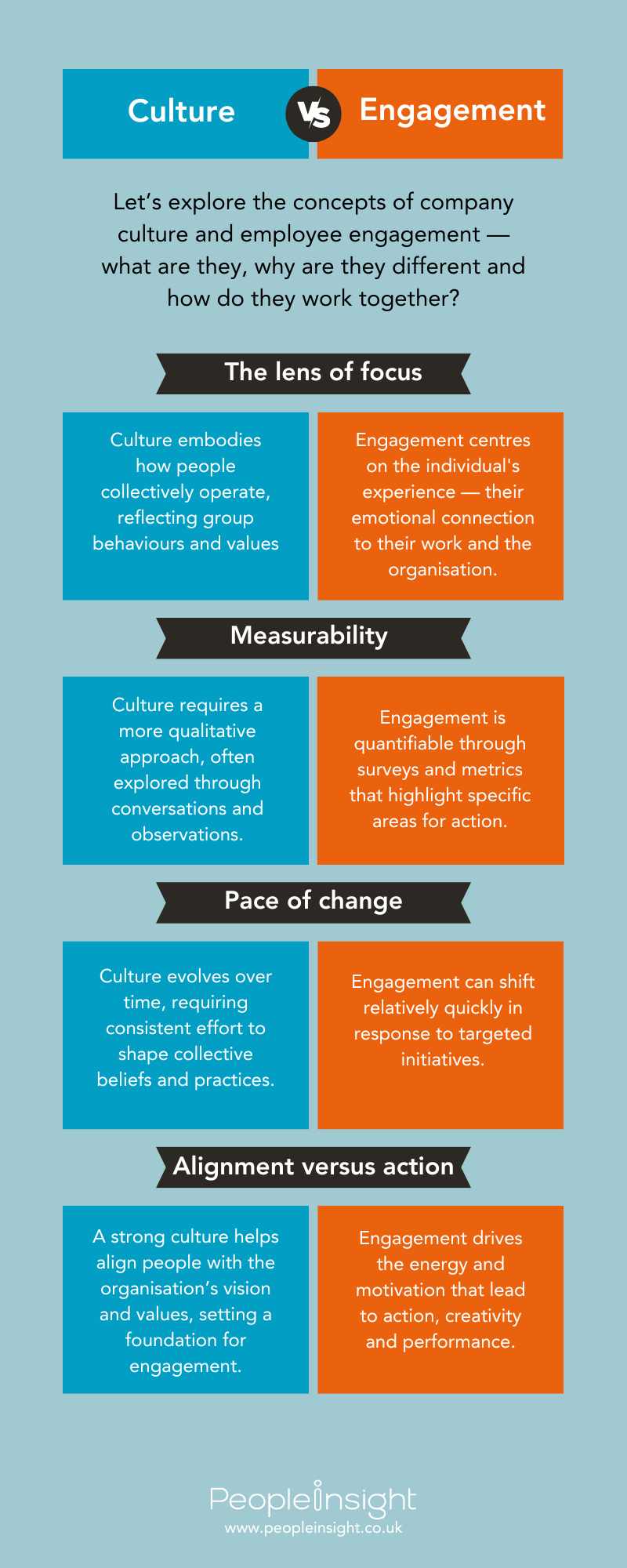
The lens of focus: Culture embodies how people collectively operate, reflecting group behaviours and values. Engagement, however, centres on the individual’s experience — their emotional connection to their work and the organisation.
Measurability: Engagement is quantifiable through culture surveys and metrics that highlight specific areas for action. Culture, by contrast, requires a more qualitative approach, often explored through conversations and observations.
Pace of change: Engagement can shift relatively quickly in response to targeted initiatives like recognising achievements or improving leadership communication. Culture, on the other hand, evolves over time, requiring consistent effort to shape collective beliefs and practices.
Alignment versus action: A strong culture helps align people with the organisation’s vision and values, setting a foundation for engagement. Meanwhile, engagement drives the energy and motivation that lead to action, creativity and performance.
For example, consider a company with a well-defined culture of innovation but low engagement among employees. People might admire the organisation’s mission but feel unsupported in their day-to-day work, leading to disengagement. Conversely, a highly engaged workforce can struggle to maintain consistency or alignment without a clear cultural framework.
Why organisations need both culture and engagement
In our years of experience in HR and employee experience, we’ve discovered that focusing on company culture and employee engagement together is the only way businesses can properly achieve their potential and motivate their employees. Here’s why it’s essential to address both.
Culture provides stability and identity
A cohesive culture creates a sense of purpose and belonging that connects employees to the organisation. This is particularly important when navigating workplace change or pressing challenges. Employees who understand and resonate with cultural values are more likely to contribute meaningfully and collaborate effectively.
Engagement drives performance and commitment
Engaged employees are known to have more energy, creativity and commitment than their disengaged counterparts. They’re more likely to advocate for the organisation, contribute to innovation and remain loyal over time.
The interplay strengthens retention
Culture and engagement both influence why employees choose to stay or leave. In a recent UK survey, over half of respondents cited cultural misalignment as a reason for leaving their jobs. Engagement often works as a protective factor, encouraging employees to stay invested even when challenges arise. Together, they create an environment where people feel connected and motivated to grow.
They help navigate misalignment
When culture and engagement are out of sync, it leads to friction within the workplace. For example, a company with a culture valuing transparency might struggle with disengagement if communication from leadership is unclear or inconsistent. Addressing both helps prevent these disconnects, ensuring alignment between values and actions.
Building synergy between company culture and employee engagement
Leaders can strengthen their organisations by intentionally addressing both culture and engagement in the following ways:
Start with understanding your culture: Use focus groups, employee interviews or external HR consultants such as us at People Insight to explore the shared beliefs and practices shaping your workplace. A clear picture of the current culture will reveal where adjustments are needed.
Measure engagement consistently: Regularly track engagement levels through employee engagement surveys and feedback tools. Share results openly and act on the insights — actually taking action post-survey builds trust and demonstrates commitment.
Bridge the gap with leadership: Leaders must model behaviours that align with cultural values while inspiring engagement. Authentic communication and recognition help connect culture and engagement in meaningful ways.
Align initiatives with both elements: Design programmes and policies that reflect cultural priorities while boosting engagement. For instance, if wellbeing is part of your culture, initiatives like flexible working arrangements can improve engagement by meeting employee needs.
While company culture and employee engagement are distinct concepts, their interplay is undeniable. Culture shapes the environment where engagement flourishes, and engagement brings culture to life through employees’ actions and attitudes. To achieve sustainable success, organisations must prioritise both — nurturing a strong cultural identity while actively engaging their workforce. By doing so, they can create workplaces where people feel connected, valued and motivated to deliver their best.
If you’re looking to achieve cultural alignment within your organisation, get in touch with us today. We’ll help you define your culture and put measures in place to make it all it can be.