



















Our experienced team works alongside organisations to help them design, deliver and communicate their listening programmes. From survey distribution to strategic guidance, we’re here when you need us
A quick insight:Climate surveys capture how people feel about the everyday ways work gets done, including norms, behaviours and team practices that shape experience. They help organisations uncover hidden patterns in culture, identify strengths and surface concerns that might not show up in broader engagement surveys. Using climate data alongside other insight supports more focused action that improves specific aspects of the workplace experience.
Many HR and internal comms leaders face the same frustration: you’re working hard on culture and engagement, but performance metrics aren’t shifting. Employee sentiment feels mixed. You sense there are problems beneath the surface, but you’re not seeing clear feedback that points the way forward.
A climate survey helps make those issues visible. It gives employees a way to share honest feedback across topics like leadership, wellbeing, communication and values, providing a clear picture of how people feel about the working environment.
But it’s not just about listening. A well-run climate survey can lead to impactful survey results that inform actions, increase engagement and align everyone behind your company’s goals.
In this guide, let’s explore what a climate survey is, how it can help your organisation in a meaningful way and best practices for implementing surveys.
A climate survey is an anonymous employee listening tool designed to measure how people see their work environment. While employee engagement surveys focus on emotional commitment, climate surveys cover a wider set of drivers: organisational culture, inclusivity, leadership, job role clarity, psychological safety and more.
They help HR leaders, managers and senior leadership teams understand which aspects of the workplace culture support performance, and which get in the way.
Unlike one-off polls or ad hoc pulse surveys, a climate survey is usually conducted annually or biannually. This gives you time to interpret the findings and act on them.
A climate survey drives real performance
If your goal is to improve performance at a company-wide level, it’s not enough to make assumptions about what employees need. You need evidence-based insights that lead to meaningful change. Here’s where climate surveys can help.
A climate survey provides:
Clear data across your workforce: You can spot trends by department, location, job role or tenure, helping you understand where culture is aligned and where it’s breaking down.
A signal of psychological safety: When people know their voices matter, they are more likely to speak up with ideas, concerns or observations, all of which drive innovation and performance.
A benchmark for progress: Running a climate survey regularly lets you track how your culture evolves over time and assess the impact of changes you’ve made.
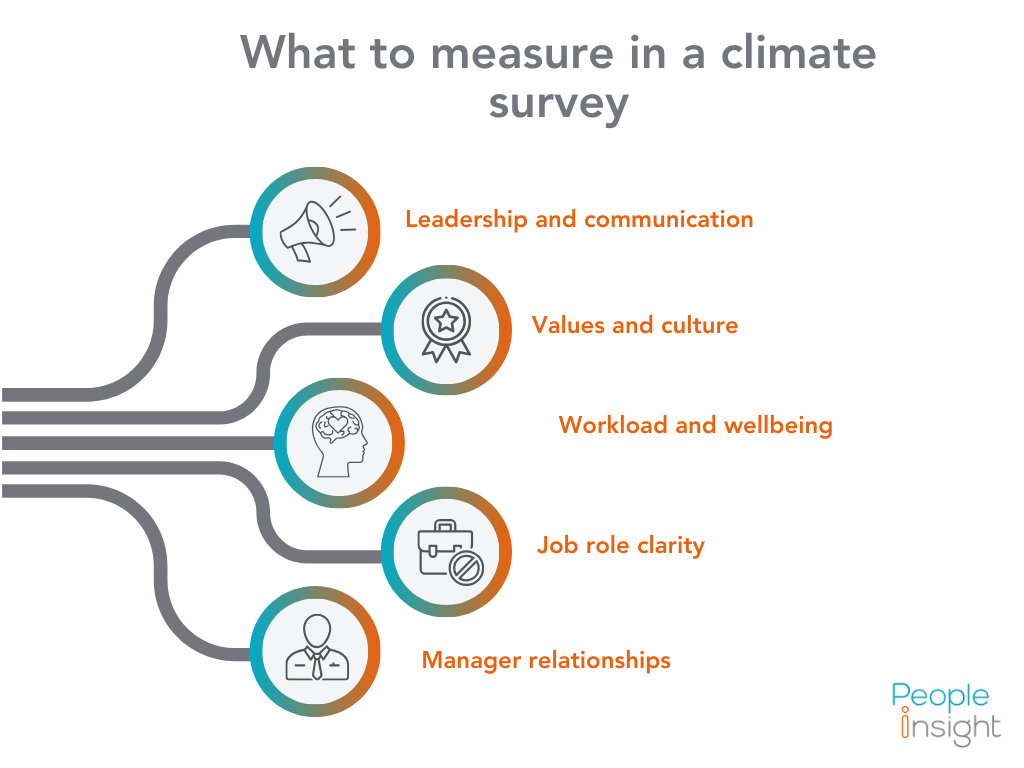
Your climate survey should be designed around the themes most relevant to your goals, culture and organisational challenges. Common areas to explore include:
Leadership and communication: Do employees feel informed, included and listened to by their leaders?
Values and culture: Is there alignment between what your organisation says and what people actually experience?
Workload and wellbeing: Are expectations realistic? Are employees supported in maintaining wellbeing? Do they feel overwhelmed and burned out, or are they able to manage and achieve a healthy work-life balance?
Job role clarity: Do people really know what’s expected of them and how their work contributes to wider goals?
Manager relationships: Are line managers perceived as supportive, consistent and fair? Do they take time to coach their people?
Choosing the right areas to measure is essential. At People Insight, our climate surveys are designed by experienced HR experts to produce actionable feedback. Data for data’s sake won’t help anyone.
Designing a climate survey that your employees will trust
Trust is the foundation of any climate survey. Employees need to believe their responses will be confidential and that their feedback will be used.
You can build trust by:
Communicating clearly: Before launching your survey, explain why you’re running it, how the data will be used and how anonymity is protected. We are unique in that we provide a comprehensive, bespoke communications service with our surveys. Our survey comms team will use your branding and work with you to create messages that will boost participation.
Choosing the right partner: A trusted employee survey platform helps guarantee anonymity and gives you expert support in designing effective, unbiased questions.
Sharing the outcomes: After the survey, be sure to share high-level results with your employees. Keep them in the loop. Explain what actions will be taken and provide regular progress updates.
Analysing your climate survey results
As we keep reiterating, collecting data is only the first step. To improve performance, you need to translate findings into action.
Here’s how to make that happen:
Look for patterns, not just scores
Low scores matter, but so do variations across locations, departments and demographics. Use segmentation to understand where perceptions differ and why. Our generative AI, Prism, does this for you in minutes, saving you hours of time.
Pay attention to open comments
Qualitative insights often contain the most actionable feedback. Use natural language processing (NLP) or manual coding to identify recurring themes and tone.
Identify quick wins and long-term shifts
Some climate survey insights will point to immediate improvements. For example, a need for clearer internal communication. Others may show systemic issues that require longer-term culture change.
Use your data to engage leaders
Present your findings in a way that resonates with leaders. Focus on how climate survey results connect to business outcomes like employee retention, innovation and performance. This helps build support for action at the top.
Turning insights into meaningful change
The most common pitfall of climate surveys is inaction. Employees speak up, but nothing changes. When this happens, trust in the process inevitably drops.
To avoid this:
Create visible actions: Whether it’s new ways of working, revised leadership behaviours or new wellbeing support, let employees see that change is happening.
Involve managers: Share relevant insights with line managers and give them ownership of local actions. Our 360 feedback platform can support this by helping managers reflect on their impact.
Track progress: Use follow-up surveys or pulse checks to track how your changes are landing. This keeps momentum going and makes culture change visible.
A climate survey is one of the most effective ways to embed employee listening into your organisation. When listening is consistent, genuine and leads to action, people are more engaged, retention improves and performance follows.
But this doesn’t happen automatically. You need an approach that combines the right survey tools, clear internal comms, skilled analysis and action planning that sticks.
Done well, climate surveys create a virtuous cycle: listening drives action, action drives engagement and engagement drives performance.
Want to see how a climate survey could help your organisation improve culture and performance?Talk to us about our employee survey platform and how we help turn insight into change.