Blogs:

What is employee engagement?

What employee engagement means, why it matters and how to improve it at work

what is employee engagement

    A quick insight: Employee engagement is the emotional commitment employees feel towards their work, their team and their organisation. It influences motivation, performance, retention and day-to-day culture. In this blog, we explain what employee engagement is, why it matters and what helps strengthen it.

    Employee engagement is one of those omnipresent terms you simply can’t avoid or ignore if you live and work in HR. However, rather confusingly, it’s also true that there is not one universal definition. That is a problem, because if you want to measure and improve engagement, you need to be clear about what the term actually means.

    So, what is employee engagement?

    Employee engagement is the emotional commitment employees have to their work, their colleagues and the organisation they work for. It describes how connected, motivated and involved people feel in their working lives. When employees are engaged, they care about their work, want to contribute and feel invested in the organisation’s success.

    And that connection matters. It influences how people perform, how they respond to change and whether they want to stay. But let’s take a wider, more complete look at this topic, including a more thorough definition, the main drivers of employee engagement, how you can measure it and why it matters for your organisation.

    What is employee engagement in simple terms?

    In simple terms, employee engagement is the level of emotional connection an employee feels towards their job and organisation.

    An engaged employee does more than just complete tasks. They understand the purpose behind their work and they care about outcomes. They feel part of something bigger than their own never-ending to-do list.

    By not means does that mean they are constantly enthusiastic or willing to overwork. It means they feel connected to what they do and why it matters.

    Employee engagement definition

    A useful employee engagement definition, and one we prefer at People Insight, is this:

    Employee engagement is the emotional commitment employees have to their work, their team and their organisation, which shapes how motivated, involved and willing they are to contribute.

    This is what separates employee engagement from other workplace ideas that are often confused with it (more on that later!).

    What employee engagement is not

    Employee engagement is not the same as job satisfaction.

    Someone can be satisfied with their role, pay or flexibility without feeling especially motivated or connected. In the same way, someone can enjoy the people they work with but still feel detached from the organisation’s direction. This is why we at People Insight don’t really care about employee satisfaction. We focus more on employee engagement as it gives a wider, more complete picture.

    Employee engagement is also not about being ‘always on’. It is not about overwork, performative enthusiasm or constant positivity. Healthy employee engagement depends on trust, clarity, support and sustainable working conditions. In a moment, we’ll cover the biggest drivers of employee engagement and signs your employees are engaged.

    Why employee engagement matters

    Employee engagement matters because it has an impact across the organisation.

    When employees feel engaged, they are more likely to care about their work, work well with others and contribute ideas. They are more likely to stay constructive through change and more likely to feel that their effort has meaning.

    Low employee engagement can have the opposite effect. People may withdraw, lose confidence in leadership, stop sharing ideas or begin looking elsewhere.

    This is why employee engagement matters beyond HR. It affects performance, retention, culture, adaptability and the everyday experience of work.

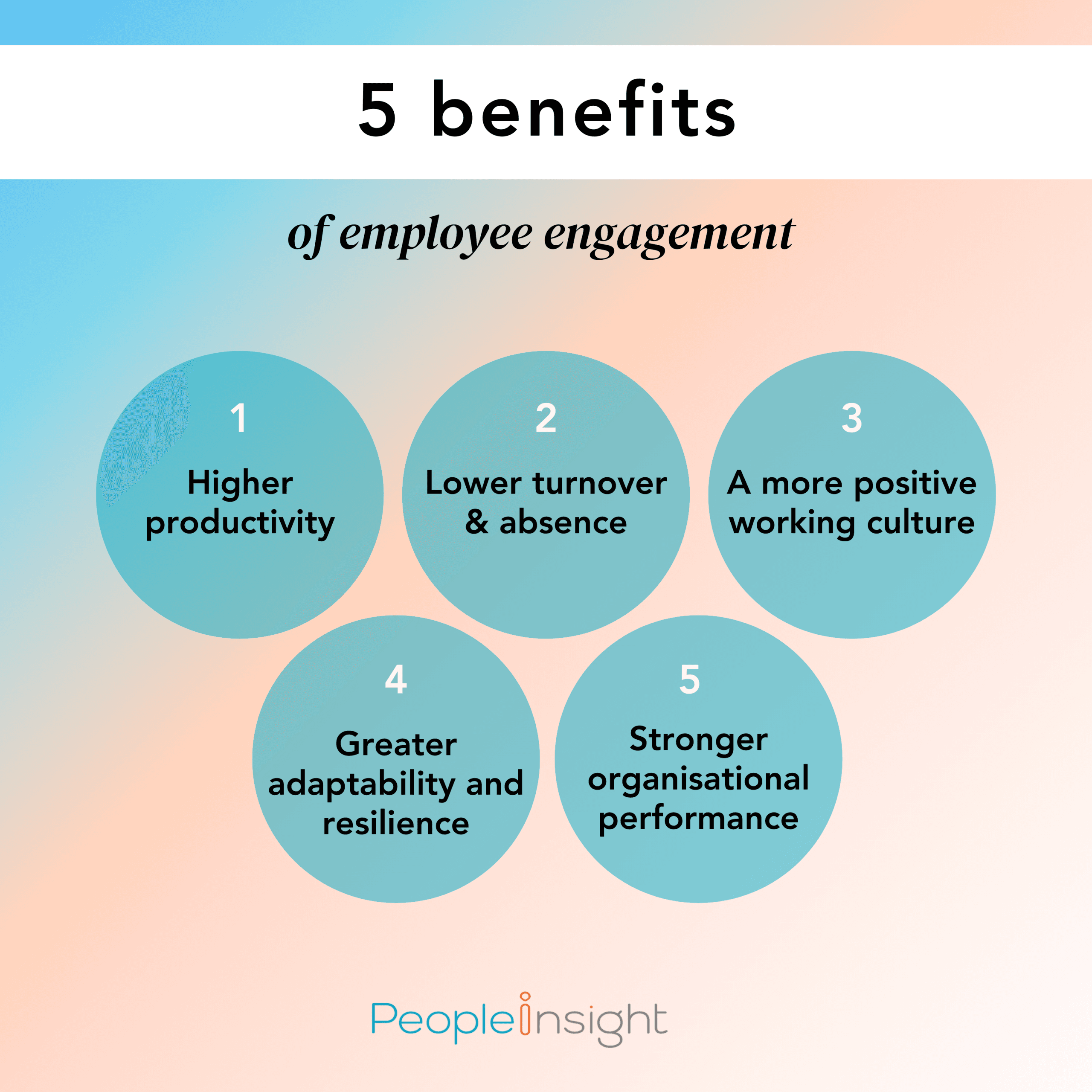
    5 Benefits of employee engagement

    When employee engagement is strong, the benefits can be felt across performance, retention, culture and the day-to-day experience of work. It is not just about morale. It shapes how people contribute, how teams function and how organisations respond to pressure and change.

    Below are five leading benefits of high levels of employee engagement:

    5 benefits of employee engagement

    1. Higher productivity

    Engaged employees tend to be more focused, proactive and committed in their work. They are more likely to take ownership, solve problems and put real effort into delivering high-quality outcomes.

    Research has found a clear positive relationship between work engagement and individual task performance. A major evidence review cited by Queen’s University Belfast found an average correlation of 0.43 between engagement and task performance. It also found that engagement explained an additional 19% of the variance in task performance beyond job satisfaction, organisational commitment and job involvement.

    In practical terms, that means engaged employees are more likely to put energy into their work, think beyond the bare minimum and contribute more consistently over time.

    2. Stronger retention and lower absence

    When people feel connected to their work and valued by the organisation, they are more likely to stay. Employee engagement helps strengthen trust, recognition and a sense of future opportunity, all of which support retention.

    It can also help reduce unplanned absence. Employees who feel supported, motivated and connected are generally less likely to disengage from work altogether. Over time, that can contribute to more stable teams, better continuity and less disruption.

    3. A more positive working culture

    Employee engagement helps create a workplace where people are more likely to collaborate, speak up and support one another. It encourages openness, shared responsibility and a stronger sense of purpose across teams.

    Culture is shaped by everyday behaviour. When employees are engaged, they are more likely to contribute positively to the working environment, not just complete their own tasks.

    4. Greater adaptability and innovation

    Engaged employees are often more willing to take part in change, share ideas and help improve how work gets done. They are more likely to stay constructive during periods of uncertainty and more likely to look for better ways of doing things.

    That makes employee engagement especially important during growth, transformation or wider organisational change. When people feel connected to the organisation, they are more likely to help move it forward.

    5. Stronger organisational performance

    Employee engagement does more than improve individual output. It helps strengthen organisational performance more broadly.

    When employees are engaged, organisations are better placed to retain talent, deliver a more consistent customer experience, maintain momentum through change and build a culture that supports long-term success. Engagement helps connect people to organisational goals, which makes it easier to turn strategy into action across the business.

    That is why employee engagement matters at leadership level. It is not just about how employees feel. It influences how the organisation performs.

    What drives employee engagement?

    Employee engagement is usually shaped by a combination of factors, not one single issue.

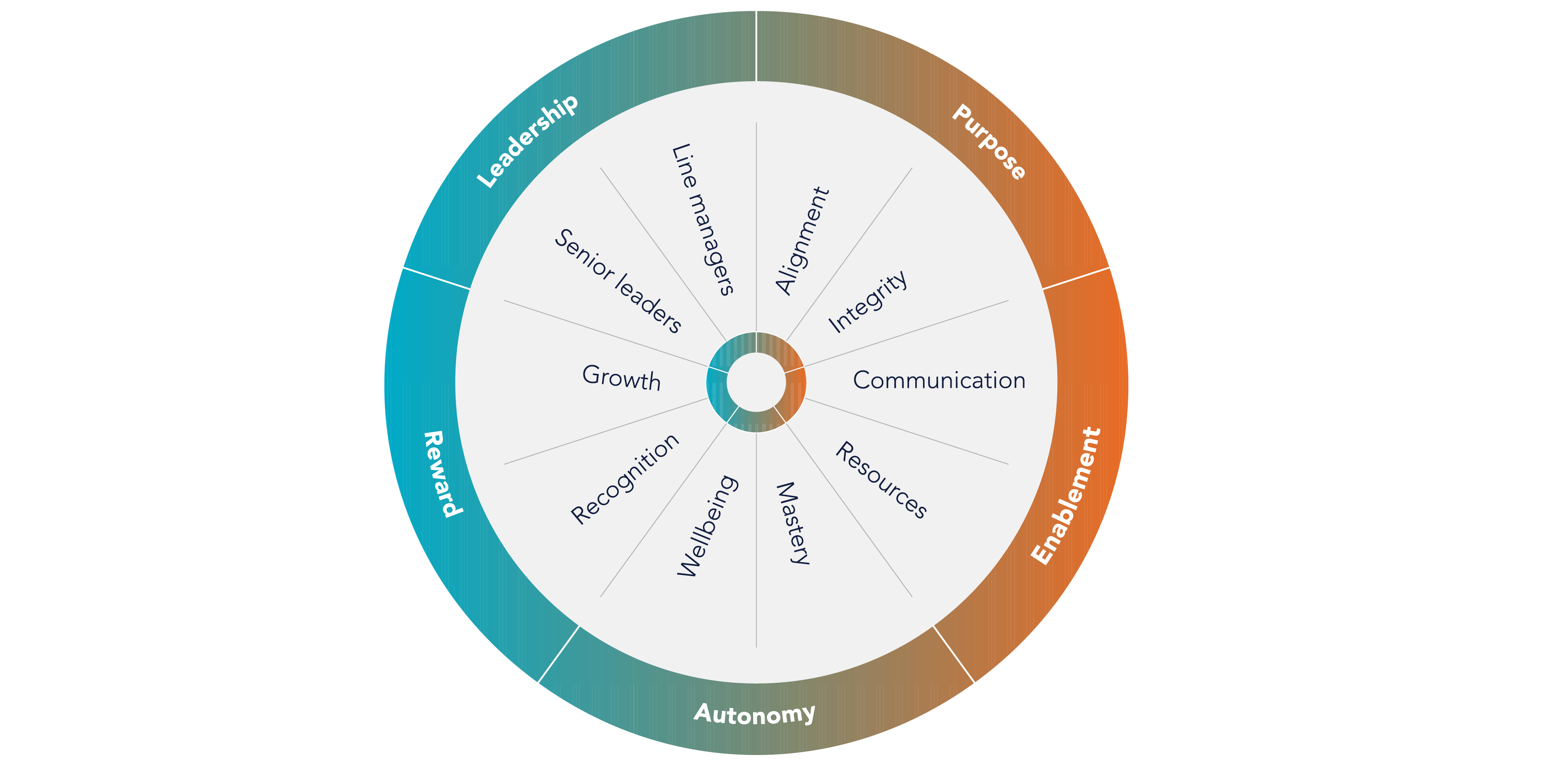
    At People Insight, we measure employee engagement through the five core drivers in our Pearl™ model: purpose, enablement, autonomy, reward and leadership.

    These drivers help explain why engagement is strong in some organisations and weaker in others.

    PEARL model 4

    Purpose

    Purpose is about whether employees understand where the organisation is going and how their role contributes to that direction.

    When people can see how their work connects to wider goals, employee engagement is often stronger.

    Enablement

    Enablement is about whether employees have what they need to do their job well.

    That includes tools, communication, clarity, support and workable processes. Even committed employees can lose engagement when day-to-day obstacles constantly get in the way.

    Autonomy

    Autonomy is about trust, flexibility and room to use judgement.

    Employees are more likely to feel engaged when they have appropriate control over how they work and when working life feels manageable and supportive.

    Reward

    Reward is about feeling valued.

    That includes pay and benefits, but it also includes recognition, development, praise and the sense that effort is noticed.

    Leadership

    Leadership has a major influence on employee engagement.

    Clear communication, credibility, empathy and support from leaders and managers all shape how connected employees feel to the organisation.

    What are signs of employee engagement?

    So what does employee engagement really look like? How can you tell if employees are actively engaged in their role and work? 

    You can often spot employee engagement in everyday behaviour.

    Engaged employees are more likely to:

    • speak up and share ideas
    • collaborate well with colleagues
    • take pride in their work
    • follow through on commitments
    • show initiative when things could be improved

    Of course, behaviour alone does not tell you everything. Some employees may appear fine on the surface while feeling disconnected underneath. That is why listening matters.

    Who is responsible for employee engagement?

    This is an important point we like to stress with our clients. Employee engagement is not owned by HR alone.

    It is shared across the organisation. Senior leaders shape trust and direction. Managers influence the day-to-day experience of work. HR and people teams provide structure, support and insight. Employees also play a role through feedback, participation and contribution.

    This shared responsibility is important because employee engagement weakens when ownership is vague. If feedback is collected but ignored, trust drops. If managers are expected to act without support, progress slows.

    Strong employee engagement depends on visible commitment across the organisation.

    How do you measure employee engagement?

    The best way to measure employee engagement is to ask employees directly, then act on what you learn.

    Employee engagement surveys are one of the most effective ways to do that. They help organisations understand how people are feeling, where strengths exist and where barriers may be affecting motivation, trust or performance.

    A strong employee engagement survey should do more than produce a score. It should help organisations:

    • listen at scale
    • understand what is driving results
    • identify priorities
    • turn insight into action
    • check whether change is happening over time

    This is where employee engagement becomes practical. Measurement only matters when it leads to better decisions and visible follow-through.

    Related: How to measure employee engagement and improve your workplace

    How to improve employee engagement

    If you want to improve employee engagement, start by listening well and responding clearly.

    That means understanding what employees are actually experiencing, not guessing. It means being honest about what needs to improve. It means giving managers support, not just expectations. And it means making sure action is visible after feedback is gathered.

    In practice, improving employee engagement often involves:

    • clarifying organisational direction
    • improving communication
    • giving employees the tools and support they need
    • recognising good work more consistently
    • developing managers and leaders
    • creating more trust, autonomy and follow-through

    Employee engagement improves when people can see that their experience matters and that feedback leads somewhere.

    Related: How to improve employee engagement in 2026

    Employee engagement is an ongoing process

    Employee engagement is far from a one-off initiative.

    It changes over time as organisations change, leaders change and employee needs shift. That is why the strongest organisations treat employee engagement as an ongoing process of listening, understanding and acting.

    When organisations keep that cycle going, they are more likely to build trust, strengthen culture and support better long-term performance.

    Want to measure employee engagement more clearly and turn feedback into action? Enquire about an employee survey and discover how People Insight helps organisations listen more sharply and act more confidently.


    Other engagement reads you’ll love:

    7 Features to look for in employee engagement software

    Employee experience vs employee engagement

    25 Inspirational employee engagement quotes

    Employee engagement: Free employee survey questions

    50 Employee engagement statistics

    How to measure the ROI of employee engagement

    14 Signs of disengaged employees

    How to improve employee engagement

    Connecting staff surveys with purpose

    20 employee performance and engagement tools you should try

    Our proven 4-step employee engagement strategy plan

    Frequently asked questions about employee engagement

    What is employee engagement?

    Employee engagement is the emotional commitment employees feel towards their work, their team and their organisation. It affects how motivated, involved and willing they are to contribute. When employees are engaged, they care about their work and feel connected to the organisation’s success.

    Why is employee engagement important?

    Employee engagement is important because it affects performance, retention, culture and how people experience work day to day. Engaged employees are more likely to contribute ideas, work well with others and respond positively to change. Low engagement can lead to withdrawal, lower trust and higher turnover.

    How do you measure employee engagement?

    Employee engagement is usually measured through employee engagement surveys, often supported by focus groups or one-to-one conversations. A good survey helps organisations understand how employees are feeling, what is driving engagement and where action is needed. The most useful measurement leads to clear follow-through, not just a score.

    What are the main drivers of employee engagement?

    The main drivers of employee engagement often include purpose, enablement, autonomy, reward and leadership. These factors shape whether employees feel supported, valued, trusted and connected to the organisation’s direction.

    What is the difference between employee engagement and job satisfaction?

    Job satisfaction is about how content someone feels with aspects of their role, such as pay, flexibility or working conditions. Employee engagement goes deeper. It reflects emotional commitment, motivation and connection to work and organisational goals.

    Here at People Insight, we tend not to focus on or measure job satisfaction in isolation. That is because employee engagement gives a more comprehensive and useful picture of how people experience work. It helps organisations understand not just whether employees feel content, but whether they feel connected, supported and motivated to contribute.


    How can you improve employee engagement?

    You can improve employee engagement by listening to employees, acting on feedback and creating the conditions that help people do their best work. That often includes clearer communication, stronger leadership, better recognition, improved support and more visible follow-through after surveys.

    Trusted By

    bernard matthews
    British red cross
    greggs 01
    bidfood
    barbour
    muller
    gdf suez
    brewin dolphin
    molnlycke
    provident financial group
    moy park
    seaco
    vision express
    gilead
    jupiter asset management
    nhs supply chain
    dcc
    pladis - employee engagement for manufacturing
    southampton fc
    sunbelt rentals
    St john ambulance
    walgreens boots alliance
    lse
    loughborough university
    university of manchester
    university of birmingham
    university of southampton
    london school of hygiene and tropical medicine
    university of st andrews
    university of london
    wolseley
    Aman
    car finance 247
    the nottingham
    Cote brasserie
    west midlands police
    Autogrill 1 01
    john laing
    vivid homes
    quorn
    anchor
    action for children
    virgin active 1
    park plaza
    the belfry hotel resort