



















Blogs:

How to measure the ROI of employee engagement

Formulas and calculations to measure your engagement… as well as qualitative metrics you need to consider

    A quick insight: The ROI of employee engagement shows up in both financial and operational outcomes. Higher engagement is linked to stronger productivity, lower turnover, lower absenteeism and healthier workplace culture. When organisations listen well, act on insight and focus on what matters most to employees, they create value that goes beyond sentiment and supports long-term performance.

    Trying to prove that employee engagement really drives business results? You are not alone. Many organisations struggle to show a clear return on efforts to improve the employee experience. The ROI of employee engagement can feel vague, especially when leaders want hard numbers rather than good intentions.

    But it does not have to stay vague.

    With the right data, a few practical formulas and the right context, you can show how employee engagement links to stronger retention, higher productivity, lower absence and better performance. Once you can measure that connection, it becomes much easier to build a case for continued investment in your people.

    Related: Discover why People Insight is the most actionable employee survey platform

    Why the ROI of employee engagement matters

    Employee engagement is not just an HR metric. It is a business metric.

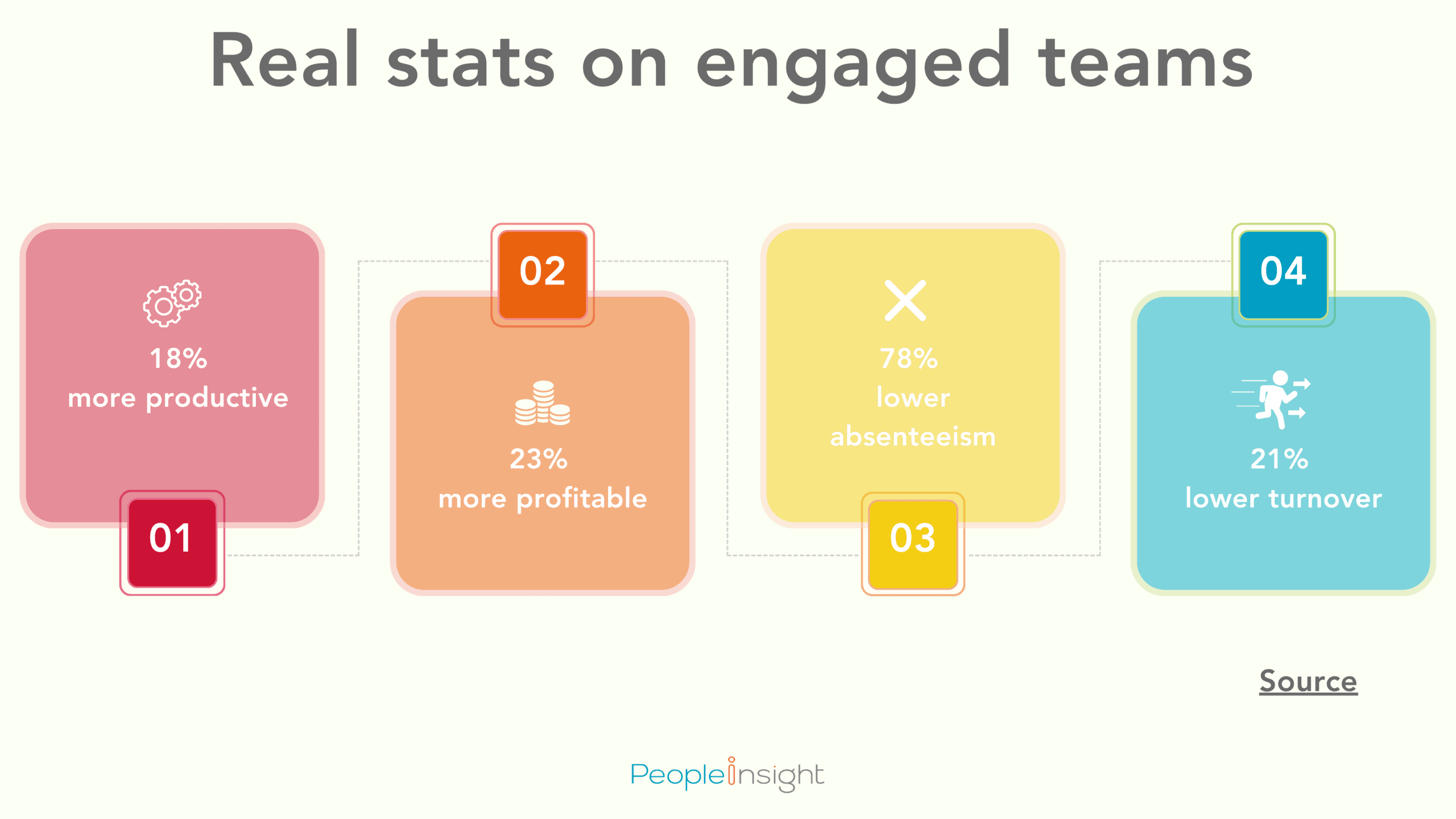
    Findings continue to show that highly engaged business units outperform others on key outcomes, including productivity, profitability, absenteeism and turnover. In fact, we see that they are 18% more productive, 23% more profitable, have 78% lower absenteeism and 21% lower turnover.

    stats on engaged teams

    That matters because leaders rarely invest in engagement for engagement’s sake. They invest when they can see a clear line between better employee experience and stronger business outcomes.

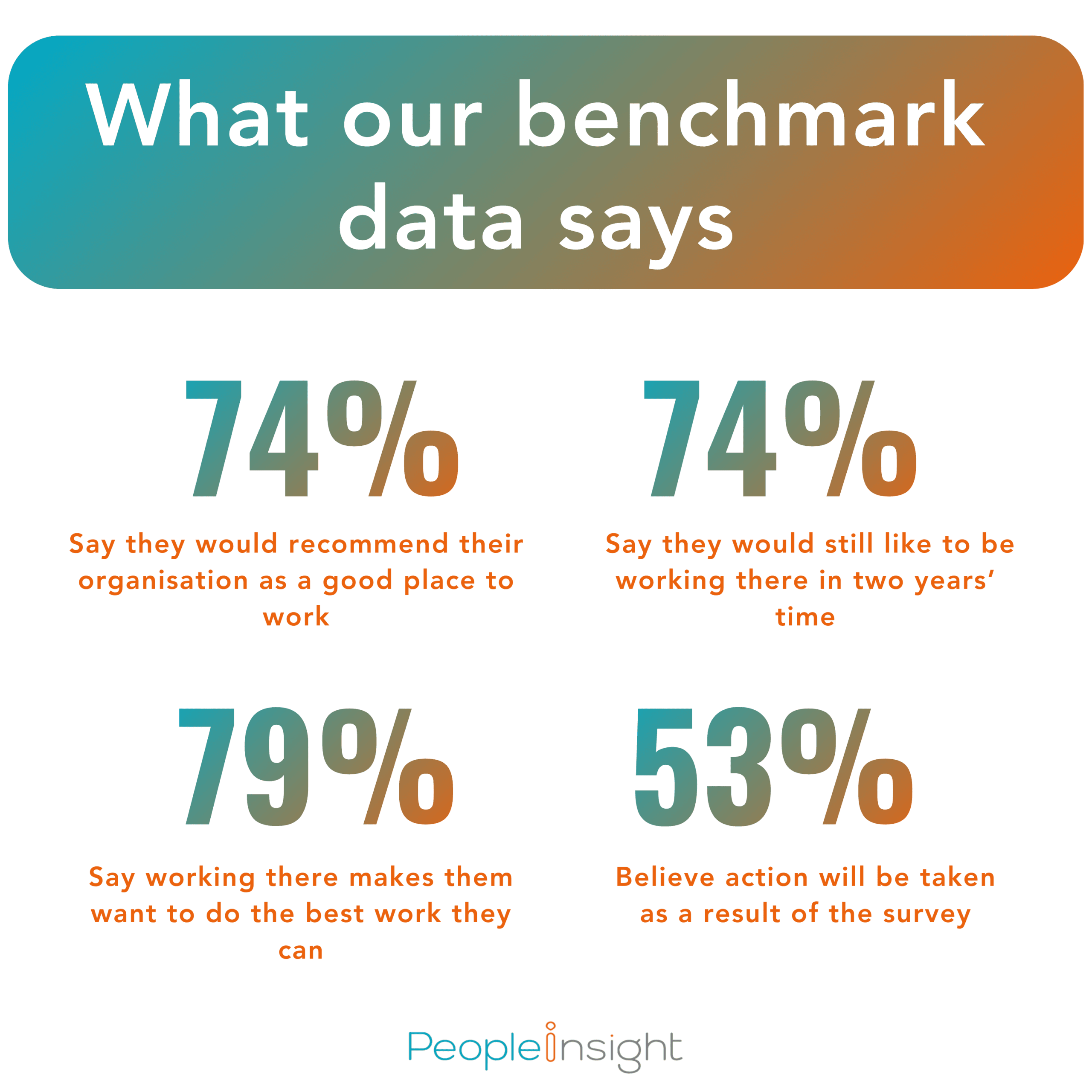
    This is where People Insight’s benchmark data also helps sharpen the picture. In our 2025 benchmark data:

    What our benchmark data says

    • 74% say they would recommend their organisation as a good place to work
    • 74% say they would still like to be working there in two years’ time
    • 79% say working there makes them want to do the best work they can
    • but only 53% believe action will be taken as a result of the survey

    That is a useful gap. Many employees still care deeply about their organisation and want to do good work, but confidence in visible follow-through is weaker. That is important because engagement only delivers full value when listening leads to action.

    Focus on outcomes, not just outputs

    Before you calculate ROI, make sure you are measuring the right things.

    Outputs are useful, but they do not show business value on their own. Examples include:

    • survey response rates
    • number of listening sessions
    • number of engagement workshops
    • number of action plans created

    Those are activity measures. They tell you what you did.

    Outcomes are what matter here. They tell you what changed as a result. For example:

    • reduced employee turnover
    • fewer sickness absence days
    • improved productivity
    • stronger customer experience
    • higher retention in underperforming teams
    • lower levels of disengagement or burnout

    This is where the ROI of employee engagement really lives: in what changes because of your effort.

    Start with business metrics you can influence

    To measure the ROI of employee engagement, start with business outcomes that engagement can realistically affect.

    The strongest ones are usually:

    • turnover
    • absenteeism
    • productivity
    • retention
    • discretionary effort
    • customer-facing outcomes where relevant

    Then gather your baseline figures.

    You do not need perfect attribution to start building a business case. What you need is a credible before-and-after view, plus a realistic estimate of the financial value of the change.

    1. Reduced turnover

    Turnover is often the clearest area for demonstrating ROI.

    When engagement improves, employees are more likely to stay. 

    A simple turnover ROI formula looks like this:

    ROI = (Reduction in leavers × Cost per leaver – Cost of engagement activity) / Cost of engagement activity

    Example

    • Number of employees: 1,000
    • Annual turnover: 15% = 150 leavers
    • After engagement action: turnover falls to 12% = 120 leavers
    • Estimated internal cost per leaver: £20,000
    • Cost of engagement activity: £100,000

    Calculation

    • Leavers reduced by: 30
    • Estimated savings: 30 × £20,000 = £600,000
    • ROI: (£600,000 – £100,000) / £100,000 = 500% ROI

    The exact cost per leaver will vary by organisation and role type, which is why using your own replacement cost is usually stronger than relying on a generic external benchmark.

    2. Lower absenteeism

    Absence is another practical area where engagement ROI can be measured.

    ONS data shows that workers lost an average of 4.4 days per worker to sickness absence in 2025, and more engaged teams generally experience lower levels of absenteeism.

    A simple absenteeism ROI formula looks like this:

    ROI = (Reduction in absence days × Cost per day – Cost of engagement activity) / Cost of engagement activity

    Example

    • Average sick days per employee: 4.4
    • Company size: 500 employees
    • Total sick days: 2,200
    • Cost per absent day: £125
    • After engagement action, average sick days fall to 3.8
    • Cost of engagement activity: £50,000

    Calculation

    • Reduction in total sick days: 300
    • Estimated savings: 300 × £125 = £37,500
    • ROI: (£37,500 – £50,000) / £50,000 = -25% in year one

    That might not look attractive at first glance, but this is exactly why engagement ROI should not be assessed on one measure alone. In many organisations, absence is only one part of the value story. Retention, productivity and performance gains often make the wider case much stronger.

    3. Improved productivity

    Productivity is one of the most compelling areas for measuring the ROI of employee engagement.

    Findings show that highly engaged business units see stronger productivity outcomes, which makes this a reasonable place to build a business case.

    A simplified productivity ROI formula looks like this:

    ROI = (Productivity gain × Output value – Cost of engagement activity) / Cost of engagement activity

    Example

    • Average annual output per employee: £100,000
    • Estimated productivity increase: 3%
    • Company size: 200 employees
    • Engagement initiative cost: £40,000

    Calculation

    • Additional value per employee: £3,000
    • Total value gained: 200 × £3,000 = £600,000
    • ROI: (£600,000 – £40,000) / £40,000 = 1,400% ROI

    The exact percentage improvement will depend on your organisation, but even modest productivity gains can justify significant investment.

    Use the right engagement metrics

    To connect these business outcomes to engagement, your surveys need to produce clear, usable data.

    Useful engagement metrics include:

    • engagement index scores
    • advocacy measures such as eNPS
    • manager-level trends
    • team-level differences
    • open-text comment themes
    • action confidence, such as whether employees believe something will happen next

    This is where an actionable employee survey platform becomes important. You need tools that help you filter results by team, demographic or engagement driver so you can see what is changing and what is actually moving the needle.

    It is also why people analytics matters here. If you want to show ROI well, you need more than raw scores. You need insight that can be linked credibly to business outcomes.

    Do not overlook intangible ROI

    Not every return will show up immediately in a spreadsheet.

    Some of the most valuable gains from engagement work are harder to cost directly, but still matter deeply. These can include:

    • stronger employee wellbeing
    • better morale
    • improved trust in leadership
    • fewer HR complaints
    • healthier team dynamics
    • stronger customer experience
    • more confidence in future listening

    That does not make them less important. It just means they should be discussed alongside the harder numbers.

    This is also where tools such as Prism and 360 feedback can add value. They help give a fuller picture by surfacing themes, sentiment and leadership patterns that simple numeric ROI models can miss.

    Related: Get strategic with employee listening through people analytics

    What People Insight’s benchmark data can add

    People Insight’s benchmark data can make the ROI case more credible because it helps you show not just where your scores sit, but which issues are most likely to be affecting business outcomes.

    For example, our 2025 benchmark data shows:

    • only 59% say their career development aspirations are being met
    • only 50% say rewards are linked to performance and contribution
    • only 46% say communication is good between different teams
    • only 60% say senior leaders make the effort to listen to staff

    Those are not just engagement topics. They are potential business risks. Weak development can affect retention. Weak recognition can affect motivation. Weak communication can slow execution. Weak leadership visibility can damage trust and follow-through.

    That is where ROI thinking becomes useful. It helps translate employee experience issues into operational and financial terms.

    Common obstacles and how to handle them

    Measuring the ROI of employee engagement is not always simple. A few challenges come up regularly.

    1. No clear baseline

    If this is your first attempt, use your current figures as your starting point and track movement over time.

    2. Too many variables

    You cannot control every variable, but you can isolate a team, department or specific initiative and track changes before and after.

    3. Siloed data

    HR, finance and operations often hold different parts of the story. Bringing them together is essential if you want to build a credible ROI case.

    4. Over-reliance on one metric

    Turnover, absence or productivity alone rarely tell the full story. The strongest case usually uses several indicators together.

    ROI matters, so it needs to be measured

    The ROI of employee engagement is one of the clearest ways to connect people experience to business value.

    And when you can show that connection, it becomes much easier to secure support, budget and attention for the work that helps employees do their best work.

    In short, what gets measured gets noticed.

    At People Insight, we help organisations measure what matters through stronger survey design, clearer reporting, Prism-powered insight and practical action planning. That makes it easier to show where engagement is improving, where it is still under pressure and where it is creating real business value.

    Want to turn engagement insights into real-world impact? Get in touch to learn how People Insight can help you measure the ROI of employee engagement more clearly.

    FAQs about the ROI of employee engagement

    A quick run down on all you need to know

    What is the ROI of employee engagement?

    The ROI of employee engagement is the measurable business value created by improving engagement, typically through better retention, productivity, reduced absence and stronger performance.

    How do you calculate the ROI of employee engagement?

    A practical way to calculate it is to estimate the financial benefit of a change, such as lower turnover or higher productivity, then subtract the cost of the engagement activity and divide by that cost.

    What business outcomes are most useful for engagement ROI?

    The most useful outcomes are usually turnover, absenteeism, productivity, retention and customer-facing measures where relevant.

    Why is employee engagement linked to productivity?

    Engaged employees are generally more committed, more focused and more likely to contribute discretionary effort. 

    How does People Insight help measure engagement ROI?

    People Insight helps organisations connect engagement data to business outcomes through survey design, reporting, benchmark context, Prism-powered analysis and practical action planning.

    Does ROI only include financial returns?

    No. Financial returns matter, but ROI should also include wider operational and cultural gains, such as stronger wellbeing, better morale, improved trust and healthier team dynamics.