



















Blogs:

Employee engagement strategy: a practical 4-step plan

Build a strategy that drives engagement and business success

Our proven 4-step employee engagement strategy plan

    A quick insight: A strong employee engagement strategy makes engagement intentional rather than accidental. It connects what matters to your people with what matters to your organisation and gives you a clear route from listening to action. The most effective strategies are built on better insight, clearer priorities and visible follow-through.

    A well-built employee engagement strategy helps organisations create a workplace where people feel connected, motivated and committed to their work. It supports better performance, helps strengthen retention and makes it easier to focus effort where it will have the greatest positive effect.

    Many organisations still take a scattergun approach. They launch disconnected initiatives, respond to whatever feels most urgent and hope to boost employee engagement over time. The problem is, that rarely leads to meaningful improvement.

    A stronger employee engagement strategy starts somewhere else. It starts with sharper listening.

    At People Insight, we believe the best strategies are built on a clear understanding of what employees are experiencing, what is getting in the way and what is most likely to improve engagement in practice. That is where Sharper listening. Smarter action. comes in. It is our approach to insightful, proactive employee listening and turning that insight into meaningful action. Listening becomes sharper when you gather the right feedback in the right way. Action becomes smarter when you use that insight to focus on the changes that matter most.

    This guide sets out a practical four-step employee engagement strategy built around that principle:

    • design the right survey
    • launch and collect feedback
    • understand what the data is telling you
    • turn insight into smarter action

    Related: Watch our webinar on how to evolve your engagement strategy

    What is an employee engagement strategy?

    An employee engagement strategy is a structured plan for understanding what drives engagement in your organisation and turning that insight into focused action.

    It is not just a list of engagement ideas or wellbeing activities. A real employee engagement strategy connects employee feedback, organisational priorities and practical action. It helps you decide where to focus, what to improve and how to track whether change is actually happening.

    A good employee engagement strategy makes a real difference

    Egagement does not improve by accident or on its own.

    Without a clear strategy, organisations often end up reacting to individual issues without a wider plan. That can lead to disconnected activity, weak follow-through and limited progress. A better strategy helps you:

    • listen more clearly
    • focus on the issues that matter most
    • align engagement work with wider business priorities
    • support leaders and managers with clearer direction
    • measure progress over time

    A structured strategy helps organisations cut through the noise, take targeted action and build long-term engagement around what matters most.

    It also helps you focus resources in the right places. With clear objectives and an action plan based on real data, your strategy makes it easier to prioritise what will have the biggest impact, whether that is developing line managers, improving internal communication or supporting employee wellbeing.

    Sharper listening. Smarter action.

    A strong employee engagement strategy is where Sharper listening. Smarter action. becomes practical.

    It is People Insight’s approach to more insightful, proactive employee listening and turning that insight into meaningful action.

    Sharper listening means:

    • asking the right questions
    • creating trust in the survey process
    • collecting both scores and comments
    • understanding what sits behind the data
    • identifying where attention is most needed

    Smarter action means:

    • translating feedback into clear priorities
    • avoiding overreaction or scattergun fixes
    • giving leaders and managers the confidence to focus
    • turning insight into visible, realistic progress
    • reinforcing action over time

    This is also where Prism strengthens the process. Prism helps turn employee feedback into clearer, more practical next steps. It can surface patterns in the data, summarise comments at scale and help organisations move from large volumes of feedback to more focused action.

    A practical 4-step employee engagement strategy

    There is no one-size-fits-all approach to employee engagement. Every organisation has different priorities and challenges, so your strategy should reflect the unique needs of your employees and your goals as a business. But at People Insight, we have created a great base strategy that can be modified and adapted to suit you

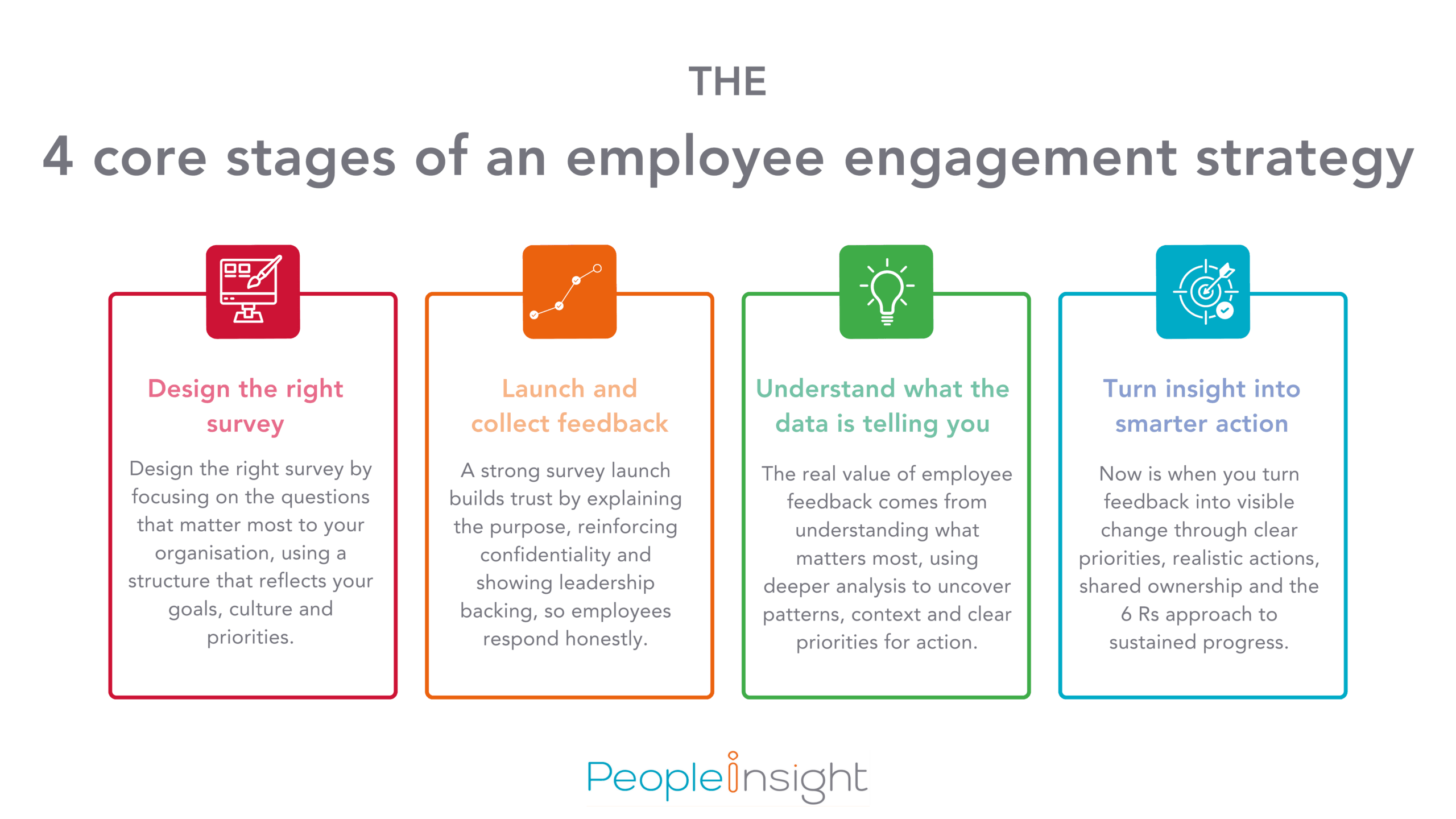
    Our employee engagement strategy model has four core stages. Let’s take a look at each in detail.

    4 core stages of an employee engagement strategy

    1. Design the right survey

    A strong employee engagement strategy starts by designing the right survey.

    That means choosing a survey approach that reflects your organisation’s goals, culture and context. If your survey is too generic, too broad or disconnected from the questions leaders actually need answering, the strategy will be weaker from the start.

    A good survey design should:

    • focus on the themes that matter most
    • align with your wider business priorities
    • balance consistency with relevance
    • make space for both quantitative and qualitative feedback
    • create the conditions for honest responses

    This is where People Insight’s wider survey approach matters. The platform supports organisations in designing a survey that fits their needs rather than forcing everything into a standard template.

    You can also use a trusted model to make the survey more strategic. Our Pearl model is a helpful framework to start with. It covers five core themes:

    • Purpose
    • Enablement
    • Autonomy
    • Reward
    • Leadership

    A good employee engagement strategy does not begin with action planning. It begins with choosing the right questions, the right structure and the right listening model.

    Learn more about our survey implementation services

    2. Launch and collect feedback

    Once the right survey is in place, the next step is to launch it well and collect feedback in a way that builds trust.

    A weak launch can affect participation, candour and overall confidence in the process. A strong launch helps employees understand why the survey matters, how their feedback will be used and why they should believe it is worth taking part.

    Good survey communications should:

    • explain the purpose clearly
    • reinforce confidentiality
    • show leadership commitment
    • give managers the language and tools they need
    • create consistency across the organisation

    This is one place where strong communications support can make a real difference. Clear manager guidance, transparent messaging and visible leadership backing all help employees feel more confident in the process.

    A stronger employee engagement strategy does not just ask employees to take a survey. It builds confidence in the process from the start, which ultimately boosts response rate and the accuracy of the results.

    3. Understand what the data is telling you

    Once feedback has been collected, the next step is to understand what the data is really saying.

    This is the point where many strategies either become sharper or start to drift. If organisations only look at top-line scores, they risk missing the patterns, context and priorities that actually matter. Stronger analysis means going deeper:

    • looking at trends and segmentation
    • comparing groups and themes
    • identifying what is improving and what is slipping
    • using comments to understand why results look the way they do

    This is where Prism, our integrated AI, can help a great deal. It can surface patterns, summarise comments at scale and provide clearer context so teams can move from raw feedback to a more focused understanding of what needs attention.

    It is also where organisations need to avoid overcomplicating the strategy. The aim is not to analyse absolutely everything. The aim is to identify what matters most.

    A better employee engagement strategy is built on more than data collection. It depends on clear interpretation and disciplined prioritisation.

    4. Turn insight into smarter action

    This is where the strategy becomes real.

    If the first three stages help you listen properly, the fourth stage is where that listening turns into visible change. This is also where many engagement strategies succeed or fail.

    Smarter action means:

    • choosing the right priorities
    • keeping actions realistic
    • making ownership clear
    • communicating progress visibly
    • reinforcing momentum over time

    At People Insight, this is where our 6 Rs approach to action planning connects naturally with the wider employee engagement strategy.

    The 6 Rs are:

    • Review
    • Replay
    • Reflect
    • Refine
    • Respond
    • Reinforce

    They provide a practical structure for turning feedback into progress. They also align closely with the idea of smarter action: understand the results, share them clearly, sense-check priorities, refine the right actions, respond visibly and reinforce progress over time.

    A stronger employee engagement strategy does not end with reporting. It creates a clear route from insight to visible, sustained action.

    What should an employee engagement strategy include?

    A good employee engagement strategy should include:

    • a clear understanding of current engagement levels
    • a survey approach designed around the right questions
    • strong survey communications and leadership visibility
    • meaningful analysis of scores and comments
    • clear priorities linked to organisational goals
    • realistic, visible action planning
    • measures for tracking progress over time

    The strongest strategies are focused, not overloaded. They do fewer things more deliberately.

    If you are building out the practical side of this work, a clear action plan is what helps your strategy move from intent to visible progress.

    Common mistakes in employee engagement strategy

    A weaker employee engagement strategy usually falls into one of a few common traps:

    1. launching disconnected initiatives without clear priorities
    2. relying on assumptions instead of employee feedback
    3. focusing only on top-line scores
    4. trying to fix too much at once
    5. failing to communicate progress
    6. not reinforcing action after the first burst of activity

    A more structured strategy helps avoid these pitfalls and keeps engagement work connected to what employees are actually experiencing.

    This is especially important in areas like diversity and inclusion, where organisations need to understand not just overall sentiment, but how experiences differ across groups and what needs to change in practice.

    An employee engagement strategy should be continuous

    The best employee engagement strategies are not fixed documents. They are living processes.

    Organisations change. Employee expectations shift. People come and go. Priorities evolve. New issues emerge. That is why an effective employee engagement strategy should be reviewed, refined and reinforced over time.

    Pulse surveys can play a valuable role here. They help organisations monitor progress, stay closer to what is changing and sustain momentum between larger annual listening moments.

    Employee engagement strategies in action

    A strong employee engagement strategy does not live on paper. It becomes visible through the actions organisations take and the way they connect listening to progress.

    At Arrow Communications, regular employee surveys, visible follow-through and a strong communications approach helped support a culture of ownership and openness. Read Arrow Communications’ employee engagement case study.

    At London South Bank University, leaders used employee survey results to shape local action, giving managers direct access to their results and enabling tailored improvements that employees could see and feel. Read more about how LSBU is enabling local action.

    These examples show what a stronger employee engagement strategy looks like in practice: clear insight, local ownership and visible follow-through.

    Improve your employee engagement strategy with People Insight

    A strong employee engagement strategy starts with better listening and gets stronger through better action.

    That means designing the right survey, launching it well, understanding what the data is telling you and turning insight into smarter action. When those four steps work together, organisations are in a much stronger position to improve engagement in a way that is focused, practical and sustainable.

    At People Insight, we help organisations do exactly that through our survey platform, Prism and expert consultancy support.

    Want to build a stronger employee engagement strategy in your organisation? Get in touch to learn how People Insight can help you listen more clearly and act with more confidence.

    FAQs about employee engagement strategy

    A quick run down on all you need to know

    What is an employee engagement strategy?

    An employee engagement strategy is a structured plan for understanding what drives engagement in your organisation and turning that insight into focused action.

    Why is an employee engagement strategy important?

    It is important because engagement does not improve by accident. A clear strategy helps organisations listen properly, prioritise effectively and act in ways that improve employee experience and performance.

    What should an employee engagement strategy include?

    A good employee engagement strategy should include survey design, strong communications, meaningful analysis, clear priorities, realistic action planning and progress tracking.

    What are the four steps in an employee engagement strategy?

    A practical employee engagement strategy can be built around four stages: design the right survey, launch and collect feedback, understand what the data is telling you and turn insight into smarter action.

    How does Prism support employee engagement strategy?

    Prism helps organisations understand feedback more clearly by surfacing patterns, summarising comments at scale and helping identify more practical next steps.

    How do surveys support employee engagement strategy?

    Surveys help organisations understand what employees are experiencing, what is driving engagement and where attention is most needed. They provide the evidence a strong strategy needs.

    Why does action planning matter in employee engagement strategy?

    Action planning matters because employee feedback only creates value when it leads to visible progress. Without clear follow-through, trust in employee listening weakens.

    How can People Insight help with employee engagement strategy?

    People Insight helps organisations build stronger employee engagement strategies through flexible surveys, Prism-powered insight, clear reporting and consultancy support that helps turn feedback into meaningful action.