



















Knowledge base:

What is the employee experience?

What it is, what shapes it and how to improve it

What is the employee experience

    A quick insight: The employee experience is the sum of what people see, feel and go through at work across every stage of their journey with an organisation. It is shaped by leadership, communication, culture, development, recognition and the practical reality of getting work done. A strong employee experience helps people feel supported, valued and able to do their best work, which in turn strengthens engagement, retention and performance.

    Employee experience is one of the most important ideas in modern people strategy, but it is also one of the most misunderstood.

    Some organisations treat employee experience as a set of perks. Others use it as a catch-all term for culture, employee engagement or wellbeing. In reality, employee experience is broader and more practical than that. It is about what work actually feels like for employees, from their first interaction with your organisation to their final day and everything in between.

    The employee experience includes:

    • how easy it is to apply for a role
    • how welcome and supported someone feels when they join
    • whether managers communicate clearly
    • whether people have the tools, recognition and development they need
    • whether work feels fair, sustainable and meaningful
    • whether feedback leads to visible action

    In this guide, we’ll explore what employee experience is, what shapes it and how organisations can improve it in a meaningful way.

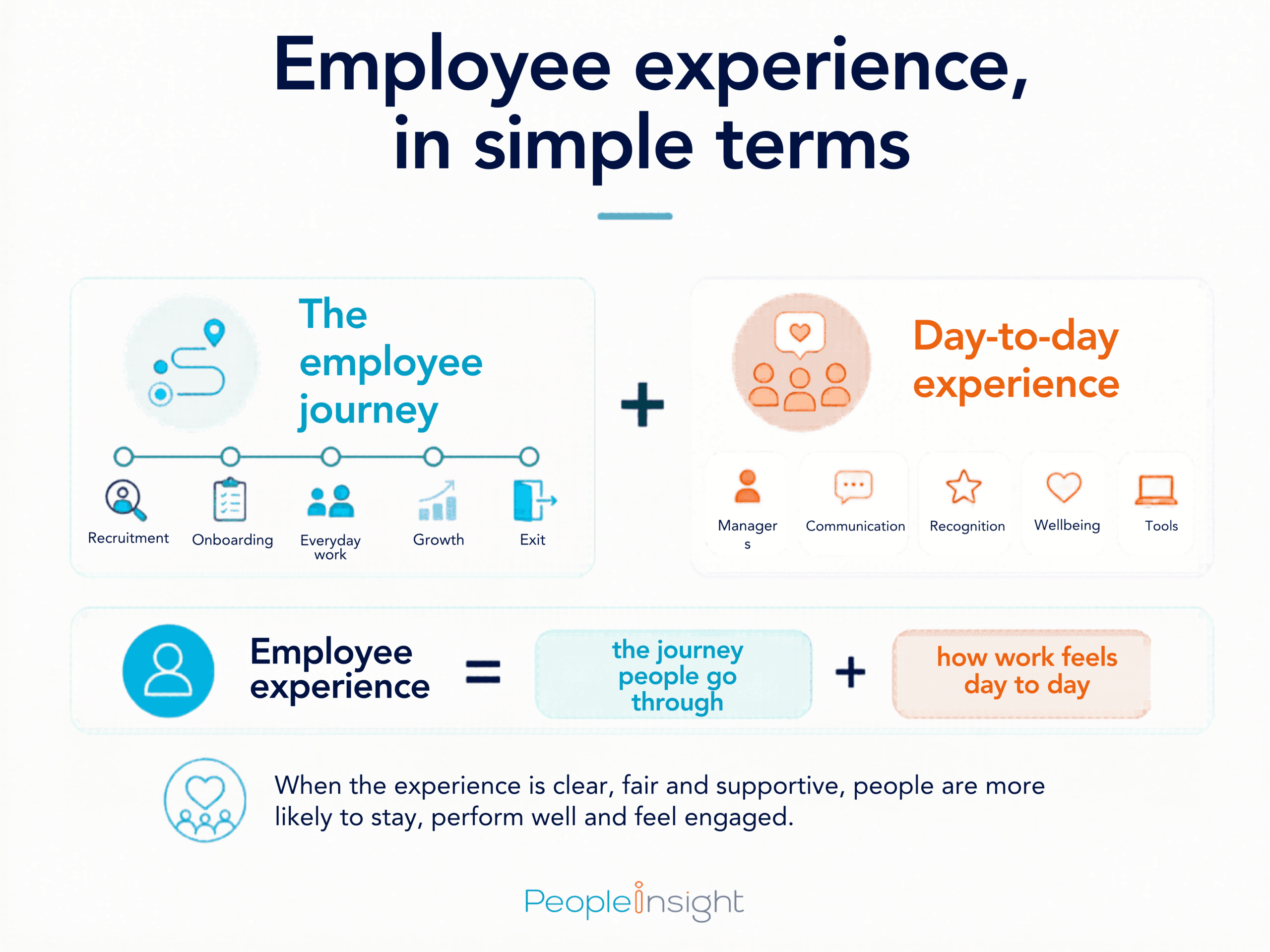
    Employee experience, in simple terms

    Employee experience is the overall experience an employee has with an organisation across the full employee lifecycle.

    It includes every interaction, system, relationship and moment that shapes how someone feels about work. That means employee experience is not one thing. It is the combined effect of many things, including:

    • recruitment
    • onboarding
    • manager relationships
    • communication
    • leadership visibility
    • team culture
    • recognition
    • development
    • wellbeing
    • technology and tools
    • growth opportunities
    • exit experience

    Employee experience, in simple terms

    In simple terms, employee experience is what work feels like from the employee’s point of view.

    That is why it has such a strong effect on engagement, retention and performance. If the experience of work is confusing, frustrating or unsupportive, engagement usually weakens. If the experience is clear, fair and supportive, people are more likely to perform well and stay.

    Related: How to design an employee experience strategy

    Clearing up a common misconception

    Despite what you may have heard, employee experience and employee engagement, while closely connected, are not the same thing.

    Employee experience is the wider environment and journey that shapes how work feels.

    Employee engagement is the level of emotional commitment, motivation and connection someone feels towards their work and organisation.

    A simple way to think about it is this:

    • Employee experience is what employees go through
    • Employee engagement is how employees feel in response

    For a deeper look at the distinction, see our guide to employee experience vs employee engagement.

    The bigger picture

    Employee experience has a direct effect on how people work, how long they stay and how they talk about the organisation.

    A strong employee experience can help improve:

    • retention
    • engagement
    • advocacy
    • wellbeing
    • performance
    • trust in leadership

    A weak employee experience can lead to:

    • disengagement
    • confusion
    • low trust
    • avoidable turnover
    • poor communication
    • burnout
    • low confidence in leadership

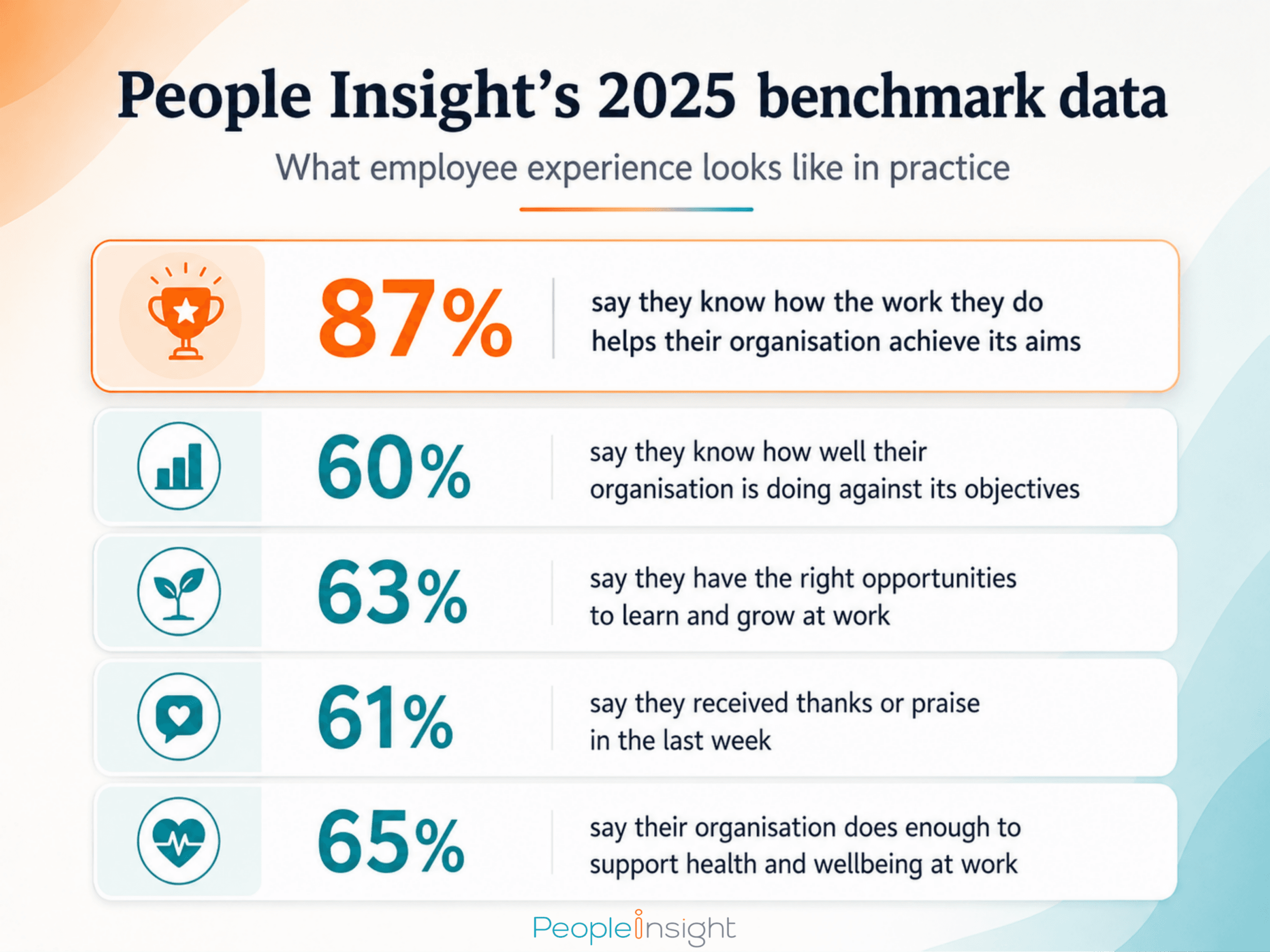
    People Insight’s benchmark data helps show what this looks like in practice. In our 2025 benchmark data:

    what employee experience looks like in practice

    • 87% of employees say they know how the work they do helps their organisation achieve its aims
    • but only 60% say they know how well their organisation is doing against its objectives
    • only 63% say they have the right opportunities to learn and grow at work
    • only 61% say they received thanks or praise in the last week
    • only 65% say their organisation does enough to support health and wellbeing at work

    That tells an important story. Many employees understand their role in principle, but the wider experience around communication, development, recognition and wellbeing is often weaker. Those are all core parts of employee experience.

    What shapes the employee experience?

    Employee experience is shaped by the everyday reality of work. It is influenced by what leaders prioritise, how managers behave, whether communication feels open, whether development feels possible and whether work feels sustainable in practice.

    People Insight’s benchmark data shows how these factors can vary. Many employees understand how their own work contributes to organisational aims, but confidence is weaker in areas such as leadership visibility, communication between teams, recognition and wellbeing support. That gap is often where employee experience starts to feel less joined-up.

    The table below shows some of the factors that most strongly shape employee experience, along with what weaker performance often looks like in practice.

    FactorHow it shapes employee experienceWhat weaker performance often looks like
    LeadershipSets the tone for trust, direction and visibilityEmployees feel distant from decision-making or unclear on direction
    Line managersShapes day-to-day clarity, support, feedback and workloadInconsistent management, weak feedback and low confidence
    CommunicationHelps employees feel informed, included and alignedConfusion, silos and poor communication between teams
    DevelopmentShapes whether people feel they can grow and build a futureEmployees feel stuck or unsupported in their progression
    RecognitionReinforces value, contribution and motivationEffort goes unnoticed and morale weakens
    Wellbeing and workloadAffects whether work feels sustainable and manageablePressure builds, energy drops and burnout risk increases
    Technology and toolsInfluences how easy it is to get work doneFrustration, inefficiency and avoidable friction

    Taken together, these factors shape whether work feels clear, fair and supportive, or inconsistent, frustrating and harder to sustain.

    Looking across the employee journey

    Employee experience is best understood across the full employee journey, not just in the middle of someone’s time with an organisation. It starts before employment begins and continues through onboarding, everyday working life, development, change and exit.

    The table below shows what employees tend to notice most at each stage, and what a stronger experience looks like in practice.

    StageWhat employees notice mostWhat good looks like
    Attraction and recruitmentClarity, responsiveness and first impressionsA fair, well-communicated process that reflects the organisation honestly
    OnboardingWelcome, support and speed to confidencePeople feel informed, included and able to contribute quickly
    Everyday working lifeCommunication, management, workload, recognition and toolsWork feels clear, supported and sustainable
    Development and progressionLearning, growth and future opportunityEmployees can see how they can grow and build their career
    Change and transitionTransparency, support and trust in leadershipChange is explained clearly and handled with credibility
    ExitRespect, reflection and how the organisation is rememberedPeople leave feeling listened to and treated fairly

    Looking at employee experience in this way helps organisations avoid focusing too narrowly on one moment or one initiative. The strongest approaches consider how the whole journey feels, and where friction, uncertainty or inconsistency may be building up over time.

    Related: What is the employee lifecycle?

    What a good employee experience looks like

    A strong employee experience is not about perfection. It is about consistency, clarity and credibility.

    It often includes:

    • clear communication
    • visible and trustworthy leadership
    • supportive managers
    • meaningful recognition
    • realistic development opportunities
    • manageable workloads
    • good tools and systems
    • a sense of belonging
    • confidence that feedback leads to action

    In practice, strong employee experience means people can do good work without unnecessary friction and feel respected while doing it.

    Where organisations often struggle

    A few patterns tend to show up again and again when employee experience is weaker than leaders expect. 

    Communication may feel patchy or unclear. Manager behaviour can be inconsistent from one team to the next. Leadership may not feel visible enough, and follow-through after employee surveys can be weak. 

    In some organisations, development opportunities feel limited, workload becomes harder to manage or different initiatives never quite join up into a coherent experience. Sometimes there is also too much focus on perks and not enough attention on the day-to-day realities that shape how work actually feels. 

    This is one reason employee experience needs a real strategy, not just a few isolated initiatives. 

    How do you measure employee experience?

    You cannot improve employee experience reliably if you do not have a clear view of what employees are actually experiencing.

    That is why measurement matters.

    A strong employee experience measurement approach often includes:

    The most useful employee experience measures usually cover:

    • communication
    • leadership
    • recognition
    • development
    • wellbeing
    • belonging
    • autonomy
    • workload
    • confidence in action

    How Prism supports employee experience work

    Prism helps organisations improve employee experience by making it easier to move from feedback to focused action.

    It supports that in three main ways:

    Prism Suggest

    Prism Suggest helps identify where focus is most needed, so organisations can prioritise the parts of the employee experience that are most likely to need attention.

    Prism Context

    Prism Context helps explain what sits behind the data by bringing together survey scores, comments and historical insight. That helps organisations understand the real experience behind the numbers.

    Prism Improve

    Prism Improve helps turn findings into more practical next steps, supporting smarter action planning and stronger follow-through.

    Together, Prism helps make employee experience work more focused, more contextual and more actionable.

    How organisations improve employee experience

    Improving employee experience takes more than good intentions. It usually comes from listening properly, understanding what the data is saying and acting on the issues that are most likely to make a real difference.

    A practical approach often includes the six steps below.

    StepWhat this looks like in practiceWhy it helps
    Listen properlyUse surveys, comments and wider feedback channels to understand what employees are experiencingGives you a clearer and more representative view of the real employee experience
    Interpret the data with contextUse comments, benchmarks and group differences to understand what sits behind the scoresHelps you avoid surface-level conclusions and focus on the real issues
    Prioritise what matters mostNarrow the focus to the issues most likely to affect trust, performance and retentionPrevents overwhelm and improves follow-through
    Support managersHelp managers understand their role in shaping day-to-day experienceStrengthens one of the biggest drivers of employee experience
    Communicate clearlyExplain what has been heard, what is being prioritised and what happens nextBuilds trust and helps employees feel their feedback matters
    Reinforce progress visiblyShare updates, show movement and keep action connected to everyday workHelps employees see that listening is leading to meaningful change

    What tends to make the biggest difference is consistency. Organisations do not need to fix everything at once, but they do need to show that they understand where the experience is weaker, are focusing on the right priorities and are following through in a visible way.

    Related: How to communicate survey results effectively

    Employee experience in practice

    Strong employee experience work is often visible in how organisations listen, communicate and act.

    At Medivet, survey timing was aligned more closely with strategic planning so employee insight could shape priorities while decisions were still being made.

    At King’s College London, stronger communications and clearer manager guidance helped survey results land more effectively and made it easier for teams to act on them.

    At London South Bank University, local action planning helped employees see how feedback translated into visible improvements closer to their day-to-day experience.

    At Brewin Dolphin, survey insights were used to strengthen inclusion and involvement, helping create a more open and participative culture.

    These examples show that improving employee experience is not about one grand gesture. It is about strengthening the chain from listening to action.

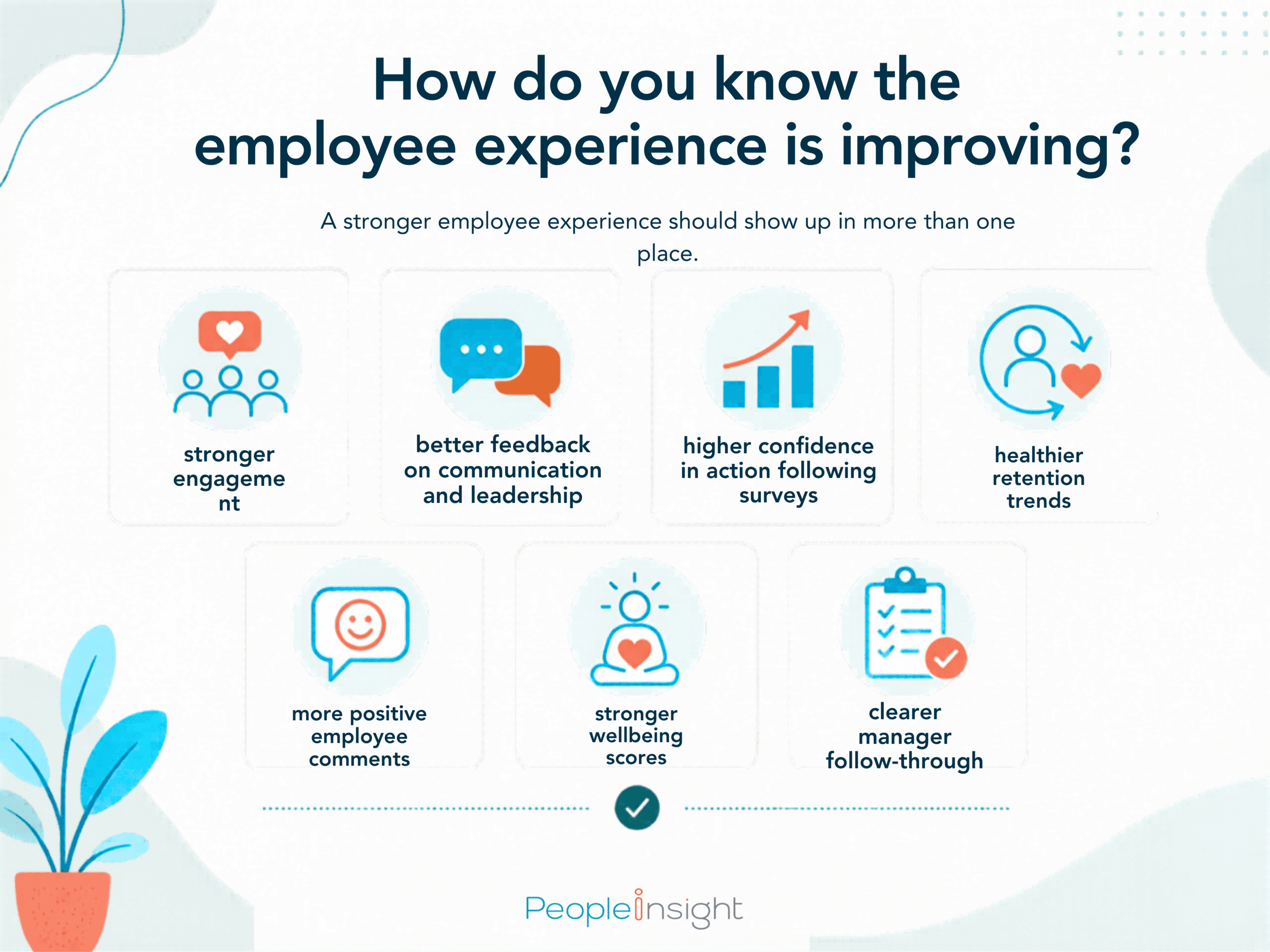
    How do you know the employee experience is improving?

    A stronger employee experience should show up in more than one place.

    How do you know the employee experience is improving

    Useful signs include:

    • stronger engagement
    • better feedback on communication and leadership
    • higher confidence in action following surveys
    • healthier retention trends
    • more positive employee comments
    • stronger wellbeing scores
    • clearer manager follow-through

    Improvement is usually most credible when it can be seen across both quantitative scores and qualitative feedback over time.

    Where the feedback loop comes in

    Employee experience improves most when feedback leads somewhere visible.

    That is why the employee feedback loop matters so much to modern organisations. If employees repeatedly share feedback but do not see meaningful change, the experience of listening itself becomes weaker.

    A stronger employee experience is built when organisations:

    • ask for feedback
    • understand what it means
    • act on the priorities
    • communicate what is happening
    • reinforce progress over time

    Improve employee experience with People Insight

    Employee experience is not a soft extra. It is the day-to-day reality of work, and it has a direct effect on engagement, retention, wellbeing and performance.

    At People Insight, we help organisations understand and improve employee experience through employee surveys, lifecycle listening, Prism-powered insight and practical consultancy support. That helps leaders see what employees are actually experiencing and act on what matters most.

    Want to improve employee experience in a way that is measurable, meaningful and built around your people? Get in touch to learn how People Insight can help.

    FAQs about employee experience

    What is employee experience?

    Employee experience is the overall experience an employee has with an organisation across the full employee journey, including recruitment, onboarding, communication, development, wellbeing and exit.

    Why is employee experience important?

    Employee experience affects engagement, retention, wellbeing, trust, productivity and how employees feel about working in the organisation.

    What is the difference between employee experience and employee engagement?

    Employee experience is the wider journey and environment employees go through. Employee engagement is the emotional commitment and motivation that often results from that experience.

    What shapes employee experience?

    Employee experience is shaped by leadership, line managers, communication, recognition, development, workload, wellbeing, culture and the practical systems employees use every day.

    How do you measure employee experience?

    You can measure employee experience through employee surveys, pulse surveys, lifecycle surveys, comments, benchmark data, people analytics and wider workforce trends such as retention and absence.

    How do you improve employee experience?

    You improve employee experience by listening properly, interpreting feedback with context, prioritising what matters most, supporting managers, communicating clearly and acting visibly over time.

    How does Prism help with employee experience?

    Prism helps organisations improve employee experience by identifying where focus is most needed, explaining what sits behind the data and supporting clearer action planning.

    How can People Insight help with employee experience?

    People Insight helps organisations improve employee experience through employee surveys, lifecycle listening, Prism-powered analysis and expert support that turns feedback into meaningful action.