


















Higher Education case studies:

King’s College London: Turning results into action with outstanding comms 

How King’s College improved engagement with clear survey communications

King’s College London Turning results into action with outstanding comms 

    Watch the case study

    King’s College and their dedication to staff engagement

    King’s College London is one of the UK’s most prestigious universities, with a long-standing commitment to listening to its people and improving the employee experience.

    King’s has worked with People Insight to strengthen its staff survey approach, build a clearer employee experience strategy and support leaders and managers with insight they can use. Their engagement work is underpinned by the People Insight employee survey platform, which helps teams collect feedback, understand results and turn insight into action.

    But successful employee listening is not only about gathering data. The real value comes from helping managers understand what the data means, giving them confidence to respond and making sure employees can see that their feedback leads somewhere.

    That was the focus of this project: helping King’s connect survey results, manager guidance, internal communication and action planning into one clearer experience.

    You might also enjoy: King’s College London: A new era of engagement 

    Understanding the importance of great survey communications

    King’s understands that the success of a staff survey is not measured only by response rates or scores. A strong survey programme also depends on what happens after the results are shared.

    Employees need to know their feedback has been heard. Managers need practical guidance on how to interpret results and talk to their teams. Senior People teams need a consistent way to support action across a large and complex organisation.

    That is where People Insight’s combination of platform and service support made a difference.

    Working closely with King’s, we aligned survey communications, dashboard guidance and internal resources so managers had a clearer route from insight to action. The aim was to create a joined-up experience where managers felt supported, employees felt listened to and survey results could be translated into focused next steps.

    By combining an intuitive employee survey platform with hands-on communications and consultancy support, King’s could make the survey process easier to understand and more useful for managers.

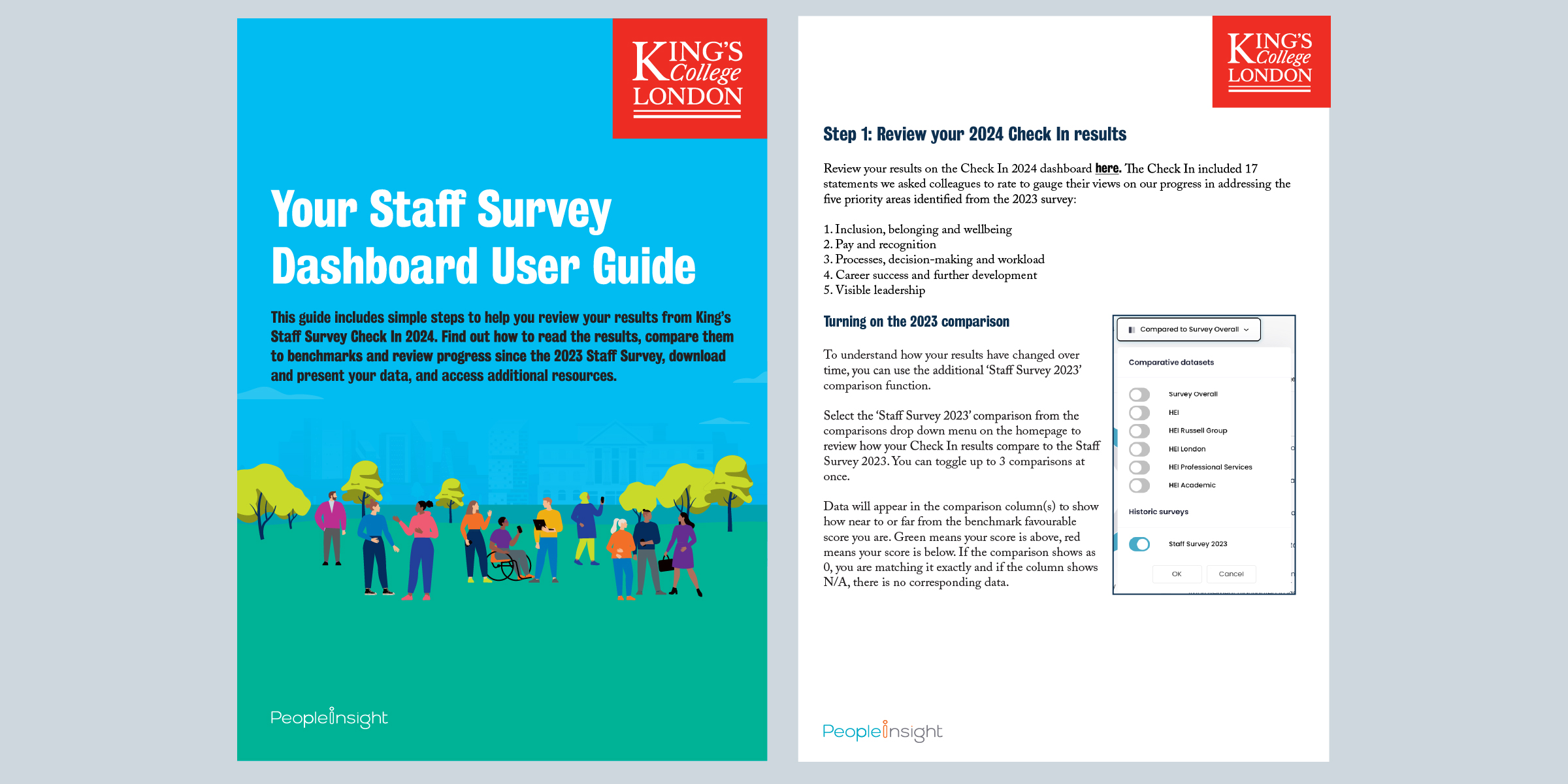
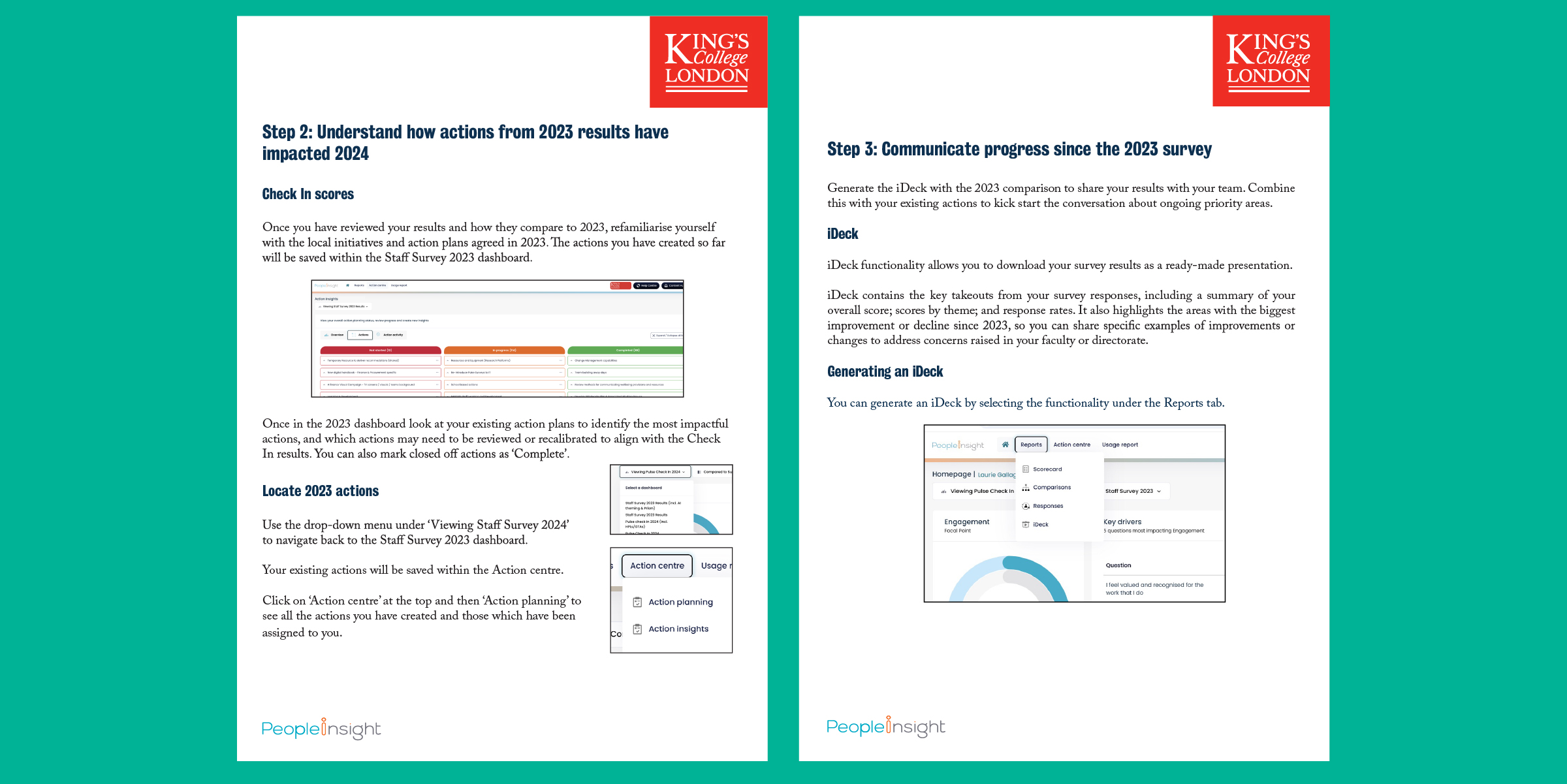
    King's cover page and step 1

    The challenge: an effective way to support managers and drive results

    King’s latest pulse survey was designed to help managers across the university identify opportunities, have better conversations and drive improvement within their teams.

    The challenge was not a lack of insight. The challenge was helping managers use that insight confidently and consistently.

    King’s had introduced a new survey platform and updated dashboard features. Some managers were returning to survey data after a long gap, while others were using an employee survey platform for the first time. To make the most of the results, managers needed clear guidance that explained what to look at, where to focus and how to move from data to action.

    King’s needed a simple, clear and visually engaging guide to help managers:

    • Understand how to access and interpret their results
    • Compare new survey data to previous results
    • Reflect on progress and adapt their action plans
    • Communicate effectively with their teams

    For People Insight, the opportunity was to make the platform easier to use, reduce uncertainty for managers and support a more consistent action-planning experience across the university.

    The solution: a step-by-step guide to encourage action

    To bridge this gap, People Insight’s dedicated survey Communications team created a bespoke, step-by-step guide to help King’s managers confidently explore their results, take meaningful action and continue building engagement in their teams.

    The guide was practical, focused and fully aligned with the survey dashboard. It walked managers through key actions such as viewing year-on-year comparisons, identifying high and low scoring areas, reviewing existing action plans and preparing for follow-up conversations with their teams.

    This was not simply a set of instructions. It was a manager enablement tool, designed to make survey results feel clearer, more accessible and easier to act on.

    By combining platform guidance with communication best practice, People Insight helped King’s create a more joined-up experience for managers. The guide reduced ambiguity, encouraged consistency and made it easier for managers to use survey insight as the starting point for meaningful conversations.

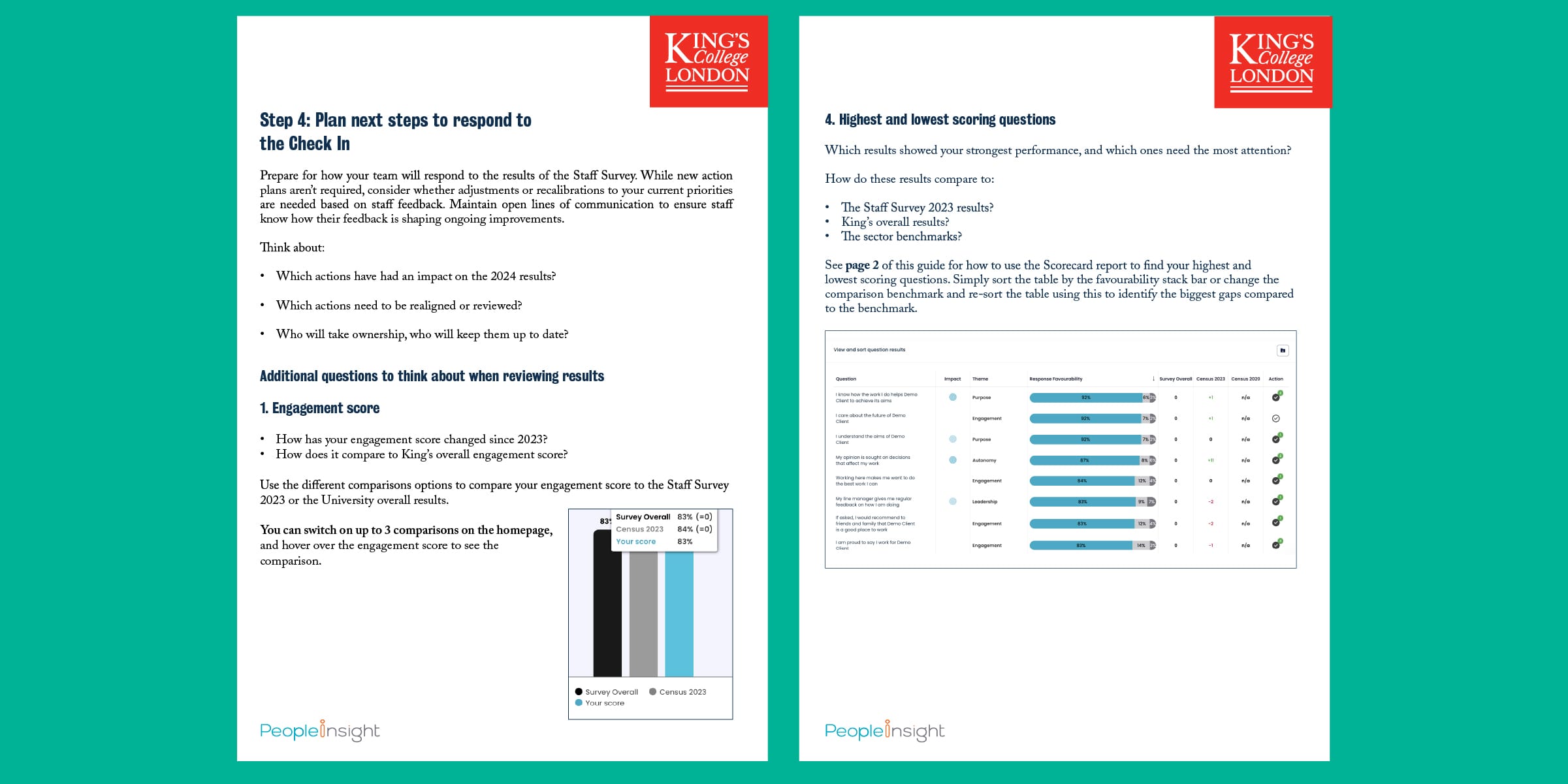
    King's user dash guide

    The journey and our approach

    Our approach to this PDF guide was collaborative from the start. Working closely with the King’s College People & Culture team, People Insight’s survey consultants refined every detail of the guide to ensure it met the needs of managers and aligned with the university’s goals.

    The project brought together several People Insight strengths: survey expertise, platform knowledge, communications support and practical action-planning guidance.

    Content first

    We started by drafting clear, plain-English instructions alongside annotated screenshots. This helped managers understand how to interact with their new dashboard, compare new and historic data and manage their action plans.

    The content was designed to reduce cognitive load. Managers did not need to interpret the platform alone or work out where to begin. The guide gave them a clear sequence to follow, from accessing results to choosing priorities and preparing team conversations.

    Design and development

    We then designed a clean, intuitive layout. Colour highlights were used to draw attention to key actions, icons helped break up the text and content was organised into bite-sized sections for easy scanning.

    This design approach made the guidance easier to use in the flow of work. Managers could quickly find what they needed, follow the right steps and return to the guide when preparing for team discussions.

    Stakeholder collaboration

    The guide went through several review rounds with King’s stakeholders to fine-tune both language and visuals. Each version brought the content closer to what managers needed: practical, trustworthy and easy to follow.

    This collaborative approach helped make sure the final guide reflected King’s internal language, priorities and ways of working, while still benefiting from People Insight’s experience of supporting employee listening programmes across higher education.

    Platform integration

    Alongside the PDF guide, People Insight also built an easy and convenient “Guidance on next steps” page directly into the King’s survey dashboard.

    This gave managers access to extra resources, templates and support tools from within the platform itself. Instead of separating survey data from manager guidance, King’s could bring everything together in one place.

    This is a key strength of People Insight’s approach. The platform does not just show results. It helps organisations support the next step, giving managers clearer routes into interpretation, communication and action planning.

    King’s College three-step guide to employee survey results success

    At the centre of the support toolkit is the three-step guide, designed to give every manager a clear route from insight to action.

    Step 1: Access and navigate your dashboard

    Step 1 instructed users on how to toggle to the historic survey comparison view, allowing them to see this year’s results side by side with last year’s scores. This made it easier to spot changes over time, identify trends and understand where progress had been made.

    The guide also explained how to sort responses to highlight the three highest and three lowest scoring areas. This helped managers quickly focus on what was working well and where more attention might be needed.

    From there, managers were guided to review any existing action plans from previous surveys, with clear instructions on how to carry over relevant actions to the current dashboard, mark completed items or add new ones if appropriate.

    This step laid the groundwork for thoughtful reflection and confident navigation of the People Insight survey platform.

    Step 2: Know where to focus and which questions to ask

    Next, the guide helped managers interpret their results in context and decide where to focus.

    It encouraged them to recognise areas that had improved and explore areas that had declined or remained static. The instructions highlighted how to review overall engagement scores, demographic insights and the top and bottom scoring questions.

    The guide also included prompts taken from the HR Business Partner presentation, designed to get managers thinking more critically about their data. This included questions like:

    • What’s changed since last year?
    • Why might that be?
    • How do different groups compare?

    This step helped managers move beyond simply reading scores. It gave them a clearer way to explore what might be driving employee sentiment and prepare for more meaningful discussion with their teams.

    Step 3: Communicate with your team

    This very important step focused on sharing results with employees in an open and constructive way.

    The guide walked managers through how to use the survey communication templates created by King’s to update their teams, making it easier to deliver a consistent message across the university. It also encouraged managers to use the new infographic to visualise results and keep communication clear and engaging.

    To provide extra support, the guide pointed managers to opportunities to book a one-to-one session with a People Insight consultant for more tailored advice. This helped managers move from dashboard interpretation to practical, confident action.

    Finally, this step reminded managers to clearly outline what would happen next, whether that involved following up on specific actions, planning future surveys or continuing the conversation in team meetings.

    This final stage brought the process full circle and helped managers close the feedback loop with clarity and confidence.

    This three-step approach made survey results feel less abstract and more actionable. Managers could quickly spot trends, consider next steps and start conversations with more confidence and enthusiasm.

    Step 4 King's user dash guide

    Results and impact

    The guide was positively received across the King’s People & Culture team, with feedback highlighting its clarity, tone and ease of use.

    Managers appreciated the clear layout and practical tips, while internal teams valued the consistency across the PDF guide, survey dashboard and presentations. The project helped create a more coherent experience for managers, connecting data, guidance and communication in one place.

    Importantly, the guide helped demystify the survey process and gave managers a framework to follow, regardless of their previous experience with survey results.

    By making results easier to understand and act on, King’s is seeing a more confident and engaged management community. The project also shows the value of combining an employee survey platform with specialist communications and consultancy support.

    People Insight helped King’s do more than collect survey feedback. We helped make the next step clearer.

    Actions: What happened next

    Clearer communication set the stage for success, but what happened once managers began turning survey insights into action?

    Looking at the actions taken in 2023 alongside wider corporate initiatives, the 2024 check-in survey shows a clear link: when action was visible, employees noticed.

    This is one of the most important lessons from employee listening. Action only builds trust when employees can see progress, understand what has changed and connect improvement activity back to their feedback.

    Improvements across specific survey items

    • Opportunities to learn and grow: Scores on this item rose by six percentage points. Alongside local initiatives, King’s invested in apprenticeships, new leadership programmes, specialist masterclasses, LinkedIn Learning playlists and the Professional Services Career Mentoring Scheme. These initiatives gave employees clearer pathways to development and practical tools to build their skills.
    • Career development aspirations: This question climbed by five percentage points. Mentoring schemes, secondment opportunities and clearer promotion frameworks were supported by corporate actions such as confidential career coaching and a broader push for progression opportunities. Together, these changes signalled that career growth was being taken seriously at every level.
    • Feeling valued and recognised: This item rose by five percentage points. Locally, employees saw recognition through appreciation dinners, awards, personal letters of thanks and improved Performance Development Reviews. At corporate level, recognition was reinforced through wider pay and reward strategies, helping to make acknowledgement of contribution more visible and consistent.
    • Pay perception: The largest increase was seven percentage points. Here the driver was corporate: pay rises across the institution directly addressed concerns about competitiveness. While local activity had a role, the pay awards were the change employees felt most clearly in their day-to-day lives.

    These improvements show how staff survey results can support targeted action when insight is made clear, managers are supported and communication helps employees understand what has changed.

    Where actions did not land as expected

    Not every area improved. The question relating to fairness and equality fell by two percentage points, despite 12 actions. These included EDI workshops, pay gap transparency, anti-bullying and harassment protocols, disability inclusion measures and the Interview Panel Diversification Scheme.

    This suggests that taking more actions does not always guarantee stronger outcomes. Possible reasons include:

    • Lagging effect: Some initiatives take time to show measurable impact.
    • Visibility gap: Employees may not have seen or connected actions to their feedback.
    • Expectation mismatch: Announcing multiple actions can raise expectations that are difficult to meet quickly.

    This is where strong survey communication becomes essential. It helps organisations explain what is happening, show progress over time and keep the feedback loop open, even when results take longer to shift.

    Quality and relevance over quantity

    The results underline that:

    • Quality, relevance and visibility of actions matter more than the number taken.
    • Even one well-targeted intervention, such as pay rises, can significantly shift sentiment.
    • Where initiatives are less visible or take longer to show results, scores may plateau or decline.

    For higher education institutions, this is an important reminder. Employee survey action planning should not become a box-ticking exercise. The most effective action plans are focused, relevant and visible to the people they are designed to support.

    People Insight helps organisations make this shift by combining survey technology, expert interpretation, manager guidance and communication support. That means managers are not left alone with results. They have the tools, context and support they need to take action with confidence.

    Supporting managers to act meaningfully

    Local managers remain central to turning survey insights into action plans.

    Their efforts are most effective when aligned with corporate initiatives that set the tone, such as the introduction of new career development pathways or wellbeing days. Managers need to understand what their local results are showing, how those results connect to wider organisational priorities and where they can make the most meaningful difference.

    Tools like Prism add organisational context to local survey results, helping managers understand the “why” behind employee sentiment and prioritise the most relevant next steps.

    By connecting corporate-level strategy with local follow-through, managers can better demonstrate progress in ways that employees can see, feel and trust. This transforms action planning from a compliance exercise into a driver of meaningful change.

    People Insight supports this by giving organisations both the platform and the expert guidance to move from listening to action. For King’s, that meant helping managers navigate results, communicate clearly and focus on action that could support meaningful improvement.

    What’s next for King’s College and their engagement journey?

    This is just the start of a refreshed approach to employee engagement at King’s.

    With a more structured platform in place, the university now has the ability to track change over time, compare across departments and support managers in a consistent way.

    Moving forward, King’s plans to continue building engagement momentum by:

    • Holding regular pulse surveys
    • Reviewing and evolving their action-planning process
    • Supporting managers with tailored training and coaching
    • Using employee sentiment insights to guide their People & Culture strategy

    By building these habits now, King’s is laying the foundation for long-term improvement.

    Their work also shows what strong employee listening looks like in practice: a clear platform, practical manager guidance, visible communication and a commitment to turning feedback into action.

    Get your higher education staff survey started today

    If you’re working in higher education and want to strengthen engagement across your organisation, People Insight can help you build a higher education staff survey programme that goes beyond data collection.

    Our employee survey platform, communications expertise and hands-on consultancy support help universities listen with confidence, understand what employees are saying and turn feedback into meaningful action.

    We can support you with:

    • Higher education staff surveys
    • Pulse surveys
    • Survey communications
    • Manager guidance
    • Dashboard support
    • Action planning
    • Employee engagement strategy
    • Insight interpretation and consultancy

    Get in touch to discuss how our team can help you create a survey experience that supports managers, builds trust and makes results easier to act on.

    FAQs about Kings College and their survey comms

    How can universities encourage managers to act on staff survey results?

    Universities can encourage managers to act on staff survey results by making the data easy to understand, providing clear dashboard guidance and giving managers practical tools for team conversations. People Insight supports this through an employee survey platform, action-planning tools, communications guidance and expert consultancy.

    Why are survey communications important in higher education?

    Survey communications help employees understand why feedback is being collected, what the results show and what action will happen next. In higher education, where teams are often large, distributed and complex, clear communication helps build trust and keeps employees connected to the feedback process.

    How does People Insight support higher education staff surveys?

    People Insight supports higher education staff surveys through a combination of survey technology and expert service. This includes survey design, platform setup, dashboard reporting, communications support, consultancy, action planning and manager guidance.

    What makes employee survey results more actionable?

    Employee survey results become more actionable when managers can see the key themes, understand what is driving sentiment and identify focused next steps. Clear dashboards, year-on-year comparisons, action-planning tools and expert guidance all help managers move from insight to action.

    How can staff survey action planning improve employee engagement?

    Staff survey action planning can improve employee engagement when actions are relevant, visible and connected to what employees have said. The most effective action plans focus on the areas that will make the biggest difference and clearly communicate progress back to employees.