



















Blogs:

Employee survey participation: what low participation really tells you

… and what to do about it

Employee survey participation: what low participation really tells you

    A quick insight: Low employee survey participation is not just a reporting issue. It can point to something deeper: weak trust, low psychological safety and a growing belief that speaking up will not change much. Once that pattern takes hold, the quality of your insight slips and it becomes even harder to rebuild confidence.

    Most organisations know that low participation in an employee survey is not ideal. Fewer people taking part means fewer voices represented, less confidence in the findings and more caution when turning insight into action.

    But the real problem runs deeper than sample size. When employee survey participation begins to fall, it often tells you something important about the experience of giving feedback in your organisation. People may be disengaging from the survey itself, but they may also be disengaging from the idea that their views will be heard fairly, interpreted well and acted on meaningfully.

    That is where the risk grows. Low participation does not just weaken your data. It can gradually weaken trust in the whole listening process.

    Related: 10 ways to improve your employee survey response rate

    What really lies behind poor employee survey participation?

    It is tempting to treat participation as a simple delivery metric. Did enough people complete the survey? Was the invitation clear? Were reminders sent? Did we hit a reasonable response rate for our sector?

    Those questions matter, but they only tell part of the story.

    Strong employee survey participation gives you a broader, more reliable picture of how people are experiencing work. It helps you understand patterns across teams, identify priorities with more confidence and make decisions that reflect more than the views of the most engaged or most visible groups.

    When participation drops, that picture becomes less stable. You are more likely to hear from those who already feel comfortable speaking up, those with strongly positive or negative views, or those who simply have more time and energy to respond. The people you most need to hear from may be the ones least represented in the results.

    That creates a serious challenge for leaders. The survey still produces numbers, dashboards and apparent themes, but the insight underneath may be less complete than it looks.

    Low participation can lead to underrepresented insight

    A survey does not become useless the moment participation falls. But it does become harder to interpret with confidence.

    If certain populations are missing or responding in much lower numbers, you may struggle to answer important questions clearly. 

    • Are particular teams staying quiet?
    • Are more pressured employees opting out?
    • Are people with low trust in leadership choosing not to take part at all?

    These gaps shape the story the data tells. If the least heard groups are absent from the results, leadership may come away with a cleaner, calmer or more positive picture than reality supports.

    That is one reason low employee survey participation should never be brushed aside as a communications issue alone. It can distort organisational understanding in ways that make action less targeted and less effective.

    Low participation can reduce confidence in action planning

    Action planning depends on confidence in the data. Leaders and managers need to believe they are responding to a fair reflection of employee experience, not a partial snapshot.

    When participation is weak, that confidence starts to wobble. Teams may question whether the findings are representative. Senior leaders may hesitate over which issues to prioritise. Managers may find it harder to turn results into credible local conversations.

    That hesitation can slow progress right at the point where follow-through matters most.

    And once action becomes slower, more cautious or less visible, employees may take that as proof that the survey did not really achieve anything. Participation suffers again next time. Trust slips further. The cycle tightens.

    The harsh reality: low employee survey participation is often a trust signal

    To understand falling participation properly, it helps to look beyond process and towards culture.

    Employees do not decide whether to take part in a survey in isolation. They make that choice in the context of what they have seen before. Have previous surveys led to change? Do leaders communicate openly about results? Do managers handle feedback well? Does the organisation genuinely invite honesty, or only safe and polished versions of it?

    That broader context shapes participation far more than many organisations admit.

    If people believe surveys are worthwhile, confidential and followed by visible action, participation tends to feel like a useful contribution. If they believe surveys disappear into a corporate black hole, or that radical candour carries risk, participation can begin to fall away.

    Declining participation can reflect low candour

    One of the clearest dangers in employee listening is assuming silence means stability.

    Sometimes people do not respond because they are busy. Sometimes they skip a survey because timing was poor. But sometimes they stay silent because they do not see the point in speaking, or because they are not convinced it is safe to do so.

    That is where low participation starts to overlap with candour.

    In organisations where openness feels constrained, employees may self-censor before they ever reach the comment box. They may answer cautiously or they may decide not to participate at all. That makes the absence of feedback just as significant as the feedback you do receive.

    When that pattern develops, survey results can become more guarded over time. Not because the organisation is necessarily improving, but because fewer people are willing to express what they really think.

    Psychological safety plays a bigger role than many teams expect

    Psychological safety is often discussed in relation to meetings, team dynamics and leadership behaviour. It also has a direct relationship with employee survey participation.

    If employees trust that they can speak honestly without being dismissed, exposed or judged, they are more likely to contribute. If they are uncertain about confidentiality, unclear on who will see the data or unconvinced that leaders want the full truth, participation can quickly drop.

    This is especially important in teams where trust in local management is mixed. Employees do not only respond to the survey platform or the comms plan. They respond to the lived reality of how feedback is received day-to-day.

    That means participation levels can sometimes reveal something important about local culture long before other indicators do.

    The vicious cycle: when low participation makes survey data harder to trust

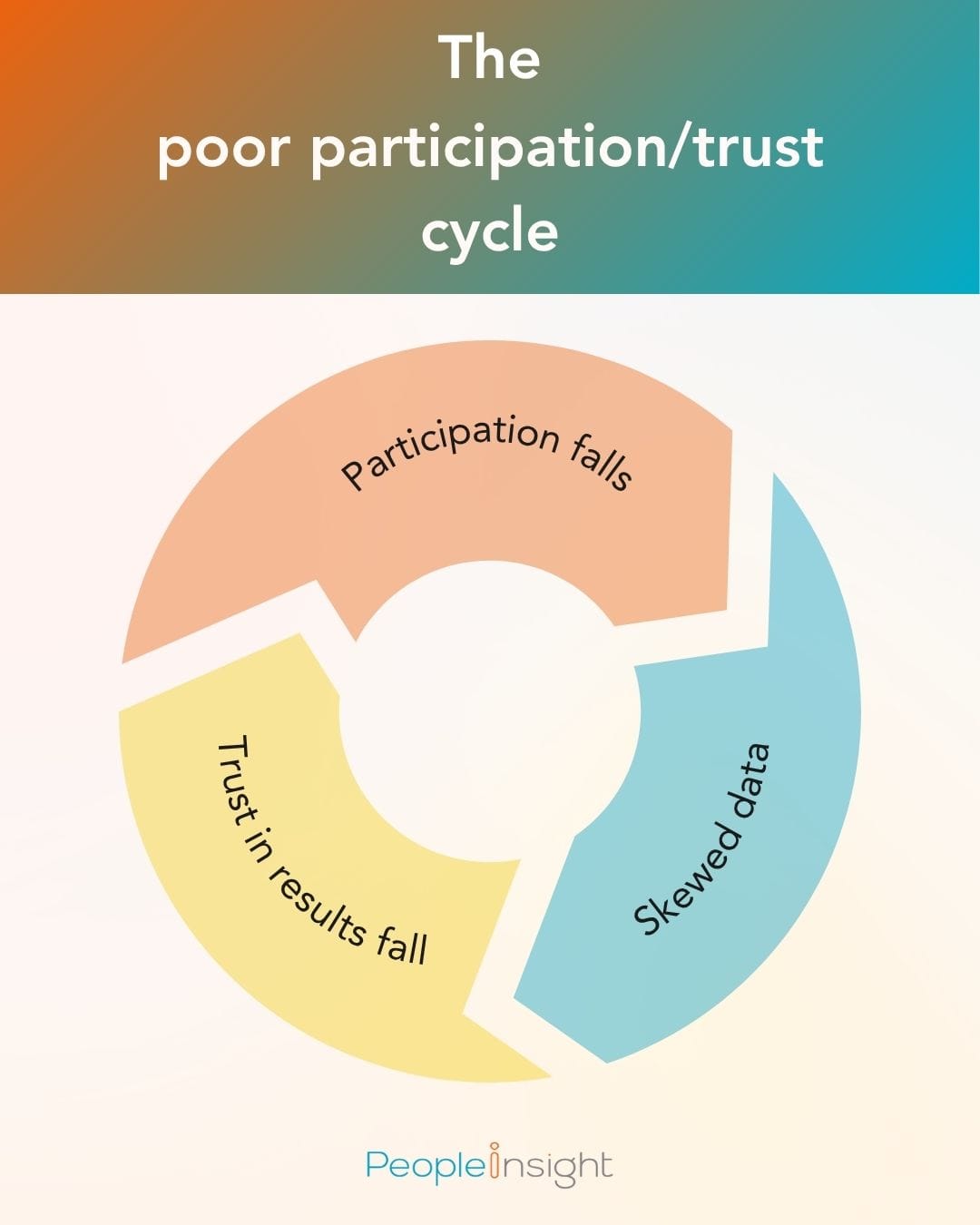
    the trust participation cycle

    There is a difficult loop at the heart of this issue.

    When participation falls, the data becomes less representative. As the data becomes less representative, leaders and employees alike may place less trust in the results. And as trust in the results weakens, future participation often falls further.

    This is how organisations can end up stuck in a listening cycle that looks active on the surface but feels fragile underneath.

    They continue surveying, they continue producing reports, but confidence in the process steadily erodes.

    That erosion can show up in several ways:

    • employees feel the survey does not reflect what people really think
    • leaders question whether the findings are strong enough to act on
    • managers avoid difficult conversations because they are unsure how reliable the results are
    • future surveys are met with more scepticism and lower energy

    At that point, improving participation is no longer just about getting better completion rates, but about rebuilding belief in the value and integrity of listening itself.

    Poor follow-through makes the cycle worse

    If there is one factor that most often pushes this cycle along, it is weak follow-through.

    Employees are far more likely to take part in future surveys when they can see what happened after the last one. Not every issue can be solved quickly. Not every request can be met. But visible acknowledgement, prioritisation and progress make a major difference.

    Without that, survey participation starts to feel extractive. People are asked to give their views, but see little evidence that those views shape anything meaningful.

    That is one reason action planning matters so much. Listening only becomes credible when people can see where it leads.

    How to improve employee survey participation in a meaningful way

    If low participation reflects deeper trust issues, then the answer cannot be limited to more reminders and better launch emails. Those things still help, but they are not enough on their own.

    To improve employee survey participation sustainably, organisations need to strengthen the conditions that make honest feedback feel worthwhile.

    Make confidentiality clear and credible

    Employees need to understand how their feedback will be handled, who can see it and where anonymity thresholds apply.

    This should be explained simply, consistently and more than once. If your survey process is confidential, say so clearly. If certain cuts of data will not be shown below a minimum threshold, explain why. If comments are reviewed in a structured and responsible way, outline that process.

    Confidence grows when people know the rules and trust they will be upheld.

    Related: People Insight’s approach to confidentiality

    Show what changed last time

    One of the strongest drivers of future participation is visible proof that feedback led somewhere.

    That means communicating what you heard, what you are prioritising and what is changing as a result. It also means being honest about what cannot change immediately and why, usually through things such as You Said, We Did campaigns.

    Organisations sometimes worry that this kind of communication will draw attention to unresolved problems. In practice, the greater risk is saying too little and leaving employees to assume nothing happened.

    Equip managers to handle feedback well

    Line managers often sit at the point where survey results either gain traction or lose it. They are expected to discuss findings, respond constructively and turn insight into action with their teams.

    If they are not given the time, confidence or tools to do that properly, the employee experience of survey follow-through becomes inconsistent. Some teams see thoughtful action. Others see very little.

    That inconsistency affects participation over time. Employees quickly notice whether feedback conversations are real, respectful and useful, or whether they are rushed and performative.

    Treat participation as insight, not just a KPI

    A falling participation rate should prompt deeper questions, not just operational fixes.

    Which groups are opting out? Where is trust weakest? Are comment levels also changing? Is candour dropping alongside participation? Are certain managers or functions seeing a sharper decline?

    These are valuable clues. Looked at properly, participation trends can tell you a great deal about how your listening culture is functioning.

    Better employee survey participation starts with better listening

    The most effective organisations do not separate participation from trust, culture and action. They understand that all three are linked.

    People take part when they believe their voice will be handled with care. They speak honestly when the environment feels safe enough for candour. They keep engaging when they can see that feedback leads to thoughtful, visible follow-through.

    That is why employee survey participation deserves more attention than it often gets. It is not only a measure of how many people responded. It can be an early signal of whether your listening approach still feels credible to the people you most need to hear from.

    And if participation is falling, the answer is not simply to ask more loudly.

    It is to listen better, respond more clearly and rebuild confidence in what employee feedback is actually for.

    How People Insight helps organisations build trust in employee listening

    Improving employee survey participation is not just about running a smoother survey. It is about creating a listening experience people trust.

    That means helping organisations communicate clearly, protect confidentiality, interpret results carefully and turn insight into action in ways employees can actually see.

    People Insight supports that full picture. Our platform helps organisations listen at scale, understand what sits behind the results and move into meaningful action planning with more confidence. And with Prism built into the experience, teams can work through themes, comments and priorities faster, while keeping human judgement firmly at the centre.

    When listening feels credible, participation has a stronger foundation. And when people can see that feedback leads somewhere useful, trust becomes easier to build and easier to keep.

    Want to strengthen employee survey participation by building more trust in the process? Get in touch to learn how People Insight helps organisations listen clearly and act with confidence.

    FAQs about employee survey participation

    A quick run down on all you need to know

    What is employee survey participation?

    Employee survey participation refers to the proportion of employees who choose to take part in a survey. It is usually measured as a percentage of the invited population and is often used as an indicator of how representative the results may be.

    Why is low employee survey participation a problem?

    Low participation can make survey data less representative, especially if certain groups are underrepresented in the results. It can also point to deeper issues such as low trust, weak follow-through, poor communication or low psychological safety.

    Does low participation always mean employees do not trust the survey?

    Not always. Timing, workload, survey length and communication quality can all affect participation. But if participation is falling over time, or if some groups are consistently less likely to respond, trust and candour are worth examining closely.

    How does psychological safety affect employee survey participation?

    When employees feel safe speaking honestly, they are more likely to complete surveys and share candid feedback. If they fear judgement, exposure or negative consequences, they may hold back or avoid participating altogether.

    How can organisations improve employee survey participation?

    The strongest approaches combine clear communication, credible confidentiality, visible follow-through and better manager support. Participation tends to improve when employees believe their feedback is safe to share and likely to lead to meaningful action.