



















Blogs:

How to communicate survey results effectively

Including a 6-step plan and 6 common mistakes

How to communicate survey results effectively

    A quick insight: Effective employee engagement survey communication does more than share a set of scores. It helps employees understand what was heard, what matters most and what will happen next. When survey results are communicated clearly and followed by visible action, organisations build trust, strengthen participation and make employee listening far more credible.

    If employees take the time to share honest feedback, they want to know it has been heard, understood and taken seriously. If survey results are poorly communicated, unclear or left to sit in silence, trust can drop quickly. Participation may suffer next time, and employees may start to question whether speaking up is worth it at all.

    That is why employee engagement survey communication can make such an incredible difference to the success of any employee listening programme.

    This guide explains how to communicate survey results effectively, with a practical structure you can use to support stronger trust, better understanding and more meaningful follow-through.

    Related: Check out how King’s College London turned survey results into action with amazing survey comms

    What is employee engagement survey communication?

    Employee engagement survey communication is the process of explaining the survey, sharing the results and keeping employees informed about what happens next.

    It includes:

    • preparing employees for the survey
    • explaining why it matters
    • sharing the survey results clearly
    • supporting managers to discuss findings
    • communicating actions and progress over time

    In other words, employee engagement survey communication is what helps employees move from giving feedback to seeing how that feedback is used.

    Related: Post-survey action planning: your complete guide

    Why employee engagement survey communication matters for you

    Communicating survey results well is one of the most important parts of any listening programme.

    It helps employees:

    • understand what the survey revealed
    • see that leadership is paying attention
    • feel more confident that their feedback mattered
    • understand what the organisation will do next
    • stay engaged with the process over time

    Without strong communication, even a well-run survey can lose credibility.

    People Insight’s benchmark data highlights why this matters. In our 2025 benchmark data:

    • only 53% of employees believe action will be taken as a result of the survey
    • only 60% say senior leaders make the effort to listen to staff
    • only 53% say people communicate openly regardless of position or level

    That is a clear signal. Many employees still do not feel fully confident that listening leads to visible action or open communication. Strong employee engagement survey communication helps close that gap.

    What does effective survey communication look like?

    Effective survey communication is clear, honest and consistent.

    It should help employees understand three things:

    • what was heard
    • what the organisation is doing with that insight
    • what they can expect next

    That means communication should not stop at one high-level update. The strongest employee engagement survey communication plans create a rhythm of updates that helps employees follow the journey from feedback to action.

    This is also where the employee feedback loop becomes so important. If you want people to keep taking surveys seriously, they need to see that feedback leads somewhere.

    And if you want employees to trust the next survey, it helps when they can clearly see how earlier survey results were understood and used.

    A practical 6-step employee engagement survey communication plan

    Below is a tried-and-tested six-step approach to help you communicate survey results effectively and keep trust high after the survey closes. It’s used by our HR experts every day to help companies boost survey participation and bring about real, meaningful improvement.

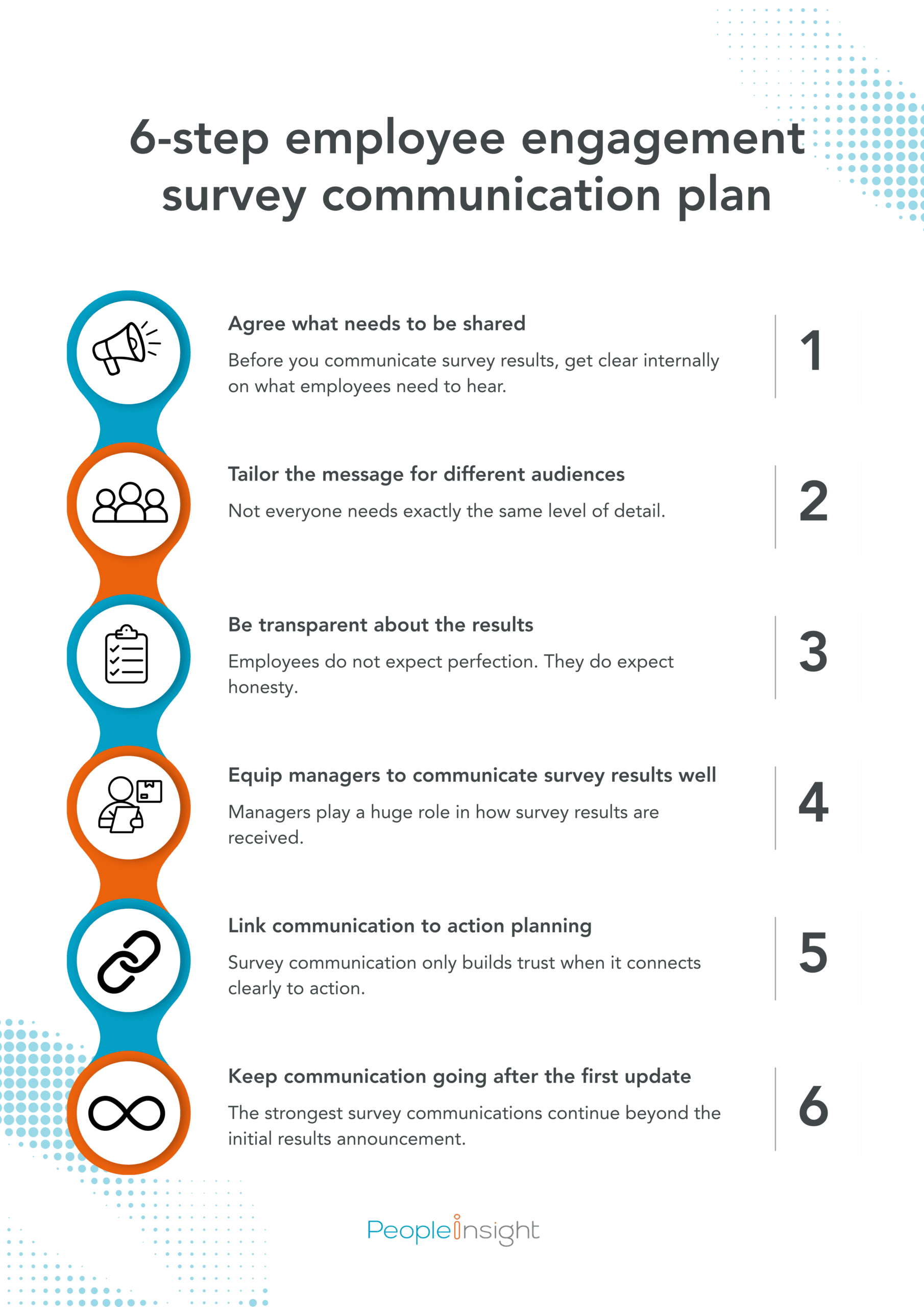
    6-step employee engagement survey communication plan

    1. Agree what needs to be shared

    Before you communicate survey results, get clear internally on what employees need to hear.

    That usually includes:

    • the main themes from the results
    • where the strongest and weakest scores sit
    • any clear priorities emerging from the data
    • what the organisation is still working through
    • what can and cannot be acted on immediately

    This matters because mixed or inconsistent messages from different leaders can create confusion. A clear internal view makes it much easier to communicate externally in a way that feels coherent and credible.

    This is where survey consultants can be especially useful. Good support helps organisations move from raw data to a clear, shared narrative about what the results really mean.

    2. Tailor the message for different audiences

    Not everyone needs exactly the same level of detail.

    Employees usually need a clear, accessible summary of the results and what happens next. Managers often need more detail so they can discuss results with their teams. Senior leaders may need a more strategic view, linked to wider priorities, risks and decisions.

    A strong employee engagement survey communication plan should therefore include:

    • an organisation-wide summary
    • manager-specific talking points
    • local team discussions where appropriate
    • leadership messaging that reinforces accountability

    At King’s College London, stronger survey communications and clearer manager support helped results land more effectively and gave teams a better structure for discussing what needed to happen next.

    3. Be transparent about the results

    Employees do not expect perfection. They do expect honesty.

    Good survey communications should acknowledge both strengths and weaknesses. If leaders only highlight the good news, the message can feel selective or defensive. If results are difficult, it is usually better to say so clearly and explain how the organisation plans to respond.

    That means:

    • sharing the most important themes, not just polished headlines
    • recognising where the organisation is doing well
    • acknowledging where improvement is needed
    • avoiding overpromising
    • being honest about what will take time

    Transparency helps strengthen credibility. It shows employees that survey responses are being treated seriously rather than filtered into something more comfortable.

    If you need a stronger structure around this, your wider survey communications approach should support not just launch messaging, but the way results and follow-up are handled afterwards too.

    4. Equip managers to communicate survey results well

    Managers play a huge role in how survey results are received.

    Employees are far more likely to trust the process when their line manager can explain:

    • what the results mean
    • how their team compares or connects to the bigger picture
    • what can be influenced locally
    • what should be escalated or explored further
    • what the next discussion will look like

    That is why employee engagement survey communication should always include manager support materials, such as:

    • briefing notes
    • FAQs
    • slide summaries
    • team discussion guides
    • suggested wording for difficult conversations

    At Croydon College, strong communication and visible engagement around the survey helped support participation and reinforced a more open, involving culture. That same principle matters after the survey too. Good manager communication helps results feel more relevant, more credible and more actionable.

    5. Link communication to action planning

    Survey communication only builds trust when it connects clearly to action.

    Employees need to know not just what the results were, but what will happen as a result. That does not mean you need to announce every action immediately. It does mean you should show that the organisation is moving into a clear next phase.

    This is where a visible post-survey action plan makes a real difference.

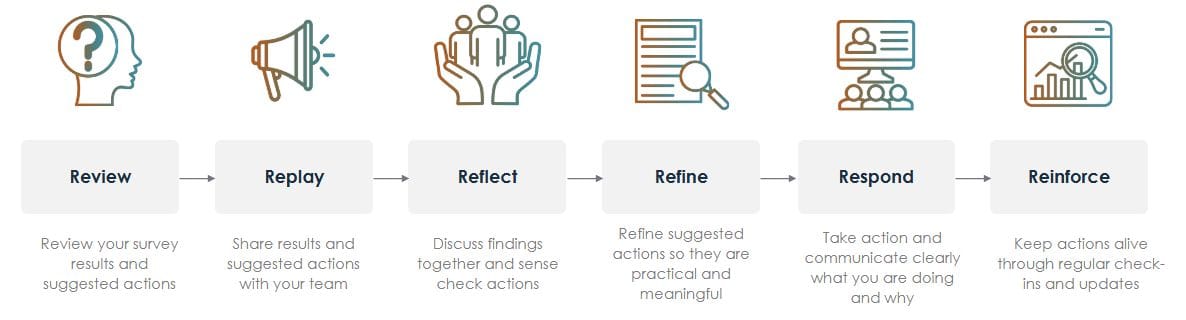
    At People Insight, our 6 Rs framework helps structure that next phase:

    6 Rs action planning

    • Review
    • Replay
    • Reflect
    • Refine
    • Respond
    • Reinforce

    That matters for survey communication because employees need to see that the results are being reviewed carefully, replayed clearly, refined into priorities and reinforced over time, not simply reported and forgotten.

    A good rule is this: when you share survey results, always share at least the outline of what happens next.

    6. Keep communication going after the first update

    One message is not enough.

    The strongest survey communications continue beyond the initial results announcement. They create a rhythm of follow-up that helps employees see progress and keeps trust alive over time.

    This might include:

    • team-level discussions
    • leader updates
    • progress summaries
    • quarterly check-ins
    • visible “you said, we did” messaging

    This is where the you said, we did approach can be so effective. It translates the feedback loop into something employees can see and recognise.

    At London South Bank University, local action became a meaningful part of the follow-through. That kind of visible, grounded communication helps employees connect survey results with real change closer to their day-to-day experience.

    6 Common mistakes in survey communications

    A few common mistakes can weaken employee engagement survey communication, even when the survey itself was well run.

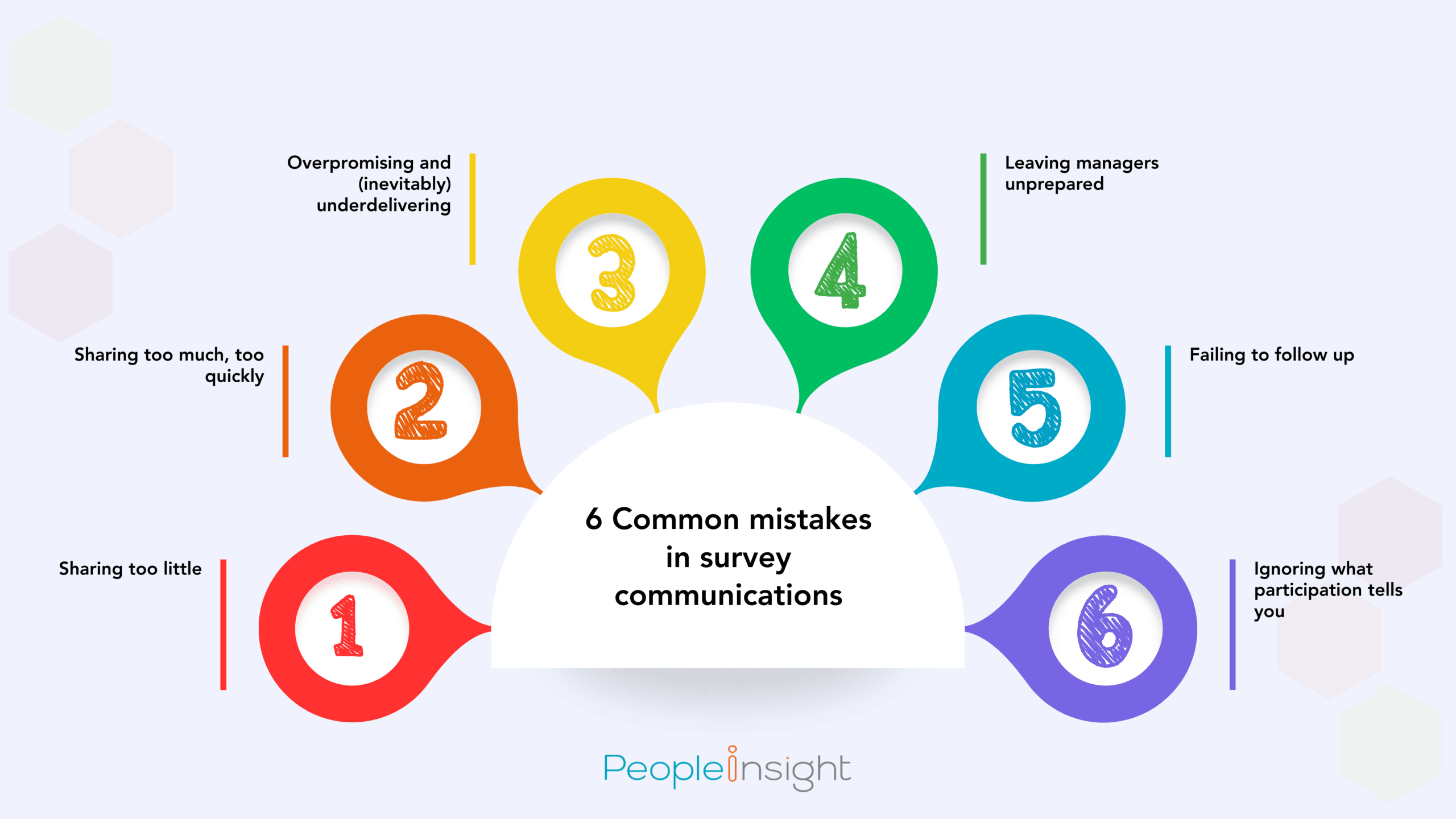
    6 Common mistakes in survey communications

    1. Sharing too little

    If employees only receive vague headlines, they may feel the organisation is avoiding the real issues.

    2. Sharing too much, too quickly

    Too much detail without context can overwhelm people and make the message harder to follow.

    3. Overpromising and (inevitably) underdelivering

    If communications promise major change too quickly, trust can suffer later when delivery is slower or more limited than expected.

    4. Leaving managers unprepared

    If line managers are not equipped to talk through results, employees may get inconsistent or unhelpful messages.

    5. Failing to follow up

    The biggest risk is silence after the initial update. This is what often breaks trust and contributes to survey fatigue.

    6. Ignoring what participation tells you

    Survey communications should also reflect how the survey landed. If response levels were weaker than expected, it is worth reviewing how your communications approach, survey timing and trust levels may have affected your survey response rate.

    A simple template for communicating survey results

    A strong survey results update usually includes five parts:

    1. Thank employees for taking part

    Acknowledge the time and honesty they gave.

    2. Share the main themes

    Summarise the most important findings in plain English.

    3. Acknowledge strengths and concerns

    Be clear about what is working well and where improvement is needed.

    4. Explain what happens next

    Outline how results will be reviewed, discussed and turned into action.

    5. Commit to further updates

    Tell employees when they will hear more and how progress will be shared.

    Example survey results communication message

    Here is a simple structure you can adapt:

    Subject: Thank you for your feedback – here is what we heard

    Thank you to everyone who took part in our employee survey. We appreciate the time, honesty and thought that went into your responses.

    We have now reviewed the results and a few clear themes are emerging. There are positive signs in areas such as [insert strengths], but the survey also highlights opportunities to improve in areas such as [insert themes].

    Over the coming weeks, leaders and managers will review the results in more detail and agree the priorities we need to focus on. We will continue to update you on what we are doing, what actions are being taken and how progress will be shared.

    Thank you again for helping shape what happens next.

    How to know if your survey communication is working

    Effective survey communication should lead to more than just awareness. It should help employees feel clearer, more confident and more engaged in what happens next.

    Good signs include:

    • managers feel more confident discussing the results
    • employees understand the main themes
    • leaders are seen as taking the results seriously
    • follow-up actions feel clearer and more credible
    • future survey participation stays strong or improves

    If communications are working well, employees should not be left wondering what happened after the survey. They should be able to see the link between feedback, priorities and progress.

    Improve employee engagement survey communication with People Insight

    Strong employee engagement survey communication helps organisations build trust, close the feedback loop and create the conditions for visible change.

    At People Insight, we help organisations design stronger survey communications, interpret feedback more clearly and turn results into meaningful action. Through our platform, Prism and expert support, we help ensure that survey results do not just get shared. They get understood and acted on.

    Want to improve the way your organisation communicates survey results? Get in touch to learn how People Insight can help.

    FAQs about employee engagement survey communication

    What is employee engagement survey communication?

    Employee engagement survey communication is the way an organisation explains the survey, shares the results and keeps employees informed about what will happen next.

    Why is survey communication important?

    Survey communication is important because it builds trust, improves understanding and helps employees feel their feedback has been taken seriously.

    How do you communicate survey results effectively?

    You communicate survey results effectively by being clear, honest and consistent, tailoring messages to different audiences and linking the results to visible next steps.

    What should be included in a survey results update?

    A survey results update should usually include a thank you, a summary of the main themes, an honest view of strengths and concerns, an explanation of next steps and a commitment to further updates.

    How often should you communicate after a survey?

    A strong employee engagement survey communication plan includes the initial results update and then follow-up messages as priorities are agreed and actions progress.

    Why do employees lose trust in survey communications?

    Employees often lose trust when communication is vague, delayed, overly polished or disconnected from visible action.

    How can People Insight help with survey communication?

    People Insight helps organisations strengthen survey communication through clearer messaging, manager support, stronger reporting and practical action planning that helps close the feedback loop.