



















Blogs:

10 non financial incentives that really motivate employees

Non-financial incentives work best when they are shaped by employee listening, everyday recognition and real employee feedback.

10 non-financial incentives that motivate employees

    A quick insight: Non-financial incentives can support motivation, engagement and retention, but only when they reflect what employees genuinely value. The best approach starts with listening, then turns employee voice into practical action through recognition, growth, autonomy, flexibility and a culture where people feel respected.

    We all want our employees to feel inspired and motivated. But motivation doesn’t always come from financial sources, such as bonuses or promotions. Sometimes, the most meaningful change stems from benefits that recognise personal lives, build community or ease daily pressures.

    Whether your goal is to improve engagement scores or reduce staff turnover, non financial incentives are a practical way to show employees you’re listening and responding to their needs. 

    Let’s take a look at what non-financial incentives are, why they matter and ten examples of non-financial incentives that really work.

    Related: 60+ Employee perks your team will love

    What are non-financial incentives?

    Non-financial incentives are rewards, forms of recognition or workplace practices that motivate employees without directly increasing salary or pay.

    They are sometimes called non-monetary incentives, non-financial rewards or non-monetary rewards. They can be formal, such as an employee recognition programme, or informal, such as a manager giving specific, timely praise after a strong piece of work.

    Examples of non-financial incentives include:

    • Employee recognition
    • Career development opportunities
    • Flexible working
    • More autonomy and trust
    • Regular feedback
    • Mentoring and coaching
    • Involvement in decision-making
    • Wellbeing support
    • A stronger sense of purpose
    • Opportunities to share ideas

    The strongest non-financial incentives are not random extras. They are linked to what employees need to do their best work, feel valued and see a future with the organisation.

    Why non-financial incentives actually matter today

    Non-financial incentives support the human side of motivation.

    Pay, benefits and job security have always been, and will always be, important. If employees feel underpaid, overworked or treated unfairly, non-financial incentives will not fix the problem. They should never be used as a substitute for fair pay, good leadership, manageable workloads or action on employee feedback.

    But once those foundations are in place, non-financial incentives can help boost employee engagement. They show people that their contribution is noticed, their development is taken seriously and their voice has influence.

    People Insight’s global benchmark data shows why this is important:

    • 63% of employees feel valued and recognised for the work they do
    • 61% say they received thanks or praise in the last week
    • 63% say they have the right opportunities to learn and grow at work
    • 65% say their opinion is sought on decisions that affect their work
    • 53% believe action will be taken as a result of employee survey feedback

    That tells us something important about non-financial motivation. Recognition, growth and involvement matter, but they need to be supported by listening and visible action. When people share feedback and nothing changes, even strong incentives can lose their impact.

    10 examples of non-financial incentives for employees

    Here are 10 practical examples of non-financial incentives that can support motivation, engagement and retention.

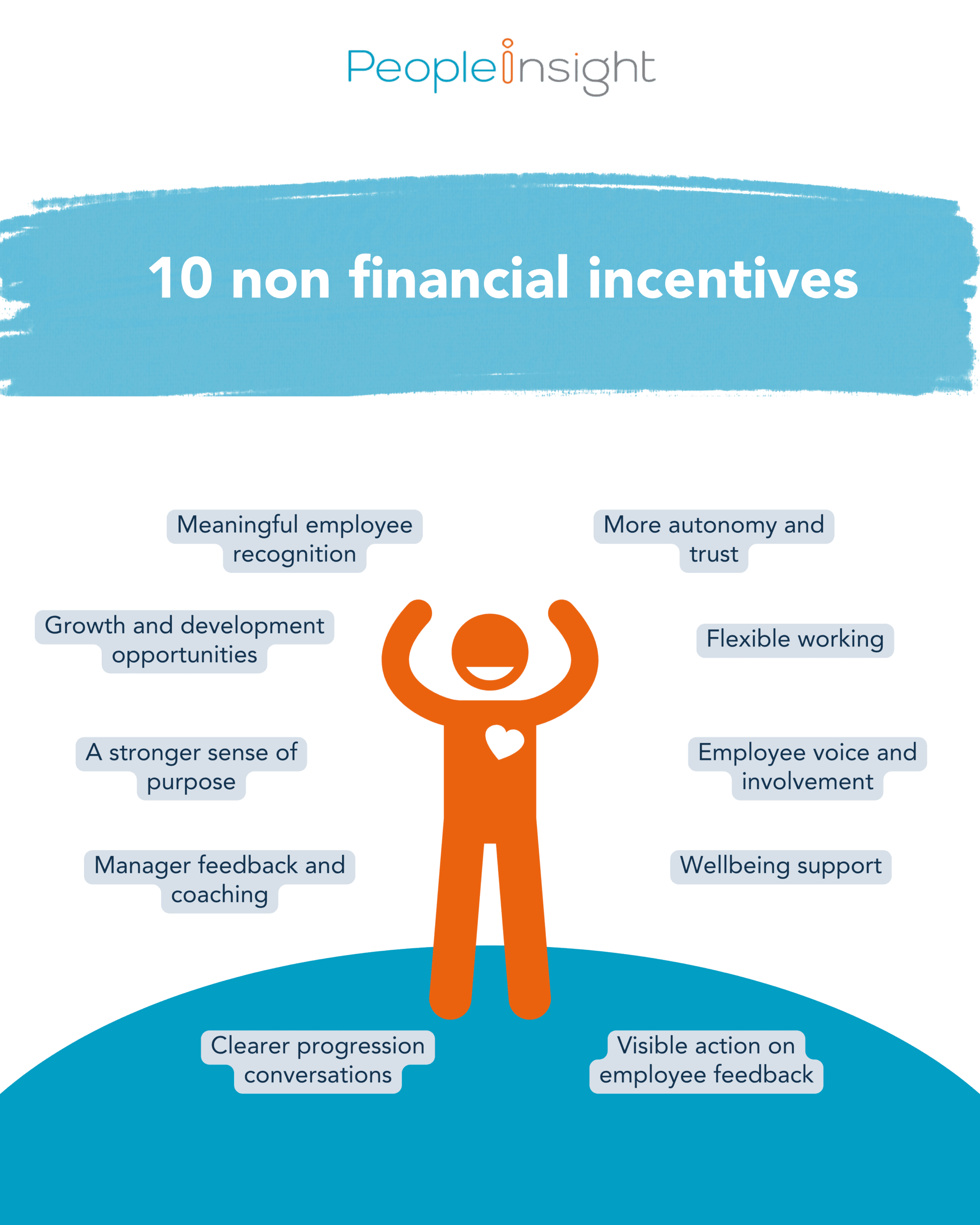
    10 non financial incentives

    1. Meaningful employee recognition

    Recognition is one of the clearest forms of non-financial motivation. It helps employees feel seen and appreciated for the work they do.

    Good recognition should be specific, timely and fair. A quick “thank you” can help, but recognition works better when it explains what the person did well and why it made a difference.

    Recognition can include manager praise, peer-to-peer recognition, team shout-outs, values-based awards, customer feedback and senior leader recognition.

    2. More autonomy and trust

    Autonomy is a powerful non-financial incentive because it shows trust. When employees have more control over how they work, they are often more motivated, focused and committed.

    This might mean giving people more ownership over projects, allowing them to make decisions within clear boundaries or reducing unnecessary approval processes.

    Autonomy works best when expectations are clear. People need to understand the outcome required, the standards expected and where they can use their judgement.

    3. Growth and development opportunities

    Many employees are motivated by learning, progression and the chance to build new skills. Development does not always need to mean promotion. It can also mean mentoring, shadowing, coaching, training or taking on a new responsibility.

    Development is especially important for retention. If people cannot see a future in the organisation, they are more likely to look elsewhere.

    4. Flexible working

    Flexibility can be a valuable non-financial incentive when it helps employees balance work with life outside work.

    This could include flexible start and finish times, hybrid working, compressed hours or greater control over where work happens. The right approach will depend on the role, team and organisation.

    Flexibility should be handled fairly and clearly. If employees see flexibility as inconsistent or only available to certain groups, it can damage trust rather than build motivation.

    5. A stronger sense of purpose

    Purpose can be a strong motivator when employees understand how their work contributes to something bigger.

    This does not mean every role needs a grand mission statement. It means helping people see the link between their day-to-day work, customer outcomes, team goals and organisational progress.

    Managers play a key role here. Regular conversations about priorities, impact and progress can help employees feel more connected to their work.

    6. Employee voice and involvement

    One of the most powerful non-financial incentives is the chance to have a voice.

    When employees are invited to share ideas, contribute to decisions and influence change, they are more likely to feel trusted and invested in the organisation. This is especially important during periods of change, growth or uncertainty.

    A strong employee survey provider can help organisations understand what employees value, where motivation is strong and where action is needed.

    7. Manager feedback and coaching

    Regular feedback can be a non-financial incentive when it helps employees improve, feel supported and understand how they are doing.

    This should not be limited to annual reviews. Employees benefit from regular, practical conversations about performance, priorities, development and wellbeing.

    Good feedback is clear, balanced and useful. It helps people understand what to keep doing, what to change and how to grow.

    8. Wellbeing support

    Wellbeing support can motivate employees when it shows the organisation cares about the conditions people are working in.

    This might include workload conversations, wellbeing check-ins, mental health support, manager training or better ways to spot pressure points before they become serious problems.

    Wellbeing support should not be treated as a surface-level perk. If workloads are unmanageable or people feel unable to speak up, wellbeing initiatives will have limited effect.

    9. Clearer progression conversations

    Employees do not always need an immediate promotion to feel motivated, but they do need to understand what growth could look like.

    Clear progression conversations help people see what skills they can build, what opportunities may be available and what support they need to move forward.

    This can be especially valuable for employees who feel stuck, overlooked or unsure how to develop within the organisation.

    10. Visible action on employee feedback

    One of the most meaningful non-financial incentives is showing employees that their feedback leads somewhere.

    When organisations ask for feedback, communicate what they have heard and take visible action, employees are more likely to feel respected and involved.

    This is where a clear post-survey action plan can make a real difference. It helps organisations move from “we’ve heard you” to “here’s what we’re doing next.”

    Non-financial incentives vs employee perks

    Non-financial incentives and employee perks can overlap, but they are not the same.

    AreaWhat it meansExample
    Employee perksBenefits, extras or workplace add-onsFree snacks, social events, discounts or office extras
    Non-financial incentivesWays to motivate, recognise and support employees without increasing payRecognition, autonomy, development, flexibility or involvement in decisions
    Reward and recognitionThe wider strategy for making appreciation consistent, fair and embedded in cultureA values-led recognition approach supported by manager habits and employee feedback

    Employee perks can improve the employee experience, but perks alone do not create engagement. Non-financial incentives are more closely linked to motivation, contribution and the everyday experience of work.

    For example, a free lunch may be appreciated, but regular recognition from a manager may have a deeper impact on how valued someone feels. A discount scheme can be useful, but career development may have a stronger effect on retention.

    The National Gallery rewards at work case study is a useful example of this in practice. After survey feedback highlighted concerns around rewards, the Gallery introduced targeted benefits around family support, London living costs, wellbeing and connection. Its benefits score rose by 29 points to 81%, showing how evidence-led action can improve perceptions of reward even when direct pay changes are harder to make.

    Why motivation is not only about pay

    Pay is important. Employees need to feel fairly rewarded for their work. If pay is poor or unfair, non-financial incentives will not compensate for it.

    But pay is not the only driver of motivation. Employees are also influenced by:

    • How they are treated by managers
    • Whether they feel recognised
    • Whether their work feels meaningful
    • Whether they can grow
    • Whether they feel trusted
    • Whether their voice is heard
    • Whether feedback leads to action
    • Whether the culture feels fair and supportive

    Non-financial incentives work best when they support the wider drivers of employee engagement, including purpose, enablement, autonomy, reward and leadership.

    For example, if employees feel trusted, recognised and involved, they are more likely to contribute ideas and stay committed. If they feel ignored or undervalued, financial reward alone may not be enough to maintain motivation.

    How employee listening helps organisations choose the right incentives

    The best non-financial incentives start with listening.

    Every workforce is different. What motivates one group may not motivate another. Early-career employees might value development and mentoring. Parents and carers might value flexibility. Managers might value better tools, clearer priorities and more support. Frontline employees might value practical recognition, fair rotas and stronger communication.

    Using employee engagement surveys helps organisations understand what people value, where motivation is strong and where barriers to engagement are holding people back.

    Survey data can show whether employees feel:

    • Valued and recognised
    • Treated fairly
    • Supported by managers
    • Able to speak up
    • Confident that action will follow feedback
    • Connected to organisational purpose
    • Able to grow and develop
    • Likely to stay

    This gives organisations a clearer picture of which non-financial incentives are likely to work. It also helps avoid guesswork.

    What this looks like in practice

    People Insight clients show how non-financial incentives work best when they are shaped by real employee feedback.

    At RNCM, transparent communication, local action planning and regular “You said, we did” updates helped build strong confidence that feedback would lead to change. Its RNCM employee voice case study shows how recognition, trust and action planning can strengthen engagement together.

    For flexibility, the University of Sunderland in London’s four-day work week is a useful example of listening first, then designing an incentive around the organisation’s real context. The model was shaped by employee feedback and linked to stronger engagement, lower turnover and a more sustainable staff experience.

    At Charity Bank, purpose, flexibility and employee voice helped support a highly engaged, values-led culture. The organisation achieved 93% engagement and a 90% purpose score, showing how non-financial motivators can support both employee experience and organisational impact.

    For a broader view of how organisations turn feedback into progress, read our action planning case study.

    Using employee feedback to improve reward and recognition

    Employee feedback should shape how non-financial incentives are designed, reviewed and improved.

    The aim is not to ask employees to choose from a list of benefits and stop there. It is to understand what sits underneath motivation, recognition and engagement.

    Useful questions might include:

    • Do employees feel valued for the work they do?
    • Do managers recognise good work consistently?
    • Do people believe recognition is fair?
    • Do employees feel trusted to make decisions?
    • Do people have opportunities to grow?
    • Do employees feel listened to by senior leaders?
    • Do people believe feedback leads to action?

    These questions help organisations move from assumption to insight. They also support better employee feedback loops, where employees can see that their views are being taken seriously.

    People Insight’s approach, Sharper listening. Smarter action., is about understanding what employees are really experiencing and turning that insight into meaningful action.

    How to review whether non-financial incentives are working

    Non-financial incentives should be reviewed regularly. What works one year may not work the next, especially as employee expectations, workloads and organisational priorities change.

    To review your approach, look at both data and employee feedback. Useful measures include:

    • Employee engagement scores
    • Recognition scores
    • Retention and turnover trends
    • Manager effectiveness
    • Pulse survey feedback
    • Qualitative employee comments
    • Differences between teams, locations or employee groups
    • Action planning progress
    • Confidence that feedback leads to action

    It is important to look beyond whether an incentive exists. The better question is whether employees experience it as valuable, fair and motivating.

    For example, an organisation may have a recognition platform, but survey comments might show that recognition still feels inconsistent. Another organisation may offer development opportunities, but employees may not believe access is fair.

    Getting non-financial incentives right

    Non-financial incentives can be a powerful part of employee motivation, but they work best when they are grounded in real employee experience.

    The most effective approaches are:

    • Fair and consistent
    • Linked to employee feedback
    • Supported by managers
    • Aligned with culture and values
    • Reviewed regularly
    • Connected to action planning
    • Clear about what they are trying to improve

    They should also sit alongside fair pay, good leadership, manageable workloads, psychological safety and genuine action on employee feedback.

    In other words, non-financial incentives are not a shortcut. They are part of a wider effort to build a workplace where people feel listened to, recognised and able to do their best work.

    Want to understand what really motivates your people?

    People Insight can help you use employee listening and employee engagement surveys to understand what employees value, improve recognition and turn feedback into action.

    Speak to our team about building a clearer, more evidence-led approach to motivation, recognition and engagement.

    FAQs about non-financial incentives

    What are non-financial incentives?

    Non-financial incentives are ways to motivate, recognise and support employees without directly increasing pay. They include recognition, development opportunities, autonomy, flexible working, employee voice, feedback, wellbeing support and involvement in decision-making.

    What are examples of non-financial incentives?

    Examples of non-financial incentives include employee recognition, career development, mentoring, flexible working, extra responsibility, manager feedback, autonomy, wellbeing support, opportunities to share ideas and a stronger sense of purpose at work.

    What is the difference between financial and non-financial incentives?

    Financial incentives involve money or direct financial reward, such as pay rises, bonuses or commission. Non-financial incentives motivate employees without increasing pay. They focus on recognition, trust, growth, flexibility, purpose, feedback and the employee experience.

    Are non-financial incentives the same as employee perks?

    No. Employee perks are often benefits, extras or workplace add-ons, such as discounts, free food or social events. Non-financial incentives are more directly focused on motivation, recognition and support. They include things like autonomy, development, feedback and meaningful recognition.

    Do non-financial incentives improve employee engagement?

    Non-financial incentives can improve employee engagement when they reflect what employees genuinely value. They are most effective when supported by employee listening, fair treatment, good leadership and visible action on employee feedback.

    How can employers choose the right non-financial incentives?

    Employers should start by listening to employees. Employee surveys, pulse surveys, focus groups and feedback channels can help organisations understand what motivates people, where recognition is missing and which non-financial incentives are most likely to support engagement and retention.

    Can non-financial incentives replace fair pay?