



















Blogs:

Data reveals: Are non-binary employees being seen (and recognised) at work?

Our benchmark data shows how does the non-binary community feel they are being appreciated in the workplace

Data reveals Are non-binary employees being seen (and recognised) at work

    A quick insight: People Insight benchmark data shows non-binary employees are less likely to feel valued and recognised at work. But the story is not only about praise. Wider gaps around listening, career development, leadership communication and belief in action suggest employers need to look more closely at whether every employee feels seen, heard and able to thrive.

    Recognition is one of the clearest ways employees understand whether their work is seen.

    It does not always need to be formal. Sometimes it’s something as simple as a thoughtful thank you, a manager noticing good work, a leader acknowledging effort during a difficult period or a team making sure contribution is visible. Whatever form it takes, it can mean a lot, and it can motivate really effectively.

    But when recognition and employee appreciation is uneven, the employee experience becomes uneven, too.

    People Insight benchmark data shows that male and female employees reported almost identical favourable scores for the statement: “I feel valued and recognised for the work that I do.” Both sit at around 65%.

    Among non-binary employees, however, the score was 50%.

    That creates a 15-point recognition gap.

    This is an important finding for employers because recognition is not just about feeling good. It shapes engagement, motivation, wellbeing, belonging and trust.

    When people feel their contribution is valued, they are more likely to feel connected to their work and the organisation. When they do not, it can quietly undermine confidence, commitment and the belief that their work is making a difference.

    For non-binary employees, the data suggests recognition may not be landing in the same way.

    So, this Pride Month, let’s take a look at our non-binary employees, how they experience life at work on average and how appreciated they feel on a day-to-day basis.

    Related: 10 non financial incentives that really motivate employees

    A hopeful note: day-to-day praise is happening

    Before we really dig into the big talking points, it’s worth pointing out that there is an important nuance in the data.

    On the statement “In the last week, I have received thanks or praise for doing good work”, non-binary employees scored 64%. That is almost identical to female employees at 64% and slightly above male employees at 63%.

    StatementFemale employeesMale employeesNon-binary employees
    In the last week, I have received thanks or praise for doing good work64%63%64%

    That is encouraging. It suggests non-binary employees are not necessarily being excluded from day-to-day praise. Managers and colleagues may be offering thanks in similar ways across gender groups.

    But it also makes the recognition gap more interesting.

    If non-binary employees are receiving thanks at similar levels but are still less likely to feel valued and recognised overall, employers need to ask a deeper question:

    Is recognition happening, but not always feeling meaningful?

    Recognition works best when it is timely, specific and connected to someone’s real contribution. A quick thank you matters, but it may not be enough if employees do not feel their wider work, potential, identity or experience is understood.

    The recognition gap may be part of a wider visibility gap

    The data suggests the recognition gap does not sit in isolation.

    Non-binary employees also reported lower favourable scores across several areas connected to voice, leadership, fairness and development.

    StatementFemale employeesMale employeesNon-binary employees
    Senior leaders make the effort to listen to staff59%59%34%
    I believe action will be taken as a result of this survey56%50%28%
    My opinion is sought on decisions that affect my work62%60%44%
    People communicate openly here regardless of position or level61%63%43%
    The organisation ensures that all people are treated fairly and equally70%73%51%

    This points to a wider issue: non-binary employees may be less likely to feel seen, heard and included in the everyday systems of work.

    That matters for any organisation trying to build a stronger employee listening strategy.

    Listening is not only about collecting feedback. It is also about making sure different groups of employees trust the process, feel safe to share their experience and can see that their feedback leads to meaningful action.

    If non-binary employees are less likely to believe action will be taken as a result of an employee survey, that is a trust signal employers should not ignore.

    What does “being seen” actually mean at work?

    Being seen at work is not about putting employees under a spotlight.

    It is about creating an environment where people feel their contribution, experience and potential are properly understood.

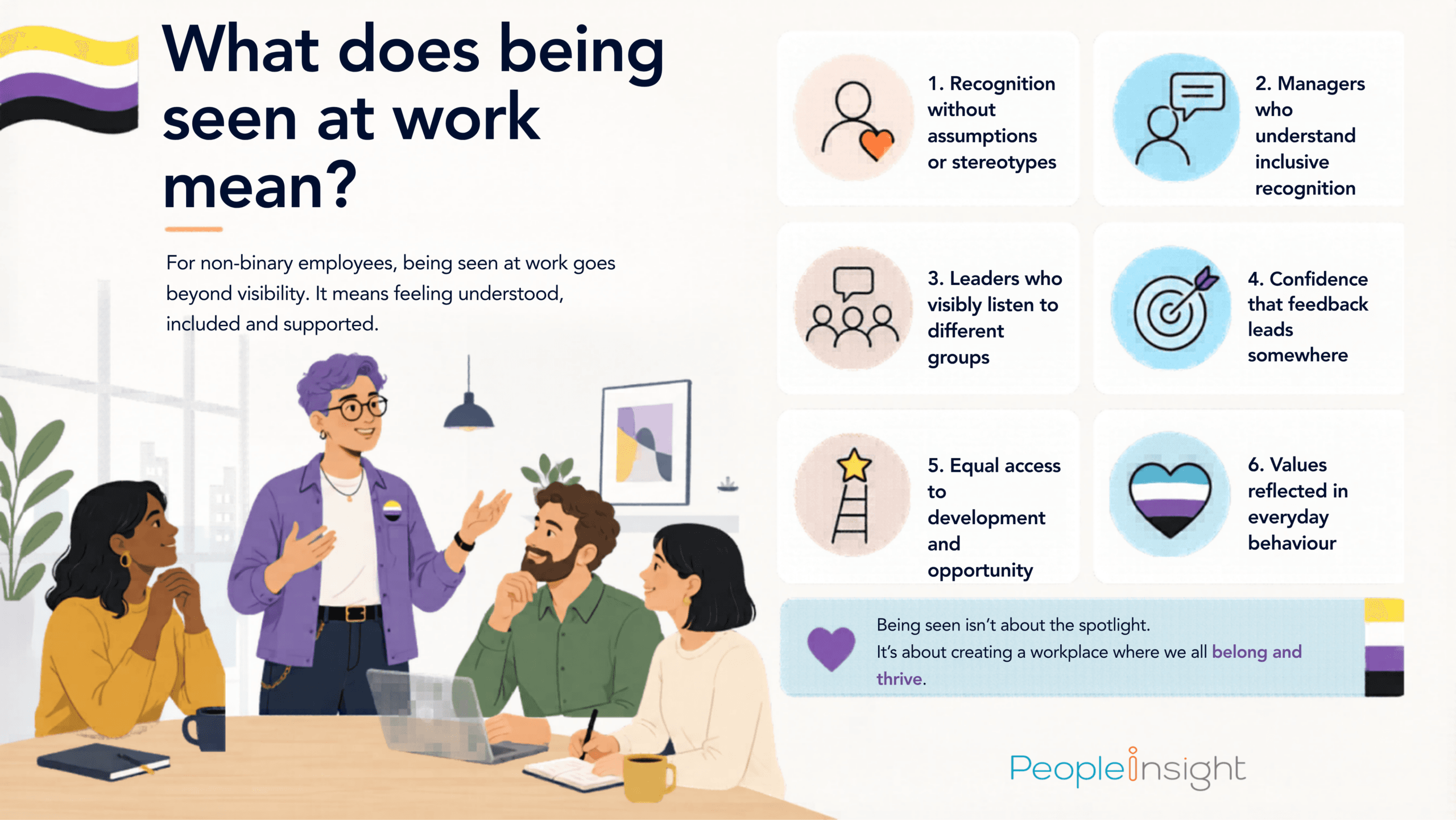
    What does being seen at work mean

    For non-binary employees, that might include:

    • being recognised for work without assumptions or stereotypes
    • having managers who understand what meaningful, inclusive recognition looks like
    • seeing leaders listen visibly to different employee groups
    • feeling confident that feedback will not disappear into a black hole
    • having equal access to development, progression and opportunity
    • knowing that organisational values are reflected in everyday behaviour

    Recognition becomes more powerful when it is part of a wider culture of listening and action.

    That is why employers should not treat the 15-point gap as a standalone recognition issue. It sits alongside lower scores for leadership listening, belief in action, open communication and fair treatment.

    Career development is another important part of the story

    Recognition is often thought of as praise. But feeling recognised can also mean feeling that your future is being taken seriously.

    Here, the data shows another notable gap.

    StatementFemale employeesMale employeesNon-binary employees
    My career development aspirations are being met70%64%44%
    I have the right opportunities to learn and grow at work64%66%52%
    My manager takes time to coach me and develop my skills68%68%58%
    I find my work interesting and challenging83%81%73%

    The biggest gap here is around career development aspirations. Non-binary employees scored 44%, compared with 70% for female employees and 64% for male employees.

    That suggests employers need to look beyond whether non-binary employees receive praise in the moment. They also need to ask whether those employees feel their skills, ambitions and future contribution are being properly supported.

    Inclusive recognition should not only say, “Thank you for what you did.”

    It should also communicate, “We see what you are capable of, and we are serious about helping you grow.”

    What employers can do next

    Pride Month is a useful moment to talk about LGBTQ+ inclusion, but the real test is what happens across the rest of the year.

    Policies, employee networks and visible support all have a role to play. But inclusion also needs to show up in the day-to-day employee experience: in manager conversations, development opportunities, listening habits, recognition practices and action planning.

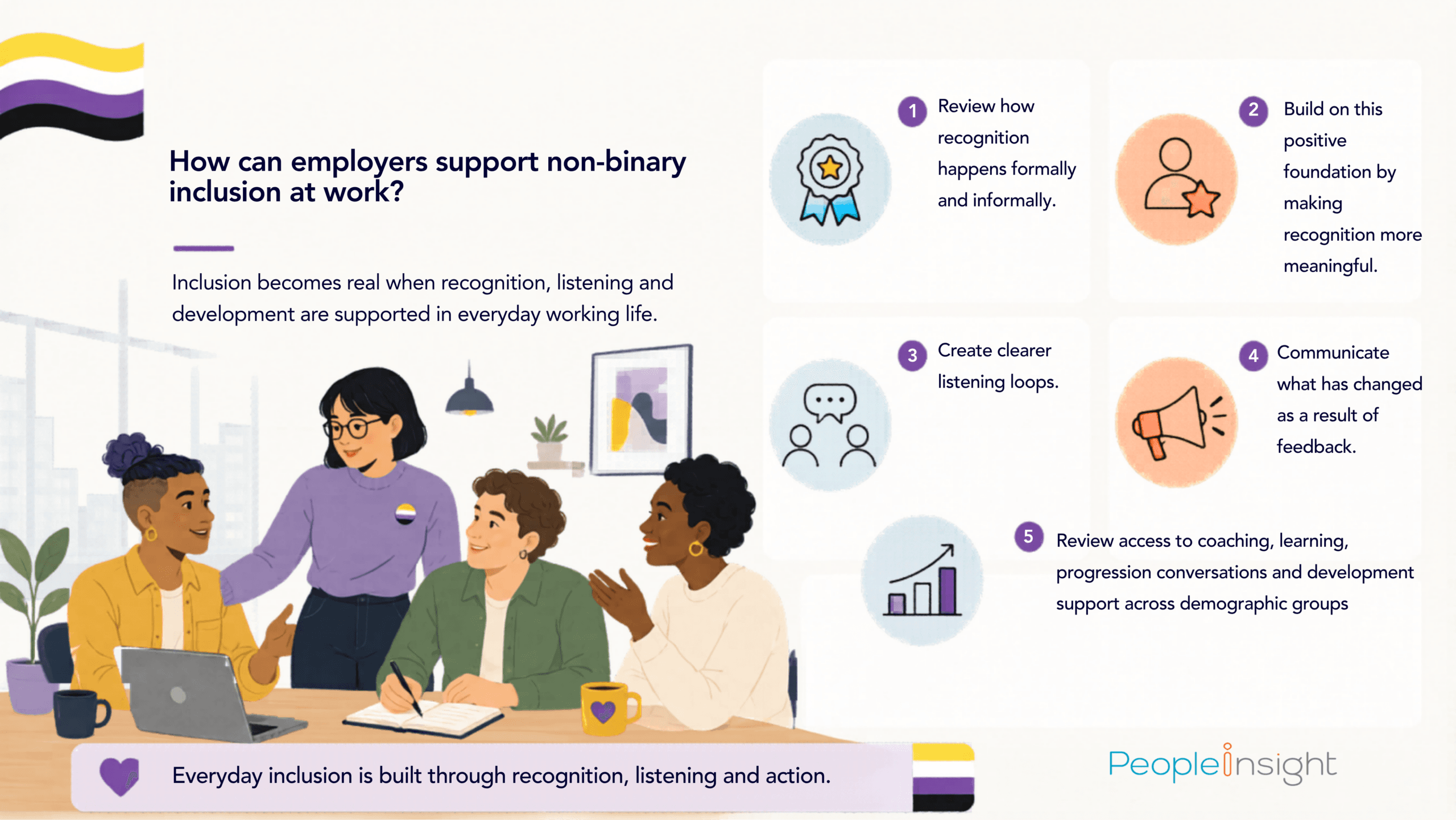
    How can employers support non-binary inclusion at work

    What the data suggestsWhat employers can do
    Non-binary employees are less likely to feel valued and recognisedReview how recognition happens formally and informally, and check whether it feels inclusive across different groups
    Day-to-day thanks and praise appears more evenly experiencedBuild on this positive foundation by making recognition more specific, meaningful and connected to contribution
    Non-binary employees are less likely to feel listened to by senior leadersCreate clearer listening loops so employees can see how feedback is heard, discussed and acted on
    Belief in survey action is much lower among non-binary employeesCommunicate what has changed as a result of feedback, including progress updates and honest explanations where action takes time
    Career development scores are weakerReview access to coaching, learning, progression conversations and development support across demographic groups

    How employee listening can support LGBTQ+ inclusion

    Good employee listening helps organisations move beyond assumptions.

    It allows employers to understand where experience differs across groups, where inclusion is being felt and where it is not yet landing.

    That is especially important when looking at demographic cuts such as gender identity. A headline engagement score may look healthy overall, while specific groups are having a very different experience underneath the surface.

    The key is to handle the data responsibly.

    Where sample sizes are smaller, results should be interpreted with care. But where gaps appear consistently across related areas, employers should take them seriously. The aim is not to single out a group or reduce people to a data point. The aim is to understand where the employee experience may be unequal and what needs to change.

    People Insight helps organisations design employee surveys, analyse results and turn feedback into practical action. Our approach combines expert support with an employee engagement platform that helps leaders understand what is really going on across the workforce.

    From Pride Month statement to everyday action

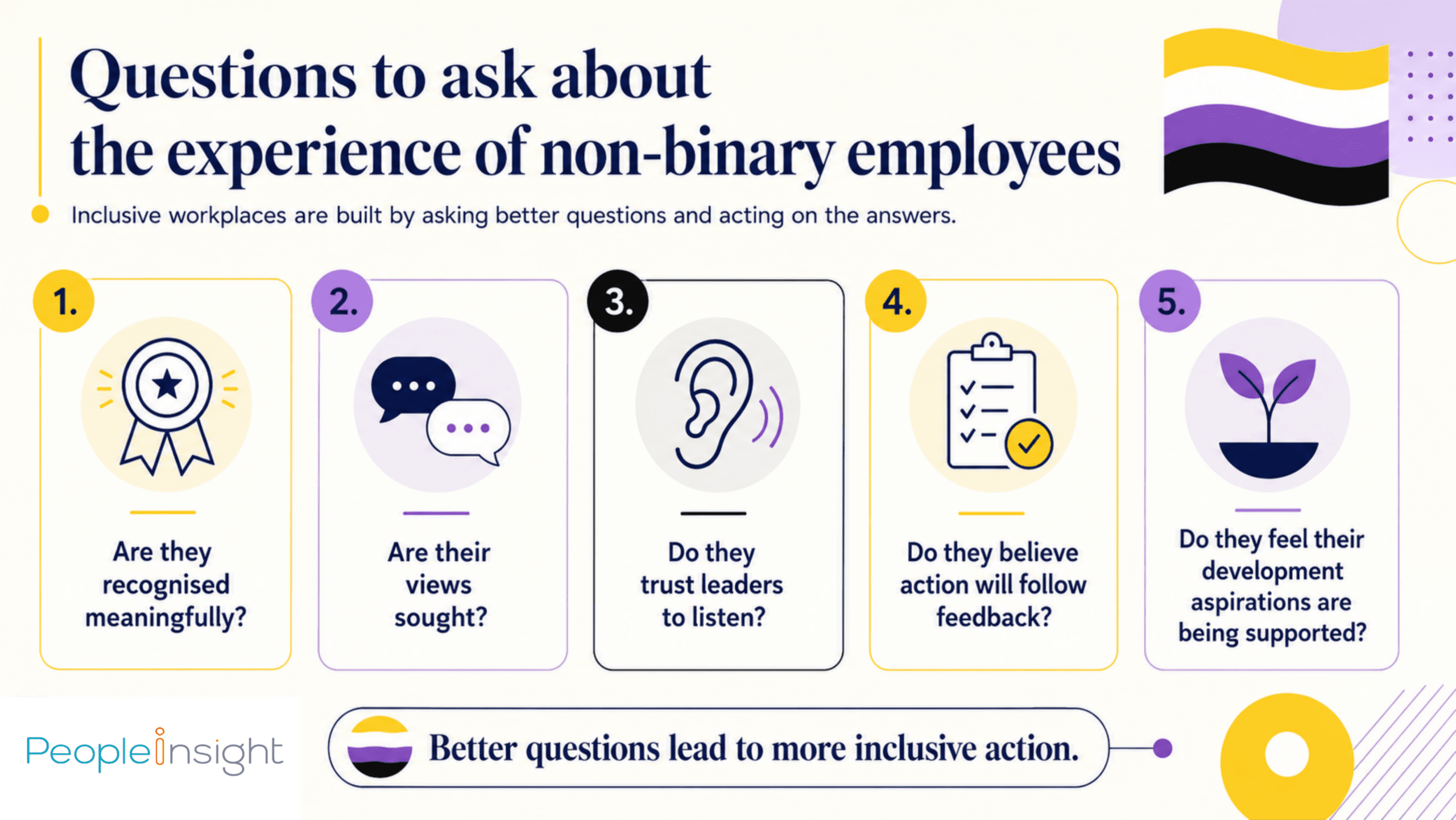
    questions to ask about the experience of non binary employees

    Pride Month gives employers a visible opportunity to show support for LGBTQ+ employees.

    But visibility is only the starting point.

    The data raises a more practical question: are non-binary employees experiencing inclusion in the everyday moments that shape working life?

    Are they recognised meaningfully? Are their views sought? Do they trust leaders to listen? Do they believe action will follow feedback? Do they feel their development aspirations are being supported?

    Those are the questions that move inclusion from statement to substance.

    The hopeful finding is that day-to-day thanks and praise appears to be happening at similar levels across gender groups. That gives employers something positive to build on.

    The challenge is to make sure recognition goes deeper. It needs to be consistent, meaningful and backed up by listening, action and opportunity.

    That is how organisations create a workplace where every employee feels seen, heard and valued.

    Ready to understand whether every employee feels seen and heard?

    People Insight helps organisations listen more clearly, understand employee experience across different groups and turn feedback into meaningful action.

    If you want to build a more inclusive employee listening strategy, get in touch with the People Insight team to learn how we can help.

    FAQs about the non-binary employee experience

    Are non-binary employees being appreciated at work?

    People Insight benchmark data shows that 50% of non-binary employees feel valued and recognised for the work they do, compared with 65% of male employees and 65% of female employees. That creates a 15-point recognition gap.

    Why does employee recognition matter for inclusion?

    Employee recognition helps people feel that their work, effort and contribution are noticed. For inclusion, this is especially important because employees need to feel valued not only through policy or statements, but through everyday workplace behaviour.

    Does the data show non-binary employees receive less praise?

    Not necessarily. On the statement “In the last week, I have received thanks or praise for doing good work”, non-binary employees scored 64%, which is similar to female employees at 64% and male employees at 63%. The bigger gap appears in whether non-binary employees feel valued and recognised overall.

    What might explain the gap between praise and feeling recognised?

    It may suggest that thanks and praise are happening, but not always feeling meaningful, consistent or connected to wider contribution. Recognition is stronger when it is specific, timely and linked to someone’s work, skills, effort and future potential.

    How can employers improve recognition for non-binary employees?

    Employers can review formal and informal recognition practices, support managers to give specific and inclusive recognition, check whether development opportunities are experienced fairly and use employee listening data to understand where different groups may be having different experiences.

    How does employee listening support LGBTQ+ inclusion?

    Employee listening helps organisations understand whether inclusion is being experienced in practice. By looking carefully at feedback across demographic groups, employers can identify gaps in recognition, communication, leadership trust and action planning, then respond with targeted, meaningful improvement.