



















Our experienced team works alongside organisations to help them design, deliver and communicate their listening programmes. From survey distribution to strategic guidance, we’re here when you need us
A quick insight:360 feedback is evolving rapidly and has emerged as a key part of modern performance and development strategies. This article reviews current trends across sectors and geographies to show how organisations are using 360 surveys in new ways. It highlights emerging practices and offers insight into the evolving role of 360 feedback for effective people development.
360 feedback is an incredible tool when it comes to leadership development, providing valuable insights into individual performance while helping organisations build strong, resilient teams. There are a lot of advantages of 360 feedback and, used in the right way, it can help to lay the foundation for more self-aware leaders, happier teams and more productive workplaces.
However, as the workplace continues to evolve, driven by changing employee expectations, technological advances and the growing emphasis on diversity and inclusion. The way 360 feedback is gathered, interpreted and used must adapt to stay relevant.
To maintain its effectiveness and drive real impact, the 360 feedback process needs to be dynamic. Organisations that don’t stay on top of, and refine, their feedback processes risk missing out on the chance to capture the most meaningful insights. By staying ahead of emerging 360 feedback trends, companies can ensure their feedback process remains engaging, actionable and aligned with the broader business strategy.
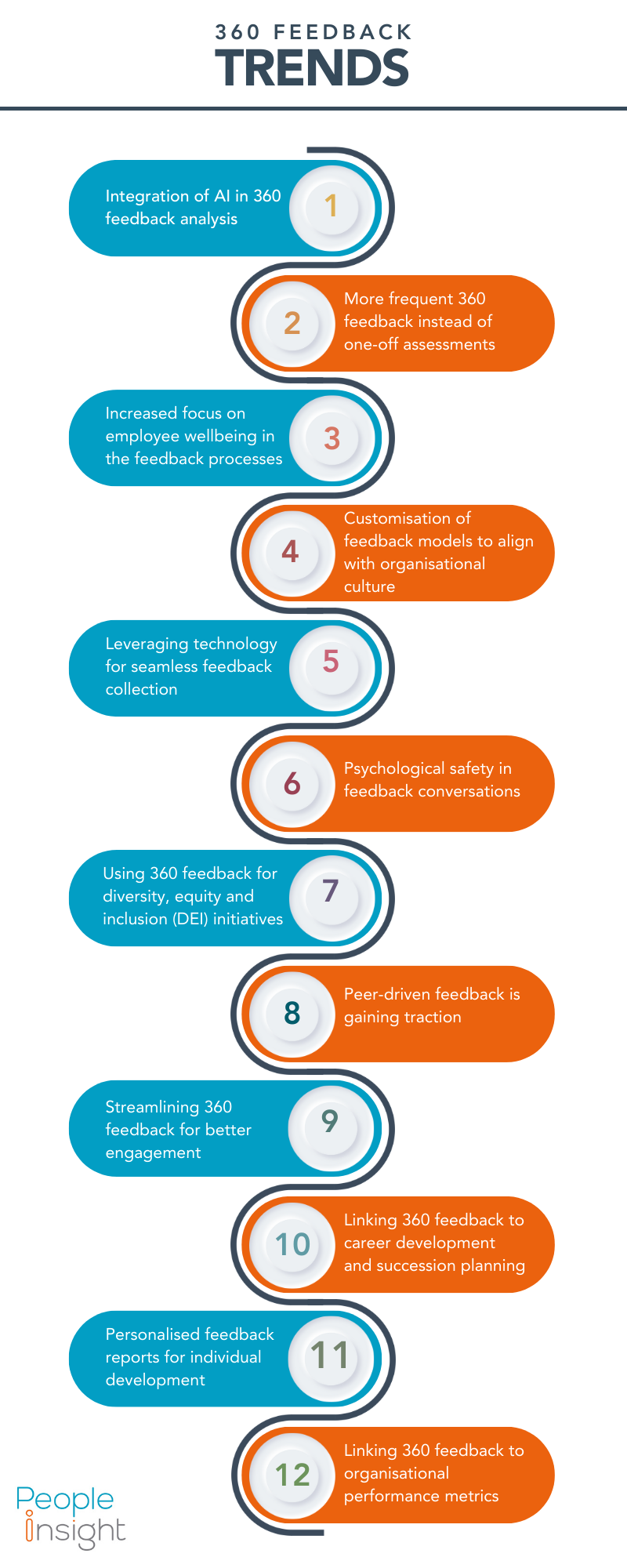
In this blog, we’ll explore the key 360 feedback trends leading the charge in 2026 and beyond. These trends not only reflect the growing importance of real-time, personalised and inclusive feedback, but also highlight how 360 feedback can drive organisational success and individual development.
Let’s take a look at the 360 feedback trends that can help you transform your feedback process for the better.
1. Integration of AI in 360 feedback analysis
Artificial intelligence is transforming how organisations interpret feedback data. In fact, here at People Insight, we have our very own generative AI, Prism, that has changed the game. By processing large volumes of qualitative responses, AI is able to rapidly and effectively identify patterns and sentiment that might otherwise go unnoticed. This allows for the creation of more objective assessments and personalised development plans.
As an example, AI-driven tools can detect recurring themes in feedback about leadership effectiveness, communication skills and workplace dynamics. As AI tools become more advanced, they can automatically process and analyse large amounts of feedback data, picking up patterns, trends and key insights that might be difficult or impossible for humans to spot on their own, allowing businesses to make more data-driven decisions without the limitations of manual work.
2. More frequent 360 feedback instead of one-off assessments
As with most things in 2026, 360 feedback is becoming more agile.
Organisations are moving away from treating 360 feedback as a one-time, annual event. Instead of gathering multi-source feedback only once a year, businesses are introducing more frequent 360 assessments, quarterly, biannually or even in real time. This shift allows for continual development tracking. It helps leaders to make incremental improvements rather than waiting months to receive constructive insights. By incorporating 360 feedback into regular performance conversations, companies ensure that feedback remains relevant, meaningful and actionable.
3. Increased focus on employee wellbeing in the feedback processes
Wellbeing is increasingly becoming a consideration in 360 feedback. Many organisations are incorporating questions that assess stress levels, workload balance and emotional health. Research from The Health Foundation highlights the strong link between wellbeing and workplace productivity, driving home the importance and need to include these factors in performance discussions.
By evaluating wellbeing alongside professional competencies, companies can create a more supportive work environment that benefits both employees and business outcomes.
4. Customisation of feedback models to align with organisational culture
One-size-fits-all feedback models are becoming less effective. Businesses are getting savvy to this and tailoring their 360 feedback processes to actually align with their unique values, leadership expectations and industry-specific competencies. The great news is that this customisation makes feedback more relevant, ensuring that leaders are assessed on criteria that truly reflects the skills and behaviours that matter most to the organisation.
5. Leveraging technology for seamless feedback collection
Advancements in technology have made feedback collection easier and more efficient than ever,and here at People Insight, we’ve been using them to give our clients a better experience. User-friendly 360 platforms, mobile apps and automated reminders help boost participation rates while reducing administrative burden. All this remarkable technological advancement helps HR teams and managers to track progress and identify key development areas quickly and painlessly.
6. Psychological safety in feedback conversations
Psychological safety plays an important role in the effectiveness of a 360 appraisal. When employees feel comfortable giving and receiving honest feedback without fear of repercussions, the process becomes more meaningful.
For exactly this reason, organisations are investing more in training managers to facilitate constructive conversations, ensuring that feedback discussions are productive rather than anxiety-inducing.
7. Using 360 feedback for diversity, equity and inclusion (DEI) initiatives
In recent months, we’ve seen a lot of leading companies scale back on their diversity, equity and inclusion initiatives. Despite this, it remains a priority for many businesses for a good reason. Diverse companies are more resilient, innovative and productive. And it’s important for leaders to understand and nurture inclusivity within their teams. With this in mind, forward-thinking companies are beginning to incorporate D&I into their 360 feedback programmes.
Instead of focusing solely on performance, organisations are evaluating how leaders contribute to an inclusive workplace. Questions tend to assess unconscious bias, equitable decision-making and leadership inclusivity. This approach helps companies measure and improve their DEI efforts, reinforcing a commitment to fairness and representation across all levels.
8. Peer-driven feedback is gaining traction
While traditional 360 feedback has focused primarily on input from managers and direct reports, peer feedback is gaining momentum. As workplaces become more collaborative, feedback from colleagues offers valuable insights into teamwork, communication and interpersonal skills. By integrating peer reviews into 360 feedback, organisations create a more comprehensive evaluation process that reflects day-to-day interactions in a more accurate, reflective way.
9. Streamlining 360 feedback for better engagement
Some organisations are streamlining 360 feedback to make it quicker and easier for employees to participate. Long, time-consuming assessments can lead to survey fatigue and lower response rates, limiting the effectiveness of feedback. To address this, businesses are adopting shorter, more targeted 360 feedback cycles, often using pulse-style assessments or AI-powered summaries. This shift ensures that feedback remains engaging, actionable and easy to apply to professional development.
10. Linking 360 feedback to career development and succession planning
Rather than treating 360 feedback as a standalone performance assessment, businesses are integrating it into career development and succession planning. Feedback results are being used to shape personalised development plans, identify high-potential employees and inform leadership training programmes. This strategic approach helps employees see a clear link between feedback and career growth, increasing employee engagement in the process.
11. Personalised feedback reports for individual development
Traditional feedback reports often present a standardised overview of strengths and weaknesses. However, organisations are now shifting towards personalised reports that offer tailored insights and development recommendations. These reports go beyond numerical scores, providing context and actionable next steps based on an individual’s role, career aspirations and past feedback trends. By making feedback more relevant and practical, employees are more likely to engage with it and take meaningful steps towards improvement.
12. Linking 360 feedback to organisational performance metrics
More businesses are aligning 360 feedback with broader organisational performance indicators. Rather than treating it as an isolated HR function, companies are using feedback data to inform business strategy, leadership effectiveness and workforce planning. For example, tracking feedback trends alongside key performance indicators (KPIs) can highlight how leadership behaviours impact team productivity and retention rates. This data-driven approach allows organisations to measure the tangible impact of feedback and adjust strategies accordingly.
These 360 feedback trends highlight a shift towards a more dynamic, personalised and technology-driven approach to 360 feedback. As businesses refine their feedback processes, they create opportunities for meaningful development and stronger employee engagement.
If you’re looking to implement or enhance your 360 feedback programme,People Insight can help. Get in touch today to explore how tailored 360 feedback solutions can support your organisation’s growth.