
















Blogs:

How to improve employee wellbeing in 2026

Data-led strategies and case studies to improve wellbeing, reduce pressure and create healthier working conditions

How to improve employee wellbeing in 2026

    A quick insight: If you want to understand how to improve employee wellbeing, it all starts with understanding how people experience work every day. The strongest wellbeing strategies go beyond benefits or one-off initiatives. They use employee feedback to identify root causes, act on workload and communication, support managers and show employees that listening leads to meaningful improvement.

    We’re in a wonderfully enlightened time, and as a result, employee wellbeing has become one of the biggest priorities for HR teams and senior leaders. But improving wellbeing is not about anything as simplistic asintroducing more benefits, running awareness days or giving people access to wellbeing apps.

    Of course those things can help. But they will not fix the deeper issues if people are overloaded, poorly supported, unclear on priorities or unconvinced that leaders will act.

    To improve employee wellbeing, organisations need to understand what is really affecting people’s experience of work. That means listening properly, looking at the evidence and making practical changes that help work feel more sustainable.

    Related: Employee wellbeing at work: A master guide

    What is the best way to improve employee wellbeing?

    The best way to improve employee wellbeing is to measure how people are experiencing work, identify the root causes of pressure and take visible action on the areas employees say need to improve.

    Beyond traditional wellbeing benefits, a strong wellbeing strategy should examine workload, work-life balance, manager support, recognition, communication, psychological safety and belief in action.

    Employee wellbeing issueWhat to look forPractical action
    High workloadLow scores for workload, balance or stressReview capacity, priorities, deadlines and admin
    Poor work-life balancePeople struggling to switch off or manage commitmentsImprove flexibility, meeting culture and workload planning
    Low recognitionPeople feeling unnoticed or undervaluedBuild regular, genuine appreciation into team routines
    Weak communicationPeople feeling uninformed, excluded or unable to speak openlyShare results clearly and keep employees updated on progress
    Low trust in actionEmployees doubt feedback will lead to changeChoose clear priorities, assign ownership and report back

    Improving employee wellbeing does not always require huge investment. The most meaningful improvements often come from listening properly, acting visibly and making work feel more sustainable.

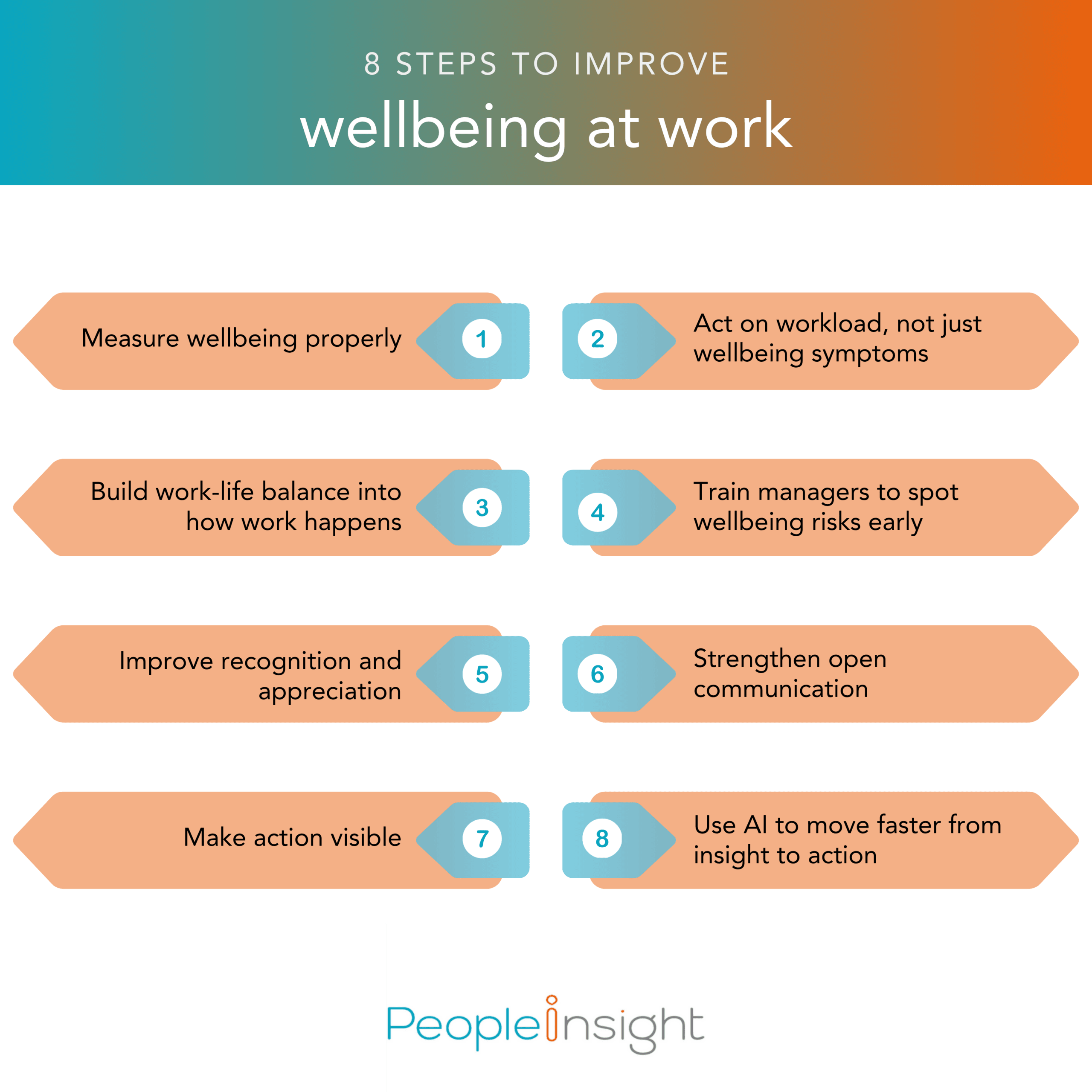
    How to improve employee wellbeing: 8 practical steps

    The information above is useful, but let’s get down to the real how-tos. Below are our top tips we give to our clients seeking to meaningfully boost levels of wellbeing at their workplace.

    1. Measure wellbeing properly

    You can’t improve employee wellbeing if you do not understand how people are really experiencing work.

    A wellbeing survey can help you measure workload, stress, balance, support, recognition, relationships and psychological safety. A wider employee engagement survey can also show how wellbeing connects to performance, retention, culture and confidence in leadership.

    The key is to ask clear questions and analyse the results in context. If wellbeing scores are low, the cause may not be a lack of wellbeing benefits. It could be workload, unclear priorities, poor communication or lack of manager support.

    This is why wellbeing should not sit separately from your wider employee surveys or employee listening strategy. Wellbeing is part of the employee experience, so it needs to be understood alongside engagement, leadership, enablement, recognition and belief in action.

    Useful wellbeing survey questions include:

    Area to measureExample survey questionWhy it helps
    WorkloadI can comfortably cope with my workloadShows whether work feels manageable
    BalanceI am able to strike the right balance between my work and home lifeMeasures sustainability and flexibility
    SupportMy line manager supports my wellbeing at workShows whether manager behaviour is helping or harming wellbeing
    RecognitionI feel valued and recognised for the work that I doLinks appreciation to motivation and belonging
    CommunicationPeople communicate openly here regardless of position or levelMeasures psychological safety and openness
    ActionI believe action will be taken as a result of this surveyShows whether employees trust the listening process

    For more detailed survey design, explore our guide to employee survey types, or check out our downloadable, free wellbeing survey questions in our question library.

    2. Act on workload, not just wellbeing symptoms

    Workload is one of the biggest wellbeing risks.

    Our benchmark data shows only 64% of employees agree they can comfortably cope with their workload. This has not improved for a number of years.

    If people are overloaded, surface-level wellbeing initiatives will have limited impact. Yoga sessions, webinars and wellbeing resources can support people, but they cannot compensate for unmanageable expectations.

    To improve workload wellbeing, organisations should:

    • review capacity across teams
    • help managers prioritise properly
    • remove unnecessary admin
    • make deadlines realistic
    • use survey data to spot workload hotspots
    • check whether pressure is concentrated in specific teams, roles or locations

    Catalyst IT Europe offers a strong example. Its survey data showed that 90% of employees could comfortably cope with their workload, supported by daily stand-ups, monthly check-ins, annual appraisals and informal catchups.

    Workload wellbeing improves when employees have regular opportunities to discuss priorities, raise concerns and rebalance work before pressure becomes burnout.

    3. Build work-life balance into how work happens

    Work-life balance is one of the strongest wellbeing indicators in our benchmark data, with 74% of employees agreeing they can strike the right balance between work and home life.

    But balance should not depend on individuals setting boundaries alone. It should be built into how work is designed, from flexible working and meeting culture to capacity planning and leadership expectations.

    That might mean reviewing:

    • how meetings are scheduled
    • whether deadlines are realistic
    • how much work happens outside contracted hours
    • how flexible working is applied
    • whether managers model healthy working habits
    • how quickly teams respond to changing capacity

    The University of Sunderland in London used employee survey data to shape a four day work week pilot. By 2025, engagement had risen from 71% to 81%, turnover had reduced by 5.2% and staff described having more time for exercise, hobbies, life admin and family.

    This is a useful example because the university did not copy a generic approach to flexibility. It used employee feedback to understand the pressure points, designed a model that fitted its operating reality and then used further feedback to track whether the change was working.

    4. Train managers to spot wellbeing risks early

    Managers have a huge influence on employee wellbeing.

    They are often the first to notice changes in behaviour, energy, performance or confidence. They also influence workload, priorities, feedback and day-to-day support.

    Organisations can support managers by helping them:

    • hold regular wellbeing conversations
    • spot early signs of burnout
    • manage workload fairly
    • recognise good work
    • create clarity around expectations
    • signpost employees to the right support
    • understand when issues need to be escalated

    Manager support should be practical, not performative. A wellbeing conversation only helps if managers have the confidence, time and authority to respond constructively.

    A 360 feedback tool can also help managers understand how their leadership style is experienced by others, including whether they create clarity, trust and psychological safety. This can be especially valuable when organisations want to improve wellbeing through better everyday management, not just through HR-owned initiatives.

    5. Improve recognition and appreciation

    Recognition is a wellbeing issue.

    When people feel their work is noticed and valued, they are more likely to feel motivated, connected and positive about their role. When recognition is missing, people can feel invisible.

    Our benchmark data shows recognition has slipped. In 2025, 61% of employees said they had received thanks or praise for doing good work in the last week, down from 65% in 2024. Only 63% said they feel valued and recognised for the work they do.

    Recognition does not need to be complicated. It does need to be consistent and genuine.

    Organisations can improve recognition by encouraging managers and leaders to:

    • thank people promptly and specifically
    • recognise effort as well as outcomes
    • celebrate team contributions
    • connect appreciation to organisational purpose
    • make recognition part of everyday management
    • check whether recognition feels fair across different teams and groups

    The Royal Northern College of Music shows how visible follow-up and trust can strengthen the employee experience. RNCM achieved 88% engagement, sitting 15 points above the sector benchmark, with belief in action 23 points above average.

    Recognition is not just about praise. It is also about helping employees feel that their voice, effort and contribution are taken seriously.

    6. Strengthen open communication

    Open communication affects wellbeing because it shapes how safe, informed and included people feel.

    Our benchmark data shows a sharp drop in this area. In 2025, only 53% of employees agreed that people communicate openly regardless of position or level, down from 60% in 2024.

    When communication is poor, people can feel uncertain, excluded or unable to raise concerns. This can increase anxiety and reduce trust.

    To improve communication, organisations should:

    • share survey results openly
    • explain what leaders are doing in response
    • create safe routes for feedback
    • keep people updated on progress
    • help managers discuss results with their teams
    • be honest about what can and cannot change

    This is where survey communications can make a real difference. Good communication helps employees understand why they are being asked for feedback, what the results show and how action will be taken.

    Poor communication leaves a vacuum. Employees fill that vacuum with assumptions, frustration or scepticism. Clear communication helps build trust and keeps wellbeing work connected to real organisational action.

    7. Make action visible

    Asking about wellbeing is not enough. People need to see that feedback leads somewhere.

    Our latest benchmark data shows belief in action has improved from 51% to 53%, but this still means almost half of employees are not clearly positive that action will happen as a result of a survey.

    To make action visible, organisations should:

    • share the main findings
    • be honest about what can and cannot change
    • choose a small number of clear priorities
    • give leaders and managers clear ownership
    • explain what will happen next
    • report back regularly on progress
    • show where feedback has influenced decisions

    A strong post-survey action plan helps turn employee feedback into focused improvement. The goal is not to create a huge list of actions. It is to identify the changes most likely to improve people’s experience of work and then follow through.

    Sunbelt Rentals shows the value of sustained listening. Its work with People Insight supported a 6% increase in employee engagement, a 20% increase in participation and belief in action, an 8% reduction in turnover and a 10% increase in operational staff retention.

    This is Sharper listening. Smarter action. in practice: listening carefully, understanding the evidence and turning insight into meaningful improvement.

    8. Use AI to move faster from insight to action

    One of the biggest barriers to improving wellbeing is not lack of data. It is knowing what to do with it.

    HR teams and leaders can quickly become overwhelmed by survey results, open-text comments and competing priorities. This slows down action, especially when wellbeing issues are complex.

    People Insight’s Prism supports organisations by helping them interpret feedback faster and move from insight to practical next steps, while keeping human judgement at the centre.

    That means AI can support wellbeing improvement by helping teams:

    • identify key themes in employee comments
    • understand what is driving low wellbeing scores
    • spot differences across teams or groups
    • prioritise areas for action
    • generate practical next steps
    • help managers respond with confidence

    AI should not replace human judgement, context or responsibility. But used well, it can help organisations move faster from feedback to action and avoid getting stuck in analysis paralysis.

    Employee wellbeing examples from People Insight case studies

    OrganisationWellbeing-related challengeWhat they didResult
    Catalyst IT EuropeSupporting workload, autonomy and balance across distributed teamsUsed survey insight, regular check-ins and open communication to manage capacity90% said they could comfortably cope with workload
    University of Sunderland in LondonImproving flexibility, engagement and retentionUsed employee feedback to shape a four day work week pilotEngagement rose to 81% and turnover reduced by 5.2%
    Royal Northern College of MusicBuilding trust, communication and visible follow-upShared survey results openly and kept progress visible88% engagement and belief in action 23 points above average
    Sunbelt RentalsStrengthening culture through a sustained listening strategyUsed survey insight to support purpose, vision and action6% engagement increase and 8% turnover reduction

    These examples show that employee wellbeing improves when organisations move beyond generic initiatives and focus on the conditions that shape everyday work.

    What should an employee wellbeing strategy include?

    A strong employee wellbeing strategy should include measurement, action planning, manager support, communication and regular follow-up. It should also connect wellbeing to the wider employee experience, rather than treating it as a separate HR project.

    ElementWhy it mattersWhat good looks like
    Employee listeningHelps you understand what is really affecting wellbeingRegular surveys, open-text feedback and clear analysis
    Workload actionTackles one of the biggest causes of stressCapacity planning, realistic deadlines and manager support
    Manager capabilityMakes wellbeing part of daily working lifeManagers can spot risks, hold conversations and take action
    RecognitionHelps people feel valued and connectedRegular, specific and genuine appreciation
    CommunicationBuilds trust and reduces uncertaintyClear updates before, during and after surveys
    Visible actionShows employees their feedback leads somewhereClear priorities, ownership and progress updates
    Continuous reviewKeeps wellbeing work relevant over timeResults are tracked and actions are refined

    Improve employee wellbeing with sharper listening and smarter action

    Improving employee wellbeing is not about choosing between benefits, flexibility, manager training or survey action planning. The strongest organisations connect these things together.

    They listen carefully, understand the evidence and act on the issues that are shaping people’s day-to-day experience of work.

    That might mean tackling workload. It might mean improving recognition. It might mean supporting managers to have better conversations. It might mean communicating more openly about what leaders are doing in response to feedback.

    The important thing is that employees can see progress.

    At People Insight, we help organisations run employee surveys, understand what their people data is saying and turn feedback into meaningful action. Our platform, Prism and expert team help you move from insight to action with confidence.

    Ready to improve employee wellbeing in your organisation? Speak to our team to plan your next employee survey.

    FAQs about how to improve employee wellbeing

    How can you actively and meaningfully improve employee wellbeing?

    You can improve employee wellbeing in the workplace by measuring how people are experiencing work, identifying the root causes of pressure and taking visible action. The most effective areas to focus on include workload, work-life balance, manager support, recognition, communication, psychological safety and belief that feedback will lead to change.

    What are the best ways to improve employee wellbeing?

    The best ways to improve employee wellbeing are to listen to employees, act on workload pressures, build work-life balance into how work happens, train managers to spot wellbeing risks, improve recognition, strengthen open communication and make action visible. These steps help organisations address the causes of poor wellbeing, not just the symptoms.

    Why is employee wellbeing important?

    Employee wellbeing is important because it affects engagement, performance, retention, productivity and trust. When people feel supported, they are more likely to do good work and stay with the organisation. When wellbeing is poor, organisations can see higher stress, lower motivation, more absence and weaker performance.

    How do employee surveys help improve wellbeing?

    Employee surveys help improve wellbeing by showing how people are really experiencing work. They can reveal issues around workload, stress, recognition, manager support, communication and work-life balance. Survey data helps leaders identify priorities, take targeted action and track whether wellbeing is improving over time.

    How can managers support employee wellbeing?

    Managers can support employee wellbeing by holding regular check-ins, setting clear priorities, reviewing workload, recognising good work and creating a safe environment for people to raise concerns. They should also be trained to spot early signs of burnout and know when to signpost employees to further support.