Increase profitability by 23%
 Boost productivity by 21%
 Increase profitability by 23%
Boost productivity by 21%
Increase profitability by 23%
Boost productivity by 21%
A quick insight: This guide brings together the most comprehensive set of employee engagement statistics available in the UK and abroad. It covers overall engagement levels alongside sector specific figures, age and gender patterns and clear trends that shape how people feel and perform at work. The article gives leaders a single, reliable source of data to inform decisions and strengthen engagement across their organisation.
We’re on a mission to improve employee engagement. We work with businesses every day to shape the employee experience to help employees feel valued, motivated and fulfilled. It’s a process that requires dedication and persistence, and while organisational change is never easy, the results are undeniable. The value of an engaged workforce can be seen in a number of tangible ways, from improved productivity and performance to decreased staff turnover and even ever-increasing profits.
We live and breathe employee engagement, and part of that is keeping up-to-date with modern studies and surveys. It’s important to keep updated on employee trends and engagement drivers to ensure we’re providing our employees with exactly what they need.
We’ve collated our top 65 favourite employee engagement statistics below. We’ve included data from our cross-sector benchmark norms, as well as a few from other highly reputable sources.
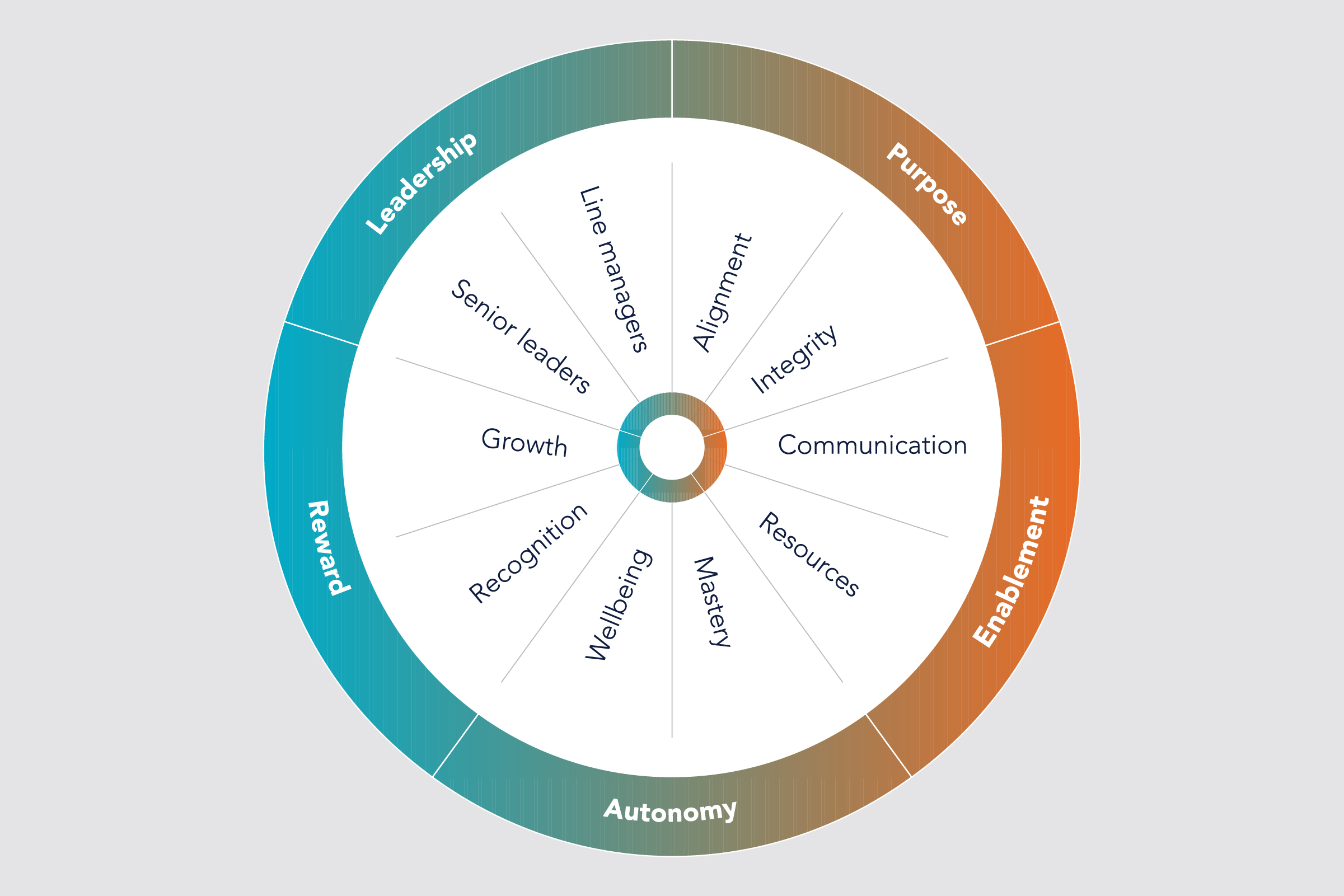
Our employee engagement statistics will be broken down into the categories of purpose, enablement, autonomy, reward and leadership, as per our own Pearl™ employee engagement model.
But first, some general statistics on the state of play when it comes to engagement. As a note, this list is updated yearly to reflect our comprehensive benchmark data and trends.
Check out our free employee survey questions
1. According to our own data, 83% of employees say that working at their company makes them want to do the best work they can — up 4% from 2025!
2. People Insight data also reveals 81% of employees are proud to say they work for their company — which is a very promising statistic in terms of employee retention.
3. On the topic of staff retention, we found 77% of employees say they would like to still be working for their company in two years’ time — up by 5% in just one year.
4. Across hundreds of thousands of data points, we discovered 91% of employees care about the future of their company.
5. Despite this, People Management and other sources share that only 10% of UK employees are engaged at work.
6. The Telegraph supports this, suggesting that 90% of Brits are either disengaged or actively disengaged at work.
7. The UK remains one of the least engaged workforces in Europe.
8. The benefits of employee engagement can’t be overlooked, with research showing that highly-engaged businesses are 21% more profitable than those without an engaged workforce..
9. Disengaged employees are costing the UK economy billions of pounds each year.
10. It seems employee surveys could help to alleviate this problem and that employees want to be heard, with 58% of employees saying they wish their employer would conduct employee engagement surveys.
Work is about more than just the money you get from it. We want our work to mean something. We want to contribute to something bigger than ourselves — preferably something that creates positive change. Purpose is a large part of what makes employees feel engaged. Let’s look at some vital statistics in this area.
11. When it comes to overall mission, our data shows an impressive 85% of employees understand the aims of their company.
12. While employees might understand the aims of the company, they don’t feel as in-the-know when it comes to company progress against these aims. Our benchmark data shows only 69% of employees know how their company is doing against its objectives.
13. One source highlights the importance of purpose — 70% of employed people say their sense of purpose comes from work.
14. Furthermore, the BBC has stated that 82% of employees believe it’s important their company has a purpose — so companies should be doing what they can to keep employees informed.
15. People Insight data shows a remarkable 85% of employees know how the work they do helps their company achieve its aims. This is great news, as we tend to find much more fulfilment in our work when we know that our efforts are helping to further something bigger.
Related case study: Charity Bank: Bringing people and purpose together
A large part of employee engagement is about whether or not we have what we need to perform our role well. Lacking the equipment or support to do your job can lead to frustration, confusion and, ultimately, disengagement.
16. Our data confirms that 77% of employees believe they have the equipment and resources needed to do their work properly. This assurance takes a lot of the strain off at work, allowing employees to simply get on with their jobs.
17. While employees feel well catered to when it comes to the physical and technological environment, communication is where it falls down. 86% of employees blame company failures on poor communication.
18. Our own data reflects that communication is an issue for companies at large, with only 54% of employees saying that communication is good between different teams, although this has improved from 46% in just one year, which shows promise.
19. Thankfully, there are tools to facilitate great communication. Organisations using effective internal communication tools are 3.5 times more likely to have better business results.
It’s not all about what we do. It’s about how we do it. Employees want to feel like they have a say over how they work. Giving employees autonomy and flexibility within their role can really pay off, as these employee engagement statistics show.
20. Our benchmark data shows across sectors, roughly 67% of employees believe their opinion is sought on decisions that directly affect their work. Giving employees a say over their environment and their employee experience can go a long way to boosting engagement in the long run.
21. Our data also shows 86% say they have the freedom required to get on with their jobs. This is clearly very promising. Micromanagement can be a real engagement killer, while flexibility helps employees to thrive.
22. The link between autonomy and employee engagement is supported by the study that shows employees are 12% more likely to report being happy with their job and engaged with their role when they have freedom and autonomy to do work in their own way.
23. When it comes to remote work, the data is clear. 32% of remote employees feel highly engaged, compared to 28% of employees working in a physical office.
24. This is supported by Harvard Business Review, which reports 77% of employees would prefer to work for a company that gives them the flexibility to work from anywhere.
25. HBR also shows 59% of employees believe flexibility is more important to them than salary or other benefits.
26. Health and wellbeing continues to be an area of focus for companies around the world. Our data shows 74% of employees believe their company does enough to support their health and wellbeing at work. This is a great start, but there is much more work to be done.
27. On the bright side, our data also shows 72% of employees are able to strike the right balance between work and home life.
28. Our data also suggests that, across sectors, 68% of employees say they can comfortably cope with workload.
Rewards aren’t only about money or perks. In fact, there are a lot of non-financial incentives that can motivate great performance. But this category of employee engagement also deals with growth and advancement. Employees want to develop and improve. If you’re not giving them the opportunity to do that with you, they might grow disillusioned and look for opportunities elsewhere.
29. Our data shows only 54% of employees are satisfied with the benefits that their company provides. It’s worth revisiting your employee value proposition regularly to see if the benefits you offer work for your employees, or if they are largely unused.
30. Our data reflects the reality that only 47% of employees are satisfied with the pay they receive for the work they do. This is particularly understandable given the financial pressure employees have been through lately.
31. Our data also shows only 51% of employees agree that their rewards are linked to their performance and contribution — meaning they could be putting in a lot of effort, but not seeing much in terms of reward or acknowledgement.
32. Like it or not, reward plays a significant role when it comes to employee engagement, with an incredible 79% of employees saying an increase in recognition rewards would make them more loyal to their company.
33. When it comes to recognition, the stats are a little more positive, with our benchmark data showing 61% of employees have received praise or thanks in the past week. A simple ‘thank you’ can go a long way to keeping employees motivated, and it costs nothing.
34. The importance of appropriate recognition can be seen by the fact that 79% of employees claim a ‘lack of appreciation’ as the reason for quitting their job.
35. We also know that employees who receive regular feedback are 2.8 times more likely to be engaged.
36. Furthermore, we have evidence to show that nearly 84% of employees feel recognition affects their motivation to succeed at work.
37. Our data shows 70% of employees feel valued and recognised, up 5% in the span of one year.
38. Reward isn’t all about flashy perks, of course. It’s about the opportunity to develop, train and advance. In fact, 59% of employees think training directly improves their performance.
39. We also know 86% of employees say they would switch employers for one which offered more opportunity to grow.
40. We have a lot of data to share in this area — our own data shows 72% of employees feel they have the training and development needed to do their jobs, which is a promising statistic.
41. Furthermore, our data shows 69% of employees feel they have the right opportunities to learn and grow at work.
42. Despite this, People Insight data shows only 57% of employees agree that their career development aspirations are being met in their current company.
We know that managers and senior leadership play a key role in employee engagement. This is why it’s so important to encourage emotional intelligence in leadership, and healthy relationships between managers and employees. The employee engagement statistics below show where we are currently and how we can improve.
43. When it comes to communication between leaders and employers, we know 32% of UK employees don’t have the confidence to put ideas forward to their managers. This could be due to a lack of psychological safety. Employees should feel free to speak up and make suggestions, to take calculated risks, without feeling that failure will cost them their jobs.
44. Another shocking statistic reveals 82% of employees don’t trust their manager to tell the truth, indicating a lot of work needs to be done to improve upon these relationships.
45. When it comes to our own data, we appear to have a mixed bag. Our data shows 68% of employees believe their senior leaders make a genuine effort to listen to staff. This indicates many employees feel heard, but there is still work to be done.
46. Our data also shows 73% of employees feel their senior leaders provide a clear vision of the overall direction of their company. To improve this, senior leaders can work on providing regular updates and insights as to the company’s direction and ambitions.
47. When it comes to feedback, managers are doing fairly well, with our data showing 68% of employees agree that their line manager gives regular feedback on how they’re doing.
48. Furthermore, our benchmark shows 65% of employees believe their line manager takes the time to coach them and develop their skills. As we know skills development and career aspirations are a large part of what makes an employee engaged, this is something to focus on moving forward.
49. On a positive note, our data shows 90% of employees think their line manager treats them fairly and with respect.
50. However, one area that managers and senior leaders appear to be falling short is follow through. For example, while employee surveys may be carried out, most employees don’t think they’ll have an impact, with only 59% of employees believing change will happen as the result of a survey. Despite the popular misconception, employees do want change — they just want meaningful, well-thought-out change. When employees don’t feel action is taken following a survey, employees can become disillusioned with the survey and the company in general.
Let’s take a quick look at the specific sectors we work with. Which ones are the most engaged and why? What are they doing right and where could they improve?
51. When it comes to workload, it appears that Hospitality, leisure and tourism is king, with 72% of employees saying that they can comfortably cope with their workload. Unfortunately, central government departments and agencies appear to be among the worst off, with only 60% agreeing that they can cope with their workload.
52. In terms of career development aspirations, the winning sector is property and real estate, with 63% saying that their aspirations are being met.
53. 78% of employees in the financial services sector say their manager gives them regular feedback on how they are doing, compared with only 57% in the engineering sector.
54. 83% of central government department employees say they have the equipment necessary to do their jobs, compared to only 59% in the publishing industry.
55. Managers clearly take the time to develop their teams int he financial services, with 71% of employees agreeing, compared to only 55% of those in media and entertainment.
56. 80% of employees in construction want to still be working in their company in two years’ time, compared to 64% of central government employees.
Now let’s take a look at men and women across the generations. How engaged are they and does it align with what you thought?
57. The younger generation (18-29) feel more heard than older generations (60+) by senior leadership. 65% of the younger generation say senior leaders make the effort to listen to staff, compared to just 54% of the older gen.
58. 73% of those aged 18-29 say that they have the right opportunities to learn and grow at work, compared with only 59% of those aged between 50-59.
59. Similarly, the same generations have opposite experiences of development opportunities, with 86% of the younger generation saying they can get the training and development needed to do their jobs, compared to only 68% of those aged 50-59.
60. It appears that we need to rethink our approach to health and wellbeing, particularly with regard to our more experienced employees. While 70% of those aged 29 and younger believe their company does enough to support their health and wellbeing, the same is true for only 62% of employees aged 50-59.
61. More women (68%) than men (65%) say they are able to strike the right balance between work and home.
62. 72% of women say their line manager gives regular feedback on how they are doing, compared to only 67% of men.
63. More women (61%) than men (56%) say their career development aspirations are being met.
64. Women (61%) also tend to receive more praise for their work than men (56%).
65. However, it seems that more men (62%) than women (60%) believe that senior leaders make the effort to listen to staff.
These employee engagement statistics paint a thorough overall picture of employee engagement within the UK. While there certainly are areas for improvement, there is also evidence that managers and senior leaders are putting in the effort required to revolutionise and enhance the employee experience.
To find out how we can help you improve levels of employee engagement at your company, get in touch for an employee engagement survey. We work with you after survey completion to help you enact real change your employees will truly appreciate.
Other engagement reads you’ll love:
7 Features to look for in employee engagement software
Employee experience vs employee engagement
14 Signs of disengaged employees