

















Blogs:

How to interpret your employee survey results

Your survey results have arrived! Now it’s time to make sense of them.

Making sense of your employee survey results

    A quick insight: Interpreting survey results well turns data into action. It means looking beyond scores to understand patterns, root causes and what matters most to your people. This guide explains how to make sense of survey results, spot meaningful insights, avoid common pitfalls and use findings to inform decisions that improve experience, engagement and business outcomes.

    Employees have taken the time to share honest feedback about their experiences, expectations and concerns. The challenge is turning that information into something useful. Interpreting survey results properly and meaningfully means understanding what the data is telling you, where the most important patterns sit and what should happen next.

    This guide explains how to interpret survey results in a practical, structured way so you can move from feedback to meaningful improvement.

    Related:Download our guide on how great managers follow up survey results with their teams

    What you should know about your employee survey results

    Survey results are the scores, comments and patterns collected through a survey, used to understand what employees are experiencing and where action is needed.

    That includes:

    • top-line scores
    • question-level results
    • differences between groups
    • trends over time
    • open-text comments
    • benchmark comparisons

    On their own, survey results are just information. Their value comes from how well they are interpreted and what happens after that.

    Employee survey results have the power to drive change

    Survey results are one of the clearest ways to understand what employees are experiencing across the organisation.

    Done well, they can help you:

    • understand what is working and what is not
    • identify strengths to protect
    • uncover the drivers behind engagement or disengagement
    • spot emerging risks
    • compare teams, groups and trends over time
    • focus action where it is most likely to make a difference

    But survey results are only valuable if they are interpreted well. Without context, teams can overreact to one low score, miss deeper patterns or focus on things that feel urgent rather than things that are actually most important.

    Where to start with your survey results

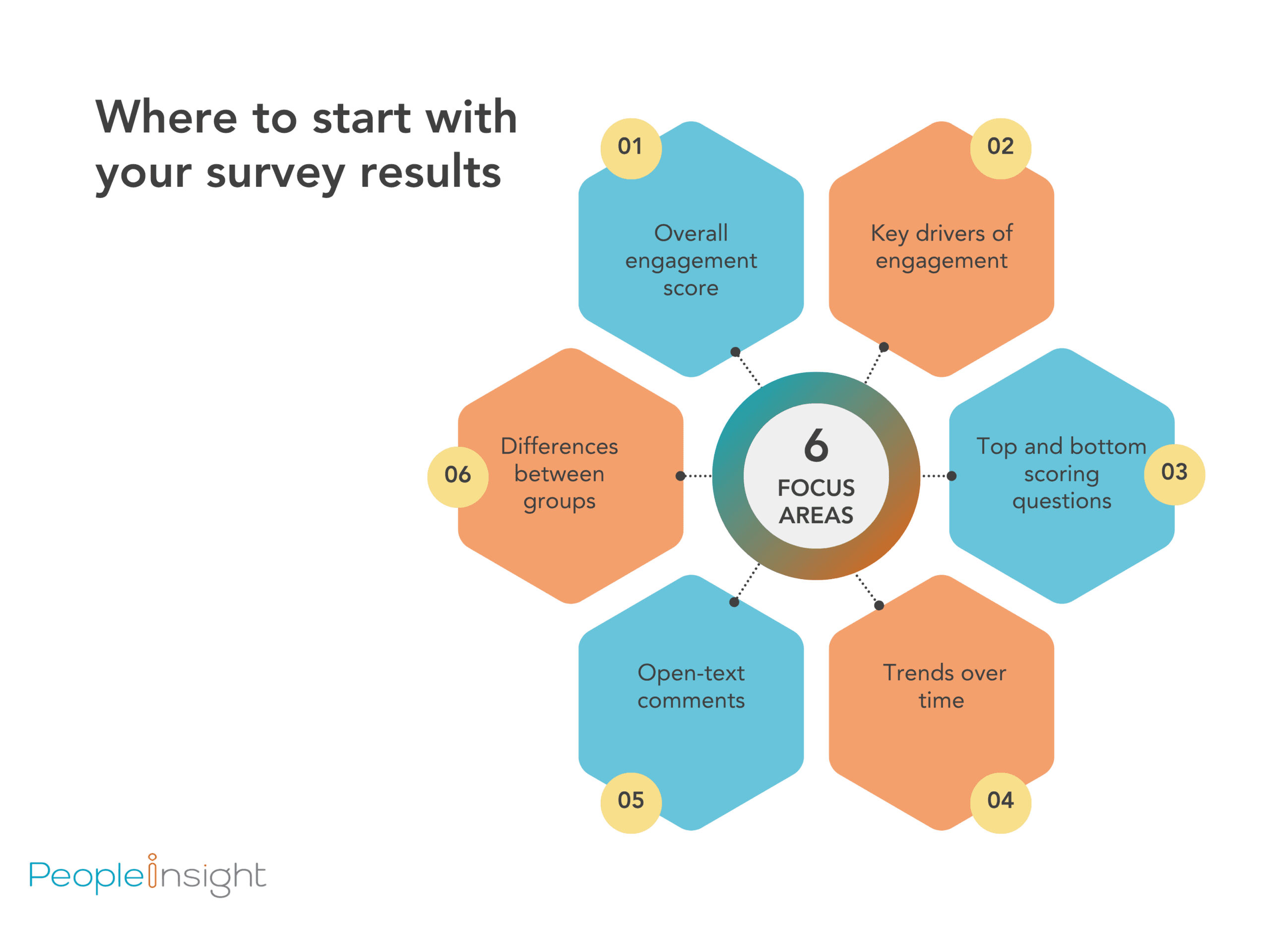
    Employee survey results can contain a huge (at times perhaps overwhelming) amount of data. Rather than trying to tackle everything at once, it helps to focus first on a few areas that are most likely to shape employee experience, employee engagement and organisational performance.

    Here’s where to start:

    Where to start with your survey results

    1. Overall engagement score

    Your overall employee engagement score gives you a high-level view of how employees feel about working in your organisation.

    If you have run previous staff surveys, compare the latest results to earlier ones so you can see whether things are improving, holding steady or declining. External survey benchmark data can also help you understand how your organisation compares with others in your sector.

    2. Key drivers of engagement

    Not all questions matter equally.

    Some themes will have much more influence on overall engagement than others. Leadership, communication, development, recognition or workload may be shaping scores more strongly than expected. A key driver view helps you see where attention is likely to have the greatest effect.

    This is where people analytics becomes especially useful. If you want to move beyond surface-level reporting, it helps to understand which themes are most strongly linked to the outcomes you care about.

    3. Top and bottom scoring questions

    Your highest and lowest scoring questions can reveal a lot, but they need to be handled carefully.

    A very low score may look alarming, but it is not always the right place to start. For example, questions about pay often score lower, but may not be the most actionable issue in the short term. Focus first on items that are both low-scoring and strongly linked to wider outcomes such as engagement, trust or retention.

    4. Trends over time

    A single survey gives you a snapshot. Trends tell you whether the picture is changing.

    If a team’s results have dropped steadily over two survey cycles, or if confidence in communication has improved since the last survey, that gives you something much more useful than a one-off percentage. Trends help show whether your actions are having an effect.

    5. Open-text comments

    Comments add a great deal of important context to survey results.

    Scores can show you where something is strong or weak. Comments help explain the why. They can reveal repeated frustrations, examples of good practice and the real-world experiences sitting behind the numbers.

    This is also where Prism can really help. Rather than leaving teams to work through hundreds or thousands of comments manually, Prism (our integrated AI) helps surface patterns, group themes and highlight what may need attention first.

    6. Differences between groups

    Survey results are rarely experienced evenly across the organisation.

    Averages can hide important differences between departments, job levels, locations or demographics. That is why it helps to compare results across groups wherever reporting thresholds make that possible. These differences often point to the practical issues that need the most attention.

    A real-world, practical framework for interpreting survey results

    To make survey results easier to work with, it helps to follow a structured sequence.

    1. Look for patterns, not just scores

    The aim is not to react to every number. It is to understand what patterns are emerging.

    Ask:

    • Which themes keep appearing across scores and comments?
    • Are there repeated concerns in the same area?
    • Are some issues isolated or widespread?
    • Which strengths appear consistently across teams?

    Related: Check out our guide on Marrying data competency with real human conversations 

    2. Add context before drawing conclusions

    A score is never the whole story on its own.

    To interpret survey results well, add context by looking at:

    • previous surveys
    • benchmark comparisons
    • group differences
    • comments
    • current organisational events or pressures

    This helps avoid knee-jerk reactions and supports more grounded decision-making.

    3. Prioritise what matters most

    Once patterns are clearer, the next step is prioritisation.

    You do not need to act on everything at once. In fact, trying to do too much usually weakens follow-through. Focus on the issues that are:

    • most strongly linked to engagement or experience
    • affecting the greatest number of people
    • realistic to improve
    • important enough to build trust if addressed visibly
    4. Translate insight into action

    This is the point where survey results either become useful or stall.

    Once you know what matters most, you need to turn that insight into a practical post-survey action plan. That means identifying a small number of priorities, assigning ownership and communicating next steps clearly.

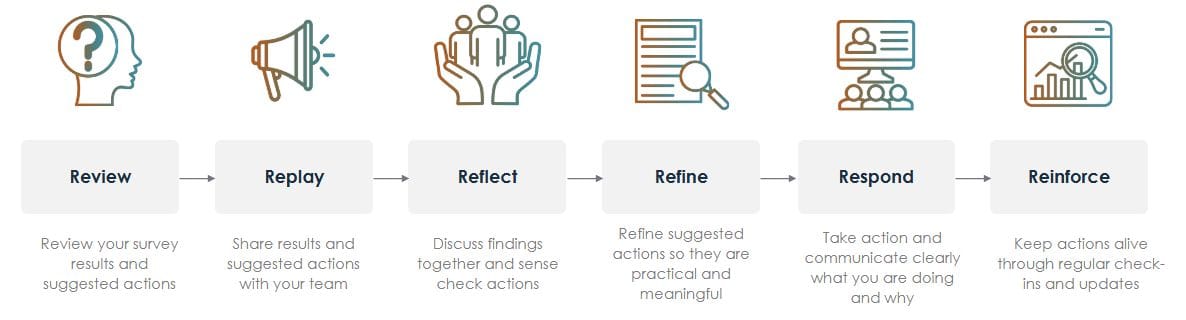
    At People Insight, this is where our 6 Rs framework can help:

    6 Rs action planning

    • Review
    • Replay
    • Reflect
    • Refine
    • Respond
    • Reinforce

    This structure helps organisations move from reporting to visible progress in a more consistent way.

    How Prism helps you interpret survey results

    Prism helps organisations move from raw survey data to clearer understanding and more focused action.

    It does that in three connected ways:

    Prism Suggest

    Prism Suggest helps identify where focus is most needed. When results contain multiple themes, mixed signals or large volumes of data, it helps surface the issues most likely to deserve attention first.

    Prism Context

    Prism Context helps explain what sits behind the scores. It brings together qualitative, quantitative and historical feedback so leaders can understand not just what has scored low or high, but what may be driving that result.

    Prism Improve

    Prism Improve helps teams turn insight into action. It supports the move from interpretation to practical next steps, helping managers and leaders focus on actions that are realistic, relevant and easier to follow through.

    Together, these parts of Prism help reduce the gap between survey results and meaningful progress. Instead of leaving teams to interpret everything manually, Prism helps make the data clearer, the priorities sharper and the next steps easier to define.

    Common biases that affect how people interpret survey results

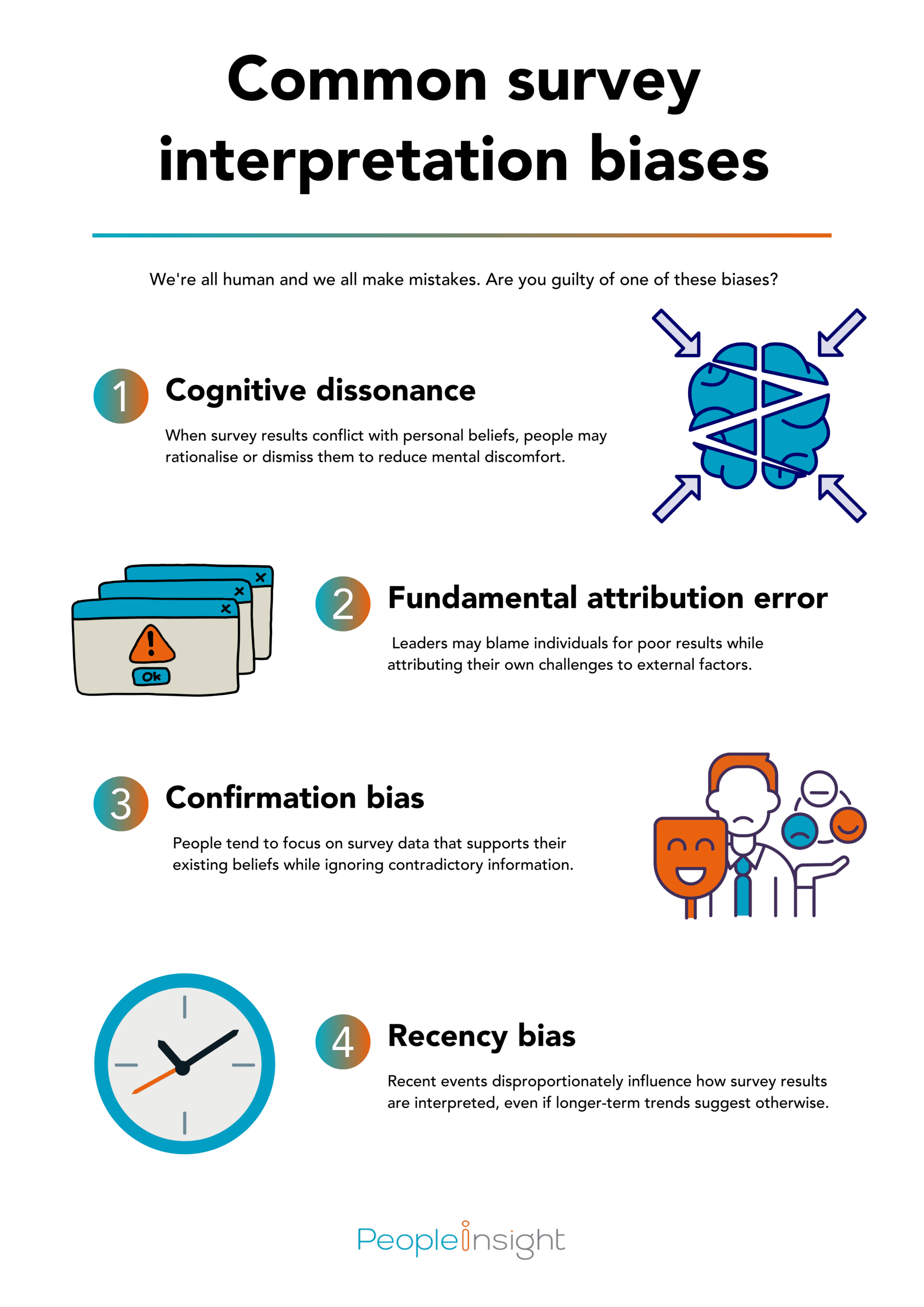
    Interpreting survey results objectively is not always easy. A few common biases can get in the way.

    Common survey interpretation biases

    Cognitive dissonance

    When results do not match someone’s self-image or assumptions, it can be tempting to explain them away. For example, a manager who sees themselves as supportive may struggle to accept weak leadership scores.

    Fundamental attribution error

    This happens when people blame others for problems without considering the wider context. A low score in one team may reflect more than just one manager or one department.

    Confirmation bias

    If leaders expect a certain outcome, they may focus on results that confirm what they already believe and downplay the rest.

    Recency bias

    Recent events can distort interpretation. A new initiative launched just before the survey may seem more influential than it really is, or a difficult month may overshadow a broader longer-term pattern.

    Being aware of these biases helps teams interpret survey results more fairly and act more intelligently.

    What to do if survey results are negative

    Negative survey results are not a failure. It’s all just more information, and information is always useful and valuable.

    Low scores or critical comments can feel uncomfortable, but they are often where the greatest opportunity sits. If employees are willing to raise concerns honestly, that gives you something valuable to work with.

    If your survey results are negative:

    • acknowledge concerns without becoming defensive
    • focus on solutions rather than blame
    • use comments and follow-up conversations to understand the issue more clearly
    • communicate what will happen next
    • avoid trying to fix everything at once

    Handled well, negative results can help strengthen psychological safety because employees see that speaking honestly leads to serious attention rather than avoidance.

    How to act on survey results effectively

    Survey results only create value when they lead to meaningful action.

    1. Communicate the results transparently

    Employees want to know their feedback has been heard. Share the key findings openly, including both strengths and improvement areas. Avoid defensiveness. Be clear about where you need to improve and how you will approach it.

    2. Prioritise two or three key areas

    Do not try to tackle everything at once. Focus on two or three actions that are realistic and likely to have the greatest impact.

    3. Encourage leadership accountability

    HR should not be the only function interpreting survey results. Leaders and managers need to engage with the findings, take responsibility for their part and be involved in shaping action.

    4. Embed changes into daily work

    Survey action should not be a one-off event. It should show up in meetings, one-to-ones, team priorities and regular updates. This is where strong survey communications support can make a real difference.

    5. Measure progress

    Track movement over time to see whether your actions are working. Pulse surveys and lighter check-ins can help maintain momentum between larger survey cycles.

    What People Insight’s benchmark data can add

    People Insight’s benchmark data can help sharpen interpretation by showing where an issue is likely to be more than a one-off frustration.

    For example, our 2025 benchmark data shows:

    • only 53% of employees believe action will be taken as a result of the survey
    • only 60% say senior leaders make the effort to listen to staff
    • only 46% say communication is good between teams
    • only 59% say their career development aspirations are being met

    These findings point to some of the common areas where organisations struggle to turn feedback into trust, clarity and visible progress, and knowing this really helps when it comes to interpreting survey results. A low score in one of these areas may not just be a local issue. It may reflect a more familiar organisational challenge that needs deliberate attention.

    Case study examples: what good interpretation looks like in practice

    Strong interpretation is not just about analysis. It is about what happens next.

    At Brewin Dolphin, survey insights helped the organisation focus on inclusion and involvement, with follow-up work designed to make the culture feel more open and participative.

    At London South Bank University, survey results were used to support local action, helping managers understand what mattered most in their areas and respond more visibly.

    At King’s College London, stronger communications and clearer manager guidance helped results land more effectively and made it easier for teams to discuss findings constructively.

    These examples show the same principle: survey results become more valuable when interpretation is combined with accountability, communication and follow-through.

    How to know if your survey results are being used well

    You are probably interpreting survey results well if:

    • leaders understand the key patterns
    • priorities are clear
    • employees hear what was learned
    • managers know what they are expected to do
    • actions are visible
    • progress is reviewed over time

    If none of that is happening, the issue may not be the survey itself. It may be the way the results are being handled afterwards.

    Improve the way you interpret survey results with People Insight

    Interpreting survey results well takes more than a dashboard. It takes context, curiosity, honest discussion and a practical route to action.

    At People Insight, we help organisations understand survey results more clearly through stronger reporting, benchmark context, Prism-powered analysis and practical follow-through, helping leaders move from data to insight, and from insight to meaningful improvement.

    Want to get more value from your survey results? Get in touch to learn how People Insight can help you interpret feedback more clearly and act on it with confidence.

    FAQs about survey results

    How do you interpret survey results?

    You interpret survey results by looking beyond top-line scores to understand patterns, trends, comments, key drivers and differences between groups. The aim is to identify what matters most and what action is likely to make the biggest difference.

    What should you look at first in survey results?

    A good place to start is your overall engagement score, key drivers, top and bottom scoring questions, trends over time, open-text comments and any meaningful differences between teams or groups.

    Why are survey comments important?

    Survey comments add context to the numbers. They help explain why employees answered the way they did and often reveal practical issues that scores alone cannot show.

    What do you do if survey results are negative?

    If survey results are negative, acknowledge the concerns, avoid defensiveness, dig deeper into the root causes and focus on a small number of clear, visible actions.

    How do you turn survey results into action?

    You turn survey results into action by identifying the most important priorities, assigning ownership, communicating next steps and reviewing progress over time.

    What are common mistakes when interpreting survey results?

    Common mistakes include focusing too much on one score, reacting defensively, ignoring comments, overlooking trends or group differences and trying to act on everything at once.

    How can People Insight help with survey results?

    People Insight helps organisations interpret survey results through clearer reporting, benchmark context, Prism-powered analysis and practical action planning support that turns feedback into meaningful progress.