



















Blogs:

What is a pulse survey and what are the benefits?

Let’s explore best practices, the benefits of carrying them out and why they can go wrong.

What is a pulse survey and what are the benefts

    A quick insight: Employee pulse surveys provide frequent, focused feedback that helps you stay close to how people are feeling and what matters most right now. They support sharper listening by giving organisations a more regular view of employee experience, and smarter action by helping leaders respond, refine and track progress over time.

    We all know employee engagement has a direct impact on performance, retention and the wider employee experience. We also know organisations that regularly monitor workforce sentiment are better placed to respond early, make better decisions and create stronger workplaces over time. That is one of the reasons employee surveys remain such an important part of a strong listening strategy.

    While annual engagement surveys still have an important role to play, pulse surveys give organisations something different: a more dynamic, more regular way to understand what employees are experiencing right now. And with the right pulse survey tool behind them, that feedback becomes easier to analyse, easier to act on and easier to track over time.

    That is where pulse surveys fit so naturally with our philosophy of Sharper listening. Smarter action.

    Pulse surveys support sharper listening because they give organisations more frequent, more focused insight into what is changing across the employee experience. They support smarter action because that regular feedback makes it easier to refine decisions, test whether actions are working and respond before smaller issues become larger problems.

    Let’s take a closer look at what a pulse survey is, the real benefits it can bring, how a pulse survey tool should support the process and how to avoid the most common mistakes.

    For a quick overview, here’s Kate Pritchard, our Head of Consultancy, discussing the value of pulse surveys: 

    What is a pulse survey?

    A pulse survey is a short, focused survey designed to gather regular feedback from employees on specific aspects of their experience at work. Unlike broader staff surveys or annual engagement surveys, pulse surveys are deliberately brief and are usually run at regular intervals such as monthly or quarterly. They often focus on themes like wellbeing, workload, communication, leadership or change.

    The aim is to take the “pulse” of the organisation. In other words, to understand how people are feeling right now, what is changing and where action may be needed sooner rather than later. Pulse surveys help organisations maintain an ongoing conversation with employees rather than relying on one large survey moment each year.

    A simple definition

    A pulse survey is a short, regular employee survey used to track sentiment, gather focused feedback and highlight issues or improvements in real time.

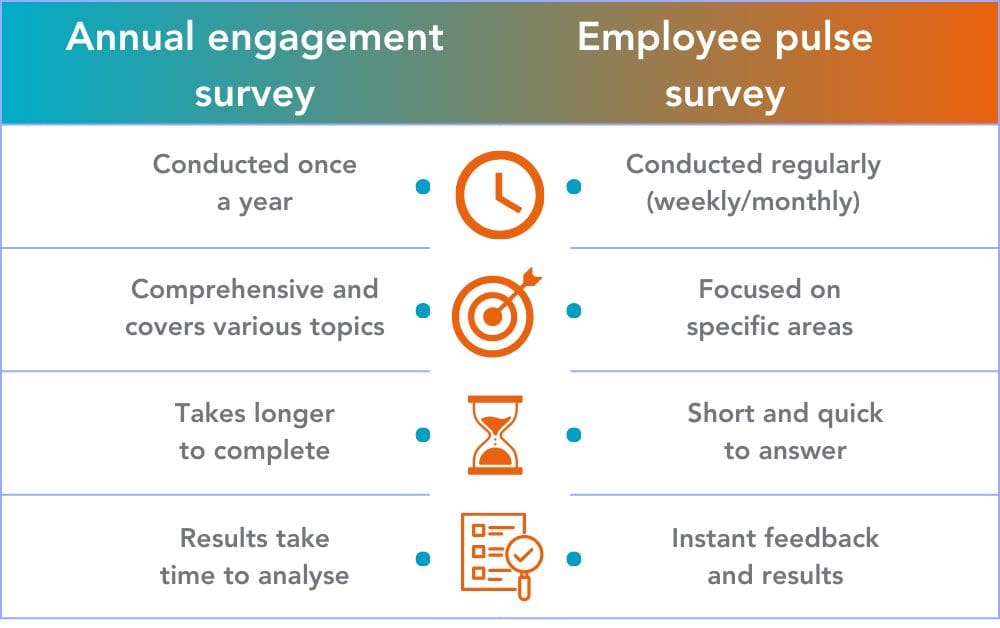
    What makes a pulse survey different?

    A pulse survey is different from a traditional employee engagement survey because it is:

    • shorter
    • more targeted
    • more frequent
    • designed to monitor change over time

    That makes it especially useful when organisations want to explore a specific issue, track the impact of an initiative or stay closer to how people are feeling between larger surveys.

    pulse table

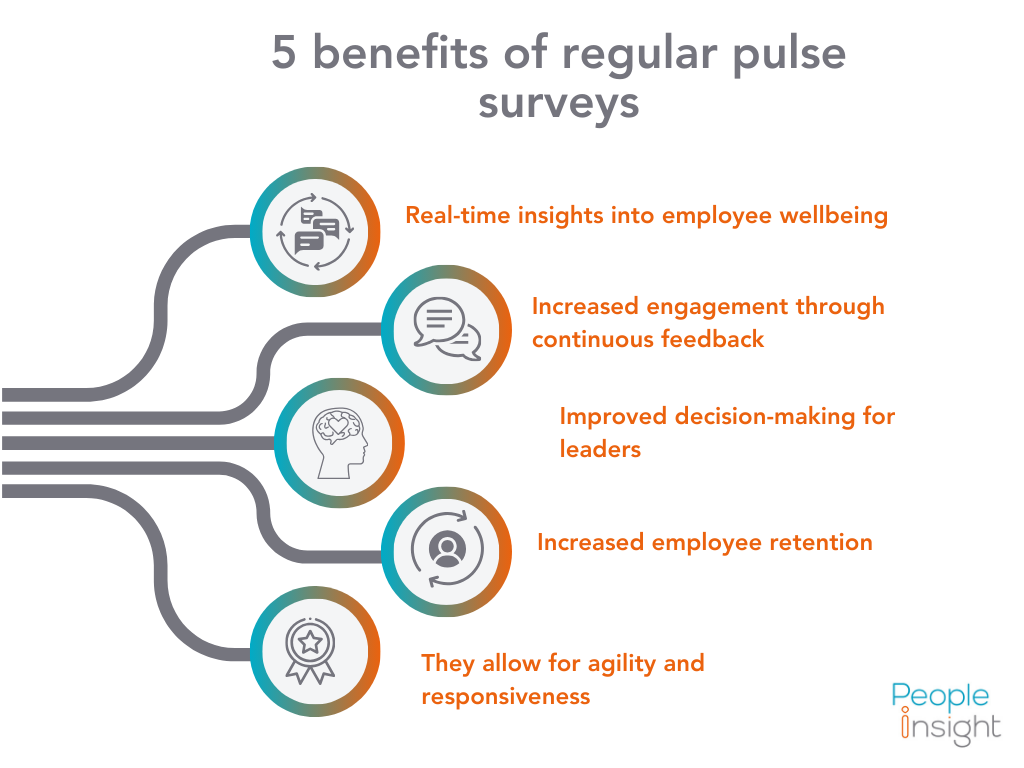
    5 benefits of regular pulse surveys

    First things first. Let’s look at the real benefits a pulse survey can bring to your organisation, your people and your decision-making.

    5 benefits of regular pulse surveys

    1. Real-time insights into employee wellbeing

    One of the clearest benefits of a pulse survey is the ability to stay much closer to employee wellbeing.

    Because pulse surveys happen more frequently, they make it easier to identify emerging issues before they become larger problems. That might include increased stress, falling morale, concerns about workload or shifts in how supported employees feel. Instead of waiting for the next large survey cycle, organisations can see those changes earlier and respond more quickly. 

    2. Increased engagement through continuous feedback

    Pulse surveys can help create a culture of continuous feedback. When employees are asked for their views regularly, and can see that those views are taken seriously, it reinforces the idea that employee voice matters.

    This is one of the reasons pulse surveys can support engagement so effectively. They do not just collect opinion. They help create a more consistent listening rhythm, where employees feel heard more often and leaders have more opportunities to respond.

    Check out our Brewin Dolphin case study and how they built an involving and inclusive culture through surveys 

    3. Improved decision-making for leaders

    Leadership teams benefit from pulse surveys because the data is more current and more focused.

    That makes pulse survey feedback particularly useful when organisations need to make decisions around policy, communication, people management or support. If a pulse survey shows a clear shift in sentiment around a specific issue, leaders are in a stronger position to respond before the problem has a wider effect on morale or performance.

    4. Dig into specific issues

    Pulse surveys are especially useful when you need targeted feedback on a particular topic.

    An annual survey can give you a broad picture of engagement, culture, inclusion or wellbeing. A pulse survey lets you go deeper into one area at the moment it matters. That might be a change programme, a return-to-office policy, a leadership transition, a workload concern or a new employee benefit.

    5. Report on new pilot programmes

    Another big benefit of pulse surveys is that they make it easier to monitor whether new initiatives are actually working.

    If you launch a new programme, introduce new company values, test a new leadership approach or trial a wellbeing initiative, a pulse survey can help you track how employees are responding at regular intervals. That gives leaders better evidence and makes it easier to refine the approach over time (see how Fuller’s did this here)

    How pulse surveys support sharper listening and smarter action

    Pulse surveys are a very good example of Sharper listening. Smarter action. in practice.

    They support sharper listening because they give organisations more regular, more focused feedback on what employees are experiencing right now. Rather than waiting for one annual view, leaders can hear what is changing as it happens.

    They support smarter action because that frequent feedback makes it easier to:

    • refine priorities
    • respond earlier
    • test whether changes are working
    • adjust action plans before issues grow
    • keep employee listening more connected to day-to-day reality

    This is where the right pulse survey tool matters.

    A pulse survey tool should not just make it easy to send short surveys. It should help you understand trends, interpret comments, compare changes over time and support action planning at a pace the organisation can sustain.

    At People Insight, Prism strengthens that process by helping organisations summarise comments at scale, add context to results and identify clearer next steps. That means pulse surveys do not just generate more data. They generate clearer priorities.

    What should you look for in a pulse survey tool?

    A pulse survey is only as useful as what happens next. That is why choosing the right pulse survey tool matters.

    A strong pulse survey tool should help you:

    • launch short, targeted surveys quickly
    • segment results clearly across teams and groups
    • combine scores with employee comments
    • track movement over time
    • support action planning after each pulse
    • avoid survey fatigue through sensible cadence and design

    The best pulse survey tools do not just help you measure employee engagement. They help you listen well and act well.

    At People Insight, pulse surveys sit within a broader employee listening approach. That means organisations can run more frequent feedback cycles without losing sight of the bigger picture. Pulse surveys, broader employee surveys, Prism-powered comment understanding and consultancy support all work together to help leaders turn insight into meaningful improvement.

    Best practices for implementing pulse surveys

    Pulse surveys can be extremely useful, but only when they are implemented thoughtfully. 

    1. Keep them short and focused

    Pulse surveys should be brief. Aim for a small number of targeted questions on a clearly defined theme. That helps improve response rates, keeps the feedback focused and makes it easier to act on what comes back.


    2. Ask clear, actionable questions

    Questions should be easy to understand and closely tied to something the organisation can explore or change. If the wording is vague or too broad, the results will be less useful.

    3. Survey regularly, but not too often

    Monthly or quarterly pulse surveys are common, but there is no single perfect rhythm. The right cadence depends on what you are measuring, how quickly things are changing and whether the organisation has time to absorb the feedback and act on it. 

    4. Ensure anonymity

    Employees need to feel safe to answer honestly. If trust is weak, the data will be weaker too.

    5. Communicate the purpose clearly

    Employees are more likely to take part when they understand why the survey is happening and how the feedback will be used. Good communication helps build trust and encourages participation.

    6. Act on the results

    This is the most important point.

    Pulse surveys only create value when organisations use the findings well. That means reviewing the feedback, deciding what to prioritise, communicating next steps and showing employees that their voice leads to visible action. 

    4 pitfalls to avoid with employee pulse surveys

    Pulse surveys can go wrong when organisations treat them as easy to send but harder to sustain. 

    1. Survey fatigue

    If surveys are too frequent, too long or too repetitive, employees will disengage from the process.

    2. Collecting data but doing nothing with it

    This is one of the biggest risks. If people keep giving feedback and see no visible response, trust drops and participation tends to fall.

    Lloyds Banking Group changed up their pulse survey approach after realising that managers were left with little time to take any action between surveys:

    “…the problem with conducting such frequent surveys “was that [the firm’s approximately 8,000] line managers weren’t gaining any new insights and didn’t have time to digest that much data and take action” on what the latest employee polls told them.”

    —  David Littlechild, previously Head of Culture and Engagement at Lloyds

    3. Asking too many questions

    Pulse surveys work best when they stay focused. If you try to cover too much in one pulse, the survey becomes less useful and more burdensome.

    4. Not leaving room for comments

    Comments add important context. Scores can tell you where to look, but comments often tell you why people feel the way they do. This is one of the reasons Prism is so useful in the pulse survey process. It helps teams work through qualitative feedback at scale and turn open-text responses into clearer insight.

    Pulse surveys work best when they are part of a wider listening strategy

    A pulse survey is not a replacement for every other listening method. It works best as part of a broader strategy.

    Annual engagement surveys still have an important role in giving organisations a deeper, more comprehensive picture. Pulse surveys then help maintain momentum between those larger listening moments. They let organisations explore specific issues, track change over time and refine action more regularly.

    That combination is powerful:

    • broader surveys help you understand the bigger picture
    • pulse surveys help you stay close to what is changing
    • Prism helps you interpret comments and context more quickly
    • stronger action planning helps you respond in a more focused way

    That is how pulse surveys contribute to sharper listening and smarter action.

    Improve employee listening with People Insight

    Pulse surveys are valuable because they help organisations gather more regular feedback, understand what is shifting and respond with greater confidence.

    When they are well designed, run at the right cadence and supported by the right pulse survey tool, they become much more than a quick temperature check. They become a practical way to improve listening, refine action and keep employee feedback connected to meaningful change.

    At People Insight, we help organisations design and run pulse surveys that are focused, useful and actionable. Through our survey platform, Prism and consultancy support, we help leaders turn frequent feedback into clearer priorities and better decisions.

    If you’ve enjoyed this post, check out our webinar on how pulse survey insights improve employee experience in Higher Education

    Want to build a stronger pulse survey approach in your organisation? Get in touch to learn how People Insight can help you listen more clearly and act more confidently.

    FAQs about pulse surveys

    A quick run down on all you need to know

    What is a pulse survey?

    A pulse survey is a short, focused employee survey used to gather regular feedback on specific aspects of work, such as wellbeing, communication, leadership or change.

    What are the benefits of a pulse survey?

    Pulse surveys help organisations gather faster insight, track changes over time, spot issues earlier and respond more quickly to employee feedback.

    How often should you run a pulse survey?

    Many organisations run pulse surveys monthly or quarterly. The right frequency depends on what you are measuring, how quickly things are changing and whether leaders have time to act on the results.

    What should a pulse survey tool include?

    A strong pulse survey tool should support quick survey delivery, clear reporting, segmentation, employee comments, trend tracking and action planning.

    What is the difference between a pulse survey and an employee engagement survey?

    An employee engagement survey is usually broader and less frequent. A pulse survey is shorter, more targeted and run more regularly to track specific themes or changes over time.

    Can pulse surveys improve employee engagement?

    Yes, when they are used well. Pulse surveys can improve engagement by helping organisations listen more regularly, respond earlier and show employees that feedback leads to action.

    How does People Insight support pulse surveys?

    People Insight combines employee listening expertise, global benchmark data, expert consultant support and in-platform AI through Prism. Prism helps organisations identify priorities, understand findings and support action planning, while our consultants help ensure the data is interpreted responsibly and turned into meaningful improvement.

    Trusted By

    bernard matthews
    British red cross
    greggs 01
    bidfood
    barbour
    muller
    gdf suez
    brewin dolphin
    molnlycke
    provident financial group
    moy park
    seaco
    vision express
    gilead
    jupiter asset management
    nhs supply chain
    dcc
    pladis - employee engagement for manufacturing
    southampton fc
    sunbelt rentals
    St john ambulance
    walgreens boots alliance
    lse
    loughborough university
    university of manchester
    university of birmingham
    university of southampton
    london school of hygiene and tropical medicine
    university of st andrews
    university of london
    wolseley
    Aman
    car finance 247
    the nottingham
    Cote brasserie
    west midlands police
    Autogrill 1 01
    john laing
    vivid homes
    quorn
    anchor
    action for children
    virgin active 1
    park plaza
    the belfry hotel resort