



















Our experienced team works alongside organisations to help them design, deliver and communicate their listening programmes. From survey distribution to strategic guidance, we’re here when you need us
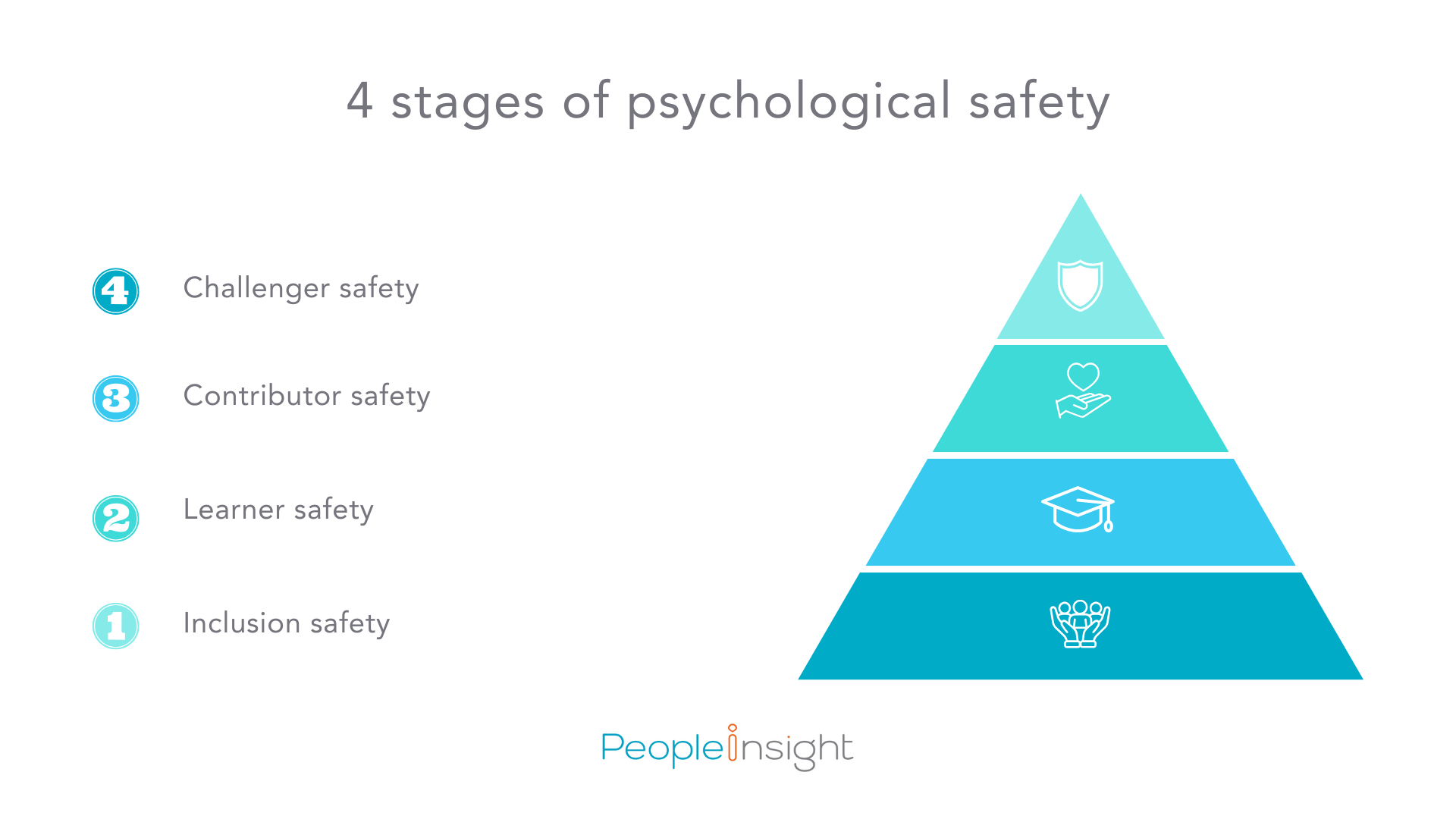
A quick insight:Psychological safety grows in stages, from basic inclusion and connection through learning, contribution and full voice where people speak up without fear. Each stage builds trust and strengthens collaboration by making it easier for people to share ideas, ask questions and raise concerns. Understanding these stages helps leaders foster environments where people feel safe, confident and genuinely part of the team.
We talk about the importance of psychological safety a lot here at People Insight … what it is, what it influences and how to build healthy levels within your workplace. But what we haven’t explored about this complicated and fascinating topic are the four different stages of psychological safety and how focusing on each stage can help to create empowered, dynamic teams.
Psychological safety is one of the most significant factors influencing employee engagement, collaboration and innovation. A workplace that prioritises psychological safety inevitably sees higher levels of productivity, lower turnover rates and increased staff wellbeing.
To create a culture where employees feel comfortable speaking up, taking risks and contributing their best work, organisations need to understand the four stages of psychological safety. Each stage represents a step in building an environment where individuals feel safe to express themselves without fear of judgement or punishment.
In this blog, we explore the four stages of psychological safety and the role leaders play in supporting employees through each stage.
Let’s take a thorough look at each stage of psychological safety, while also exploring how to work toward each stage within your organisation.
Stage 1: Inclusion safety
The foundation of psychological safety is inclusion. Employees must feel accepted and valued before they can fully engage in their roles, or with their company. Inclusion safety means individuals believe they belong within a group and that their presence is acknowledged and respected.
When employees do not feel included, they are less likely to share ideas or participate in discussions. One source suggests that as many as 57% of employees have witnessed discrimination or a lack of inclusivity at work. Our own benchmark data shows that across sectors, 31% of people don’t believe that all people are treated fairly and equally at their organisation, leading to decreased engagement and productivity.
How to strengthen inclusion safety
Promote diversity and equity – Representation matters. When employees see diversity in leadership and across the organisation, they feel more included. Our own diversity and inclusion surveys can help here (one of the many survey types we offer).
Encourage active listening – Employees need to feel that their voices are heard. Leaders should actively seek input from all employees, not just those who are most vocal.
Address bias in decision-making – Bias, whether conscious or unconscious, can exclude certain employees from opportunities. Structured processes can help reduce bias in hiring, promotions and daily interactions.
Celebrate individual differences – Acknowledging different backgrounds, experiences and perspectives builds a culture of acceptance.
When inclusion safety is established, employees can move to the next stage — feeling safe to learn.
Stage 2: Learner safety
Once employees feel included, they need to feel safe to ask questions, make mistakes,and engage in learning experiences. Learner safety creates an environment where curiosity is encouraged and employees are not penalised for not knowing everything.
Organisations with high learner safety embrace a growth mindset — believing that skills and intelligence can be developed with effort and learning. This stage is particularly important in industries where innovation and adaptability are key.
How to enhance learner safety
Encourage a culture of feedback – Employees should feel comfortable seeking feedback and giving it without fear of negative repercussions.
Reframe mistakes as learning opportunities – Instead of blaming employees for errors, leaders should treat mistakes as valuable learning experiences.
Provide continuous learning opportunities – Offering training programmes, mentorship and development resources shows employees that learning is supported.
Set the example at the leadership level – When leaders openly share their learning experiences and admit when they don’t have all the answers, it signals to employees that it’s safe to do the same.
Research shows that psychological safety improves employees’ willingness to take risks in learning environments, which is crucial for problem-solving and innovation. When learner safety is established, employees feel ready to apply their knowledge and contribute.
Stage 3: Contributor safety
Employees who feel safe to learn must also feel safe to contribute. Contributor safety means employees have the confidence to use their skills, voice their opinions and add value to the organisation without fear of being ignored or ridiculed.
In environments lacking contributor safety, employees may hesitate to share ideas due to concerns about judgement or lack of recognition.
How to reinforce contributor safety
Give employees autonomy – Empowering employees to take ownership of projects builds confidence and motivation.
Recognise and reward contributions – Employees who feel their work is valued are more likely to continue contributing. Acknowledging efforts through verbal recognition, rewards or career growth opportunities is key.
Create psychological contracts – Unspoken agreements that employees will be treated with respect when they speak up help build trust and confidence.
Encourage diverse perspectives – Leaders should actively invite differing viewpoints and ensure all contributions are considered.
When employees feel confident contributing, they reach the final and most advanced stage of psychological safety — the ability to challenge existing ideas and push for change.
Stage 4: Challenger safety
The highest level of psychological safety is challenger safety, where employees feel secure enough to question processes, suggest improvements and challenge the status quo. This is incredibly important and necessary when it comes to innovation and continuous improvement.
Without challenger safety, organisations risk stagnation. Employees may notice inefficiencies or better ways to approach tasks but remain silent due to fear of repercussions. A lack of challenger safety is one of the key reasons organisations struggle to innovate.
How to build challenger safety
Encourage respectful debate – Employees should feel comfortable challenging ideas in a way that is constructive and solutions-focused.
Make it safe to challenge authority – Employees should not fear backlash when questioning leadership decisions. Leaders must respond with openness rather than defensiveness.
Act on employee suggestions – If employees consistently see their ideas dismissed, they will stop speaking up. Structured processes should be in place to evaluate and implement employee suggestions.
Train leaders to embrace dissent – Leaders must shift their mindset from seeing challenges as threats to viewing them as opportunities for improvement.
Should organisations aim for all 4 stages of psychological safety?
In short, the answer is a resounding ‘yes’. Organisations that want to build a culture of trust and innovation should aim to help employees reach all four stages of psychological safety. Each stage builds on the one before it — without inclusion safety, employees are unlikely to engage in learning. Without learner safety, they may hesitate to contribute ideas. Without contributor safety, they are unlikely to challenge the status quo.
While all four stages are important, some are harder to achieve than others. Many organisations succeed in establishing inclusion safety by promoting diversity and equity and creating a welcoming environment. However, moving beyond inclusion to learner safety can be more difficult, especially in workplaces where mistakes are penalised. Challenger safety is often the hardest stage to reach, as it requires a workplace culture where questioning leadership decisions is not only accepted but encouraged.
What happens if employees only experience one stage? A workplace that offers only inclusion safety might feel welcoming, but employees may not feel encouraged to learn, contribute or challenge ideas. If an organisation creates contributor safety without inclusion safety, employees who already feel confident may thrive, but others may feel excluded from opportunities to contribute. In workplaces where challenger safety exists without earlier stages, only a select few may feel empowered to challenge ideas, while others remain hesitant to speak up.
For psychological safety to benefit the entire organisation, all four stages need to be in place. But this does not happen overnight — it requires conscious and continuous effort from leadership and ongoing employee listening to identify gaps and barriers.
Why psychological safety matters for long-term success
The four stages of psychological safety do not exist in isolation. They build upon one another to create an environment where employees feel safe to engage, learn, contribute and challenge ideas.
Building psychological safety requires ongoing effort and employee listening plays a vital role in assessing progress. Conducting regular staff wellbeing surveys can help organisations understand whether employees feel safe in their roles and identify areas for improvement.
Wanting to boost levels of psychological safety at your company? It all starts with gauging where you are now, assessing where you can improve and making realistic organisational changes. Give your employees a voice today and make sure they’re heard — get in touch for an employee engagement survey, or check out our free psychological safety survey questions.