



















Blogs:

Workload pressure in legal services

When “busy” becomes part of the culture

Workload pressure in legal services

    A quick insight: Our sector benchmark data shows 61% of legal services employees can comfortably cope with their workload, below the all-sector average of 65%. This suggests workload pressure deserves closer attention before it becomes an accepted part of firm culture.

    Workload pressure is not new in legal services. It’s hardly a well-kept secret that long hours, urgent client demands, complex work and high professional standards have always shaped the sector. But there is a difference between work that is demanding and work that is completely unsustainable.

    That line can be difficult to spot in legal organisations, where pressure is often treated as an innate part of the job. People may be busy, stretched and still performing well. Teams may keep delivering for clients, supporting each other and maintaining high standards. On the surface, everything can look under control.

    But that is exactly why workload pressure is something you need to be monitoring closely through structured employee listening.

    The risk is not always that people suddenly just stop coping. It is that overwork becomes normal, feedback becomes harder to give and the early warning signs of burnout, disengagement and retention risk are missed. In this blog, we’re going to take a closer look at workload pressure in the legal sector, what our benchmark data shows and what can be done about it.

    Related: 6 Signs of stress at work (and stats on workplace stress)

    What our legal services data shows

    Our sector benchmark data shows a mixed picture for legal services. There are clear strengths, especially around quality, support and autonomy. But there are also signals that workload pressure may be affecting how people experience purpose, feedback and their future with the organisation.

    QuestionLegal servicesAll-sector averageWhat this suggests
    I can comfortably cope with my workload61%65%Workload pressure is slightly more challenging than average
    I am able to strike the right balance between my work and home life69%70%Work-life balance is broadly in line with average, but not a major strength
    My manager gives me regular feedback on how I am doing65%69%Feedback may be squeezed when teams are under pressure
    I would still like to be working here in two years’ time65%73%Retention risk may be linked to more than workload alone
    The purpose of the organisation makes me feel good about my work60%76%Legal services scores much lower on emotional connection to purpose
    People help and support each other here86%78%Peer support is a clear strength
    The organisation is committed to doing high quality work90%82%Quality standards are a clear strength
    I have the freedom I need to get on with my job88%83%Autonomy appears relatively strong

    The important point is that legal services does not look like a sector where everything is broken. In fact, in many ways, it’s an amazing sector.

    Employees report strong commitment to quality. They feel trusted to get on with their work. They are more positive than average about people helping and supporting each other.

    But that may be exactly why workload pressure is so easy to miss. When people are capable, committed and supported by colleagues, they may continue delivering good work even when the level of pressure is becoming unsustainable. The risk is that firms confuse resilience and dedication with capacity.

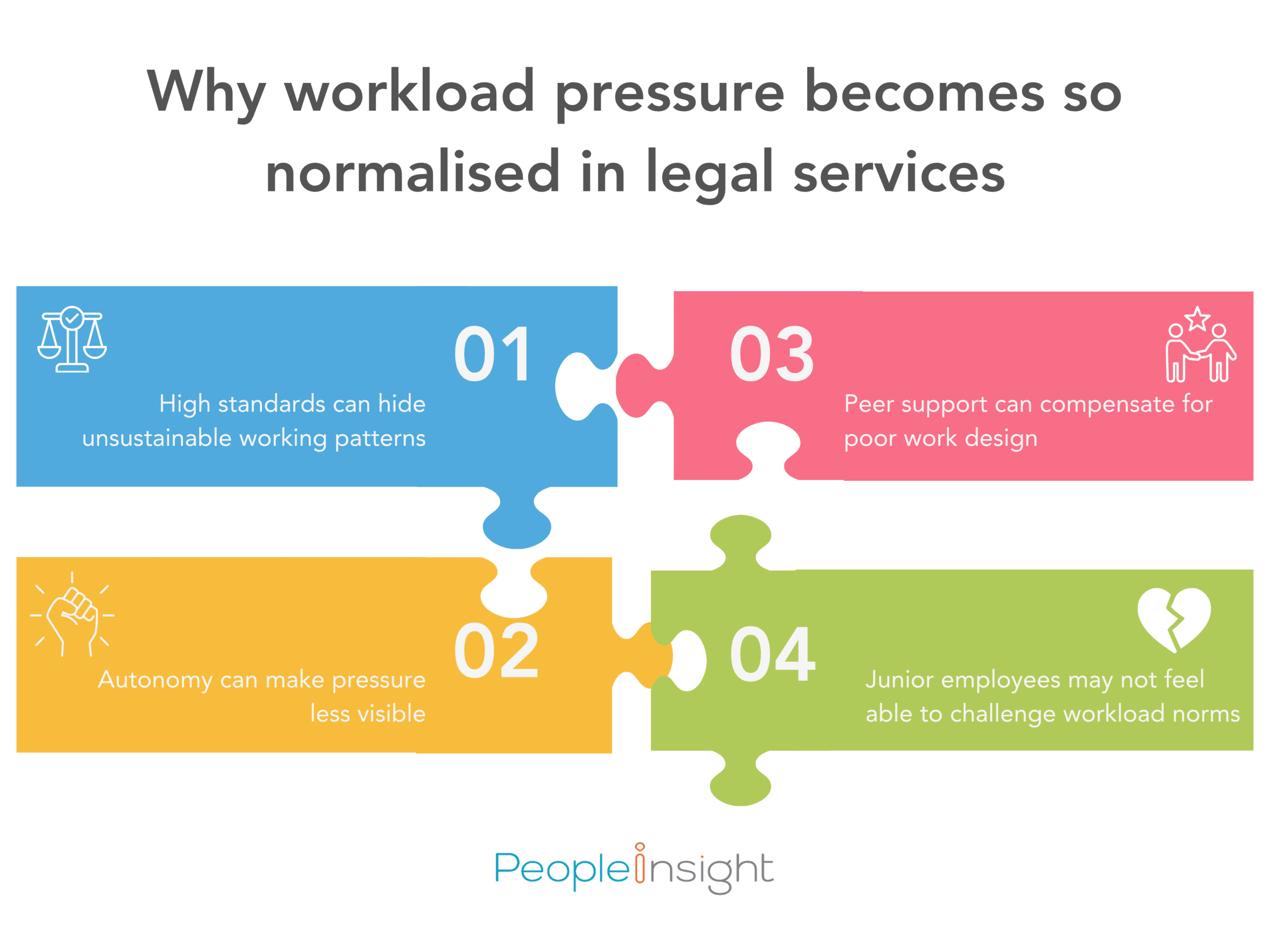
    Why workload pressure becomes so normalised in legal services

    Workload pressure often becomes normalised when it is treated as part of the profession, rather than a workplace issue that can be understood and managed.

    In legal services, this can happen for several reasons.

    Why workload pressure becomes so normalised in legal services

    1. High standards can hide unsustainable working patterns

    Legal work demands accuracy, judgement and responsiveness. Those standards matter. But when high quality work depends on people regularly working beyond a sustainable level, the organisation has a structural issue, not just a wellbeing issue.

    Our sector benchmark data shows that 90% of legal services employees say their organisation is committed to doing high quality work. That is a real strength, but firms need to understand what sits underneath that quality.

    Is it supported by clear priorities, good resourcing and healthy working rhythms? Or is it being maintained because people are absorbing pressure privately?

    2. Autonomy can make pressure less visible

    Legal services employees score strongly on autonomy, with 88% saying they have the freedom they need to get on with their job.

    Autonomy is usually (and rightly) seen as a positive. It gives people control, professional trust and flexibility. The problem is, autonomy can also make workload pressure harder to spot, especially when employees are expected to manage their own capacity without enough visibility, feedback or support.

    If people have freedom but not enough protection from overwork, autonomy can quietly become isolation.

    3. Peer support can compensate for poor work design

    One of the strongest legal services scores in our data is peer support, with 86% saying people help and support each other.

    That is hugely valuable. Supportive teams can protect morale, reduce stress and help people through difficult periods.

    But peer support should not become the system that holds everything together. If colleagues are constantly stepping in to cover capacity gaps, absorb urgent work or help each other recover from pressure, the organisation still needs to look at the source of the problem.

    4. Junior employees may not feel able to challenge workload norms

    Workload pressure can be especially difficult for trainees, junior lawyers and early-career employees to raise. They may worry about being seen as less committed, less capable or less suited to progression.

    The Law Society’s guidance on remote supervision of junior staff and trainee solicitors highlights the importance of making sure junior staff and trainees are properly supported, including in remote or hybrid working arrangements.

    That support matters because workload is not only about volume. It is also about guidance, confidence, access to feedback and knowing when it is acceptable to push back.

    For legal firms, this creates a listening challenge. The people most affected by workload pressure may also be the least likely to raise it openly.

    Workload pressure is connected to retention risk

    When it comes to workload pressure, wellbeing is always a huge concern, but there is something else that firms need to consider; that of staff retention

    Our legal services benchmark data shows that 65% of employees said they would still like to be working at their organisation in two years’ time. The all-sector average was 73%.

    That does not prove workload pressure is the only cause, of course. Retention is shaped by many factors, including career development, reward, leadership, progression, purpose and external opportunity. But it does suggest firms should be asking a sharper question:

    Are people leaving because they dislike the work, or because the way the work is organised has become too difficult to sustain?

    This is where a strong employee engagement survey can help firms move beyond assumptions. Instead of treating turnover as a lagging indicator, firms can track the signals that often appear before people decide to leave.

    Early warning signalWhy it matters
    Lower confidence in coping with workloadIndicates pressure may be exceeding capacity
    Reduced belief in long-term futureSuggests employees may already be considering alternatives
    Weak feedback from managersCan leave employees unclear, unsupported or overlooked
    Poor connection to purposeMakes pressure harder to justify emotionally
    Low belief that action will follow feedbackReduces trust in surveys and listening activity

    Sharper listening helps firms spot these patterns earlier, before disengagement becomes resignation.

    Workload pressure is not solved by wellbeing initiatives alone

    Wellbeing support has an important place. Employee assistance programmes, mental health resources, manager guidance and wellbeing campaigns can all help.

    But if workload pressure is rooted in work design, resourcing, supervision, client expectations or leadership habits, wellbeing initiatives will only go so far.

    The SRA’s workplace environment guidance highlights risks linked to unsupportive, bullying or toxic working environments, including poor supervision, pressure to take shortcuts or pressure to act unethically.

    This is why workload pressure should not be treated as a soft issue. In legal services, it can affect not only employee wellbeing, but also decision-making, conduct, client service and risk.

    The answer is not simply to ask people whether they are stressed. Firms need to understand what is creating the pressure and what would help people work more sustainably.

    What legal firms should listen for

    Legal organisations should consider measuring workload pressure through questions that cover capacity, support, supervision and recovery.

    Listening areaWhat to measure
    CapacityWhether people can comfortably cope with their workload
    Work-life balanceWhether work allows enough space for life outside work
    Manager supportWhether managers check in, give feedback and help prioritise
    SupervisionWhether junior employees have the guidance they need
    Psychological safetyWhether people feel able to raise concerns or mistakes
    Team supportWhether people help each other without masking deeper issues
    Action confidenceWhether employees believe feedback leads to change

    The goal is not to create a longer survey for the sake of it. It is to ask the right questions, analyse the results properly and act on what people are telling you.

    A well-designed employee survey platform helps firms collect confidential feedback, segment results and identify where action is most needed.

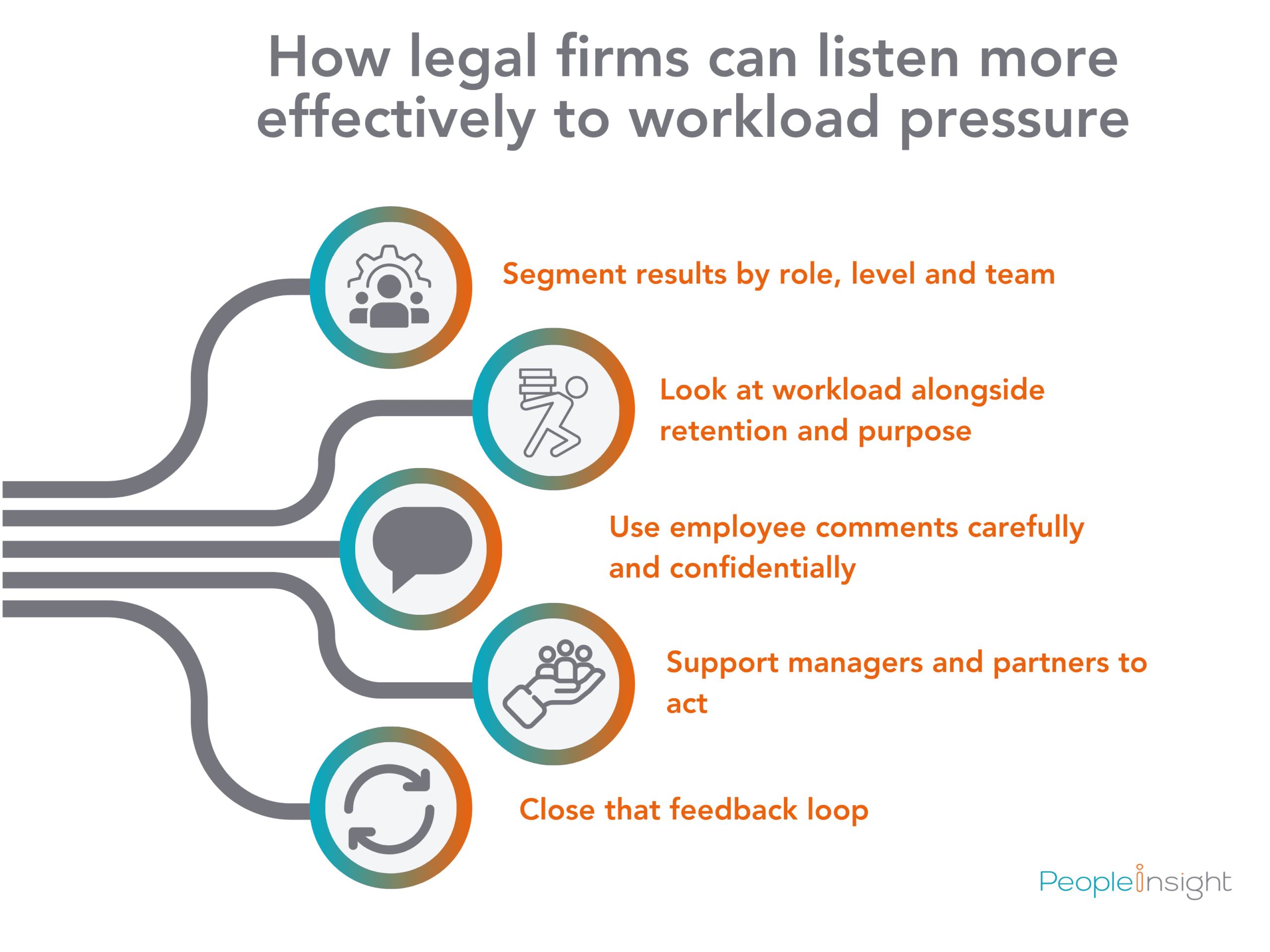
    How legal firms can listen more effectively to workload pressure

    Workload pressure can be difficult to address because it often cuts across teams, clients, managers, partners and working practices.

    That means listening needs to be both confidential and practical.

    How legal firms can listen more effectively to workload pressure

    1. Segment results by role, level and team

    Legal services organisations should avoid relying only on firm-wide averages.

    Workload pressure may look very different for partners, associates, trainees, paralegals and business services teams. It may also vary by practice area, office, client group or manager.

    Segmentation helps firms see where pressure is concentrated, rather than treating it as a general cultural issue.

    2. Look at workload alongside retention and purpose

    Workload data becomes more useful when it is read alongside related measures.

    For example, if a team scores low on workload but high on purpose and manager support, the action may be different from a team that scores low on workload, low on belief in action and low on intention to stay.

    This is where sharper listening makes a difference. It helps leaders see the pattern, not just the individual score.

    3. Use employee comments carefully and confidentially

    Employee comments can reveal the reality behind workload pressure. They can show whether the issue is volume, prioritisation, supervision, client demands, unclear expectations or uneven distribution of work.

    But in legal firms, confidentiality is especially important. Employees may be cautious about sharing honest feedback if they think comments could identify them or affect their reputation.

    Clear communication about anonymity, reporting thresholds and how feedback will be used is essential.

    4. Support managers and partners to act

    Listening is only useful if someone can do something with the insight.

    Managers and partners need support to interpret results, talk about workload constructively and agree practical actions with their teams. Without that support, survey results can sit in dashboards without changing the day-to-day experience of work.

    Good action planning does not always mean big, firm-wide initiatives. It might mean clearer prioritisation, better handover processes, more regular check-ins, improved supervision or more realistic capacity planning.

    This is where expert survey consultancy can help leaders understand the story behind the data and decide what to do next.

    5. Close that feedback loop

    Employees are more likely to keep sharing honest feedback when they can see that it leads somewhere.

    That does not mean every issue can be fixed immediately. But firms should be clear about what they heard, what they are prioritising, what will change and what needs further discussion.

    In our legal services data, 55% of employees said they believe action will be taken as a result of the survey. That is slightly above the all-sector average of 53%, but still leaves room to build stronger confidence.

    For workload pressure, closing the feedback loop is especially important. If employees say they are struggling and nothing visible changes, the next survey may feel less safe and less worthwhile.

    Legal sector workload pressure needs sharper listening

    The LawCare Life in the Law research continues to show why mental health and wellbeing need serious attention across the legal profession. But legal firms should not wait until workload pressure becomes a visible crisis.

    The earlier signs are often already there.

    People may be coping, but only just. Teams may be supportive, but overstretched. Standards may be high, but maintained at a cost. Employees may still care deeply about the work, but question whether they can keep doing it in the same way.

    That is why legal services organisations need to listen carefully, analyse results in context and turn feedback into practical action.

    At People Insight, we call this Sharper listening. Smarter action. It is our approach to helping organisations listen with more focus, understand what people are really experiencing and turn insight into meaningful improvement.

    For legal firms, that means looking beyond whether people are engaged and asking deeper questions about workload pressure, culture, supervision, retention and trust.

    How People Insight supports legal services organisations

    People Insight helps organisations run trusted employee surveys, understand what people are experiencing and turn feedback into meaningful action.

    For legal services organisations, that means moving beyond a simple engagement score and building a clearer picture of workload pressure, wellbeing, retention risk, leadership, manager support and culture.

    Our approach combines robust survey technology with expert support, helping firms listen with confidence and act with focus.

    Through our employee experience platform, legal firms can collect confidential feedback, segment results, explore comments and identify the areas where action will have the greatest impact.

    Prism, our integrated AI, supports survey analysis, comment interpretation and action planning. It helps leaders make sense of complex feedback more quickly, while keeping human judgement, context and accountability at the centre of decision-making.

    And through our survey implementation support, we help organisations build listening programmes that employees trust from the start.

    Ready to understand workload pressure more clearly in your organisation? Get in touch with People Insight to plan your next employee survey.

    FAQ: workload pressure in legal services

    What is workload pressure?

    Workload pressure is the experience of having too much work, too much intensity or too little capacity to sustain performance in a healthy way. It can include long hours, unrealistic deadlines, poor prioritisation, insufficient support or a lack of recovery time.

    Why is workload pressure a concern in legal services?

    Legal services is a high-pressure sector where client demands, professional standards and complex work can make intense workloads feel normal. If firms do not listen carefully, they may miss early signs of burnout, disengagement and retention risk.

    How can employee surveys help law firms understand workload pressure?

    Employee surveys help law firms measure whether people can cope with their workload, whether they have enough support and whether pressure differs by role, level, team or office. Survey comments can also help explain what is causing the pressure.

    Is workload pressure the same as burnout?

    No. Workload pressure can contribute to burnout, but they are not the same. Workload pressure is often one of the conditions that increases the risk of burnout, especially when it is sustained over time and employees feel unable to recover or ask for support.

    What should legal firms do after identifying workload pressure?

    The best response depends on what the data shows. Firms may need to review resourcing, supervision, prioritisation, manager support, client demands, handover processes or team-level working habits. The most important step is to turn feedback into visible action.