


















Blogs:

Physical wellbeing at work: the missing link in employee engagement

How physical wellbeing shapes energy, engagement and people’s ability to do their best work

Physical wellbeing at work the missing link in employee engagement

    A quick insight: At work, physical wellbeing is not separate from employee engagement. When people are exhausted, uncomfortable, overloaded or unable to recover properly, their energy and commitment suffer. Employee listening helps organisations spot where physical wellbeing risks are affecting engagement, so leaders can act with clarity, confidence and care.

    Employee engagement is often talked about in terms of motivation, purpose, pride and connection.

    And all of that is important. But engagement also depends on something more basic: whether people have the physical energy, capacity and resilience to do good work.

    If employees are exhausted, physically strained, uncomfortable in their working environment or unable to recover from sustained pressure, engagement will eventually suffer. People may still care deeply about their role, their team and their organisation, but without the right conditions, that commitment becomes harder to sustain.

    That is why we need to be talking more about physical wellbeing at work, and ensuring that it has much more central place in employee engagement strategy.

    It is not just about gym discounts, step challenges or fruit in the office. Physical wellbeing is about how work affects people’s bodies, energy levels, workload, recovery, safety and day-to-day ability to perform.

    And the best way to understand that is through employee voice.

    At People Insight, we help organisations use employee surveys to understand what people are experiencing at work, where physical wellbeing risks are showing up and what needs to change. With our expert support and Prism (our integrated AI), organisations can move from broad wellbeing intentions to clearer priorities, sharper listening and smarter action.

    Related: How to build an outstanding employee wellbeing programme

    What is physical wellbeing at work?

    Physical wellbeing at work is the extent to which employees can maintain their health, energy and physical capacity while doing their job.

    It includes obvious areas such as workplace safety, ergonomics, physical demands and the working environment. But it also includes factors that are sometimes less visible, such as fatigue, workload, sleep disruption, recovery time, stress-related physical symptoms and the impact of long hours or poor work-life balance.

    Physical wellbeing in the workplace can look different depending on the organisation. For some employees, it may be about safe equipment, manageable shift patterns and enough rest between physically demanding tasks. For others, it may be about screen fatigue, back pain, sedentary work, long commutes or blurred boundaries when working from home.

    The common thread is simple: work has a physical impact. Good employee engagement strategies need to recognise that.

    Physical wellbeing is not separate from employee experience

    Organisations sometimes separate wellbeing, engagement, health and safety, culture and performance into different initiatives. In practice, employees experience them together.

    A person who feels proud of their organisation but is constantly exhausted is unlikely to stay engaged for long. A manager who wants to support their team but is overloaded themselves may struggle to create healthy working patterns. A team with strong relationships may still see engagement drop if workload becomes unsustainable.

    This is where employee engagement and wellbeing need to be looked at together. Engagement is not just how people feel about the organisation. It is also shaped by whether they have the conditions, support and energy to contribute well.

    Why physical wellbeing is becoming harder to ignore

    Many organisations are operating in an environment of sustained pressure. Teams are being asked to do more, adapt faster and absorb constant change. Hybrid work has brought benefits, but it has also created new challenges around boundaries, movement, connection and recovery.

    Desk-based work can create its own physical strain too. Long periods sitting down, poor workstation set-up, back and neck pain, screen fatigue and reduced movement can all affect how people feel and perform. These issues may not always appear in absence data or formal health and safety reports, but they can still shape energy, concentration and engagement.

    For leaders, the risk is that physical wellbeing issues become normalised. Tired teams keep going. Managers absorb pressure. Employees adapt around poor processes, heavy workloads or uncomfortable environments until the strain shows up in engagement, absence, turnover or performance.

    By that point, the organisation is already dealing with the consequences.

    Employee listening helps leaders spot the warning signs earlier.

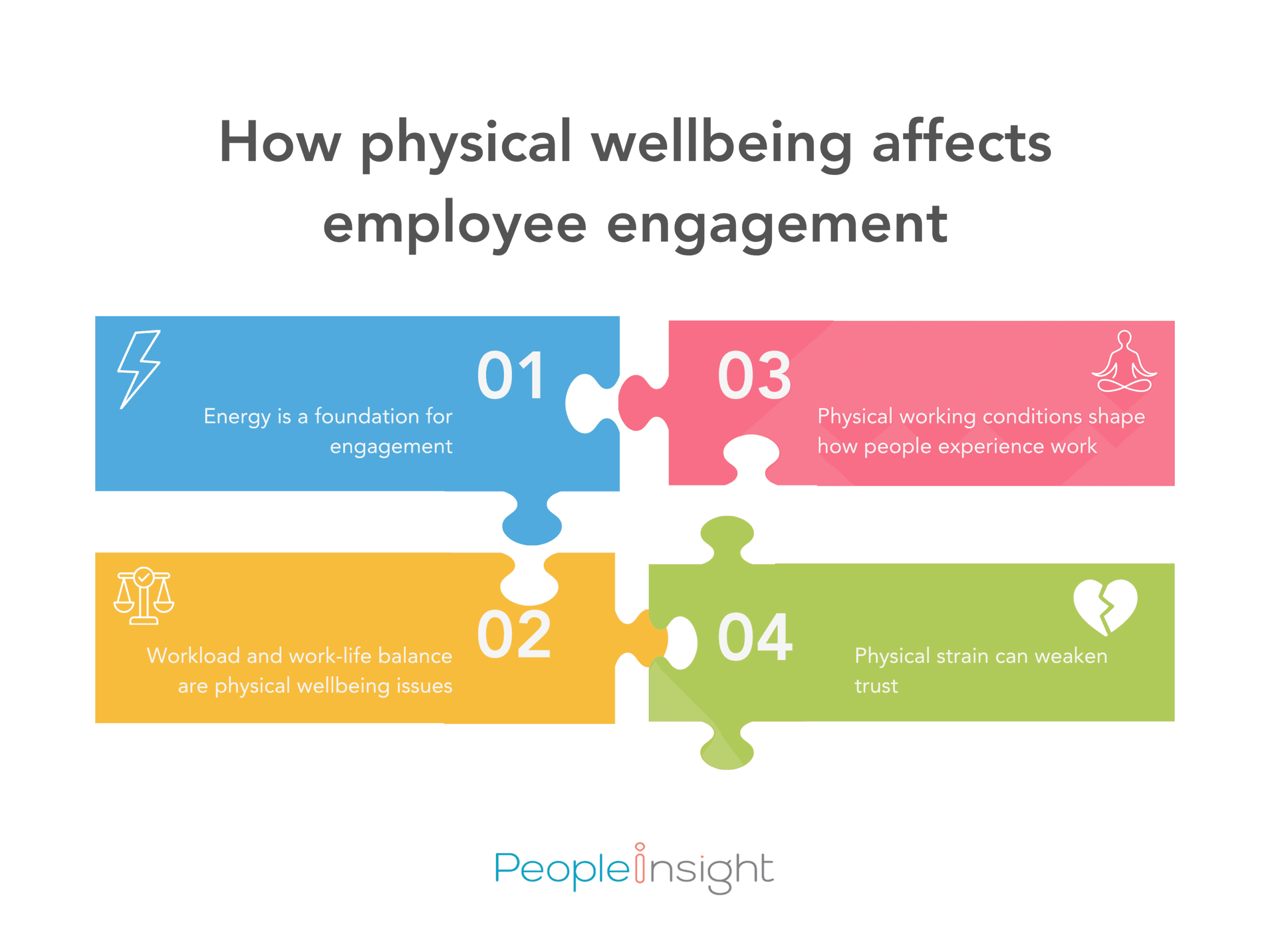
    How physical wellbeing affects employee engagement

    Physical wellbeing influences engagement because it affects people’s capacity to care, contribute and keep going.

    When people have enough energy, a manageable workload and a healthy working environment, they are more likely to feel motivated and able to do their best work. When those conditions are missing, engagement becomes harder to sustain, even among highly committed employees.

    Energy is a foundation for engagement

    Engaged employees are not just emotionally invested. They also need enough energy to think clearly, collaborate well, solve problems and respond to change.

    If people are physically drained, they may become less patient, less creative and less able to stay focused. They may withdraw from team conversations, avoid extra responsibility or feel less connected to the organisation’s goals.

    This does not mean they care less, but it may mean they simply have less capacity left to give.

    For organisations measuring engagement, this is an important distinction. A drop in engagement is not always caused by poor communication, weak leadership or lack of purpose. Sometimes the issue is more practical: people are tired, stretched or unable to recover.

    Workload and work-life balance are physical wellbeing issues

    Workload is often discussed as a productivity or resourcing issue. But it is also a physical wellbeing issue.

    When workloads are consistently too high, people may work longer hours, skip breaks, lose sleep or struggle to switch off. Over time, this affects concentration, mood, health and engagement.

    Our benchmark data shows why this needs attention. Only 64% of employees say they can comfortably cope with their workload, while 74% say they are able to strike the right balance between work and home life. That suggests many organisations still have a sizeable group of employees who may be experiencing sustained pressure, even when overall engagement looks relatively steady.

    Global benchmark snapshot:

    Only 64% of employees say they can comfortably cope with their workload

    This is exactly why broad wellbeing messaging is not enough. Leaders need to understand where pressure is concentrated and what sits behind it.

    Physical working conditions shape how people experience work

    Physical wellbeing is also influenced by the practical conditions around the work itself.

    In People Insight’s 2025 benchmark data, 74% of employees say they are satisfied with their physical work environment and 72% say they have the equipment and resources they need to do their work properly. These are solid scores, but they also show that around one in four employees may not be fully positive about their environment, equipment or resources.

    That is a meaningful signal.

    Poor equipment, unsuitable spaces, uncomfortable environments or inefficient tools can make work more tiring than it needs to be. Over time, those frustrations can affect how people feel about their role, their manager and the organisation.

    Physical wellbeing is not always about major health risks. Sometimes it is about the everyday friction that drains energy.

    Global benchmark snapshot:

    74% of employees say they are satisfied with their physical work environment

    Physical strain can weaken trust

    When employees repeatedly say they are overloaded, uncomfortable or struggling to recover, but nothing changes, trust starts to erode.

    People may begin to feel that feedback is being collected but not acted on. This can damage future participation in surveys, reduce confidence in leaders and weaken the connection between employee voice and meaningful improvement.

    Our benchmark data makes this connection clear. In 2025, 53% of employees say they believe action will be taken as a result of the survey. That is a slight improvement from 51% in 2024, but it still leaves a significant opportunity for organisations to build confidence through visible follow-through.

    That is why action planning is such a critical part of workplace physical health. Listening is only the start. Employees need to see that their organisation understands the issue, is prepared to make practical changes and will keep communicating progress.

    People Insight’s approach to post-survey action planning helps organisations turn feedback into clear priorities, ownership and follow-through, so insight does not get stuck at the reporting stage.

    Global benchmark snapshot:

    53% of employees say they believe action will be taken as a result of the survey

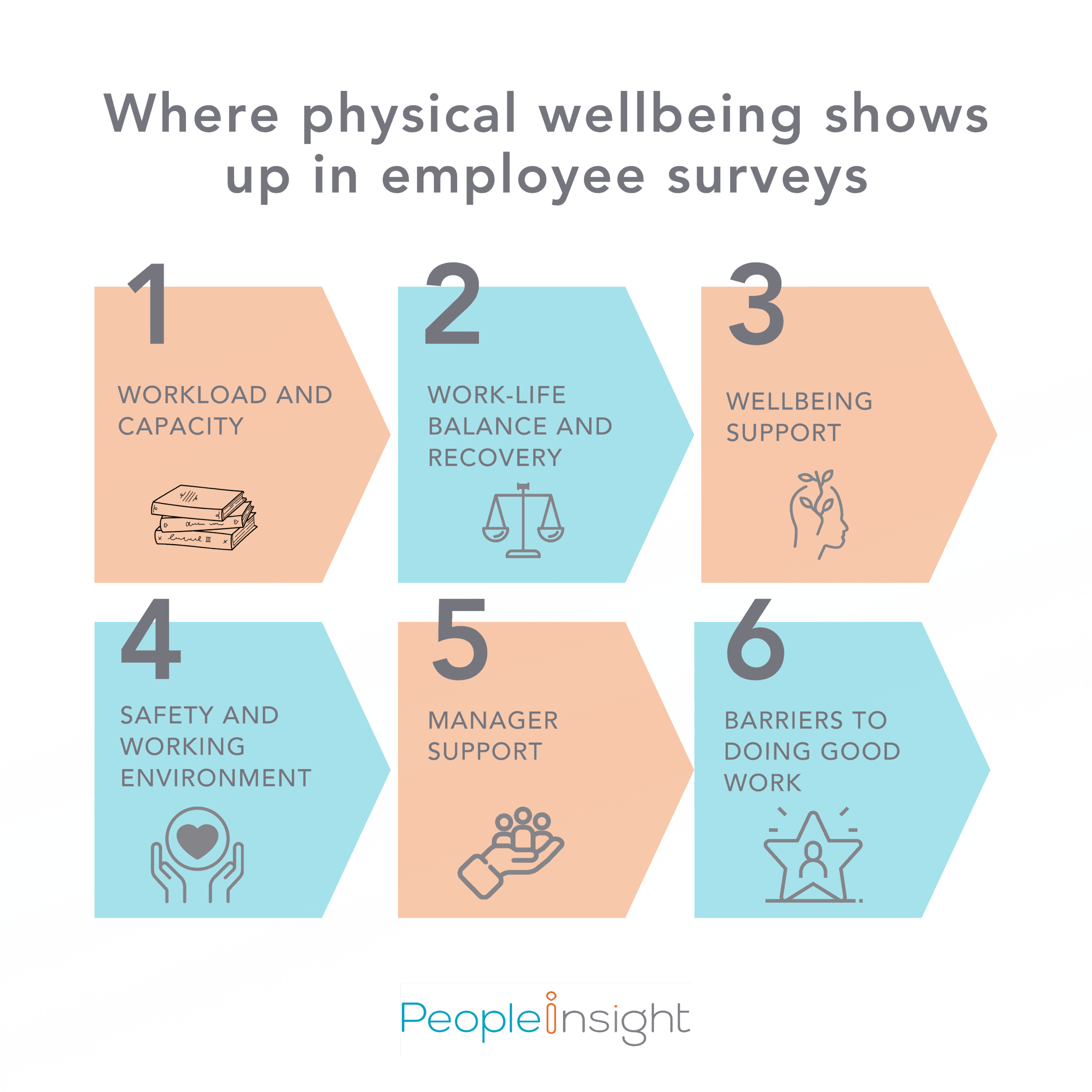
    Where physical wellbeing shows up in employee surveys

    Physical wellbeing at work is not always measured through one direct question.

    Sometimes it appears through patterns across different areas of the employee experience. That is why survey design and expert interpretation are so important.

    A well-designed employee survey can help identify where physical wellbeing risks are affecting engagement, performance and retention.

    Where physical wellbeing shows up in employee surveys

    Workload and capacity

    Questions about workload, resourcing and pace can reveal whether employees feel able to manage the demands of their role.

    Useful areas to explore include:

    • whether workload feels manageable
    • whether people have enough time to do their work well
    • whether teams have enough resource
    • whether employees can take breaks and annual leave
    • whether expectations are realistic

    These questions help leaders distinguish between short-term busy periods and deeper capacity issues.

    If only 64% of employees feel they can comfortably cope with their workload, as shown in People Insight’s 2025 benchmark data, leaders need to look beyond the headline score. The next question is where pressure is building and why.

    Global benchmark snapshot:

    64% of employees feel they can comfortably cope with their workload

    Work-life balance and recovery

    Work-life balance is one of the clearest indicators of physical wellbeing risk.

    If employees cannot switch off, recover or maintain healthy boundaries, the impact will eventually show up in engagement. This is especially important in organisations where people are highly committed to their work, because commitment can sometimes mask unsustainable pressure.

    Survey questions might explore whether employees can maintain a healthy balance, whether they feel able to disconnect outside work and whether working patterns support their wellbeing.

    Health and wellbeing support

    One of the most direct ways to explore physical wellbeing in the workplace is to ask whether people feel the organisation does enough to support their health and wellbeing at work.

    In People Insight’s 2025 benchmark data, 65% of employees respond positively to this question, down slightly from 67% in 2024. That does not mean support is failing. But it does suggest that employees’ expectations may be rising, or that existing support is not always reaching the people who need it most.

    This is where employee listening is valuable. A single score can show the direction of travel. Comments, segmentation and follow-up analysis can help leaders understand what needs to change.

    Safety and working environment

    For some organisations, physical wellbeing is closely tied to health and safety, equipment, facilities and the working environment.

    This might include physical safety, access to appropriate tools, workplace comfort, temperature, noise, desk set-up, lighting or the suitability of spaces for different types of work.

    In hybrid organisations, it can also include whether people have a suitable home-working set-up and whether office time supports the work people need to do.

    A good employee listening strategy should capture these practical realities, not just broad sentiment.

    Manager support

    Managers play a major role in physical wellbeing in the workplace.

    They influence workload, priorities, expectations, flexibility, recovery and whether people feel able to raise concerns. But managers also need support themselves. If they are overloaded, unclear on priorities or under pressure from above, they may struggle to protect their team’s wellbeing.

    Employee surveys can help organisations understand whether managers are having the right conversations, spotting early signs of strain and supporting sustainable working habits.

    Our 2025 benchmark data shows that 84% of employees say their line manager treats them fairly and with respect, while 69% say their line manager gives them regular feedback on how they are doing. Those are useful strengths to build from. The opportunity is to make sure manager conversations include workload, recovery and physical wellbeing, not only performance and task delivery.

    Global benchmark snapshot:

    84% of employees say their line manager treats them fairly and with respect

    Enablement and barriers to doing good work

    Physical wellbeing is closely linked to enablement.

    If people do not have the tools, systems, processes or support they need, work becomes harder than it needs to be. That extra friction drains energy and can leave employees feeling frustrated, tired or ineffective.

    This is where People Insight’s Pearl™ model of engagement can be useful. Enablement is one of the five drivers of engagement, alongside Purpose, Autonomy, Reward and Leadership. When enablement is weak, employees may still want to do good work, but the organisation is making it physically and mentally harder for them to succeed.

    The benchmark data shows that 72% of employees say they have the equipment and resources they need to do their work properly. That leaves room for organisations to explore where practical barriers are making work more difficult, especially in teams with lower engagement or higher workload pressure.

    Global benchmark snapshot:

    72% of employees say they have the equipment and resources they need to do their work properly

    How to use employee listening to improve physical wellbeing

    Improving physical wellbeing at work starts with understanding what people are actually experiencing.

    That means going beyond generic wellbeing initiatives and using employee listening to identify where action will have the greatest impact.

    Ask specific questions, not just broad wellbeing questions

    A general wellbeing question can be useful, but it will not tell leaders enough on its own.

    For example, “My organisation does enough to support my health and wellbeing at work” may give a useful overall score. But if the score is low, leaders still need to know why.

    Is the issue workload? Working patterns? Poor equipment? Lack of breaks? Manager behaviour? A difficult environment? Unclear expectations? Long hours? Stress? Safety concerns?

    Specific survey questions give leaders more actionable insight. They also help avoid vague action plans that sound positive but do not solve the real issue.

    For a wider view of how wellbeing can be measured, read The Ultimate Employee Wellbeing Guide.

    Look at the data by team, role and demographic group

    Physical wellbeing risks are rarely spread evenly.

    One department may be struggling with workload. Another may have issues with shift patterns. Remote workers may report different challenges from office-based workers. Managers may be under pressure in ways that are not visible in the overall score.

    Segmenting survey results helps leaders understand where support is needed most. It also avoids treating physical wellbeing as a one-size-fits-all initiative.

    At People Insight, our dashboards help leaders explore results in a way that protects anonymity while still giving useful, practical insight. That balance is important. Employees need confidence that their feedback is safe, and leaders need enough clarity to act.

    Use comments to understand context

    Scores can show where the issue is. Comments often explain what is behind it.

    For example, a low work-life balance score might be driven by too many meetings, unclear priorities, constant firefighting, understaffing, inefficient systems or a culture where people feel guilty taking breaks.

    This is where Prism can support leaders. Prism helps organisations spot patterns, understand context and prioritise action across large volumes of employee feedback. It supports interpretation, rather than replacing human judgement, so leaders can make better decisions with a clearer view of what employees are saying.

    Connect wellbeing insight to engagement and performance

    Physical wellbeing should not sit in a separate reporting pack, disconnected from engagement.

    If workload, recovery, safety or environment scores are weak, leaders should look at how these relate to engagement, enablement, confidence in leadership and belief that action will be taken.

    This helps make the business case for change. It also helps leaders see physical wellbeing as part of employee experience, not an optional extra.

    For example, if a team has low work-life balance, low enablement and low confidence that feedback leads to improvement, the priority may not be a wellbeing campaign. It may be workload redesign, clearer decision-making or better local action planning.

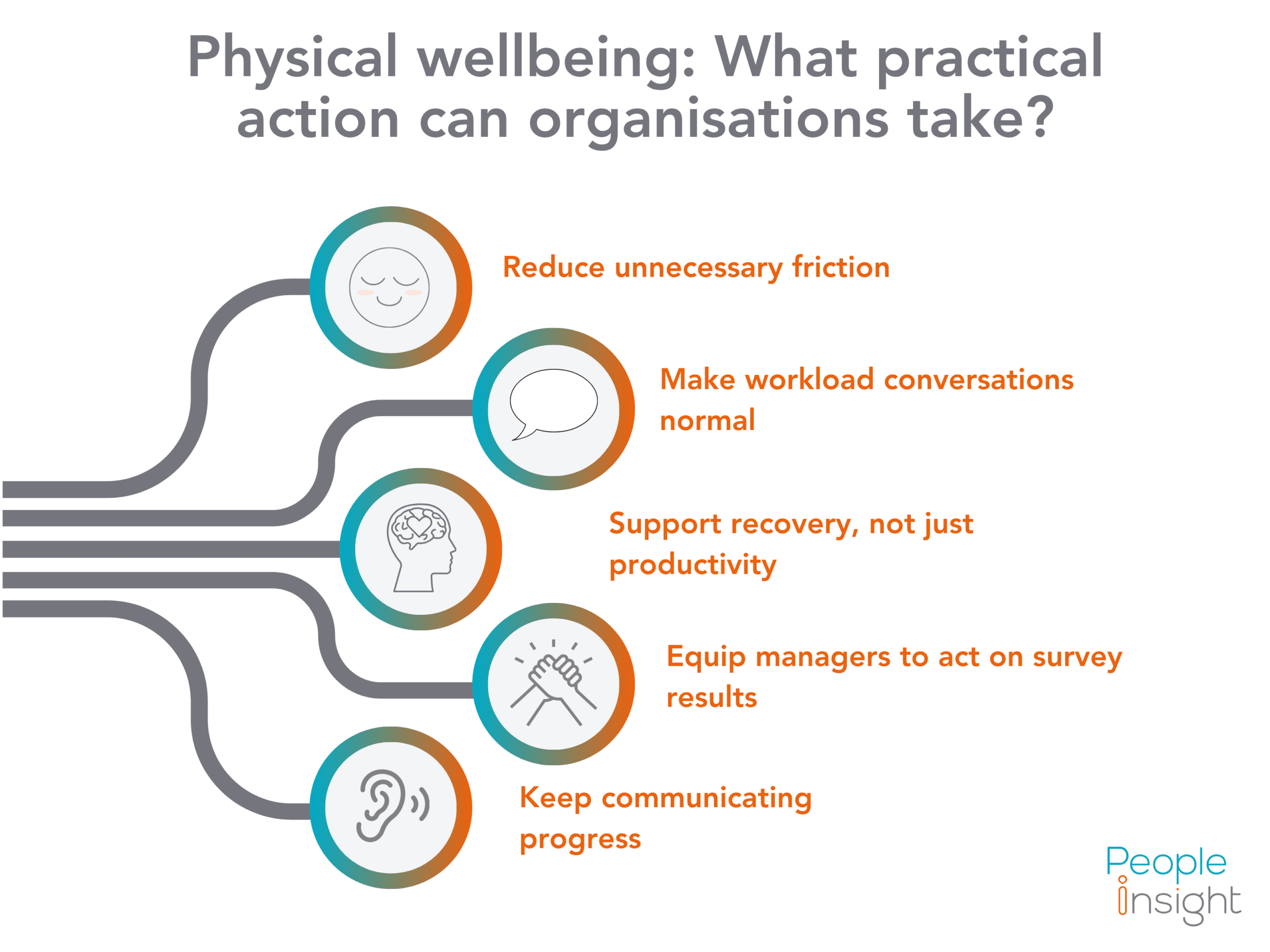
    What practical action can organisations take?

    Once the data is clear, action needs to be practical, visible and proportionate.

    Physical wellbeing at work will not improve through slogans. Employees need to see changes that make their day-to-day experience healthier and more sustainable.

    Physical wellbeing What practical action can organisations take

    Reduce unnecessary friction

    Some physical wellbeing issues come from work being harder than it needs to be.

    That might mean inefficient systems, duplicated processes, unclear ownership, too many meetings or constant changes in priority. These issues drain energy and make it harder for employees to do good work.

    Reducing friction can be one of the most powerful wellbeing actions an organisation can take. It shows employees that leaders are not just asking them to be more resilient. They are improving the conditions around the work.

    Make workload conversations normal

    Workload should not only be discussed when someone is already struggling.

    Managers need regular, structured conversations about capacity, priorities and pressure. This helps teams make trade-offs before work becomes unsustainable.

    Senior leaders also have a role here. If everything is urgent, nothing is. Clearer priorities help managers protect their teams’ energy and make better decisions about what can realistically be delivered.

    Support recovery, not just productivity

    Recovery is a core part of workplace physical health.

    Organisations should look at whether people can take breaks, use annual leave, switch off outside work and recover after intense periods. In some roles, recovery may also mean safe shift patterns, appropriate rest breaks and enough time between demanding tasks.

    This is especially important in cultures where employees are highly committed. When people care deeply, they may keep pushing themselves until the organisation actively gives them permission to stop.

    Equip managers to act on survey results

    Managers are often expected to turn survey results into action, but they may not always feel confident doing so.

    They need clear insight, practical guidance and support to focus on what will make the biggest difference. Without that, action planning can become too broad or too disconnected from the reality of the team.

    A local action plan can help managers translate survey insight into realistic, visible improvements with their teams.

    People Insight supports organisations with expert guidance throughout the survey process, from survey design to results interpretation and action planning. Prism can help managers and leaders identify priority areas faster, while our consultants help make sure action is grounded, credible and achievable.

    Keep communicating progress

    Employees do not expect every issue to be solved overnight. But they do need to know their feedback has been heard.

    Clear communication after a survey should explain what was found, what will happen next and how progress will be reviewed. This is especially important for physical wellbeing, because many issues affect employees’ daily working lives.

    When people see visible follow-through, they are more likely to trust future listening activity and believe that feedback leads to meaningful improvement.

    How People Insight helps organisations connect physical wellbeing and engagement

    Physical wellbeing is not a standalone HR issue. It is part of the wider employee experience.

    At People Insight, we help organisations understand how wellbeing, engagement, leadership, enablement and action connect. Our employee engagement platform brings together survey design, dashboards, benchmark context, AI-supported insight and integrated action planning, supported by experienced consultants who know how to turn feedback into practical improvement.

    Our approach helps organisations:

    • ask the right questions about physical wellbeing at work
    • identify where risks are showing up across teams, roles and groups
    • understand the link between workplace physical health and engagement
    • use comments and survey data to explore the context behind scores
    • prioritise the actions most likely to improve employee experience
    • give leaders and managers the confidence to act

    This is People Insight’s approach to Sharper listening. Smarter action. It means listening in a way that gives leaders a clearer understanding of what people are experiencing, then turning that insight into focused, visible action that supports meaningful improvement.

    Physical wellbeing deserves that level of attention.

    Because when people have the energy, support and conditions to do good work, engagement becomes much easier to sustain.

    If you want to understand where physical wellbeing is affecting engagement in your organisation, get in touch with People Insight. We’ll help you listen more clearly, interpret what your people are telling you and turn insight into meaningful action.

    FAQs about physical wellbeing at work

    What is physical wellbeing at work?

    Physical wellbeing at work is the extent to which employees can maintain their health, energy and physical capacity while doing their job. It includes safety, workload, working environment, ergonomics, recovery, physical strain, working patterns and the impact work has on people’s bodies and energy levels.

    Why is physical wellbeing important for employee engagement?

    Physical wellbeing is important for employee engagement because people need enough energy, capacity and resilience to contribute well. If employees are exhausted, uncomfortable, overloaded or unable to recover, they may become less motivated, less focused and less able to stay connected to their work.

    How can employers measure physical wellbeing in the workplace?

    Employers can measure physical wellbeing through employee surveys, pulse surveys, wellbeing questions, workload measures, work-life balance questions, safety feedback and employee comments. The strongest approach is to look at physical wellbeing alongside engagement, enablement, manager support and confidence that feedback leads to action.

    What are examples of physical wellbeing at work?

    Examples of physical wellbeing at work include manageable workloads, safe working environments, suitable equipment, healthy working patterns, enough breaks, good ergonomics, appropriate recovery time, supportive managers and the ability to maintain a healthy work-life balance.

    How does workload affect physical wellbeing?

    Workload affects physical wellbeing because sustained pressure can lead to fatigue, poor recovery, stress, sleep disruption and reduced energy. When workload is consistently too high, employees may struggle to stay engaged even if they care about their role and organisation.

    How can employee surveys improve workplace physical health?

    Employee surveys can improve workplace physical health by showing where risks are emerging, which groups are most affected and what employees need from leaders and managers. Survey results help organisations move from broad wellbeing intentions to targeted action on workload, environment, safety, support and recovery.

    What should leaders do after finding physical wellbeing issues in survey results?

    Leaders should share the findings, identify priority areas, involve managers and employees in practical action planning and communicate progress clearly. The most effective actions are usually specific, visible and focused on improving day-to-day working conditions.

    How can People Insight support physical wellbeing at work?

    People Insight helps organisations design effective employee surveys, interpret results, understand comments and turn insight into action. Our platform, Prism AI and expert consultants help leaders identify physical wellbeing risks, understand their impact on engagement and prioritise meaningful improvement.