
















Blogs:

Survey action plan: how to turn survey results into meaningful action

Let’s explore the 6 Rs model of post-survey action planning

Post-survey action planning Your complete guide

    A quick insight: A strong survey action plan helps organisations move from listening to meaningful improvement. It gives structure to what happens after the survey, helping leaders focus on the right priorities, involve teams in the right way and keep momentum going over time. At People Insight, we see action planning as the point where sharper listening becomes smarter action.

    Running an employee survey is important, but the real value of employee listening is not in the survey itself. It is in what happens next.

    That is where a survey action plan comes in.

    Without a clear plan, survey results can quickly become something organisations admire rather than use. Themes are identified, presentations are shared and dashboards are reviewed, but employees do not always see real change follow. When that happens, trust drops, future participation can weaken and the credibility of employee listening suffers.

    That is why survey action planning matters so much and can make such a difference.

    At People Insight, we believe action planning should not be treated as an afterthought. It should be built into the whole listening process from the start. That is a big part of what we mean by sharper listening, smarter action. Listening becomes sharper when organisations understand what matters most. Action becomes smarter when that insight is translated into focused, visible and sustainable improvement.

    Rather than seeing post-survey action planning as a short exercise that happens once results are shared, we recommend a six-stage approach we refer to as The 6 Rs. It gives organisations a more practical structure for reviewing results, sharing them clearly, agreeing priorities and reinforcing progress over time.

    Related: How to use a local action plan to enact meaningful change

    What is a survey action plan?

    A survey action plan is a structured approach for turning employee feedback into clear priorities, agreed actions and visible follow-through.

    It helps organisations answer some vital questions after a survey:

    • What are the most important themes in the results?
    • Where should we focus first?
    • How should we involve leaders, managers and teams?
    • What actions are realistic and likely to make a difference?
    • How will we track progress and keep momentum going?

    In simple terms, a survey action plan is what turns feedback into improvement your people will see and feel.

    Why a survey action plan makes a real difference

    Listening without action damages trust. If employees give honest feedback and then see little happen as a result, it becomes harder to believe that surveys are worth the time or effort. That is one of the biggest risks in employee listening.

    Action planning also matters because it helps organisations focus. Survey data can be rich and complex. There may be strengths to celebrate, gaps to address and multiple issues competing for attention. A strong survey action plan helps leaders avoid trying to fix everything at once. It creates clarity around what matters most and what is most likely to have a positive effect.

    Done well, it also supports:

    • stronger trust in employee listening
    • better alignment between organisational and local priorities
    • more confident managers
    • clearer ownership and accountability
    • more visible progress over time

    Global benchmark snapshot:

    Only 53% of employees believe action will be taken as a result of an employee survey

    Survey action planning is not a one-off task

    One of the biggest mistakes organisations make is treating survey action planning as a short-term activity that happens immediately after results are shared, then fades away.

    In reality, a survey action plan should be an ongoing process.

    Meaningful change rarely comes from one meeting or one document. It comes from review, discussion, refinement, delivery and reinforcement over time. Priorities need to be sense-checked, actions need to stay realistic and progress needs to be made visible. Importantly, momentum also needs to be protected. A survey action plan works best when it is treated as a cycle, not a one-off response.

    Related resources: Explore our webinar on making post-survey action plans stick, or see how InHealth embedded action planning in practice.

    Sharper listening. Smarter action.

    A strong survey action plan is where Sharper listening. Smarter action. becomes real.

    Sharper listening means understanding results clearly:

    • knowing what the data is telling you
    • identifying strengths to protect
    • spotting areas that need attention
    • recognising which priorities are most likely to have the greatest effect

    Smarter action means:

    • focusing effort where it will count most
    • involving the right people in the right way
    • choosing fewer, better actions
    • keeping progress visible
    • reinforcing action over time

    This is also where more regular listening can help. Pulse surveys, for example, can support smarter action by helping organisations refine priorities, test whether changes are landing and keep action plans connected to what employees are experiencing now.

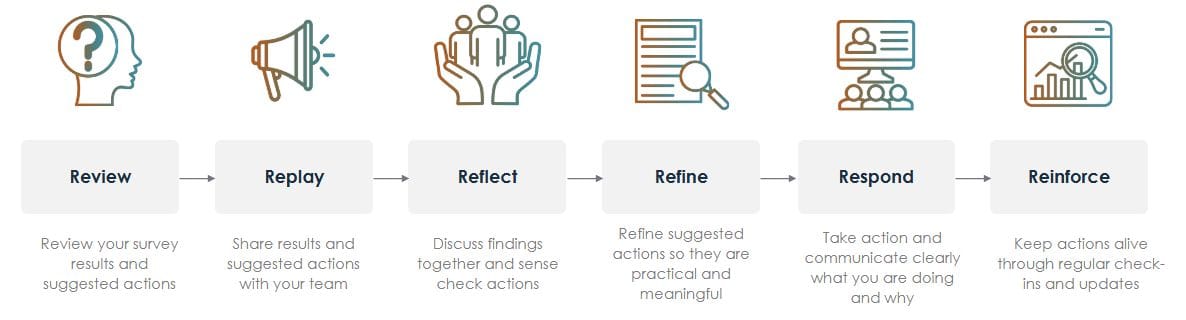
    The 6 Rs of survey action planning

    We recommend a six-step approach to survey action planning. It is more realistic, more actionable and better suited to the way change actually happens in organisations. Let’s explore each R and what they entail below.

    6 Rs action planning

    1. Review

    Action planning begins with a clear, shared understanding of survey results and where attention is most needed.

    At an organisational level, this means reviewing:

    • overall engagement and key themes
    • strengths to protect and build on
    • areas where improvement is most likely to have the greatest impact

    At a local level, leaders and managers review their own results in the context of those wider patterns.

    The aim here is clarity and focus, not exhaustive analysis. This is also where Prism, our integrated AI, can add real value by helping surface key priorities early, so effort can be directed where it matters most.

    2. Replay

    Once results and priorities are clear, they need to be shared openly.

    At an organisational level, Replay means:

    • sharing headline results, themes and priorities with leaders and managers
    • explaining why certain areas have been highlighted
    • setting clear expectations about roles in action planning and delivery

    At a local level, managers share team results and suggested priorities as a starting point for discussion, not a finished plan.

    This matters because sharing results and priorities together reduces confusion, increases trust and creates better alignment between organisational intent and local action.



    3. Reflect

    Before actions are finalised, organisations need time to sense-check priorities.

    At an organisational level, leaders and HR should consider whether the suggested focus areas align with strategy, capacity and other change activity. At a local level, managers should discuss results and possible actions with their teams to test relevance, gather insight and build ownership.

    Helpful reflection questions include:

    • What do we recognise as true in these results?
    • How do these priorities land for us?
    • What context should be considered before we act?
    • Where could well-chosen actions make the biggest positive difference?

    This stage helps ensure that actions are grounded in lived experience, not just data patterns alone.

    4. Refine

    This is the point where insight becomes decision.

    The refining phase is about moving from possible actions to agreed priorities. It is where organisations decide what they will focus on, what is realistic and how to avoid trying to do too much at once.

    At an organisational level, this means:

    • agreeing focus areas and guardrails
    • ensuring actions are coherent and realistic
    • reinforcing the principle of doing fewer things well

    At a local level, managers refine actions with their teams. Wording or scope may change, but the action should still stay aligned to the wider priorities.

    As a rule, local teams should focus on no more than two to three actions at a time. That keeps the plan focused and achievable.

    5. Respond

    With priorities agreed, action planning moves into delivery.

    At an organisational level, that means:

    • logging and tracking actions
    • making ownership and accountability visible
    • sharing progress updates and early wins
    • ensuring leaders reinforce expectations

    At a local level, managers and teams begin work on agreed actions and keep them visible through regular conversations and updates.

    This is where survey action planning becomes visible to employees. Starting action, even in small ways, signals that feedback has been heard. Visible progress builds confidence, credibility and momentum.

    6. Reinforce

    Sustained change depends on reinforcement.

    This final stage is about keeping action alive over time:

    • monitoring progress
    • identifying where more support is needed
    • celebrating progress and learning, for example through “you said, we did” campaigns
    • checking in regularly with action owners
    • revisiting actions as priorities shift

    The biggest risk is not choosing the wrong action. It is losing momentum and follow-through. That is exactly why this stage matters so much.

    What should a good survey action plan include?

    A good survey action plan should include:

    • a clear summary of the key findings
    • agreed priorities at organisational and local level
    • realistic actions linked to the data
    • named owners
    • clear timescales
    • visible communication
    • a way to track progress
    • regular follow-through and reinforcement

    The strongest plans are focused, not overloaded. Trying to tackle too much at once usually weakens the outcome. A smaller number of clear, meaningful actions is almost always more effective.

    Why action planning should always be prioritised post-survey

    Post-survey action planning is not just about project management. It is about credibility, leadership and follow-through.

    Employees need to feel that listening leads somewhere. They need to see that survey results are being taken seriously, that priorities are clear and that action is moving forward in a visible way.

    That is why survey action planning needs to be more structured, more visible and more sustained. It is also why the process matters just as much as the plan itself.

    What makes a survey action plan more effective?

    The most effective survey action plans tend to have a few things in common.

    They are:

    • focused on the priorities that matter most
    • rooted in data, not assumptions
    • realistic in scope
    • shaped with employee input
    • clearly communicated
    • tracked over time
    • supported by leaders and managers

    This is where People Insight’s approach helps. Prism can help surface priority areas and suggested actions early. Managers can then sense-check and refine those actions with their teams. Organisational leaders can keep sight of progress through the wider action planning process. That gives organisations a much better chance of moving from feedback to meaningful change.

    Survey action planning in practice

    Strong survey action planning is not about creating the perfect document. It is about creating a process that people trust and can see working.

    That usually means:

    • helping leaders and managers understand their results properly
    • creating space for teams to discuss what matters most
    • agreeing realistic actions
    • tracking progress visibly
    • reinforcing momentum after the initial survey moment has passed

    This is why survey action planning works best when it is supported by the right mix of data, structure and follow-through.

    Why survey action planning works best as a continuous cycle

    The real strength of the People Insight 6 Rs model is that it reflects how improvement actually happens.

    A survey action plan is not:

    • review the results
    • write down some actions
    • hope for the best

    It is a cycle:

    • Review the findings
    • Replay them clearly
    • Reflect together
    • Refine priorities
    • Respond visibly
    • Reinforce over time

    That makes action planning more realistic, more collaborative and more likely to create lasting change.

    Improve survey action planning with People Insight

    A survey only creates real value when it leads to meaningful improvement.

    That is why survey action planning matters so much. It is the point where employee listening either gains credibility or loses it. With the right structure, the right support and the right follow-through, it becomes one of the most powerful ways to build trust and improve the employee experience.

    At People Insight, we help organisations turn sharper listening into smarter action. Through our survey platform, Prism and consultancy support, we help leaders understand results clearly, prioritise confidently and keep momentum going after the survey.

    Want to build a stronger survey action plan in your organisation? Get in touch to learn how People Insight can help you move from feedback to visible progress.

    Action planning resources:

    Inspirational case studies:

    FAQs about survey action plans

    A quick run down on all you need to know

    What is a survey action plan?

    A survey action plan is a structured process for turning survey results into agreed priorities, practical actions and visible follow-through.

    Why does a survey action plan matter?

    It matters because employee feedback only creates value when people can see that it leads to action. Without a plan, trust in surveys can quickly weaken.

    What should a survey action plan include?

    A good survey action plan should include clear priorities, realistic actions, named owners, timescales, communication and progress tracking.

    What are the 6 Rs of action planning?

    The 6 Rs are Review, Replay, Reflect, Refine, Respond and Reinforce. Together, they provide a more complete framework for turning survey feedback into meaningful improvement.

    How does Prism support action planning?

    Prism helps surface priority areas, suggested actions and clearer context from the data, making it easier for organisations to focus effort where it matters most.

    How many actions should teams agree locally?

    As a rule, local teams should focus on no more than 2 to 3 actions at a time, so the plan stays realistic and achievable.

    Is survey action planning a one-off task?

    No. It works best as an ongoing process of review, discussion, delivery and reinforcement over time.

    How can People Insight help with survey action planning?

    People Insight helps organisations build stronger survey action plans through employee surveys, Prism-powered insight and consultancy support that helps leaders turn feedback into meaningful improvement.

    Trusted By

    bernard matthews
    British red cross
    greggs 01
    bidfood
    barbour
    muller
    gdf suez
    brewin dolphin
    molnlycke
    provident financial group
    moy park
    seaco
    vision express
    gilead
    jupiter asset management
    nhs supply chain
    dcc
    pladis - employee engagement for manufacturing
    southampton fc
    sunbelt rentals
    St john ambulance
    walgreens boots alliance
    lse
    loughborough university
    university of manchester
    university of birmingham
    university of southampton
    london school of hygiene and tropical medicine
    university of st andrews
    university of london
    wolseley
    Aman
    car finance 247
    the nottingham
    Cote brasserie
    west midlands police
    Autogrill 1 01
    john laing
    vivid homes
    quorn
    anchor
    action for children
    virgin active 1
    park plaza
    the belfry hotel resort