

















Blogs:

Advantages of 360 feedback

Why 360 feedback remains one of the most effective tools for leadership development, self-awareness and behaviour change

Advantages of 360 feedback

    A quick insight: The advantages of 360 feedback go well beyond collecting more opinions. A well-run 360 process helps people understand how they are experienced by others, identify strengths and development areas more clearly, and turn that insight into focused action. It is one of the most effective ways to strengthen self-awareness, leadership capability and day-to-day working relationships.

    360 feedback has become one of the most widely used development tools for a reason. In organisations where collaboration, communication and leadership matter, feedback from only one person is rarely enough to give a complete picture.

    This is where a 360 feedback tool comes in and adds real value.

    By gathering views from different sources, 360 feedback helps individuals understand how their behaviour is experienced from different angles. That fuller view can lead to better self-awareness, more targeted development and stronger leadership over time. Let’s take a deeper look at everything 360 and why it’s such an advantageous investment for any modern, forward-thinking organisation.

    Related: What are the 6 stages of the 360 feedback process?

    Why 360 feedback can be so effective

    Traditional top-down feedback can be useful, but it only shows part of the picture.

    A manager may see delivery, results and performance in one context, but they may not fully see how someone collaborates or communicates across teams. 360 feedback helps fill those gaps by widening the lens.

    That is why 360 feedback can be so incredibly effective for organisations that want to:

    • develop stronger leaders
    • improve management capability
    • increase self-awareness
    • strengthen communication and collaboration
    • support more targeted development planning

    Our benchmark data helps underline why this matters. For example:

    • 69% of employees say their line manager gives regular feedback
    • 84% say their line manager treats them fairly and with respect
    • 60% say senior leaders make the effort to listen to staff

    Those figures suggest that while some aspects of management are relatively strong, feedback and visible listening still have room to improve. 360 feedback can help leaders understand those gaps more clearly.

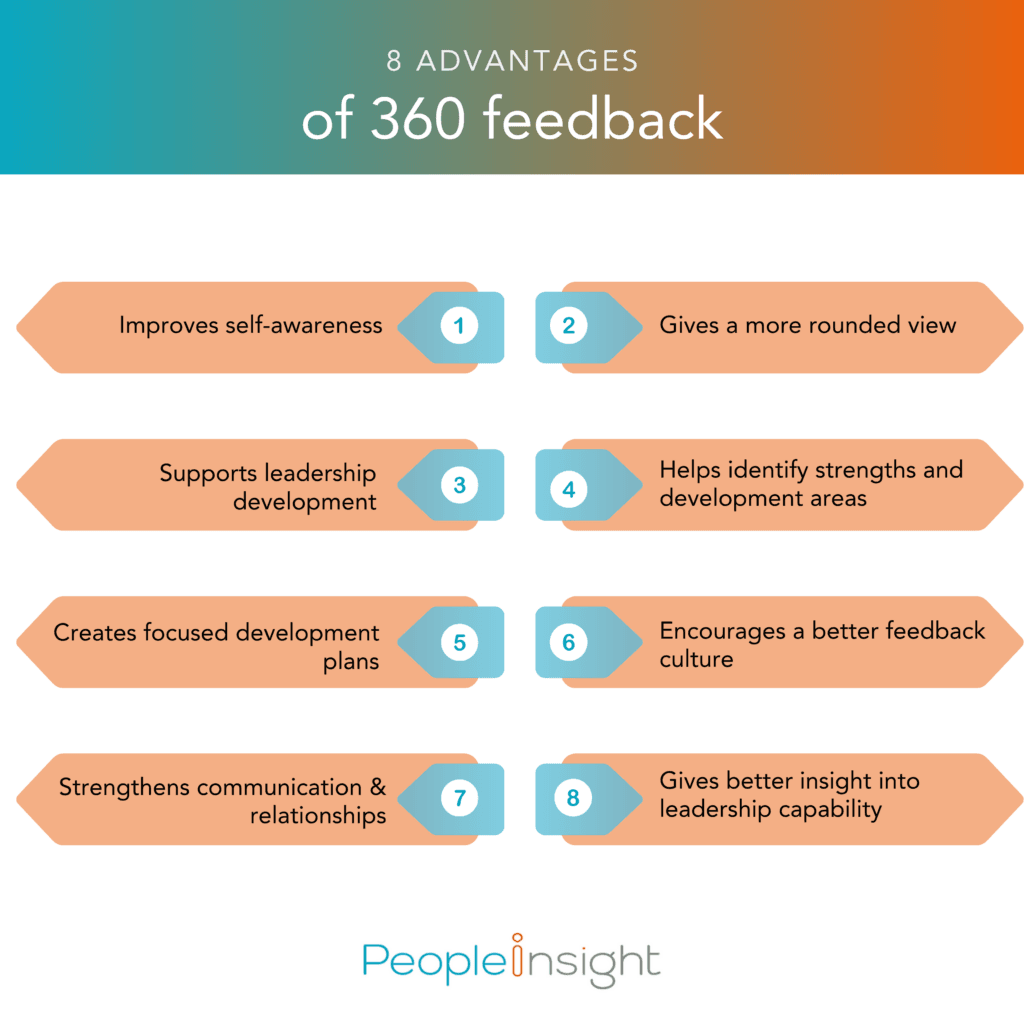
    8 advantages of 360 feedback

    Let’s get down to the specific benefits of 360 feedback, which we’ve outlined below.

    8 advantages of 360 feedback

    1. It improves self-awareness

    One of the biggest advantages of 360 feedback is that it helps people see themselves more clearly.

    Self-perception is often incomplete. Someone may believe they communicate well, delegate effectively or create a positive team environment, but others may experience them differently. 360 feedback brings those differences into view.

    That kind of self-awareness is valuable because it gives people a clearer starting point for development. It becomes easier to understand where strengths are recognised and where there may be blind spots.

    2. It gives a more rounded view than manager-only feedback

    Another major advantage of 360 feedback is breadth.

    Instead of receiving feedback from just one person, individuals hear from several people who experience their behaviour in different contexts. That makes the feedback more balanced and more useful.

    This is especially important in roles where influence, collaboration and communication matter as much as technical delivery. A single-source view may miss too much.

    Related: what is 360 feedback

    3. It supports stronger leadership development

    360 feedback is especially effective in leadership development because leadership is experienced by many different people.

    A leader may think they are approachable, supportive and clear, but what matters is how those around them actually experience their behaviour. 360 feedback helps reveal that gap, if there is one.

    That is why many organisations use 360 feedback to support:

    • emerging leaders
    • senior leaders
    • line managers
    • succession planning
    • leadership coaching

    Related: Developing your leadership with 360 feedback

    4. It helps identify strengths as well as development areas

    360 feedback is not just about finding what is wrong.

    One of the most useful advantages of 360 feedback is that it highlights strengths that can be built on. This matters because development is often more effective when people understand both what they do well and what they need to improve.

    That balance also helps the process feel more constructive and credible. People are more likely to engage with feedback when it feels fair, specific and useful.

    5. It creates more focused development plans

    A strong 360 process helps turn general feedback into practical development priorities.

    Without structure, development can become vague. People may know they need to improve, but not know where to start. 360 feedback gives more clarity by identifying patterns in the feedback and highlighting the behaviours that matter most.

    This helps individuals focus on:

    • two or three priority areas
    • specific behaviour changes
    • clearer development goals
    • more realistic follow-through

    That is also why coaching can work so well alongside 360 feedback. It helps translate insight into action.

    6. It encourages better feedback culture

    One of the wider advantages of 360 feedback is that it can help normalise feedback across the organisation.

    When done well, it sends a clear message that feedback is not something to fear or avoid. It becomes part of how people learn, lead and improve.

    This can support a healthier feedback culture by making it easier for people to:

    • give input more constructively
    • receive feedback more openly
    • talk about development more regularly
    • treat feedback as a normal part of working life

    That kind of shift can support wider improvements in trust, communication and learning.

    7. It strengthens communication and relationships

    360 feedback can improve relationships because it helps people understand the impact of their behaviour on others.

    Sometimes the biggest value in 360 feedback comes from helping someone see that their intentions and their impact are not always the same. That insight can make communication more thoughtful, improve collaboration and reduce friction in teams.

    This is one reason 360 feedback often supports not just individual development, but healthier team dynamics, too.

    8. It gives organisations better insight into leadership capability

    For organisations, one of the biggest advantages of 360 feedback is that it reveals patterns across groups.

    Used well, it can help organisations understand:

    • common leadership strengths
    • repeated development gaps
    • management capability trends
    • where extra support is needed
    • how leadership is experienced across teams

    That makes 360 feedback valuable not just for individuals, but for broader leadership and culture strategy.

    How Prism strengthens the benefits of 360 feedback

    The advantages of 360 feedback become even stronger when organisations can interpret the results quickly, clearly and in context.

    This is where Prism, our integrated AI, adds some real value.

    Prism helps organisations move from raw 360 feedback data to clearer development insight by highlighting patterns, surfacing strengths and development areas and making it easier to identify what matters most. That means leaders and HR teams do not just receive a report. They get better support in understanding the themes that are emerging and where development should focus.

    In practice, Prism can help organisations:

    • spot recurring themes across rater groups
    • identify the clearest strengths and development priorities
    • add context to written comments
    • make feedback easier to interpret at scale
    • support more focused action planning after the report

    That is especially useful when 360 feedback is being used across a larger leadership cohort or as part of a wider leadership development programme.

    How 360 feedback supports sharper listening and smarter action

    360 feedback is a strong example of Sharper listening. Smarter action. in practice.

    Sharper listening means:

    • collecting multiple perspectives rather than one
    • understanding how behaviours are experienced across relationships
    • identifying patterns rather than relying on assumptions
    • surfacing both strengths and development needs

    Smarter action means:

    • turning feedback into clear priorities
    • supporting leaders with practical next steps
    • using coaching or development planning where needed
    • following through over time rather than treating feedback as a one-off event

    That is what gives 360 feedback its real value. It is not just the report. It is the reflection, development and action that follow, especially when the feedback is supported by clearer insight through tools such as Prism.

    Common mistakes that weaken the value of 360 feedback

    The advantages of 360 feedback are strongest when the process is designed well. A few common mistakes can limit the value.

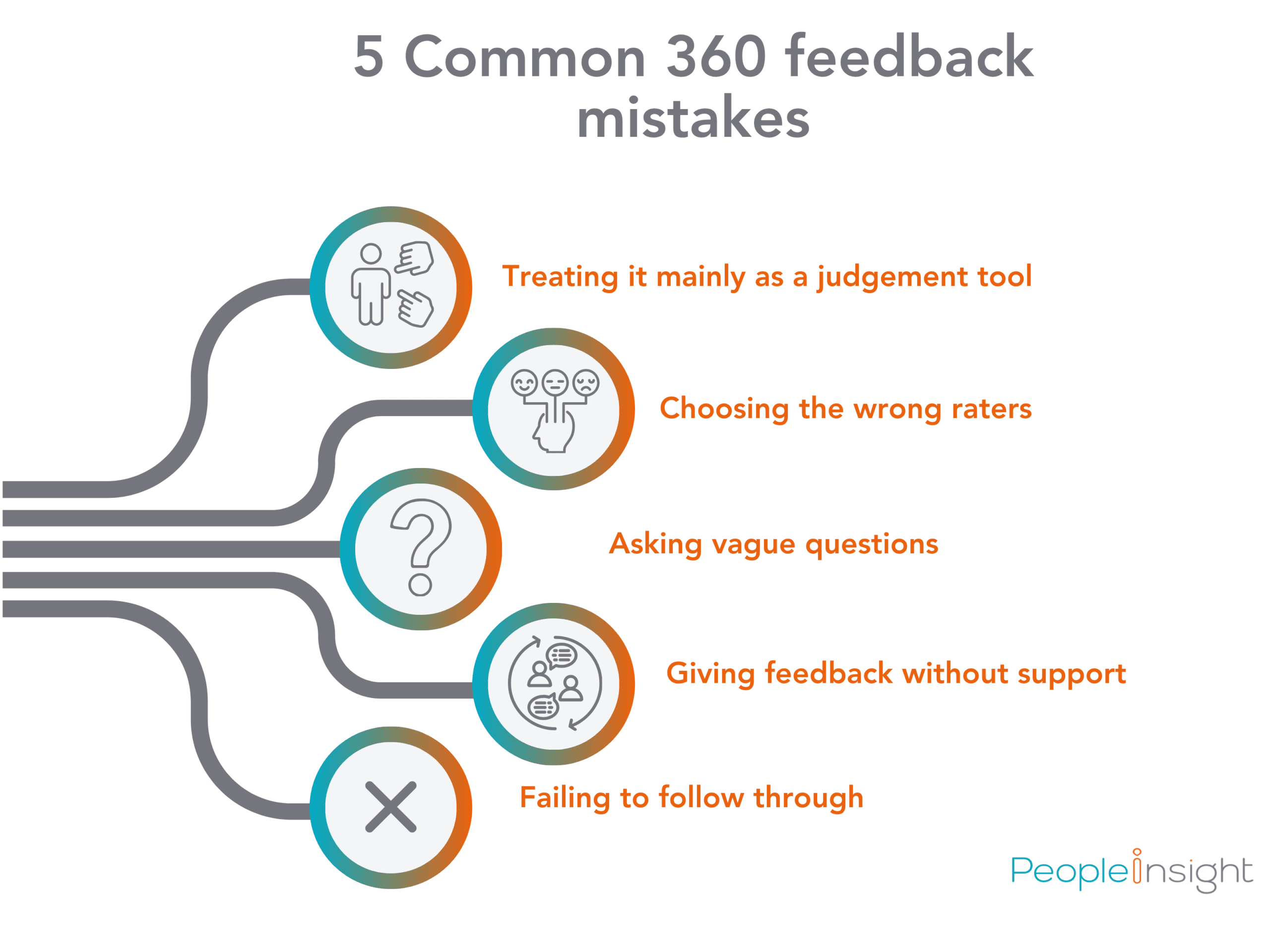
    Common 360 feedback mistakes

    1. Treating it mainly as a judgement tool

    360 feedback is usually most effective when it is used for development rather than punishment or hidden performance management.

    2. Choosing the wrong raters

    The process only works well when feedback comes from people who know the individual’s behaviour closely enough to comment meaningfully.

    3. Asking vague questions

    Behaviour-based questions produce better insight than broad personality statements.

    4. Giving feedback without support

    A report alone is not enough. People need time, reflection and often conversation to use the feedback well.

    5. Failing to follow through

    The biggest value of 360 feedback comes from what changes afterwards. Without follow-through, the insight quickly loses momentum.

    What good 360 feedback looks like in practice

    A strong 360 feedback process usually includes:

    • a clear purpose
    • the right mix of raters
    • behaviour-based questions
    • clear, well-structured reporting
    • thoughtful debrief or coaching support
    • realistic development priorities
    • visible follow-through over time

    That combination helps make the feedback constructive, credible and useful.

    Improve development with 360 feedback from People Insight

    The advantages of 360 feedback are clearest when the process is well designed, easy to trust and focused on meaningful development.

    At People Insight, we help organisations run 360 feedback in a way that is structured, insightful and practical. Through our platform, Prism-powered insight, proven models and expert support, we help individuals and organisations turn multi-source feedback into clearer self-awareness, better leadership and more focused development. 

    Want to explore the advantages of 360 feedback for your organisation? Talk to us about our 360 feedback approach.

    FAQs about the advantages of 360 feedback

    What are the main advantages of 360 feedback?

    The main advantages of 360 feedback are stronger self-awareness, broader insight, better leadership development, clearer strengths and development areas, and more focused follow-through.

    Why is 360 feedback useful for leaders?

    360 feedback is useful for leaders because it shows how their behaviour is experienced by managers, peers and direct reports, giving them a more complete picture of their impact.

    How does 360 feedback improve self-awareness?

    It improves self-awareness by comparing self-perception with the way others experience the individual’s behaviour, helping reveal strengths, alignment and blind spots.

    Is 360 feedback only useful for managers?

    No. It is especially useful for leaders and managers, but it can also support development in any role where collaboration, communication and influence matter.

    What makes 360 feedback more effective than manager-only feedback?

    It is often more effective because it gathers multiple perspectives rather than relying on one person’s view, which creates a more balanced and rounded picture.

    Does 360 feedback help organisational culture?

    Yes. When used well, 360 feedback can support a healthier feedback culture, stronger communication and better leadership behaviour across the organisation.

    How can People Insight help with 360 feedback?

    People Insight helps organisations run 360 feedback through intuitive technology, proven models and expert support that turns multi-source feedback into practical development action.