















Knowledge base:

How to run an employee survey project

A practical guide to planning, launching and following through on an employee survey project

How to run an employee survey project

    A quick insight: A strong employee survey project does much more than launch a questionnaire and report a score. It brings together clear planning, thoughtful survey design, strong communications, useful analysis and visible follow-through. The best projects help organisations understand what is really happening, prioritise what matters most and turn employee voice into meaningful improvement.

    A successful employee survey project is about creating a clear route from employee voice to meaningful action.

    Many organisations know they should listen to employees more closely, but the project can still lose momentum if it becomes too focused on the survey itself. A questionnaire goes out, results come back, a few headlines get shared and then the real challenge begins. What exactly should the organisation do next? Which issues deserve attention first? How do leaders, managers and employees stay involved? And how do you stop the whole thing becoming another exercise that looked promising but changed very little?

    That is why a good employee survey project needs to be treated as a full programme, not just a survey launch.

    This guide sets out a practical way to run an employee survey project from planning through to implementation.

    Related: What is an employee survey?

    What an employee survey project really involves

    An employee survey project is the full process of designing, launching, analysing and acting on employee feedback.

    It is not just about measuring engagement or asking people how they feel. It is about understanding what the organisation needs to learn, using the right methods to gather that insight and turning the results into meaningful improvement.

    That usually includes setting a clear purpose, choosing the right survey approach, communicating the project well, launching the survey, analysing the results, prioritising action and reviewing progress over time.

    A strong employee survey project is less about collecting data for its own sake and more about building a clear route from employee voice to visible change.

    Where a good project starts

    Before anything is launched, it helps to get clear on the purpose of the project.

    A strong employee survey project should begin with a simple question:

    What problem are we trying to solve?

    That might be:

    • improving engagement
    • reducing turnover
    • strengthening leadership visibility
    • improving communication between teams
    • understanding wellbeing pressures
    • increasing confidence in action following surveys

    Knowing this changes the role of the project. Instead of measuring for measurement’s sake, the survey becomes part of a wider effort to improve business and people outcomes.

    The 6 stages of an employee survey project

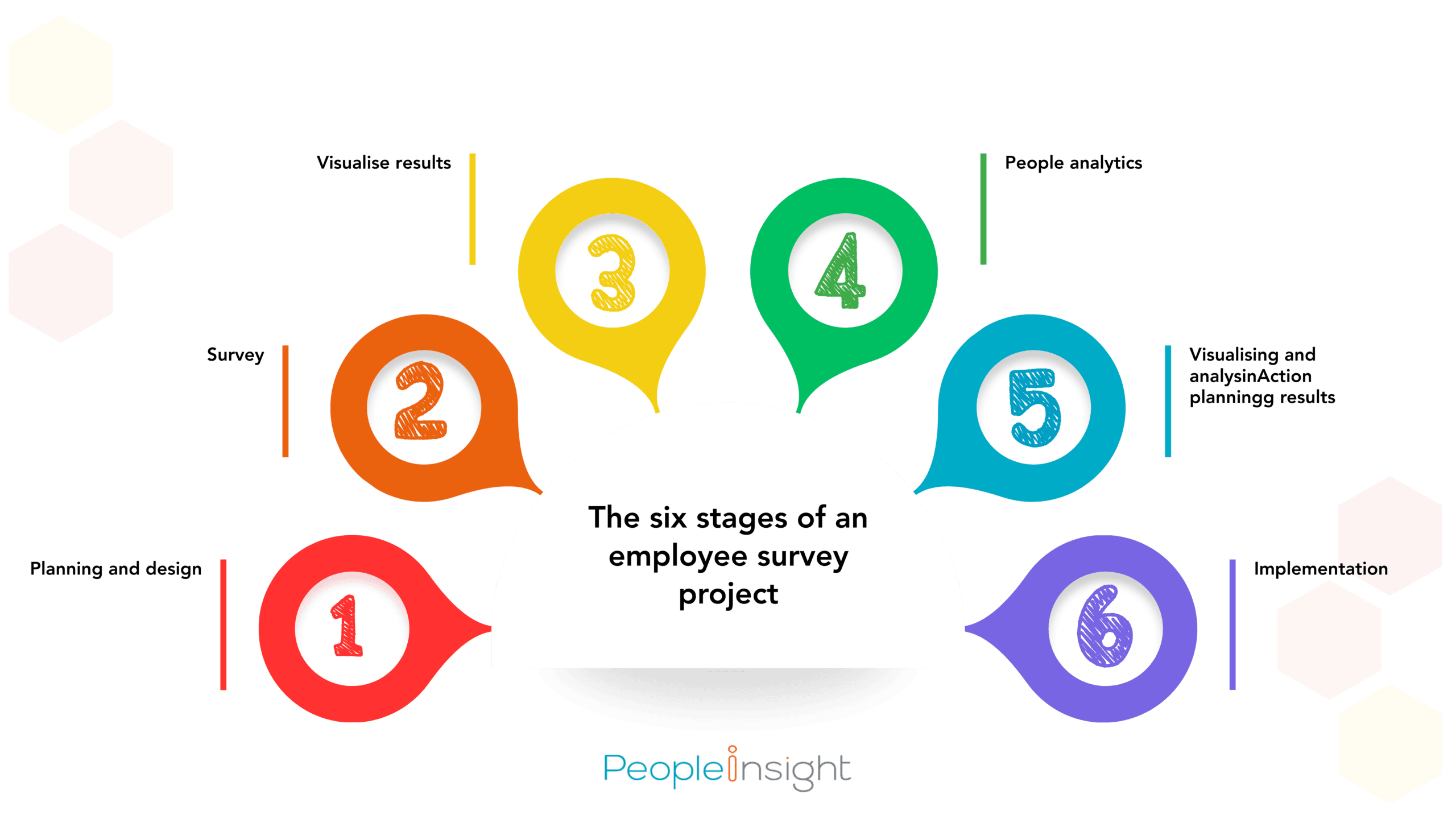
    At People Insight, the most practical way to think about an employee survey project is in six connected stages:

    The six stages of an employee survey project

    1. Planning and design
    2. Survey
    3. Visualise results
    4. People analytics
    5. Action planning
    6. Implementation

    The strongest projects also shift a larger share of effort towards what happens after the survey, especially action planning and implementation.

    Planning and design

    A strong employee survey project starts with careful planning.

    That means:

    • engaging leaders early
    • deciding what the organisation needs to learn
    • agreeing how success will be judged
    • planning the survey timetable realistically
    • deciding what demographic cuts will matter later
    • shaping communications before launch

    Senior leaders should be fully briefed and visibly engaged, especially where the survey is meant to support wider business objectives such as customer satisfaction, turnover or profitability.

    This stage is also where you decide how often to survey. One of the most useful principles here is to only survey at a rate you can make change happen. If organisations ask for feedback too often without creating visible progress, employees can quickly become disheartened.

    That is one reason a combined approach often works best:

    • a deeper organisation-wide survey less frequently, often around 35 questions
    • lighter pulse surveys more regularly, often around 5 to 15 questions, to monitor change over time

    Designing the right survey

    Question design matters more than many organisations expect.

    A good survey should be:

    • short enough to complete without frustration
    • clear and unambiguous
    • relevant to the organisation’s goals
    • strong enough to support action later
    • built around themes that can be benchmarked and analysed properly

    This is where experienced survey design makes a real difference. The strongest surveys combine occupational psychology best practice with the organisation’s own needs, including agreed themes and carefully planned demographics.

    That is also where People Insight’s approach differs from a more generic template-led model. We help organisations design the right survey for the context, not just repeat the same exercise on autopilot.

    Related:  How to write effective staff survey questions

    Communicating the project well

    A strong employee survey project needs strong communications before, during and after the survey.

    Before launch, employees are much more likely to participate when:

    • they know the survey is coming
    • they understand the deadline
    • they see endorsement from senior leaders and trusted colleagues
    • they believe something will happen afterwards

    Survey communications should never be left until the last minute. Good communications create momentum, reduce cynicism and make the project feel purposeful rather than procedural.

    This is also where your internal comms teams can make a real difference. They help keep energy and momentum high throughout the journey.

    Launching the survey

    Once the project is live, the experience needs to feel simple and accessible.

    The right launch approach depends on your workforce. Some employees will be comfortable on smartphones, some will respond well by email and some may still need paper-based access.

    A good employee survey project therefore makes sure the survey is:

    • easy to access
    • easy to complete
    • distributed in ways that suit the workforce
    • supported by reminders where needed

    Tracking response rates during the live survey window is also useful. Managers can then nudge teams where participation is lower and reminders can be targeted more effectively.

    That is one reason the right platform matters. A strong platform should reduce admin, improve visibility and make the project easier to manage.

    Related: How to improve your survey response rate

    Visualising the results clearly

    Once the survey closes, results need to be easy to understand.

    A good dashboard should allow organisations to:

    • see the overall engagement score
    • compare against historic and external results
    • identify strengths and weaknesses
    • view prioritised focus areas
    • explore comments by theme
    • compare groups while protecting anonymity
    • give managers access to their own team results only

    That matters because raw data on its own rarely leads to good decisions. Visualisation helps leaders and managers see patterns more quickly and understand where attention should go first.

    This is also where Prism, our integrated AI, can help. Prism strengthens the post-survey stage by surfacing patterns, adding context to comments and helping organisations move more confidently from results to priorities.

    Going beyond the dashboard

    A good survey dashboard is important, but it is not enough on its own.

    The real value comes from looking at correlations, patterns and links to wider outcomes such as customer satisfaction, turnover, recruitment, leadership impact or profitability.

    That is where people analytics becomes so useful.

    A stronger employee survey project should help answer questions such as:

    • which issues are most strongly linked to engagement
    • which teams or groups are experiencing work differently
    • which levers appear to support retention or performance
    • which leadership or management behaviours matter most
    • whether previous interventions are working

    This is one place where People Insight’s consultancy support adds real value. Our experts help clients interpret results properly, not just look at charts. And Prism helps surface clearer themes and focus areas at pace.

    Related: How to interpret survey results

    Action planning

    There is little point investing in an employee survey project if nothing happens afterwards.

    Action planning needs proper time, focus and resource, because this is where the project either gains credibility or loses it.

    A strong action planning stage often includes:

    • a small number of strategic programmes at organisation level
    • some quick wins to show momentum
    • workshops for leaders
    • support for managers so they can understand the data and lead local action planning well

    That lines up closely with how People Insight works today. Good action planning means:

    • narrowing the focus
    • making ownership clear
    • involving the right people
    • helping managers feel confident discussing results
    • giving teams enough structure to act locally as well as strategically

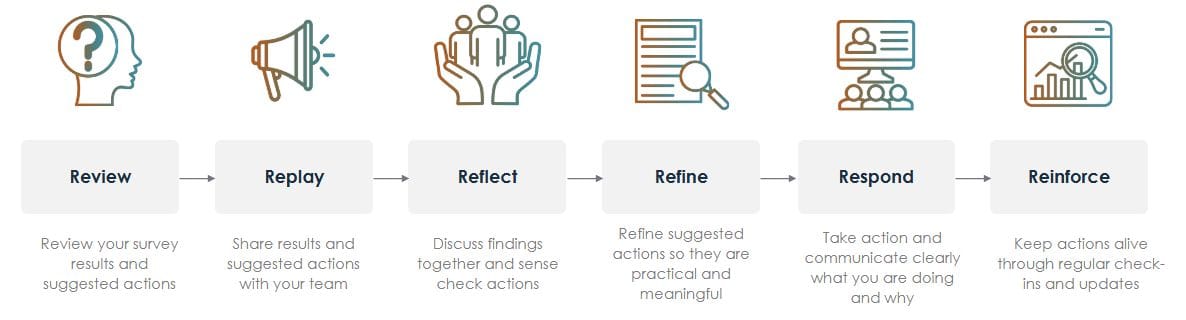
    This is also where our 6 Rs framework helps:

    6 Rs action planning

    • Review
    • Replay
    • Reflect
    • Refine
    • Respond
    • Reinforce

    And where Prism Improve can support the move from priorities to practical next steps.

    Implementation and follow-through

    Implementation is where the employee survey project becomes real.

    This usually means:

    • linking actions to existing business and people plans
    • keeping survey action progress visible in leadership and company updates
    • using tracking tools to monitor actions
    • celebrating progress
    • reviewing employee reaction through pulse surveys or other listening channels

    Action planning is only useful if it becomes visible in everyday work, so this step is especially important.

    That is also why feedback loops matter so much. If employees can see how their input shaped decisions, belief in the survey process rises.

    Related: Post-survey action planning

    What to look for in an employee survey partner

    A good employee engagement partner should provide:

    • a methodology tailored to your workforce and goals
    • robust evidence and experience
    • manageable surveys on accessible platforms
    • anonymity and respect
    • results that are easy to communicate
    • clear dashboards
    • strong prioritisation support
    • help through action planning and change
    • a process that feels as simple as possible

    That reflects the way we at People Insight approach employee survey projects today. Technology matters, but expert support matters too. The strongest outcomes usually come from the combination of:

    • a good platform
    • thoughtful survey design
    • clear communications
    • strong analysis
    • practical action planning support

    What ‘good’ looks like

    A strong employee survey project usually includes:

    • a clear purpose linked to business and people priorities
    • visible leader support
    • a well-designed survey
    • strong internal communications
    • an accessible launch
    • clear reporting and dashboards
    • deeper analysis where needed
    • focused action planning
    • visible implementation
    • continued listening through pulse or follow-up activity

    In other words, it is a project with a real arc. It starts with purposeful listening and ends with meaningful improvement.

    Run a stronger employee survey project with People Insight

    A good employee survey project helps organisations understand what is really happening, focus on what matters most and turn feedback into meaningful progress.

    At People Insight, we help organisations do exactly that through stronger survey design, clear communications, Prism-powered insight, practical action planning and expert support at every stage. That makes it easier to move from survey data to real change, with more confidence and less wasted effort.

    Want to run an employee survey project that leads to meaningful, visible progress? Get in touch to learn how People Insight can help.

    FAQs about employee survey projects

    What is an employee survey project?

    An employee survey project is the full process of planning, launching, analysing and acting on employee feedback, not just sending out a questionnaire.

    What are the stages of an employee survey project?

    A strong employee survey project typically includes planning and design, survey launch, results visualisation, people analytics, action planning and implementation.

    How often should you run an employee survey project?

    That depends on how quickly your organisation can respond and make change happen. A combined approach often works well, with a deeper survey less frequently and shorter pulse surveys in between.

    How long should an employee survey be?

    For a fuller organisation-wide survey, around 35 questions is often a useful guide. For pulse surveys, around 5 to 15 questions is more typical.

    What makes an employee survey project successful?

    A successful employee survey project usually has a clear purpose, visible leader support, strong communications, good analysis, focused action planning and visible implementation.

    Why is action planning so important in an employee survey project?

    Because the value of the project depends on what happens after the survey. Without visible action, employee trust in the process usually weakens.

    How does Prism support an employee survey project?

    Prism helps by surfacing patterns, adding context to survey comments and results, and helping organisations move more quickly from feedback to clearer priorities and practical actions.

    How can People Insight help run an employee survey project?

    People Insight helps organisations run employee survey projects through tailored survey design, accessible technology, expert analysis, Prism-powered insight and practical support from planning through to implementation.