

















Blogs:

Why public sector teams feel stretched (even when workforce numbers are rising)

What the data says and what you can do about it

Why public sector teams feel stretched, even when workforce numbers are rising

    A quick insight: Public sector engagement has remained steady, but that does not mean pressure has eased. People Insight’s benchmark data shows employees are still connected to their work, while scores around reward, recognition, fairness, openness and belief in action are under strain. For leaders, the challenge is to look beyond headcount and understand the real employee experience.

    Public sector employment is rising. On paper, that’s great. In practice, however, many public sector employees are still working under sustained pressure.

    That is the tension leaders need to understand. A larger workforce does not automatically mean people feel less stretched, better supported or more confident in the direction of their organisation. More people in the system does not always mean the right capacity in the right places. It does not show how pressure is being distributed, where skills gaps are growing or whether managers have the time and confidence to support their teams properly.

    People Insight’s public sector benchmark data tells an important story. Engagement in the sector remained broadly stable (at 77%) over the past few years, as has purpose at 73%.

    Importantly, this shows that public sector employees are not necessarily disconnected from their work. Many still care deeply about what they do and the organisations they serve.

    But the picture underneath is more uneven. Reward (how rewarded people feel for the effort they put in) fell from 60% to 58%. Enablement (how equipped they feel to perform their job well) slipped from 64% to 63%. Scores around open communication, fair treatment, recognition and belief that action will follow feedback all point to pressure in the employee experience.

    This is where employee surveys become essential. They help leaders move beyond broad workforce numbers and understand what employees are actually experiencing day to day. Let’s take a look at what the sector is experiencing so far and why public sector employees feel so stretched.

    Related: 5 factors damaging public sector employee engagement

    Rising workforce numbers do not tell the whole story

    According to the latest ONS figures, UK public sector employment was estimated at 6.19 million in December 2025, up 43,000 compared with the previous year. NHS employment reached a record 2.07 million, while local government employment fell to a record low of 1.97 million.

    This is good to know, but while workforce data is useful, it can only take leaders so far.

    A national figure can show whether employment is rising or falling overall. It cannot show whether one service area is carrying an unsustainable workload, whether managers are struggling to translate strategy into local action or whether employees believe feedback will lead to change.

    That distinction is especially important in the public sector, where workforce pressure is rarely spread evenly. One part of an organisation may be growing, while another is losing experienced people. One team may have enough roles on paper, but not enough specialist skills. One department may have strong leadership and clear communication, while another feels disconnected from senior decision-making.

    Employees feel the reality of work locally. They feel it in rota gaps, delayed decisions, rising demand, unclear priorities and the emotional strain of delivering services when resources are tight.

    That is why public sector leaders need to ask a better question.

    Not simply: “How many people do we employ?”

    But: “Where are people under pressure, what is driving it and what would help them do their best work?”

    What our public sector benchmark data shows

    People Insight’s public sector benchmark data gives us a clearer view of what is happening beneath the headline engagement score.

    At a high level, the sector looks steady. Engagement remained at 77% between 2024 and 2025. Purpose remained at 73%. Autonomy also stayed broadly stable at 65%.

    Those are encouraging signs. They suggest many public sector employees still feel a strong connection to their work, understand its purpose and want to do a good job.

    But the data also shows where strain is building.

    Enablement fell from 64% to 63%. Reward fell from 60% to 58%. The data shows that employees are still asking for clearer communication, stronger recognition and more visible follow-through.

    Only 59% of public sector employees said they could comfortably cope with their workload in 2025, broadly unchanged from 2024. Work-life balance improved from 65% to 68%, which is positive, but still leaves a sizeable proportion of employees who are not giving a positive response.

    That is the challenge for leaders. Pressure does not always show up as a sudden collapse in scores. Sometimes it sits beneath stable engagement, quietly shaping morale, trust and confidence.

    The strongest warning signs sit around openness, fairness and action. In 2025, only 49% of public sector employees said people communicate openly regardless of position or level, down from 54% in 2024. The score for fair and equal treatment fell from 69% to 61%. The proportion who said their opinion is sought on decisions that affect their work fell from 59% to 56%.

    And just 44% said they believe action will be taken as a result of the survey.

    That is the real story. Public sector employees may still be engaged, purposeful and committed. But many are also experiencing weaker recognition, less open communication and lower confidence that feedback will lead to change.

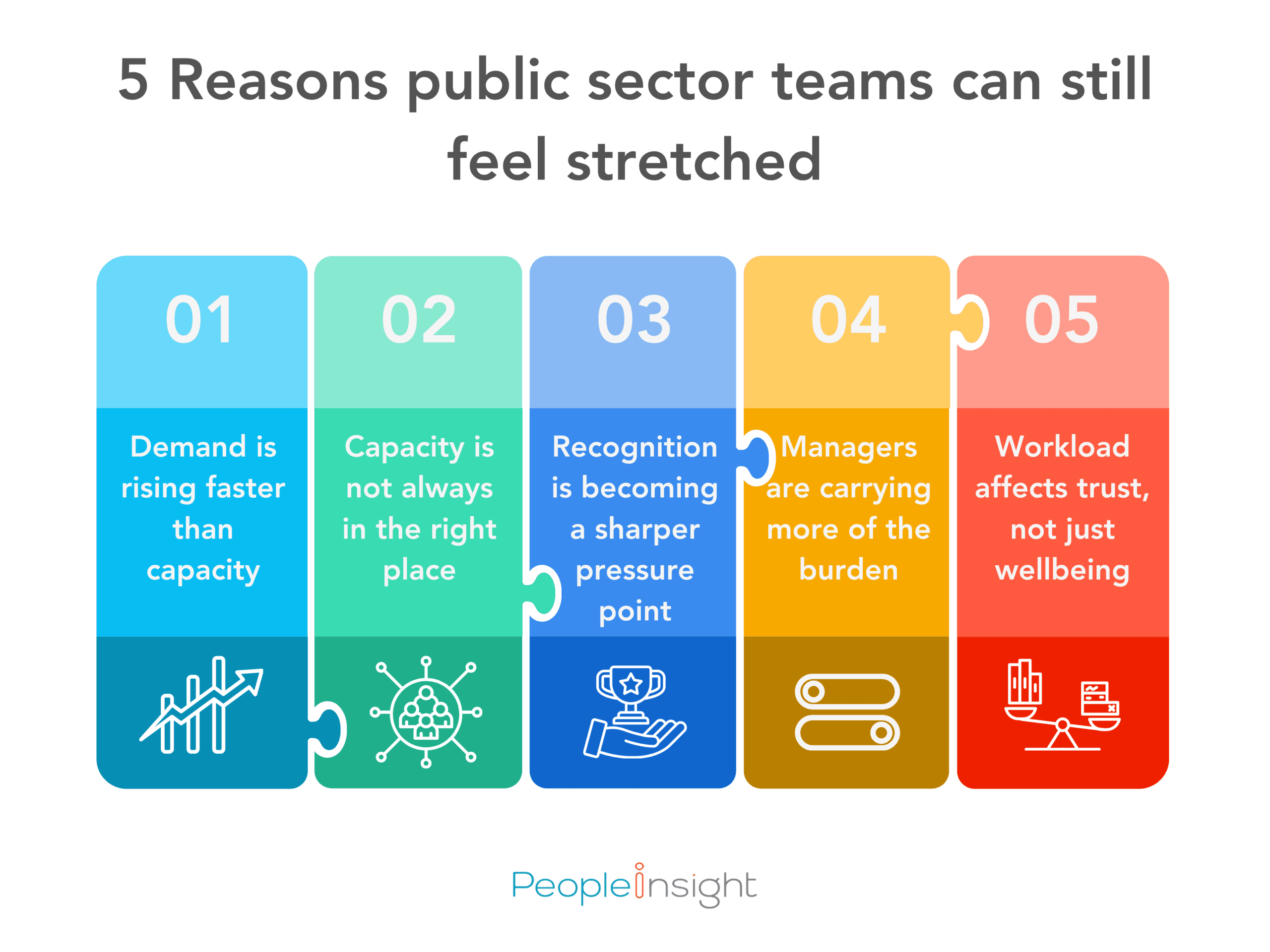
    5 Reasons public sector teams can still feel stretched

    There are several reasons employees can feel under pressure, even when workforce numbers are rising overall.

    5 Reasons public sector teams can still feel stretched

    1. Demand is rising faster than capacity

    Public services are often dealing with increasing complexity, higher expectations and tighter resources at the same time.

    In healthcare, this might mean more patients, higher acuity, longer waiting lists and greater emotional strain. In local government, it might mean rising demand for social care, housing, safeguarding, environmental services and community support, often while budgets remain constrained. In education, it might mean more student need, more regulation, more admin and growing pressure on academic and professional services teams.

    When demand rises faster than usable capacity, employees do not experience workforce growth as relief. They experience it as a system still asking too much of too few people.

    This is why workload should not be treated as a simple wellbeing topic. It links directly to engagement, retention, trust in leadership and confidence in the future.

    2. Capacity is not always in the right place

    Even when headcount increases, pressure may remain if capacity is not reaching the areas that need it most.

    A public sector organisation might recruit into one function while another continues to face high vacancy rates. It might bring in new employees, but lose experienced colleagues who held essential organisational knowledge. It might fill roles, but still lack the skills, systems or decision-making structures needed to work efficiently.

    For employees, that can feel frustrating. They hear that the organisation is growing, but their own workload does not feel lighter. They see new appointments, but their team remains stretched. They are told improvement is coming, but the day-to-day reality has not changed.

    This is where employee engagement surveys are particularly valuable. They help leaders understand how experiences differ across teams, roles, locations and employee groups, rather than relying on an organisation-wide average that may hide the pressure points.

    3. Recognition is becoming a sharper pressure point

    Reward and recognition are two of the clearest pressure points in the public sector benchmark data.

    The overall Reward theme fell from 60% in 2024 to 58% in 2025. Only 40% of public sector employees said their rewards are linked to their performance and contribution, down from 45%. Recognition has also softened, with 61% saying they feel valued and recognised for the work they do, down from 63%.

    That does not mean every issue can be solved through pay. In many public sector organisations, pay structures are complex, constrained or set outside local leadership control.

    But it does mean leaders need to understand how reward, recognition and value are being experienced. Employees want to know that their contribution is seen, that effort is acknowledged and that leaders are taking practical steps where they can.

    Our National Gallery case study is a useful example. After its first staff survey highlighted concerns around rewards at work, the Gallery introduced targeted benefits shaped around employee needs, including family-friendly support, help with London living and commuting, health and wellbeing initiatives and more opportunities for connection.

    The benefits score rose by 29% to 81%, and perceptions of rewards improved even though salaries themselves had not changed.

    The lesson for public sector leaders is not that benefits can replace fair pay. They cannot. The lesson is that visible, thoughtful action can make a difference when it responds directly to what employees have said.

    4. Managers are carrying more of the burden

    Line managers often sit at the sharpest point of public sector pressure.

    They are expected to support wellbeing at work, manage performance, explain change, handle absence, respond to feedback, keep services moving and maintain morale. At the same time, many are dealing with their own workload pressures.

    There are encouraging signs in the benchmark data. The proportion of public sector employees who said their manager gives them regular feedback rose from 67% to 69%. The score for managers taking time to coach and develop skills also rose from 62% to 63%. Manager fairness and respect remained high, rising from 87% to 87%.

    But these results should not lead leaders to assume managers are fine. If anything, they show how much organisations rely on managers to hold the employee experience together.

    That creates a difficult pattern. Organisations ask managers to own engagement, but do not always give them the tools, time or support to act on what employees are saying.

    Managers need more than a dashboard of results. They need to understand what the data means, which priorities matter most and what realistic action looks like in their context.

    This is where Prism, our integrated AI, can help. Prism supports leaders and managers by interpreting survey data, surfacing priority areas and helping turn employee feedback into clearer next steps. It supports professional judgement rather than replacing it, giving managers more confidence to act without adding more noise.

    5. Workload affects trust, not just wellbeing

    When employees feel stretched for a long time, the impact goes beyond tiredness.

    They may start to question whether senior leaders understand the reality of their work. They may become more sceptical about change programmes. They may disengage from surveys if previous feedback has not led to visible action. They may stop raising concerns because they assume nothing will change.

    That is when workload becomes a trust issue.

    The public sector benchmark data shows why this needs attention. Only 44% of employees said they believe action will be taken as a result of the survey. Although that is a small improvement from 42% in 2024, it remains one of the lowest scores in the data.

    Employees do not expect every problem to be solved immediately, especially in complex public sector environments. But they do expect honesty, visibility and follow-through. They want to know that leaders understand what is happening, are making informed decisions and are prepared to act where they can.

    Our Healthcare at Home case study shows this clearly. After a difficult period, employees were sceptical about whether survey results would be shared or acted on. Healthcare at Home worked with us to build transparency around the survey, involve leaders visibly and turn results into meaningful action plans. The organisation also introduced an “Action Taken” stamp to show where employee feedback had directly led to change.

    The lesson for public sector leaders is simple: when trust is fragile, communication and action have to be visible.

    The risk of relying on averages

    One of the biggest risks in public sector listening is treating the average result as the full story.

    An organisation-wide engagement score might look stable, while certain teams are under intense pressure. A leadership score might improve overall, while frontline employees still feel disconnected from senior decision-making. A wellbeing score might look broadly steady, while one employee group is struggling.

    Averages are useful, but they can soften the edges of the employee experience.

    That is exactly what the benchmark data shows. Public sector engagement is steady at 77%, yet only 49% of employees say people communicate openly regardless of position or level. Purpose is steady at 73%, yet only 44% believe action will be taken as a result of the survey. Employees may care about their work, but still feel unsure whether their voice is being heard and acted on.

    Public sector organisations need insight that shows where pressure is concentrated and what is driving it. That means looking carefully at:

    • differences between teams, directorates and locations
    • workload and wellbeing scores
    • leadership visibility and communication
    • confidence in organisational direction
    • manager support
    • employee comments
    • perceptions of fairness and inclusion
    • whether people believe feedback leads to action

    This is where People Insight’s consultancy services add real value. Our consultants help organisations interpret survey results, identify priority areas and understand what sits behind the numbers, so leaders can focus their energy where it will make the greatest difference.

    What public sector leaders need to understand before they act

    When employees feel stretched, the temptation can be to jump straight into solutions.

    That is understandable. Leaders want to show they are listening. But action that is not rooted in the real employee experience can miss the point.

    Before deciding what to do next, leaders need to understand a few key things.

    1. Where pressure is being felt most sharply

    This means identifying the teams, roles or locations where workload, morale or confidence are most under strain.

    For one organisation, the issue might be frontline capacity. For another, it might be middle manager pressure. For another, it might be professional services teams absorbing more work behind the scenes.

    The point is not to assume. It is to listen carefully enough to know.

    2. What is actually driving the pressure

    Workload is rarely just about volume.

    Employees may feel stretched because priorities are unclear, systems are inefficient, communication is poor or decision-making is slow. They may have enough people in theory, but not enough authority, skills or support to get work done properly.

    This is where the benchmark data around communication matters. Communications between teams remained low, moving only slightly from 42% to 43%. Open communication across position or level fell from 54% to 49%.

    These are not small cultural details. They shape how quickly work moves, how safe people feel to raise issues and how confident employees are that leaders understand the reality on the ground.

    Survey comments are especially useful here because they bring context to the scores. They help leaders understand the story behind the data and avoid making shallow assumptions.

    For more on this, our guide to survey comments explores how employee feedback can be turned into clearer action using AI and human expertise together.

    3. Whether managers feel equipped to respond

    If managers are expected to act on survey results, they need practical support.

    That includes clear dashboards, useful guidance, realistic expectations and action planning tools that help them focus. Without that, engagement becomes another task on a long list.

    Our InHealth case study is a strong example of how this can work. InHealth gave People Managers access to survey data and the People Insight dashboard, provided training to help them use it well and introduced an action planning toolkit using a Red, Amber, Green approach. Survey results were also built into People Business Review meetings, keeping employee voice connected to leadership discussion and decision-making.

    That is what smarter action looks like. Not just sharing results, but building the habits, tools and accountability that help people act on them.

    4. Whether employees believe feedback leads to change

    This is one of the most important questions in any listening programme.

    If employees do not believe anything will happen, they may still complete a survey once. But over time, participation and candour will suffer. People will either stop responding or give safer, less honest answers.

    In the public sector benchmark data, belief in action remains low at 44%. That should be a clear signal to leaders. The issue is not simply whether people are willing to give feedback. It is whether they trust the organisation to do something useful with it.

    A strong listening strategy needs communication before, during and after the survey. Employees need to know why their feedback is being collected, how it will be used and what has changed as a result.

    Our survey communications team helps organisations build trust and momentum around employee listening, so surveys feel like the start of a conversation rather than a one-off request for data.

    Lessons from organisations turning feedback into action

    Public sector organisations face their own specific pressures, but there are useful lessons from organisations that have used employee feedback to rebuild trust, strengthen action and improve employee experience.

    Lesson 1: Visible action can shift perceptions, even when budgets are tight

    Reward is one of the clearest pressure points in the public sector benchmark data. That makes it tempting for leaders to feel stuck, especially when pay decisions are constrained.

    But the National Gallery case study shows that meaningful action can still happen.

    After its first staff survey highlighted concerns around rewards at work, the Gallery worked with People Insight to understand what employees needed and where practical improvements could be made. It then introduced targeted benefits across family-friendly support, travel, wellbeing and connection.

    The result was a significant improvement in perceptions of benefits and reward.

    For public sector organisations, the lesson is not that every reward challenge can be solved locally. It is that employees value visible, thoughtful action when it responds to their feedback and reflects the reality of their lives.

    Lesson 2: Action planning needs ownership, not just intention

    A survey does not create change on its own.

    InHealth’s approach shows the importance of giving managers access, training and a clear structure for action. The organisation did not simply collect feedback and produce a report. It embedded survey results into leadership conversations, equipped managers to use the data and kept progress under regular review.

    That is especially relevant for public sector organisations, where action often needs to happen at multiple levels. Some issues need senior leadership decisions. Some need service-level changes. Some need team-level conversations.

    Good action planning helps separate those layers, so responsibility is clear and employees can see progress.

    Lesson 3: Communication has to be continuous

    Healthcare at Home shows how powerful communication can be when employees are sceptical.

    The organisation created a strong survey identity, involved managers, shared participation updates and made sure results were understood. Senior leaders took part in open conversations with employees and the organisation used visible markers to show where feedback had led to action.

    For public sector teams, this is important because trust is often shaped by communication as much as action itself. If employees cannot see what is happening, they may assume nothing is happening.

    Regular “you said, we did” updates, honest progress reports and clear explanations of what is still being worked through can all help maintain confidence.

    From sharper listening to smarter action

    For public sector organisations, the challenge is not simply to collect more employee data. Most already have plenty of information.

    The bigger challenge is making that information useful.

    That means listening in a way that identifies where pressure is concentrated, what is driving it and what action will make the biggest difference. It means giving managers insight they can actually use. It means helping senior leaders understand where organisation-wide intervention is needed. And it means keeping employees informed, so they know their voice is shaping decisions.

    This is People Insight’s approach to public sector employee surveys: sharper listening that gives organisations a clearer understanding of their people’s experience, and smarter action that turns feedback into meaningful improvement.

    Our employee survey platform brings listening, insight and action together. With expert-designed survey models, clear reporting, benchmark comparisons, Prism AI and consultant support, public sector leaders can move from broad concern to focused action.

    What should leaders do next?

    If public sector teams are feeling stretched, leaders should avoid two traps.

    The first is assuming that rising workforce numbers mean pressure is easing.

    The second is assuming that steady engagement means there is nothing serious to address.

    The People Insight benchmark data shows why both assumptions are risky. Public sector employees remain engaged and purposeful, but scores around reward, recognition, fairness, openness and belief in action show where trust can start to weaken.

    A good starting point is to ask:

    • Where are employees feeling the most pressure?
    • Which teams or groups are having a different experience?
    • Do managers feel equipped to act on feedback?
    • Do employees believe leaders understand their reality?
    • Are survey results leading to visible change?
    • Where are reward, recognition and fairness scores weakest?
    • What can we act on now, and what needs longer-term planning?

    Those questions move the conversation beyond headcount and into employee experience.

    Because public sector performance depends on more than workforce numbers. It depends on whether people have the clarity, support, trust and capacity to do their best work.

    If your public sector teams are feeling the pressure, People Insight can help you understand what is driving it and where action will make the biggest difference. Get in touch to learn how our employee surveys, Prism AI and expert consultants can help you listen more sharply and act with confidence.

    FAQs on public sector employee experience

    A quick run down on all you need to know

    Why do public sector teams feel stretched even when workforce numbers are rising?

    Public sector teams can still feel stretched because overall headcount does not show where pressure is concentrated. Demand may be rising faster than capacity, vacancies may remain high in critical roles or employees may lack the systems, support and clarity they need to work effectively. Workforce numbers tell leaders how many people are employed. Employee feedback shows what work actually feels like.

    What does People Insight’s public sector benchmark data show?

    People Insight’s public sector benchmark data shows that engagement remained broadly stable at 77% between 2024 and 2025, while purpose remained at 73%. But the deeper results show pressure around reward, recognition, openness, fairness and belief in action. Only 44% of public sector employees said they believe action will be taken as a result of the survey.

    How can public sector leaders understand workload pressure?

    Public sector leaders can understand workload pressure by listening to employees directly and analysing results by team, role, location and employee group. Employee surveys help leaders identify where pressure is highest, what is driving it and where action will make the biggest difference.

    Why is employee listening important in the public sector?

    Employee listening is important in the public sector because employees are often working through high demand, complex change and constrained resources. A strong listening programme helps leaders understand morale, workload, wellbeing, trust, manager support and confidence in organisational direction, so they can make better decisions and act where support is most needed.

    How can employee surveys help with public sector workforce challenges?

    Employee surveys help public sector organisations move beyond broad workforce data and understand the lived experience of employees. They can show where workload is affecting engagement, where managers need more support, where communication is unclear and whether employees believe feedback leads to change.

    What should public sector organisations do after an employee survey?

    After an employee survey, public sector organisations should share the results clearly, identify priority areas and create practical action plans. Some actions may sit with senior leaders, while others may need local team ownership. The most important thing is to keep employees informed about what has been heard, what will happen next and what progress is being made.

    How can People Insight support public sector employee listening?

    People Insight helps public sector organisations design and run employee surveys, interpret feedback and turn insight into meaningful action. Our employee survey platform, Prism AI and expert consultants help leaders understand where pressure is concentrated, identify priority areas and support managers with practical action planning.