



















A quick insight: Job hugging is when employees stick with a role mainly for security, not because work feels rewarding or growth feels real. It can look like loyalty on the surface, but it often hides worry, stalled development and muted employee sentiment. This blog shares what to look for and how listening can help you respond well.
Last quarter, someone on your best performing team quietly asked for their job description. Not for a promotion. Not for a change. Just to check what they are “meant” to be doing. They started arriving earlier, taking fewer risks and saying less in meetings. Output is fine. Energy is not.
That is the shape job hugging often takes. People stay and they do the work. But they stop reaching, stop speaking up and stop believing a move is worth the risk.
Let’s take more of a look into this job hugging concept, what it is and why you should be keeping an eye out for it in your company.
Related: 14 Signs of disengaged employees
Job hugging is when employees hold tight to their current job even when it is not working for them, mainly because the outside market feels uncertain or worrying. In many ways, it is the exact opposite of the job hopping mood many employers saw a few years ago. Commentary in the UK has linked the shift to softer hiring conditions and a more cautious workforce overall.
It helps to name what job hugging is not.
It is not long service that comes with pride, mastery and progression. It is not retention driven by good work design. Job hugging is, in essence, staying without forward motion.
If people feel the market is tightening, staying put starts to feel sensible.
The UK’s unemployment rate is now 4.9%, according to the ONS. While this rate is not quite low enough to suggest a severe job crisis, it does point to a labour market that is softening, rather than booming. Knowing this, employee behaviour can often shift as a result. Employees see fewer attractive moves. They hear more talk about hiring freezes. They become more cautious. We’re seeing this reflected in our own global benchmark data. In 2024, 73% of employees said they would like to still be working at their company in two years’ time. This number rose to 74% in 2025, reflecting the reality that most people are choosing to stay put in this environment.
External signals reinforce it, too. Recent reporting on UK vacancies using Adzuna data described a cooling labour market and tougher competition for roles. Even if your organisation is stable, the wider story leaks into employee sentiment.
There is also a quieter driver: confidence. When people have not interviewed in years, the process can feel like a cliff edge. And when internal career paths are unclear, staying put starts to feel like the only safe option.
If this is ringing faint bells and you’re hearing echoes of the ‘quiet quitting’ trend of a few years ago, we understand. Job hugging and quiet quitting can look similar from a distance. People stay. Output is steady enough. Energy feels flatter than it used to. But the drivers are often different, and that changes how you respond.
With job hugging, the pull is safety. Employees stay put because moving roles feels risky, the market feels uncertain or confidence is low. You may see fewer stretch asks, less visibility and less appetite for internal moves. They are not always disengaged. They are often just cautious.
With quiet quitting, the shift is about effort. Employees keep to what the role requires and stop giving extra. It can show up after a long period of being stretched, unclear expectations or feeling taken for granted. The behaviour looks like boundaries, not fear.
So the response needs to be different. Job hugging calls for clearer internal pathways, practical career development frameworks and managers who can talk about growth without overpromising. It also helps to remove friction from internal moves, like unclear criteria or informal selection
So you might be thinking, ‘what’s the problem?’. For a lot of employers, job hugging can feel like great news. Attrition slows. Knowledge stays in-house. Recruitment pressure drops.
All true. But the bill often arrives later.
You can get slower decision making. Don’t forget, people are being cautious. When employees are overly cautious, they stop offering ideas that might fail. Managers start protecting headcount instead of developing it. Performance can hold for a while, then dip. Not in a dramatic way. In a gradual flattening.
And succession gets awkward. When fewer people move, fewer roles open up. High potential employees can start to stall, then leave in a single wave when confidence returns.
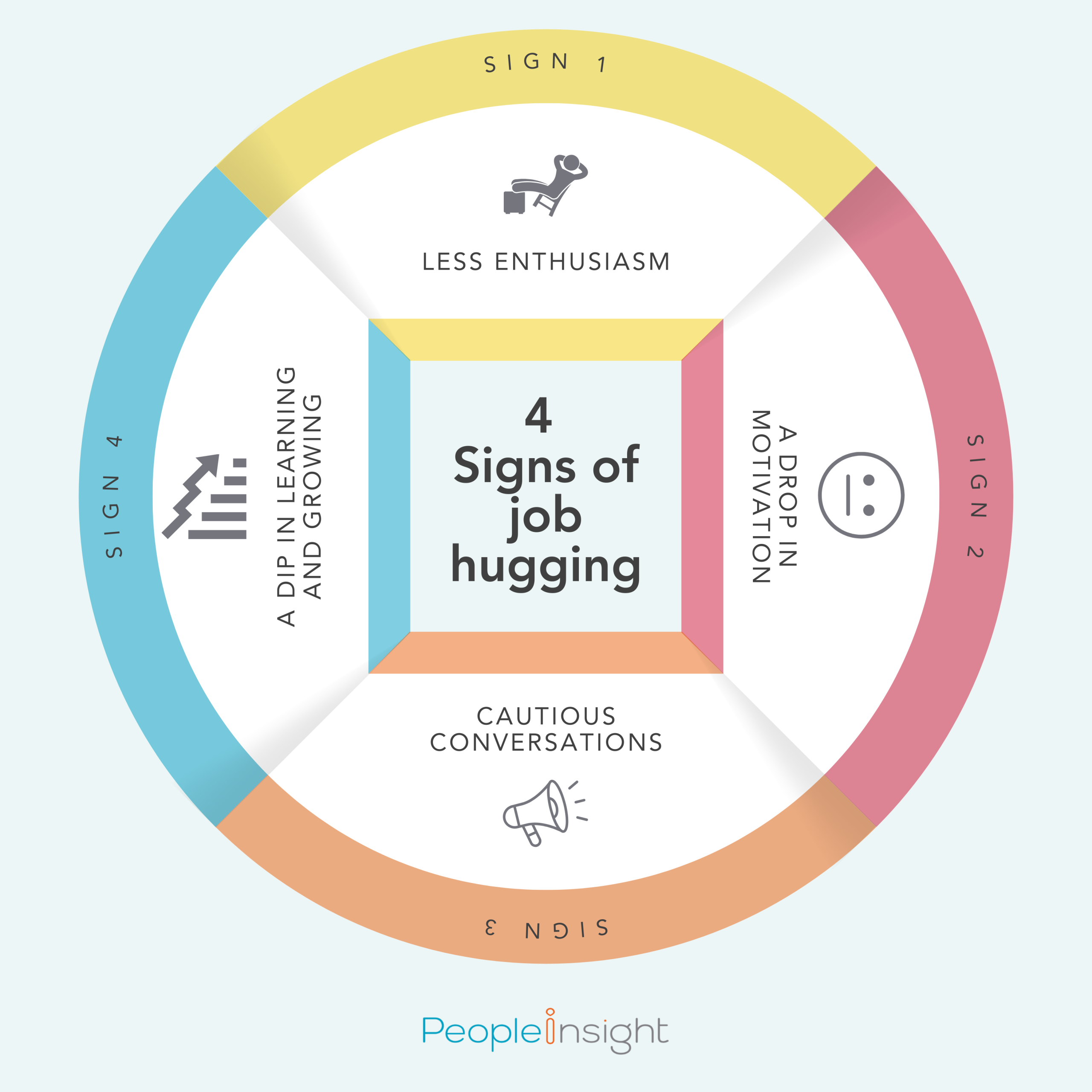
You rarely identify job hugging from one metric. It shows up as a pattern.

Job hugging is one of those dynamics that hides in plain sight. Your headline engagement score might stay stable while the texture of feedback changes.
In survey comments, you may see more language like:
“I do not know what growth looks like here.”
“It feels risky to move internally.”
“I am keeping my head down.”
“I want clarity on what good looks like.”
That is where actionable feedback really earns its keep. Numbers can tell you where to look. Comments tell you what to do next.
If you use an employee survey platform that supports strong comment analysis (as ours does through our innovative signature AI, Prism), you can map themes like security, workload, fairness, confidence in leaders and career development to specific groups. That turns a vague feeling into sharper insights and smarter action.
Managers often rush this part. They try to reassure … but it lands badly.
Instead, start with grounded questions.
“What would you like more of in your work over the next six months?”
“What feels risky right now?”
“If we made one thing clearer, what would help most?”
“What would a good move look like, even if it is small?”
Then reflect back what you hear. Name the trade-off. “It sounds like you want growth, and you are worried that moving roles could backfire.”
In practice, this is where trust is built. Not with big speeches, but with simple honesty and visible follow through.
If a manager cannot offer a promotion, they can still offer a pathway. A project, a mentor, a skill plan, training. The point is movement. Even a small step breaks the freeze.
Most organisations have internal opportunities. The issue is confidence, clarity and access.
Start with clarity. Publish examples of real moves. Not generic career ladders that nobody believes. Real names, real pathways, real timeframes. Make it normal to move sideways. Make it normal to try a different function for six months.
Then improve access. If internal roles are filled through informal networks, job hugging continues to grow. People assume they will not be chosen, so they stop trying. Create a visible process. A simple internal talent marketplace can help, but even a shared channel with clear criteria can shift behaviour.
Bring managers along. Job hugging often becomes manager hugging too. Leaders hold onto good people because backfilling feels hard. The CIPD has reported lower employer confidence and cautious employment intentions in recent Labour Market Outlook findings. In that climate, managers need support to develop talent and release it. Otherwise internal mobility stays stuck.
What this looks like in practice is a quarterly talent conversation that includes planned moves. Not as a threat, but as a normal operating rhythm:
“Who is ready for a stretch?”
“Where can we lend capacity?”
“Which roles can we design as stepping stones?”
Job hugging is useful information, if you treat it that way.
It can tell you where psychological safety is low. It can flag teams where work design is thin. It can reveal that progression is too opaque. It can show that employees do not trust what happens when they speak up.
So treat job hugging like a signal and build it into your employee listening system.
Pulse surveys can track confidence in career opportunities, fairness of progression, confidence in leaders and perceived job security. Focus groups can test what people think happens when they apply internally, and 360 feedback can highlight whether managers are coaching growth or blocking it. A 360 feedback platform can be especially helpful where “support for development” is the gap between manager intent and employee experience.
The goal is to stop “staying” from turning into stagnation.
Job hugging has a human logic. People are trying to protect their income, their routines and their confidence. That does not make them disengaged by default. It makes them cautious.
But for employers, caution is not neutral. Over time it shapes organisational culture. It changes how problems are raised. It affects whether innovation happens at the edges or not at all.
That is why employee listening has to go beyond a once a year score. When you combine actionable employee surveys with strong follow up habits, you can spot job hugging early and respond in a way that keeps trust intact. That is how you move from quiet caution to meaningful change.
If job hugging is starting to show up in your organisation, enquire about an employee survey with People Insight so you can measure the mood accurately, understand the story behind the scores and turn feedback into visible action.