


















Blogs:

How to improve employee engagement in 2026

Assess what needs to change and make actionable steps for meaningful improvements

How to boost employee engagement in 2026

    A quick insight: If you want to improve employee engagement in 2026, generic initiatives will only take you so far. The strongest results come when organisations listen properly, identify what matters most to their people and act with focus. This guide sets out 10 practical ways to improve employee engagement, alongside team engagement strategies that help leaders turn insight into meaningful change.

    If you are wondering how you might improve employee engagement this year, you are not alone. It is one of the most common questions HR teams and senior leaders ask, and for good reason. Employee engagement influences performance, retention, collaboration and the wider employee experience. When people feel connected to their work and supported by the organisation around them, they are more likely to contribute well, stay longer and speak positively about where they work.

    But improving employee engagement is not about throwing perks at the problem or launching one-off initiatives. It starts with understanding what employees are actually experiencing, where the biggest gaps sit and what kinds of action will make the greatest difference.

    That is why employee listening matters so much today.

    At People Insight, we help organisations move beyond assumptions. Through employee surveys, pulse surveys, 360 feedback, Prism-powered comment analysis and consultancy support, we help leaders understand what is shaping engagement and what to do next. 

    Using our experience supporting organisations across sectors, we have pulled together 10 practical ways to improve employee engagement in 2026. These are the approaches most likely to make a meaningful difference, especially when they are shaped around what your people are actually experiencing. 

    Related: 20 employee performance and engagement tools that will change the way you manage and lead 

    What does it mean to improve employee engagement?

    To improve employee engagement is to strengthen how connected, motivated and committed employees feel to their work and organisation.

    In practice, that usually means improving things like:

    • communication
    • leadership
    • recognition
    • development
    • wellbeing
    • trust
    • collaboration
    • purpose

    A strong employee engagement strategy is not just about making people happier. It is about creating the conditions that help people do good work, feel valued and want to stay.

    How to improve employee engagement: 10 practical methods for 2026

    These are 10 of the most effective ways to improve employee engagement, along with team engagement strategies that help bring them to life in day-to-day working environments.

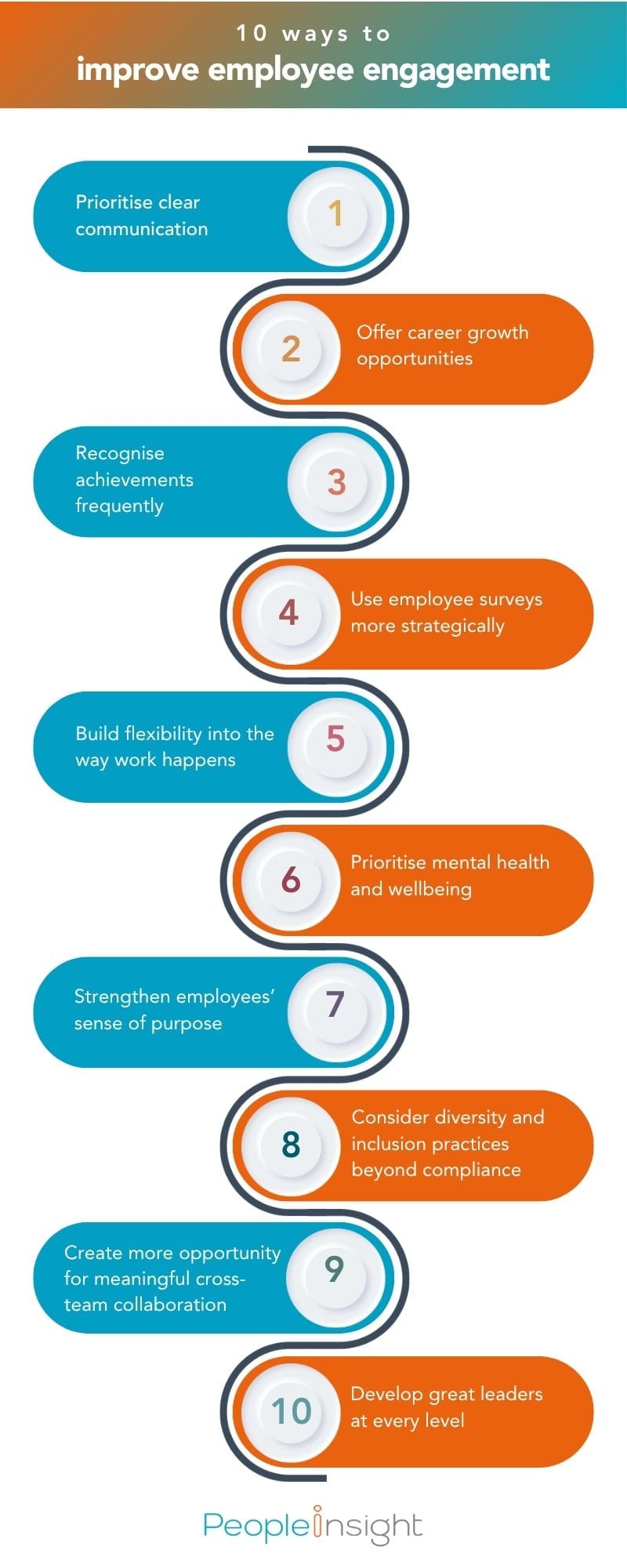
    10 ways to improve employee engagement

    1. Prioritise clear communication

    Clear communication remains one of the most important ways to improve employee engagement.

    When communication is poor, employees can feel disconnected, uncertain and left out of the bigger picture. This is especially true in hybrid and distributed workplaces, where misunderstandings and silos can build up quickly if communication is not actively managed.

    Your 2025 benchmark data suggests this is still a major area of opportunity:

    • 53% of employees feel people communicate openly regardless of position or level
    • only 46% feel communication is good between different teams

    That gap highlights something pretty important. Employees may communicate reasonably well within teams, but still feel the wider organisation is fragmented.

    To improve communication:

    • set clearer expectations
    • share regular updates on priorities and progress
    • give managers space for meaningful one-to-ones
    • create more visibility around decisions and changes
    • improve communication between teams, not just within them

    This is also where team engagement strategies can make a real difference. Cross-team updates, shared goals, project retrospectives and more intentional collaboration points can all help employees feel more connected to the organisation beyond their immediate role.

    Read further: How to run a company successfully 

    2. Offer stronger career growth opportunities

    If employees cannot see a future with your organisation, engagement is likely to weaken over time.

    Career development continues to be one of the clearest engagement levers, and it is often one of the areas employees feel most acutely. Your benchmark data shows:

    • 63% say they have the right opportunities to learn and grow at work
    • 59% say their career development aspirations are being met

    That means a large proportion of employees still do not feel fully supported in their development.

    To improve employee engagement here:

    • create clearer development pathways
    • invest in mentoring and coaching
    • offer stretch opportunities and cross-functional learning
    • support managers to have better growth conversations
    • use 360 feedback to support leadership and development plans

    Development feels more credible when it is structured, visible and linked to real feedback rather than vague encouragement.

    Related: How Fish & Richardson built an employee engagement programme 

    3. Recognise achievements frequently

    Recognition is one of the simplest and most effective ways to improve employee engagement, but it is still too inconsistent in many organisations.

    Your benchmark data shows:

    • 63% feel valued and recognised for the work they do
    • only 61% say they have received thanks or praise for doing good work in the past week

    That tells a familiar story. Recognition exists, but not regularly enough.

    Strong employee recognition does not have to be expensive. It does need to be timely, genuine and specific.

    Practical ways to improve this include:

    • more regular thank-yous from managers
    • peer recognition moments in team meetings
    • shout-outs linked to company values
    • recognition built into team routines, not saved for special occasions
    • clearer links between contribution, appreciation and opportunity

    This is also where team engagement strategies can have a particularly strong effect. Team-based recognition habits can improve morale faster than grand company-wide gestures that feel distant or generic.

    Related: Check out these non financial incentives that will motivate employees 

    4. Use employee surveys more strategically

    If you want to improve employee engagement, you need to know what is driving it in your organisation, not just in theory.

    Employee surveys remain one of the most valuable ways to gather that insight, but only when they are designed well and followed by visible action. Surveys should help you understand where engagement is strongest, where it is weakest and what is shaping the experience behind the scores.

    At People Insight, this is where the combination of surveys, benchmark data and consultancy support matters. It is not just about collecting feedback. It is about interpreting it well and turning it into clear priorities.

    Prism adds another layer by helping teams summarise comments at scale, identify recurring themes and understand what employees are really saying without trawling manually through hundreds or thousands of responses.

    In 2026, the expectation is higher. Employees want to know their feedback will lead to change. Listening without visible follow-through damages trust.

    5. Build flexibility into the way work happens

    Flexibility is no longer a nice extra for many employees. It is part of what good work looks like.

    Your benchmark data suggests this is one of the comparatively stronger areas:

    • 74% feel they can strike the right balance between work and home
    • 80% feel they have the freedom they need to get on with their job

    That is encouraging, but it does not mean the work is done. Flexibility is only meaningful when it is fair, consistent and supported by managers.

    To improve engagement through flexibility:

    • review whether flexibility is applied consistently across teams
    • make expectations around hybrid working clearer
    • give employees more ownership over how work gets done
    • ensure flexibility does not become isolation
    • equip managers to lead flexible teams well

    Some of the best team engagement strategies now depend on getting this balance right. Teams need autonomy, but they also need enough structure and connection to collaborate effectively.

    Related case study: Check out the Catalyst IT Europe approach to autonomy and balance 

    6. Prioritise mental health and wellbeing 

    Wellbeing has been a major talking point for years, but in 2026 the real question is whether organisations are making it easier for people to work sustainably.

    Your benchmark data shows:

    • 65% say their company does enough to support their health and wellbeing at work
    • 64% say they can comfortably cope with their workload

    That points to progress, but also clear pressure points.

    To improve employee engagement through wellbeing:

    • look beyond benefits and wellbeing initiatives alone
    • review workload, pressure and role clarity
    • train managers to spot stress earlier
    • create psychologically safer environments for speaking up
    • use wellbeing surveys and comments analysis to understand what employees need

    This is one reason why employee listening matters so much. The real barriers to wellbeing often sit in culture, leadership and workload, not just in whether an organisation offers support services.

    7. Strengthen employees’ sense of purpose

    Purpose is one of the most powerful drivers of employee engagement because people want to feel that what they do matters.

    Your benchmark data shows:

    • 82% understand the aims of their company
    • 87% know how the work they do helps the company achieve its aims
    • only 60% know how well the company is doing against its objectives

    That last figure is important. It suggests many employees understand their role in theory, but far fewer have a clear view of progress in practice.

    To improve engagement through purpose:

    • connect everyday work more clearly to organisational priorities
    • communicate progress against goals more openly
    • help managers explain the “why” behind work, not just the “what”
    • make successes and setbacks more visible across the business

    Purpose becomes much more powerful when employees can see both contribution and progress.

    Related: Check out our webinar on connecting staff surveys with purpose

    8. Consider diversity and inclusion practices beyond compliance 

    A more inclusive workplace is usually a more engaging workplace.

    When employees feel respected, represented and able to contribute fully, engagement is stronger. When inclusion feels superficial or inconsistent, engagement suffers.

    This is why DEI should not sit off to one side as a compliance issue. It should be part of how leaders think about culture, belonging, voice and fairness.

    Ways to strengthen engagement here include:

    • listening to different groups more closely
    • reviewing where experience differs across demographics
    • supporting ERGs and inclusive leadership behaviours
    • acting on feedback from underrepresented groups
    • using surveys to understand whether inclusion is truly felt

    This is another area where comments matter. Quantitative data is important, but qualitative insight often reveals where belonging is strongest or weakest.

    9. Create more opportunity for meaningful cross-team collaboration

    If you want to improve employee engagement, one of the smartest team engagement strategies is to reduce silos.

    People are more engaged when they can see how their work fits into a bigger mission and when they feel connected to colleagues beyond their immediate team. Cross-functional collaboration supports that by broadening understanding, improving communication and creating a stronger sense of shared purpose.

    This matters even more when your benchmark data shows only 46% of employees feel communication is good between teams.

    Practical ways to improve this include:

    • shared projects across functions
    • peer learning groups
    • team showcases and knowledge-sharing sessions
    • clearer handovers between departments
    • cross-team goals where appropriate
    10. Develop great leaders at every level 

    Leadership quality has a huge effect on engagement.

    Employees look to leaders and line managers for clarity, support, feedback and fairness. Strong leadership makes communication better, recognition more consistent and change more credible.

    Your benchmark data shows:

    • 62% feel senior leaders provide a clear vision of the overall direction of the company
    • 69% say their line manager gives regular feedback
    • 84% say their line manager treats them fairly and with respect

    That paints a mixed picture. Fairness from managers is strong, but clarity from senior leaders and consistency of feedback still leave room for improvement.

    This is where 360 feedback can be especially valuable. It helps leaders understand how they are experienced by others, identify strengths and development needs, and improve the behaviours that shape engagement most directly.

    If you want to improve employee engagement in a lasting way, leadership development is one of the most effective places to invest. If you’re curious about your leadership style and how you can make the most out of it, check out our Goleman leadership style quiz! 

    What are the best team engagement strategies in 2026?

    The best team engagement strategies in 2026 are the ones that make engagement more visible, local and actionable. Strong examples include:

    • regular team check-ins with real follow-through
    • recognition built into team routines
    • shared problem-solving across functions
    • better manager-led development conversations
    • clear team priorities linked to wider business goals
    • pulse surveys to track team sentiment over time
    • team-level action planning after surveys

    Employee engagement is often experienced most directly at team level. Organisation-wide strategy matters, but managers and teams are where engagement becomes real.

    How to improve employee engagement with sharper listening and smarter action

    The organisations making the greatest progress in 2026 are not just listening more. They are listening more intelligently and acting more consistently.

    That means:

    • using surveys to gather better evidence
    • using benchmark data to understand context
    • using Prism to uncover what sits behind comments at scale
    • using consultancy support to turn findings into practical action
    • using 360 feedback to strengthen leadership where it matters most

    This is where People Insight can help. Our platform, Prism and consultancy support are designed to help organisations move from measurement to meaningful improvement.

    Improve employee engagement with People Insight

    If you want to know how to improve employee engagement, the answer starts with understanding what your people are actually experiencing.

    Communication, development, recognition, flexibility, wellbeing, purpose, inclusion, collaboration and leadership all play a role. But the right priorities will depend on your organisation, your people and the realities of your workplace.

    That is why evidence matters.

    At People Insight, we help organisations measure engagement, understand what sits behind it and take focused action through employee surveys, pulse surveys, 360 feedback, Prism-powered comment analysis and practical consultancy support.

    Want to improve employee engagement in a way that is measurable, meaningful and built around your people? Get in touch to learn how People Insight can help you listen more clearly and act with more confidence.


    Other engagement reads you’ll love:

    7 Features to look for in employee engagement software

    Employee experience vs employee engagement

    14 Signs of disengaged employees

    Free employee survey questions

    How to measure the ROI of employee engagement

     25 Inspirational employee engagement quotes

    FAQs about how to improve employee engagement

    A quick run down on all you need to know

    How can you improve employee engagement?

    You improve employee engagement by understanding what employees are experiencing, identifying the biggest barriers to connection and motivation, and taking focused action in areas such as communication, leadership, recognition, development and wellbeing.

    What are the best ways to improve employee engagement in 2026?

    Some of the best ways to improve employee engagement in 2026 include improving communication, giving employees better development opportunities, recognising contribution more consistently, strengthening leadership, supporting wellbeing and using employee feedback more effectively.

    What are team engagement strategies?

    Team engagement strategies are practical ways to improve engagement at team level rather than only through company-wide initiatives. Examples include regular team check-ins, clearer team goals, peer recognition, stronger manager conversations and team-level action planning.

    Why are employee surveys important for engagement?

    Employee surveys are important because they help organisations understand what employees are experiencing and what is shaping engagement. They also help leaders prioritise action rather than relying on assumptions.

    How often should you run employee engagement surveys?

    It depends on the organisation, but many companies use a mix of larger engagement surveys and more frequent pulse surveys. The key is not just frequency, but whether the feedback is acted on and communicated back clearly.

    How does leadership affect employee engagement?

    Leadership affects employee engagement by shaping clarity, trust, support and recognition. Employees are more likely to feel engaged when leaders communicate well, listen properly and follow through on what they say.

    How does recognition improve employee engagement?

    Recognition improves employee engagement by helping employees feel valued and appreciated. Timely, specific and genuine recognition can improve morale, motivation and commitment.

    How can People Insight help improve employee engagement?

    People Insight helps organisations improve employee engagement through employee surveys, pulse surveys, 360 feedback, benchmark insight, Prism-powered comment summaries and consultancy support that helps turn feedback into meaningful action.