




























Our experienced team works alongside organisations to help them design, deliver and communicate their listening programmes. From survey distribution to strategic guidance, we’re here when you need us
A quick insight:Strong employer-employee relationships boost trust, engagement and long-term retention. This post outlines practical ways organisations can build and sustain positive connections by strengthening communication, clarifying expectations, showing appreciation and responding meaningfully to people’s needs. Better relationships support a more motivated workforce and healthier workplace culture.
Strengthening the employer employee relationship is a challenge that organisations cannot afford to ignore. A positive connection between employer and employee drives engagement, boosts productivity and helps attract and retain top talent. It influences how employees perceive their work, their leaders and their future within the business.
The employer employee relationship is not just a one-time event. It starts at recruitment and continues throughout the entire employee lifecycle. Every interaction — whether during onboarding, performance reviews or everyday conversations — shapes this relationship. Organisations that take deliberate action to improve it gain a measurable advantage in an increasingly competitive job market.
What defines a strong employer employee relationship?
The employer employee relationship is based on trust, mutual respect, clear communication, and aligned goals. Work-life balance is now the top priority for workers when choosing an employer, surpassing even salary and benefits. If employees feel that their employer genuinely supports their personal and professional needs, they are more likely to remain loyal and committed.
Conversely, poor relationships result in barriers to communication. When employees view managers as distant or intimidating, opportunities for feedback, collaboration and growth fade away. This harms not only individual development but the organisation’s overall performance — so what can be done about it?
How feedback strengthens the employer employee relationship
Frequent, meaningful feedback is a core component of a healthy employer employee relationship. Employees want clear, constructive insights into their work and expect opportunities to share their own thoughts about systems, processes and organisational culture.
However, employee feedback must be approached carefully. Neuroscience research shows that negative feedback triggers the brain’s threat response, making employees defensive. The answer to this could be as simple as keeping feedback frequent. Regular, supportive conversations between employees and managers create familiarity and trust, making feedback less threatening and more developmental.
Using tools such as performance conversations and employee engagement surveys can really improve feedback across the organisation. Surveys collect anonymous data about the employee experience and highlight areas for improvement, helping businesses to act on what matters most for maintaining strong employer employee relationships.
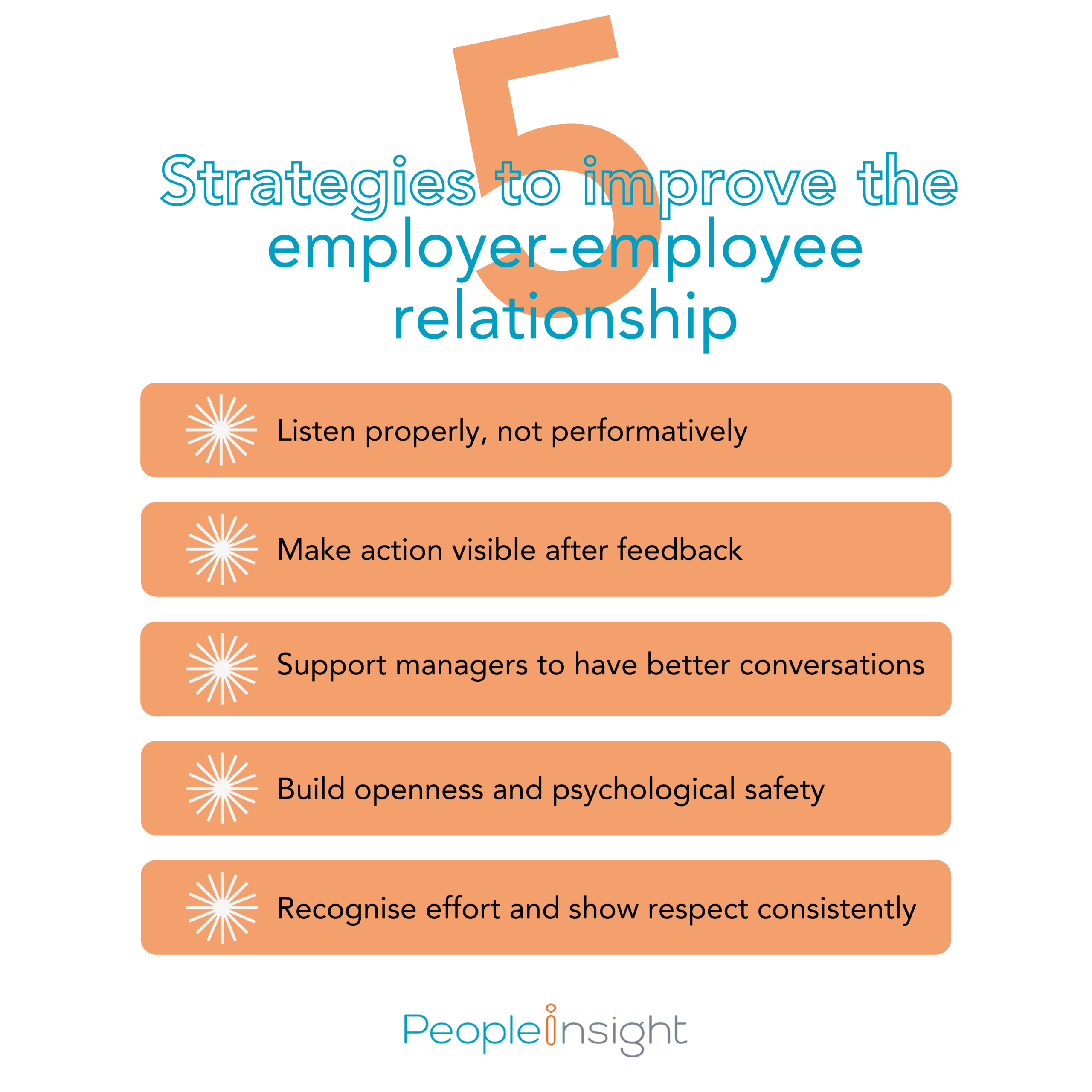
Three strategies to improve the employer employee relationship
1. Empower people with flexible working arrangements
Hybrid and flexible working models are no longer seen as perks—they are expectations.
Flexible working directly influences the employer employee relationship by demonstrating trust in employees’ ability to manage their own time and deliver results without micromanagement. Organisations like Twitter and Reddit were among the first to announce permanent hybrid policies, recognising that autonomy over working patterns improves wellbeing, reduces burnout and attracts new talent.
However, hybrid working requires careful thought. Managers must maintain consistency in how they engage with all employees, regardless of location. Cultural practices such as dialling into meetings virtually or sharing asynchronous updates via video help maintain cohesion and fairness.
Measuring performance based on outcomes (rather than hours logged) encourages a results-driven mindset that benefits both the organisation and its people.
An empathetic approach is a major differentiator in the employer employee relationship. According to Catalyst research, employees with empathetic leaders are 4.5 times more likely to innovate, 2.4 times more likely to be engaged, and 3 times more likely to describe their workplaces as inclusive.
Following the collective trauma of the pandemic, employees expect leaders to acknowledge them as whole individuals, not just workers. The boundary between personal and professional life has blurred. Managers must now engage authentically with the full human experience.
Adapting work arrangements for those facing personal difficulties
3. Build psychological safety within teams
Psychological safety — the belief that you will not be punished or humiliated for speaking up with ideas, questions, or mistakes — is so important to the employer employee relationship. Google’s Project Aristotle identified psychological safety as the most important factor for effective teams.
Without psychological safety, employees are unlikely to report errors, suggest improvements or challenge decisions. A culture of blame stifles innovation and fuels disengagement.
Managers can improve psychological safety by:
Involving employees in decision-making processes
Actively seeking and valuing diverse opinions
Demonstrating genuine interest during meetings by closing laptops and maintaining eye contact
Highlighting how colleagues’ contributions have shaped successful outcomes
Modelling openness by sharing their own mistakes and learnings
Creating psychological safety strengthens the employer employee relationship by allowing open dialogue and building trust across all levels of the organisation.
The employer employee relationship matters — it needs to be prioritised more than ever
Improving the employer employee relationship at its heart is simply about embedding respect, communication and trust into organisational life. As employees increasingly look for meaningful, people-first workplaces, businesses must focus on building relationships that feel genuine and supportive.
Feedback plays a core role in this dynamic. 360 feedback provides an ideal framework for nurturing better conversations, surfacing valuable insights, and helping leaders and employees alike grow stronger connections.
If you are ready to strengthen the employer employee relationship in your organisation, get in touch to learn more about how our 360 feedback platform can support your goals.