

















Blogs:

How to design an employee experience strategy

All you need to keep your employees engaged, proactive and productive

hows to Create a Winning Employee Experience Strategy

    A quick insight: A strong employee experience strategy shapes how people feel, grow and perform throughout their time at work. It brings together recruitment, onboarding, development, recognition, listening and action into a clear, consistent approach. The best strategies help organisations improve retention, strengthen engagement and create a better experience at every stage of the employee journey.

    Today, organisations need to focus on more than just pay and benefits to keep their people engaged. A strong employee experience strategy can make a real difference to attraction, retention and performance, because it improves how work feels in practice, not just how it looks on paper.

    At People Insight, our approach is grounded in Sharper listening. Smarter action; our approach to insightful, proactive employee listening and turning that insight into meaningful action. Listening becomes sharper when you understand what employees are experiencing at each stage of the journey. Action becomes smarter when that insight is turned into clearer priorities, visible follow-through and a better day-to-day employee experience.

    This guide sets out a practical framework for designing an employee experience strategy that is measurable, relevant and realistic to deliver.

    What is an employee experience strategy?

    An employee experience strategy is a deliberate approach to improving the full journey employees take with an organisation, from first contact through to exit. It covers every touchpoint that shapes how people feel about work, including recruitment, onboarding, leadership, communication, development, recognition and employee wellbeing at work.

    It is not just about perks. A strong employee experience strategy is about creating an environment where employees can do their best work while feeling supported, informed and valued. That is why it has such a strong link to engagement, retention and productivity.

    Why employee experience strategy matters

    A well-designed employee experience strategy matters because it helps organisations improve the parts of work that shape how people feel and perform every day.

    It can help strengthen:

    Our global benchmark data reinforces why a good employee experience strategy is so important. For example:

    • 87% of employees say they know how the work they do helps their organisation achieve its aims
    • but only 60% say they know how well their organisation is doing against its objectives
    • only 63% say they have the right opportunities to learn and grow at work
    • only 61% say they received thanks or praise in the last week
    • only 65% say their organisation does enough to support health and wellbeing at work

    Taken together, those figures show that many organisations have a strong foundation of purpose, but weaker communication, development, recognition and wellbeing support. Those are all core parts of employee experience.

    A practical framework for employee experience strategy

    The strongest employee experience strategies do not try to fix everything at once. They focus on the moments and conditions that matter most, then build outward from there.

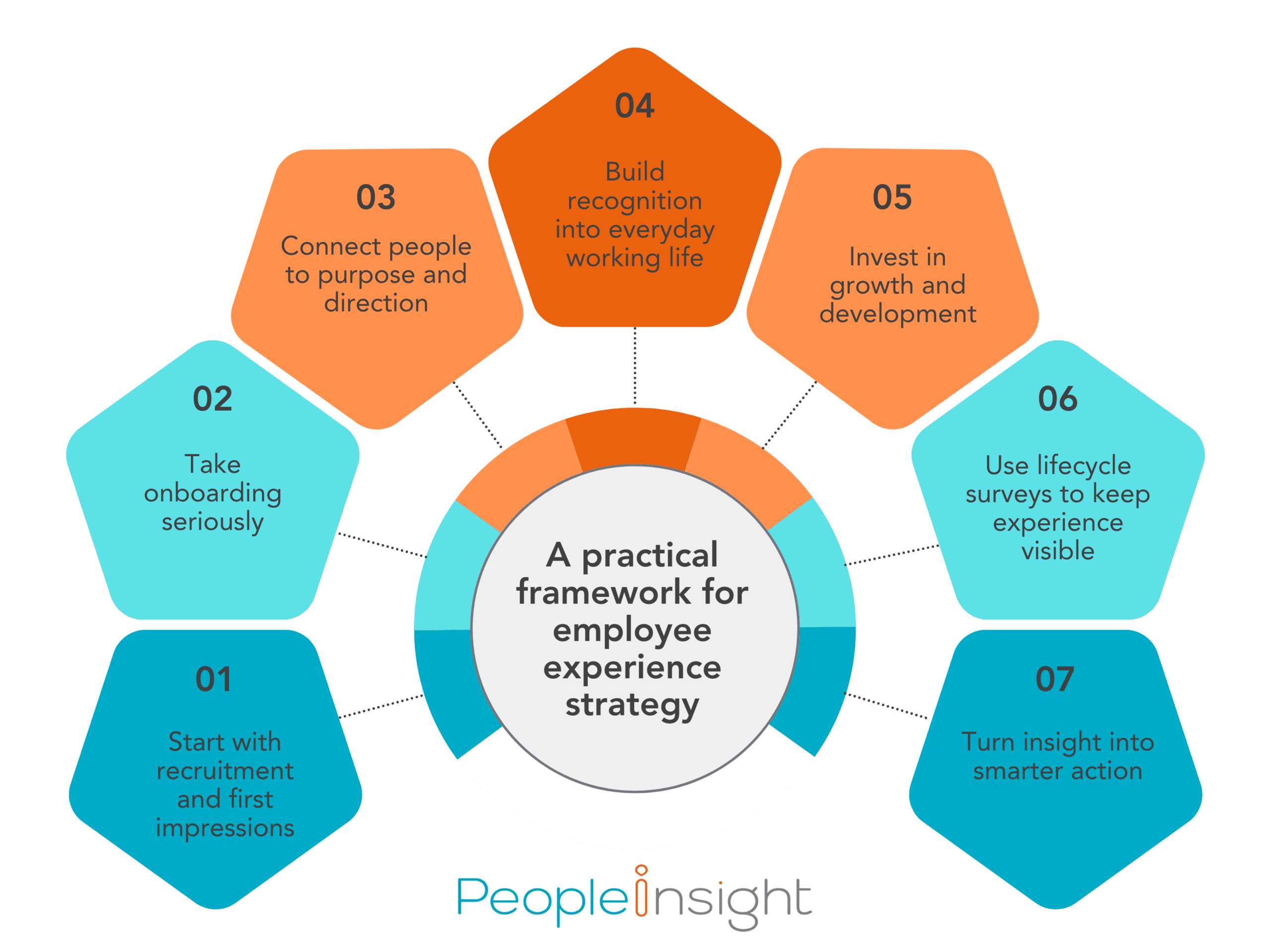
    Below is a practical seven-step framework, based on what People Insight’s employee experience specialists see working in organisations around the world.

    A practical framework for employee experience strategy

    Related: What are moments that matter and why are they important?

    1. Start with recruitment and first impressions

    The employee experience does not begin on day one. It begins the moment someone interacts with your organisation as a candidate.

    That means your employee experience strategy should start by asking:

    • Is the application process straightforward and accessible?
    • Are there unnecessary barriers in the process?
    • Are you considering diversity and inclusion in recruitment?
    • Do candidates leave interviews with a positive impression of the organisation?

    A poor recruitment experience can weaken your employer brand before employment has even started. A strong one helps create confidence, clarity and trust from the outset.

    2. Take onboarding seriously

    Onboarding is one of the most important stages in the employee experience. It shapes early confidence, connection and clarity, and it has a direct effect on how quickly people feel settled and able to contribute.

    A stronger onboarding experience usually includes:

    • a clear introduction to the organisation’s mission and values
    • practical support and training
    • visible manager involvement
    • early check-ins
    • a sense of welcome and belonging

    When onboarding is done well, it supports retention and engagement from the very start.

    3. Connect people to purpose and direction

    Employees are more likely to stay engaged when they can see how their role contributes to something meaningful.

    This means a strong employee experience strategy should help employees understand:

    • what the organisation is trying to achieve
    • how their work contributes
    • how progress is going
    • why certain priorities matter

    Our benchmark data makes this point clearly. While 87% of employees say they know how their work helps the organisation achieve its aims, only 60% say they know how well the organisation is doing against those aims. That gap matters. It suggests many employees understand contribution in theory, but have less visibility on progress in practice.

    This is where clearer leadership communication and better strategic storytelling can make a real difference.

    4. Build recognition into everyday working life

    Recognition is one of the most practical ways to improve employee experience.

    People want to feel their effort is noticed and valued. That recognition does not always need to be expensive or formal, but it does need to be consistent.

    Our benchmark data shows this is still a weakness:

    • only 61% say they received thanks or praise in the last week
    • only 63% feel valued and recognised for the work they do

    That suggests many employees are still doing good work without feeling properly acknowledged.

    Recognition can include:

    • timely thank-yous from managers
    • peer recognition
    • celebrations of contribution
    • reward and appreciation schemes
    • visible examples of great work linked to organisational values

    Related: Check out these employee appreciation ideas

    5. Invest in growth and development

    Career growth is a key part of employee experience.

    People are more likely to stay engaged when they can see opportunities to learn, develop and progress. That means employee experience strategy should include space for:

    • career conversations
    • mentoring
    • training
    • stretch opportunities
    • leadership development
    • clear progression pathways

    This is another area where our benchmark data points to a gap:

    • 63% say they have the right opportunities to learn and grow at work
    • only 59% say their career development aspirations are being met

    That leaves a large minority of employees who may not feel fully supported in their future.

    Culture gets stronger when development feels real, visible and achievable, not just something mentioned in principle.

    Related: How (and why) to create a career development framework

    6. Use lifecycle surveys to keep experience visible

    Employee experience strategy should not be built on assumptions. It should be informed by regular, relevant listening.

    This is where employee lifecycle thinking becomes useful. Different stages of the journey create different challenges and opportunities, and those need to be understood in context.

    Regular lifecycle surveys can help organisations:

    • identify where experience is strongest or weakest
    • understand pain points at different stages
    • track change over time
    • respond more quickly during organisational change

    This is also where more focused listening, such as pulse surveys or comment analysis, can help keep the strategy relevant rather than static.

    7. Turn insight into smarter action

    Listening only adds value when it leads to meaningful change.

    That is why employee experience strategy should never stop at measurement. Once feedback is gathered, the next step is to interpret it clearly, prioritise well and act visibly.

    This is where Prism strengthens the process. Prism helps identify patterns, summarise comments at scale and bring together qualitative, quantitative and historical insight so leaders can focus on what matters most.

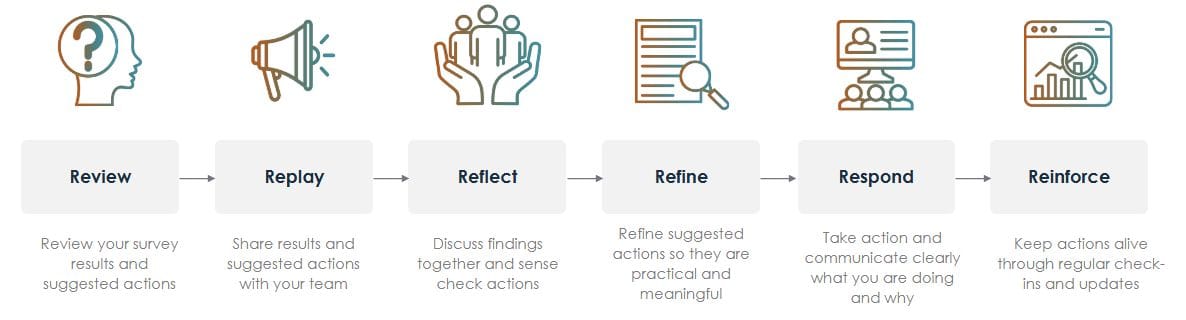
    This is also where our 6 Rs framework helps:

    6 Rs action planning

    • Review
    • Replay
    • Reflect
    • Refine
    • Respond
    • Reinforce

    That structure gives organisations a clearer route from feedback to visible progress.

    Related: Post-survey action planning

    What gets in the way of a good employee experience strategy?

    A few common barriers tend to weaken employee experience strategies:

    • treating employee experience as a perks programme rather than a whole-journey strategy
    • listening without clear follow-through
    • weak manager capability
    • inconsistent communication
    • low visibility from leaders
    • disconnected initiatives that do not add up to a coherent experience

    This is one reason strategy matters. It helps connect the dots between individual actions and the wider employee journey.

    What good employee experience strategy looks like in practice

    A strong employee experience strategy usually includes:

    • a clear view of the employee journey
    • priorities based on real feedback
    • attention to key moments and touchpoints
    • recognition, development and wellbeing built into the experience
    • strong communication and leadership visibility
    • regular listening and visible action

    Real examples help bring this to life.

    At Croydon College, the employee survey supported the HR strategy by helping leaders understand what needed attention and by reinforcing an open, visible approach to improvement.

    At King’s College London, stronger communications and clearer manager guidance helped results land more effectively and made it easier for teams to translate insight into practical next steps.

    At London South Bank University, survey results were used to enable local action, giving managers direct access to their results and helping employees see how feedback could shape change close to their day-to-day experience.

    These examples show the same principle in action: employee experience gets stronger when listening is built into decision-making and followed by visible progress.

    How to know if your employee experience strategy is working

    A stronger employee experience strategy should lead to clearer signs of progress over time.

    That might include:

    • stronger engagement
    • healthier retention
    • better feedback on leadership and communication
    • improved development scores
    • stronger wellbeing indicators
    • more positive employee comments
    • greater belief that feedback leads to action

    This is one reason regular measurement matters. If you want to improve employee experience, you need a way of knowing whether the experience is actually changing.

    Improve your employee experience strategy with People Insight

    A strong employee experience strategy helps organisations create better working lives, not just better policies.

    It connects recruitment, onboarding, communication, development, recognition, wellbeing and action into a clearer, more intentional approach. When those parts work together, organisations are in a much stronger position to improve retention, strengthen engagement and create a more supportive culture.

    At People Insight, we help organisations do exactly that through stronger survey design, lifecycle listening, Prism-powered insight and practical consultancy support.

    Want to design an employee experience strategy that is measurable, meaningful and built around your people? Get in touch to learn how People Insight can help.

    FAQs about employee experience strategy

    A quick run down on all you need to know

    What is an employee experience strategy?

    An employee experience strategy is a structured approach to improving the full journey employees take with an organisation, from recruitment through to exit.

    Why is an employee experience strategy important?

    It is important because employee experience shapes engagement, retention, wellbeing and performance. A clear strategy helps organisations improve these areas in a more deliberate and measurable way.

    What should an employee experience strategy include?

    A good employee experience strategy should include recruitment, onboarding, communication, development, recognition, wellbeing, regular listening and visible action planning.

    How does Prism support employee experience strategy?

    Prism helps organisations identify patterns in feedback, summarise comments and focus on clearer priorities, making it easier to turn insight into practical action.

    What are the most important parts of employee experience?

    Some of the most important parts include onboarding, communication, purpose, recognition, development, wellbeing and leadership behaviour.

    How can People Insight help with employee experience strategy?

    People Insight helps organisations design stronger employee experience strategies through employee surveys, lifecycle listening, Prism-powered analysis and consultancy support that turns feedback into meaningful action.