



















Higher Education case studies:

The University of Oxford: building belief in action through listening at scale 

A look into how The University of Oxford’s approach and commitment to employee listening gained them recognition through Inspire HE

uni of oxford case study
74%
engagement score
63%
participation
71%
communication score
15pp
above benchmark for “I feel valued and recognised for the work that I do”

    A quick insight 

    Oxford’s staff survey journey shows how complex universities can strengthen trust by making listening more visible, joined-up and action-focused. With a 74% engagement score, 63% participation and clear improvements across engagement and research staff career development, Oxford is showing how belief in action can grow at scale.

    The University of Oxford: An Inspiring university for employee experience 

    The University of Oxford has been recognised through Inspire HE for its remarkable commitment to employee experience across one of the world’s most complex higher education institutions. 

    With more than 17,000 staff across academic, research, professional, managerial, support and technical roles, Oxford’s listening challenge is one of scale, complexity and local variation. Its latest results reflect a listening approach built around trust, visibility and shared ownership. 

    From survey exercise to strategic listening 

    Oxford’s first University-wide staff survey launched in 2016, supporting measures of progress for the Athena Swan gender equality charter. In 2021, the University began working with People Insight to develop a more sophisticated and consistent approach. 

    By 2025, the survey had become much more than a measurement exercise. Feedback from 2023 was informing strategic programmes and local plans, helping Oxford understand and improve staff experience across the institution. 

    Building belief before asking for feedback 

    Oxford’s challenge was helping staff believe that taking part would lead to meaningful action. In 2023, only 41% believed action would be taken as a result of the survey. 

    The University responded by starting early, with a six-month lead-in involving senior leaders, HR, divisions and departments. For four months before launch, Oxford used “You said, we did” communications to show what had changed since the previous employee survey. 

    Making action visible 

    Oxford did not simply ask staff to complete another survey. It showed them that previous feedback had been listened to and acted on. 

    Throughout the survey programme, communications were implemented at local level rather than top level, allowing for local ownership. This enabled a more relevant tone and  positioning. 

    Departments were encouraged to share local examples of progress, even if that meant starting with one meaningful update. This helped staff see the link between feedback and change before they were asked for more feedback. 

    That approach is a powerful reminder for any university: trust grows when people can see what has happened since they last gave their views. 

    Making insight usable across the University 

    Oxford also recognised that stronger listening depends on what happens after results are shared. 

    To support employee survey action planning, the University invested in capability, access and confidence. This included dashboard users, a superuser model, dashboard training, leader workshops, templates, timelines, branding, communications packs and ongoing support. 

    The aim was simple: make insight easier to understand, communicate and act on across a large, decentralised institution. 

    Shared ownership made the difference 

    Oxford’s approach worked because listening became a shared institutional effort. 

    Senior leadership gave the survey visibility and sponsorship. Divisions supported communication and resource-sharing. Departments made the work real through local engagement, analysis and action planning. Central communications amplified key messages, while divisional EDI leads acted as important partners and connectors. 

    This helped turn the survey into a wider listening cycle, where insight could inform decisions, shape conversations and support practical improvement. 

    The results: stronger participation, stronger engagement 

    Oxford’s 2025 results show the value of investing in the full listening cycle. 

    The University achieved a 74% employee engagement score, 63% participation rate and 71% communication score. Engagement increased by two percentage points since the previous survey and sits six points above the sector norm. 

    Career development scores for research staff increased by nine percentage points, while Oxford scored 15 points above benchmark for staff feeling valued and recognised for the work they do. 

    How People Insight helped 

    People Insight supported Oxford with a managed employee survey approach that helped bring consistency, structure and usability to a large and complex listening programme. 

    We helped Oxford manage survey delivery, access insight and support local teams with clear results. Dashboards, training and resources helped leaders and departments understand what staff were saying and what could be done next. 

    This strengthened the link between listening, understanding and action, helping Oxford make staff feedback more visible, usable and connected to meaningful improvement. 

    Lessons we can learn from the University of Oxford’s approach to employee experience 

    What lessons can we take from Oxford, its Inspire HE recognition and its wider approach to employee experience? 

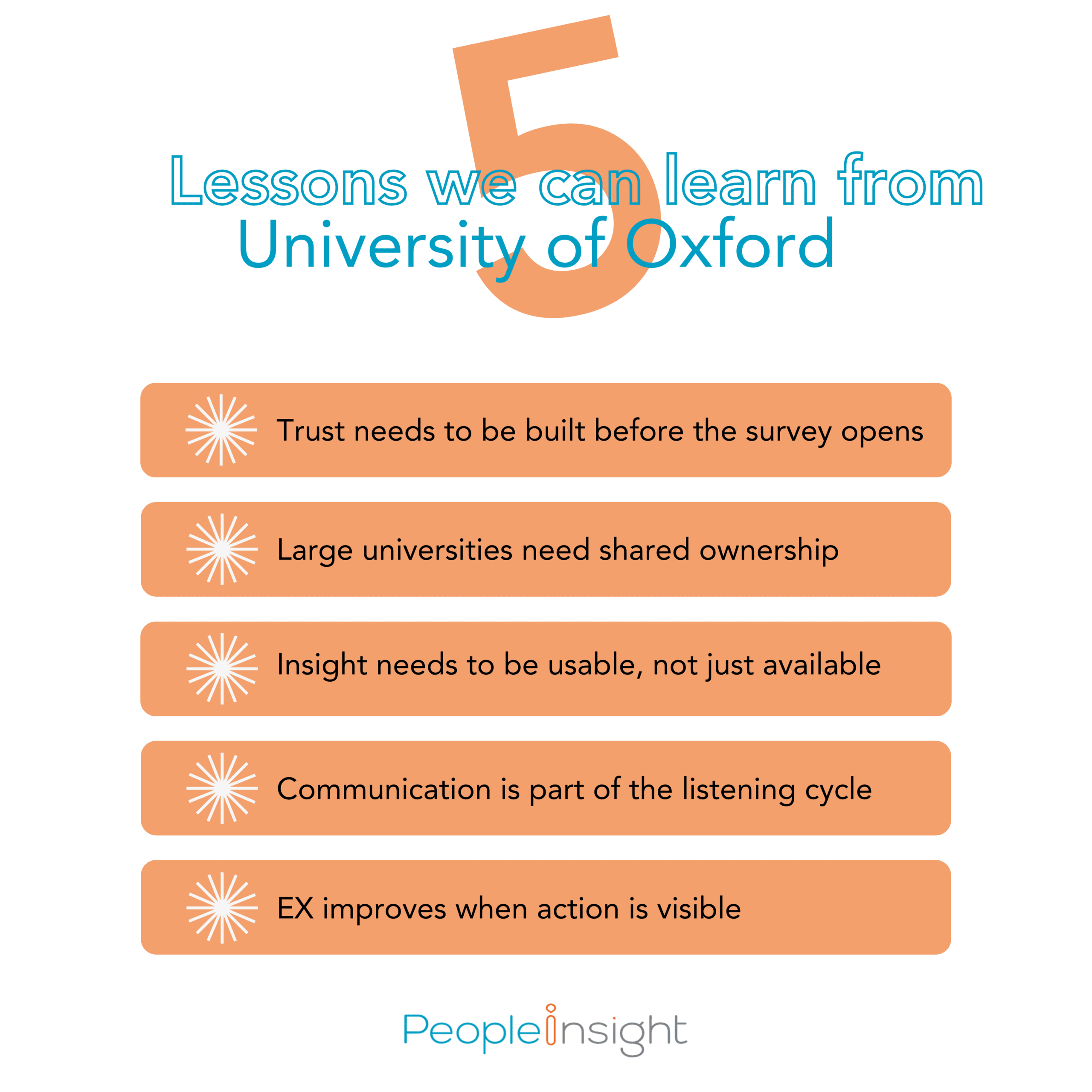
    lessons we can learn from un iof oxford

    1. Trust needs to be built before the survey opens
      Oxford’s “You said, we did” activity gave staff evidence that previous feedback had led to action.
       
    2. Large universities need shared ownership
      Leaders, divisions, departments, comms and EDI leads all played a part.
    3. Insight needs to be usable, not just available
      Dashboards, training, templates and workshops helped local teams move towards action.
    4. Communication is part of the listening cycle
      Clear, consistent communication helped staff understand why their voice mattered.
    5. Employee experience improves when action is visible
      Oxford’s results show the value of linking feedback to visible progress. 

    Work with us to create an inspirational culture in HE 

    Oxford’s story shows what can happen when a complex university takes a strategic, visible and action-focused approach to employee listening. 

    At People Insight, we help higher education institutions listen better, understand what sits behind the scores and comments and turn insight into meaningful improvement. Whether you are looking to strengthen participation, support managers with action planning or build greater belief in action, we can help. 

    See how we support higher education staff surveys or get in touch to find out how we can help you create an inspirational culture in HE. 

    What is the University of Oxford’s employee engagement score?

    The University of Oxford achieved a 74% employee engagement score. This is six percentage points higher than the sector norm and reflects the University’s continued focus on strengthening staff experience, listening and action across a large and complex institution.

    What was the University of Oxford’s staff survey participation rate?

    The University of Oxford achieved a 63% participation rate in its latest staff survey. This is especially significant given the scale and complexity of the University, with more than 17,000 staff across different roles, divisions and departments.

    How did Oxford build belief in the staff survey process?

    Oxford focused on building belief before the survey opened. The University started planning six months ahead and used “You said / We did” communications for four months to show staff what had changed since the previous survey. This helped colleagues see that feedback could lead to meaningful action.

    Why is listening at scale challenging for Oxford?

    Oxford’s staff community includes academic, research, professional, managerial, support and technical roles across seven divisions. That means the University needs a listening approach that provides consistent institution-wide insight while still being relevant to different local contexts.

    How did Oxford make survey results more usable?

    Oxford invested in dashboard users, a superuser model, dashboard training, leader workshops, templates, timelines, communications packs and ongoing support. This helped leaders and local teams understand the results, communicate findings clearly and move from insight to action.

    What can other universities learn from Oxford’s approach?

    Oxford’s approach shows that trust grows when staff can see action from previous feedback. Other universities can learn from its early planning, visible communication, shared ownership and focus on making insight practical for leaders, departments and teams.

    How did People Insight support the University of Oxford?

    People Insight supported Oxford with a managed employee survey approach that helped bring structure, consistency and usability to a complex listening programme. The platform helped Oxford manage survey delivery, access clear insight and support local teams to understand and act on results.