



















Blogs:

Ahead of NSS results: aligning student voice with staff voice

To understand what sits behind NSS scores, leaders need to up their listening game

Ahead of NSS results universities need to connect student voice with staff voice

    A quick insight: With NSS results due to be published on 8 July 2026, universities will soon be looking closely at what students are saying. But student experience is shaped every day by staff workload, leadership, systems, communication and support. To make meaningful improvement, universities need to connect student voice with employee voice. 

    The National Student Survey gives universities a detailed view of how final-year undergraduate students feel about the quality of their course, from teaching and academic support to organisation, learning resources and student voice. The 2026 results are expected to be published by the Office for Students on 8 July 2026, and HEIs everywhere are on tenterhooks, awaiting the reveal. 

    For university leaders, NSS publication is a truly important moment. It can shape priorities, inform faculty and school-level conversations, influence reputation and provide a visible measure of student experience. 

    But before the results land, there is a bigger question worth asking: 

    What staff experience sits behind the student experience? 

    A weaker score for organisation and management might suggest students are experiencing inconsistency. A dip in academic support may point to gaps in availability, clarity or responsiveness. Lower satisfaction with student voice may indicate that students do not feel listened to, or that they cannot see what has changed as a result of their feedback. 

    Those findings matter, of course, but they rarely tell the whole story. 

    Behind each student experience measure sits a staff experience. Teaching quality, communication, support, responsiveness and consistency are all shaped by the people, systems and pressures inside the institution. If staff are stretched, unclear on priorities, unsupported by systems or disconnected from decision-making, that will eventually be felt by students. 

    That is why NSS results should not be treated as a standalone student feedback moment. They should be used as a prompt for more joined-up listening. 

    Related: How universities are tackling equal treatment for staff 

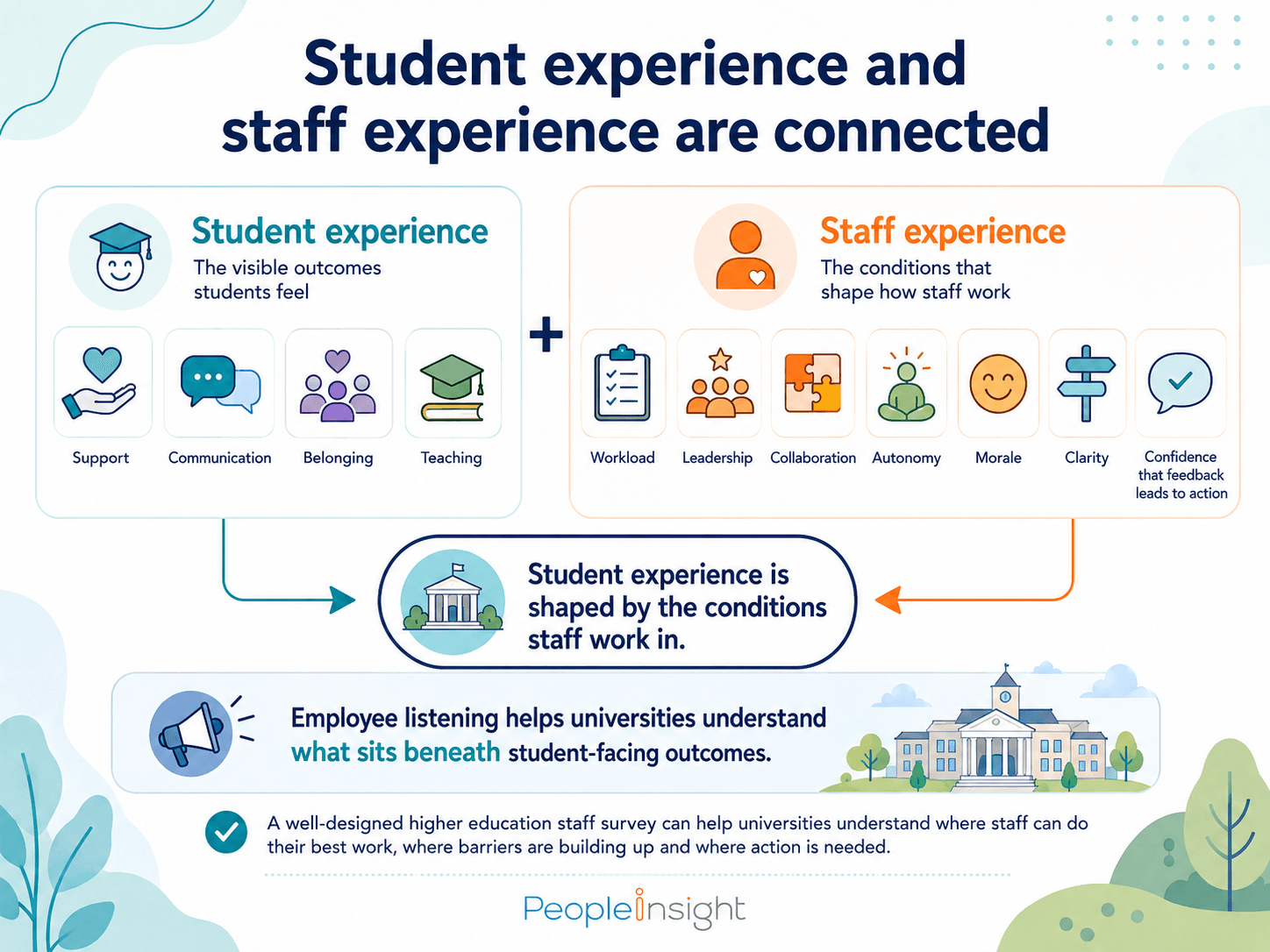
    Student experience and staff experience are connected 

    student experience and staff experience

    It is tempting to treat student experience and employee experience as separate workstreams. One belongs to academic quality, education, marketing or student success. The other sits with HR, organisational development or internal communications. But in practice, they are very much deeply connected. 

    Students experience the university through the people around them. They notice how quickly queries are answered, how clearly information is communicated, how consistently services work and how supported academic and professional services teams seem to be. They may not actually see the internal causes, but they certainly feel the effects. 

    What this all means is that student experience cannot be improved through student feedback alone. 

    If an institution wants to improve the way students experience support, teaching, communication or belonging, it needs to understand the conditions staff are working in. That includes workload, leadership, cross-team collaboration, autonomy, morale, clarity of purpose and confidence that feedback leads to action. 

    This is where employee listening becomes strategically important. 

    A well-designed higher education staff survey can help universities understand what sits beneath the surface of student-facing outcomes. It can show where staff feel able to do their best work, where barriers are building up and where local leaders may need more support to turn insight into action. 

    What NSS results can (and can never) tell you 

    NSS data is valuable because it gives universities a clear view of student perceptions at scale. It helps inform conversations about teaching, support, organisation, learning resources and student voice. 

    But it is not designed to explain every internal factor behind those perceptions. 

    NSS may show… Staff listening can help explain… 
    Students feel communication is inconsistent Whether staff have clear priorities, joined-up systems and enough time to communicate well 
    Students feel academic support is weaker Whether academic staff have the workload capacity, tools and local leadership support to respond effectively 
    Students feel organisation and management could improve Whether teams are aligned across departments, schools and services 
    Students do not feel their feedback leads to change Whether staff themselves believe feedback is acted on and whether action planning is visible 
    Students report weaker access to resources or support Whether professional services teams have the capacity, clarity and processes needed to deliver consistently 
    Student voice scores are low Whether the institution has a strong listening culture internally as well as externally 


    This is about building a fuller picture. Student feedback can show where improvement may be needed. Staff feedback can show what will make improvement possible.
     

    The risk of treating NSS results as a performance problem only 

    When NSS results are published, the pressure to respond quickly is undeniable and understandable. Universities may need to reassure students, departments, governing bodies and external stakeholders that action is being taken. There is, however, a significant risk in treating NSS results purely as a performance issue. 

    If leaders focus only on the scores, they may move too quickly to action plans that look good on paper but do not address the real causes. A faculty may be told to improve communication, for example, without enough understanding of whether staff have the capacity, systems or decision-making clarity to do so. A professional services team may be asked to improve responsiveness, while already managing high volumes, fragmented processes or unclear ownership. 

    That can create frustration. Staff may feel held responsible for outcomes they care deeply about, but cannot fully control without wider organisational support. 

    A better response is to treat NSS results as the start of a listening loop, not the end of one. 

    That means asking: 

    • What are students telling us? 
    • What are staff telling us? 
    • Where do those experiences overlap? 
    • What is within local control? 
    • What requires institutional action? 
    • How will we show both students and staff that feedback has led to meaningful improvement? 

    This is how universities can move from reaction to understanding. 

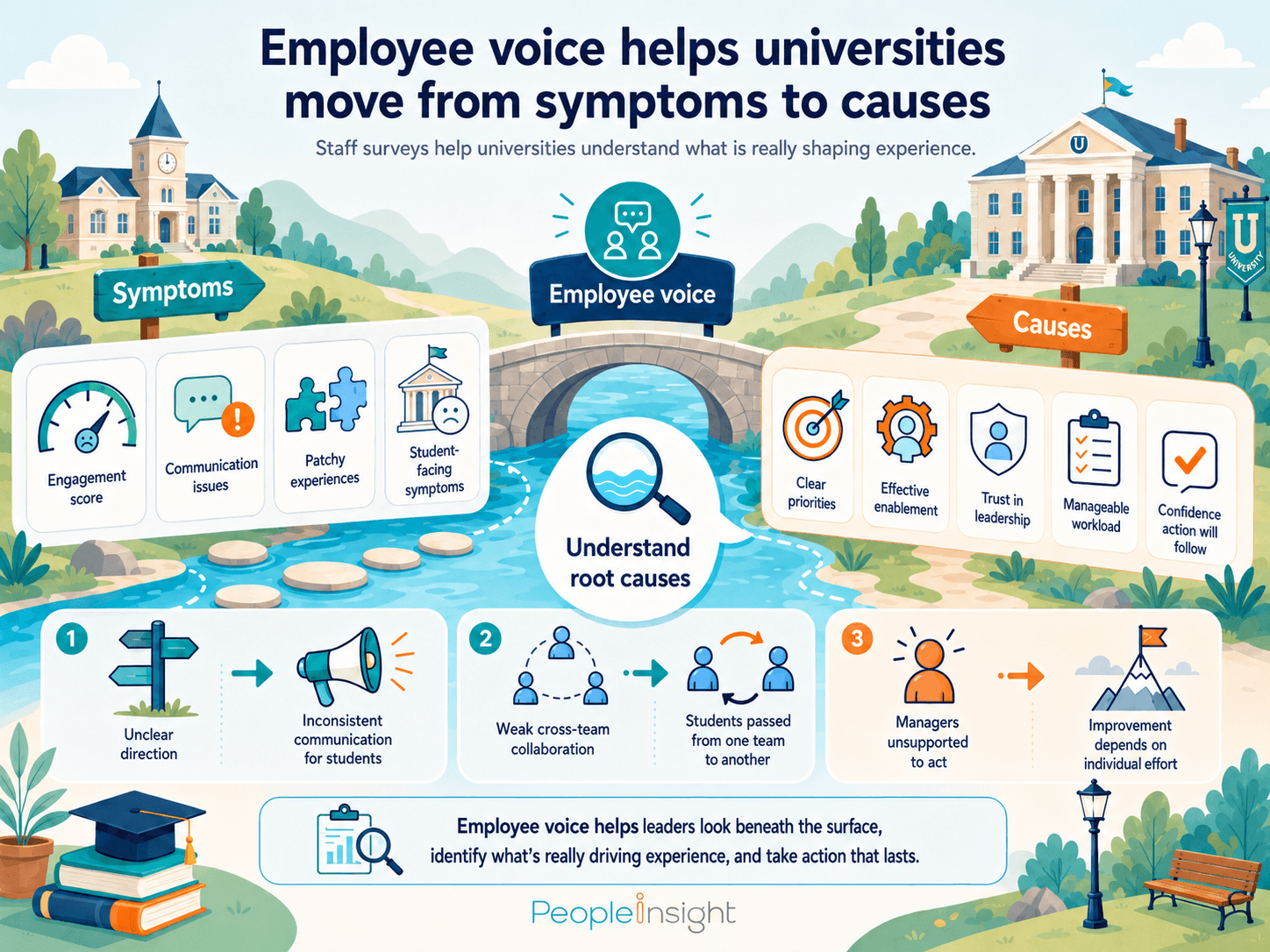
    Employee voice helps universities move from symptoms to causes 

    employee voice helps universities move from symptoms to causes

    For many institutions, the most valuable staff survey insight does not come from the headline engagement score alone. It comes from understanding the drivers behind the score. 

    At People Insight, we often help universities look beyond surface-level results and explore the themes that shape engagement and experience. That includes whether staff understand the organisation’s priorities, feel enabled to do their work, trust senior leadership, experience manageable workloads and believe action will follow feedback. 

    These are the themes that affect how universities function. 

    If staff do not feel clear on direction, students may experience inconsistent communication. If teams do not collaborate well across departments, students may feel passed from one place to another. If local managers are not supported to act on feedback, improvement may depend too heavily on individual effort rather than a consistent institutional approach. 

    Employee voice can help leaders identify these patterns earlier and respond more intelligently. 

    It can also support a more honest conversation about what needs to change. In a complex university environment, not every issue is caused by one department, one process or one leadership decision. Staff surveys can help show where responsibility is shared, where support is missing and where action needs to happen at more than one level. 

    Listening at scale is especially important in higher education 

    Higher education institutions are dynamic, complex organisations. They are often large, devolved, multi-site and shaped by distinct academic, professional services and leadership communities. What staff experience in one faculty, school or department may be very different from another. 

    That makes employee listening harder, but also more important. 

    A university-wide staff survey can give leaders a shared evidence base. Local reporting can help faculties, departments and services understand their own priorities. Benchmarks can show whether an issue is local, sector-wide or particularly acute. Open-text comments can add context to the numbers, especially when analysed carefully and responsibly. 

    The key is not just gathering the data, but making it usable and actionable. 

    People Insight supports universities with employee engagement surveys, lifecycle listening, reporting, benchmarking, comment analysis, action planning and expert guidance. The value is not only in running a survey. It is in helping institutions understand what the results mean, share insight clearly and support managers to take action in a way that feels practical rather than performative. 

    That is especially important in higher education because trust is often fragile. Staff have seen many consultations, surveys and strategy exercises before. If listening does not lead to visible follow-through, confidence can fade quickly. 

    Student voice and employee voice should reinforce each other 

    Universities already invest heavily in student voice. NSS results, module evaluations, student rep systems, complaints, focus groups and informal feedback all help institutions understand the student experience. 

    But employee voice should not sit separately from that work. 

    The most effective institutions connect the two carefully. They do not merge the data in a simplistic way or assume one explains the other. Instead, they use both sources of insight to ask better questions. 

    For example: 

    • If students feel communication is unclear, do staff feel they receive clear communication from leaders? 
    • If students want faster support, do staff feel workload and systems allow them to respond well? 
    • If students feel changes are not visible, do staff feel action planning is clear and accountable? 
    • If students experience inconsistency across courses or services, do staff see the same inconsistency internally? 
    • If student belonging is a priority, do staff feel a strong sense of belonging too? 

    This kind of joined-up listening helps universities avoid fragmented action. It also helps leaders spot where one intervention could improve both staff and student experience. 

    You can see how this works in practice through our higher education case studies, where universities use staff feedback to support clearer priorities, stronger local action and more meaningful improvement. 

    The role of action planning after NSS results 

    The real test after NSS results are published is not whether a university can produce a response. It is whether that response leads to meaningful improvement that people can see. 

    For staff, this means clarity. What are the priorities? What is being acted on locally? What needs senior leadership attention? What will not change immediately, and why? 

    For students, it means visibility. They need to see that their feedback has been heard, understood and acted on. They also need honest communication about what is changing, what takes time and where the institution is still listening. 

    In practice, that means helping universities listen in a more insightful, joined-up way, then turn that insight into focused action that can be understood, owned and followed through. 

    Prism, People Insight’s integrated AI, can also support this process by helping teams interpret survey results, understand comment themes and identify practical focus areas. It does not replace professional judgement. It helps leaders and managers work through complex feedback more clearly, so action planning can become more focused and manageable. 

    What universities can prepare before NSS results land

    Universities do not need to wait for the NSS results to start thinking about how they will respond. The strongest approach is to prepare the questions, processes and listening routes that will help leaders interpret the results properly once they arrive. 

    Step What to prepare Why it helps 
    1. Agree how NSS results will be reviewed Decide who will review the results, at what level and with what supporting evidence Avoids a rushed or fragmented response 
    2. Identify related staff experience themes Review existing staff survey, pulse or lifecycle data against likely NSS themes Helps connect student experience with internal conditions 
    3. Prepare local conversations Plan how faculties, departments and services will explore results in context Avoids one-size-fits-all action 
    4. Separate quick wins from deeper issues Be clear on what can change locally and what requires institutional action Makes action planning more realistic 
    5. Support managers and local leaders Give them clear insight, guidance and practical support Helps action happen closer to the experience 
    6. Plan how progress will be communicated Decide how students and staff will hear what has been learned and what will change Builds trust in the listening process 

    This is how NSS results can become more than a reporting moment and more of an opportunity to create a stronger culture of listening, learning and improvement. 

    The opportunity for HE leaders 

    The publication of NSS results will always bring scrutiny … but it also creates an opportunity. 

    The opportunity is not to respond to NSS results in isolation, but to use them as a prompt for sharper, more connected listening. 

    If students are about to tell you where the experience feels weaker, staff may already understand why. They may also have ideas about what needs to change. But they need the right channels, the right support and the confidence that speaking up will lead somewhere useful. 

    That is the real opportunity ahead of NSS results to listen harder, connect the evidence and act smarter. 

    How People Insight can help 

    People Insight works with higher education institutions to run trusted staff surveys, understand employee experience and turn feedback into meaningful action. We are also working with individual HEIs to explore the relationship between NSS data and staff engagement data, helping them see where student and staff experiences may be connected. The outputs are proving incredibly insightful, giving institutions a richer view of what may be shaping student experience and where internal action could have the greatest impact. 

    Alongside this work, we support universities with employee engagement surveys, pulse surveys, lifecycle listening, reporting, benchmarking, comment analysis, action planning and expert consultancy. We help institutions understand what staff are experiencing across complex structures, then support leaders and managers to act on the insight. 


    If your university is preparing for NSS results and wants to understand how staff experience may be shaping student experience, get in touch with People Insight to learn how employee listening can support clearer priorities, stronger action planning and more meaningful improvement.

    FAQs about NSS scores & the employee experience

    What is the link between NSS results and staff experience?

     NSS results show how students experience their course and wider university environment. Staff experience helps explain the conditions behind that experience, including workload, communication, leadership, systems, collaboration and confidence that feedback leads to action. 

    Why should universities compare student feedback with employee voice?

    Student feedback and employee voice give different but connected perspectives. Looking at both helps universities understand not only where improvement may be needed, but what may be enabling or blocking progress internally. 

    How can staff surveys help improve student experience?

    Staff surveys can identify barriers that affect student experience, such as unclear priorities, high workload, weak cross-team collaboration or lack of confidence in action planning. When universities address these issues, staff are better supported to improve the experience students receive. 

    Should NSS results shape employee listening priorities?

    Yes, but carefully. NSS results can help universities decide which staff experience themes to explore more deeply. For example, if students raise concerns about organisation, communication or support, staff listening can help leaders understand the internal causes and practical next steps. 

    How can People Insight support higher education staff surveys?

    People Insight helps universities design and run staff surveys, analyse results, compare against benchmarks and support action planning. Our platform and expert consultants help institutions move from feedback to focused action across complex higher education environments.