



















Blogs:

Pacesetting leadership: how high standards shape team performance

What it means to lead by high standards, speed and example

Pacesetting leadership

    A quick insight: Pacesetting leadership is a high-performance leadership style where leaders set ambitious standards and lead by example. It can help skilled, motivated teams move quickly and deliver excellent work, but it can also create pressure, stress and burnout if people do not receive enough support, recognition or room to learn.

    Some leaders create momentum through collaboration. Some lead through vision. Others raise the bar by showing what excellence looks like and expecting their team to keep up … and that is pacesetting leadership.

    It is one of the six leadership styles popularised by Daniel Goleman, alongside authoritative, coaching, affiliative, democratic and coercive leadership. Goleman’s work argues that effective leaders do not rely on one fixed style. They adapt their approach depending on the team, the situation and the outcome needed.

    At the time of writing, more than 24,000 people have taken our Goleman leadership styles quiz. Of those, just 5.7% found they were pacesetting leaders, making it the second least common style in our quiz results. The only style less common is coercive leadership.

    That might suggest pacesetting leadership is not the most popular or widely used style today. But that does not mean it lacks value. When used well, pacesetting leadership can be energising. It gives people a clear standard to aim for, removes ambiguity and creates a strong sense of pace. For capable, motivated teams, that can be powerful.

    But, of course, there is a catch.

    If pacesetting becomes the default, employees can start to feel like nothing is ever good enough. The team may deliver in the short term, but at the cost of morale, trust and wellbeing. So the real question is not whether pacesetting leadership is good or bad. It is whether the leader knows when to use it, when to soften it and how it feels to the people being led.

    Related: Take our Goleman leadership styles quiz to see which leadership style best reflects you

    What is pacesetting leadership?

    Pacesetting leadership is a management style where the leader sets high standards, works at pace and leads by example. These leaders often have strong technical ability, high personal commitment and a clear idea of what good looks like.

    Rather than simply telling people what to do, pacesetting leaders demonstrate the level of performance they expect from others. They are often the first to spot quality issues, push for faster progress and challenge people to improve.

    At its best, pacesetting leadership can drive strong performance. It works especially well when teams are already experienced, confident and motivated. In these environments, a pacesetting leader can create focus, energy and ambition.

    But it can be less effective when people need coaching, reassurance or time to develop. If the leader sets the pace without checking whether the team has the capacity, clarity or confidence to keep up, performance pressure can quickly turn into stress.

    That is why pacesetting leadership needs balance. High standards are useful. Relentless pressure is not.

    6 characteristics of pacesetting leadership

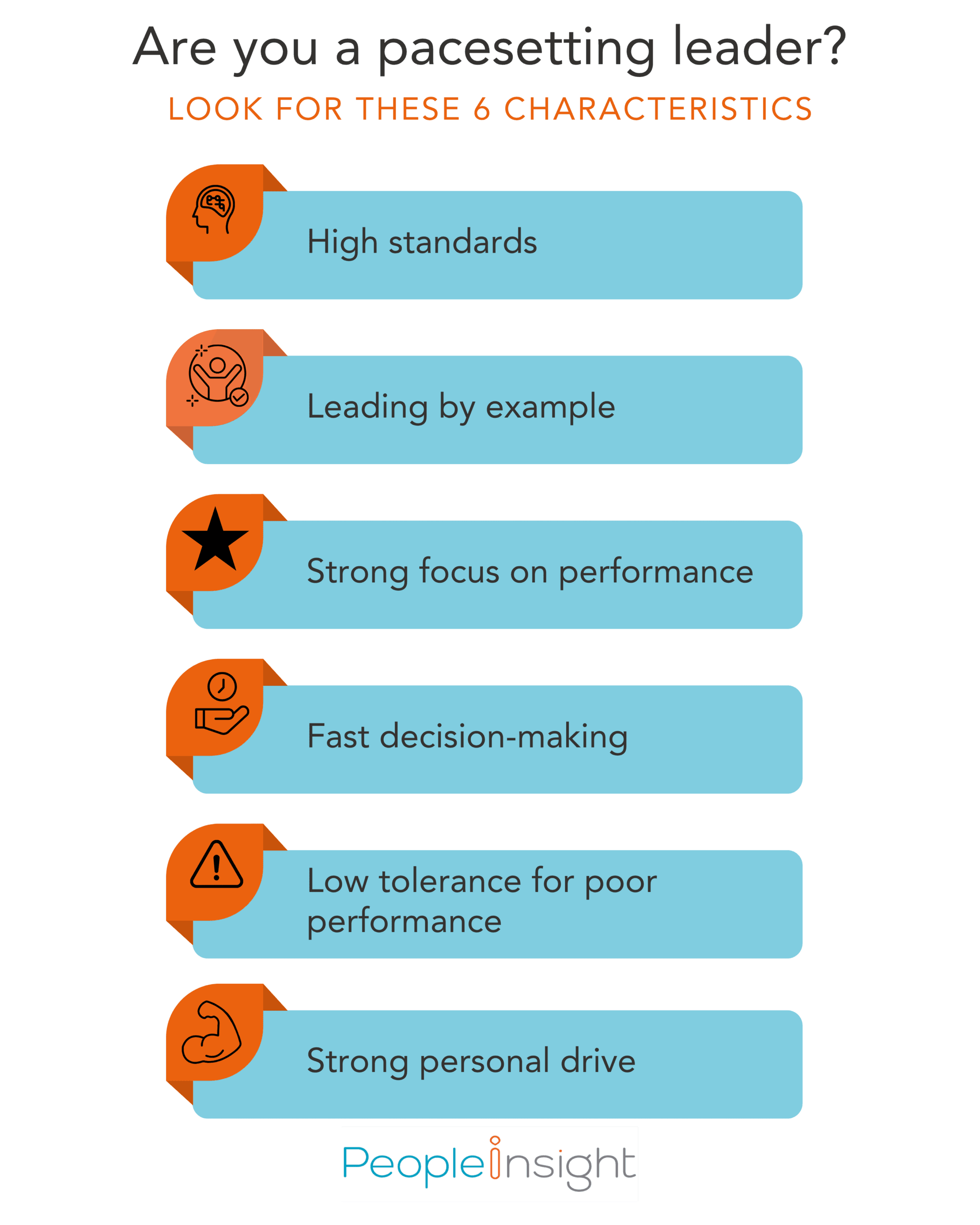
    Pacesetting leaders are usually easy to spot. They bring energy, urgency and high expectations into the way they work.

    Are you a pacesetting leader

    1. High standards

    Pacesetting leaders expect excellent work. They are rarely satisfied with “good enough” and often push themselves and others to improve the quality, speed or impact of what they deliver.

    2. Leading by example

    This style is built on modelling the behaviour the leader wants to see. Pacesetting leaders often work hard, move quickly and hold themselves to the same standards they expect from their team.

    3. Strong focus on performance

    Results are central to pacesetting leadership. These leaders care about outcomes, progress and delivery, which can help teams stay focused on what needs to be achieved.

    4. Fast decision-making

    Pacesetting leaders often move quickly. They can make decisions at pace, remove blockers and keep work moving, especially when there is a clear goal or deadline.

    5. Low tolerance for poor performance

    Because expectations are high, pacesetting leaders may become frustrated when others do not meet the standard. If handled poorly, this can make employees feel judged rather than supported.

    6. Strong personal drive

    Many pacesetting leaders are highly motivated themselves. Their energy can be inspiring, particularly for employees who are ambitious, skilled and comfortable with challenge.

    Famous examples of pacesetting leaders

    It is important to say that famous leaders rarely fit neatly into one leadership style. Most use different approaches at different times. But some well-known figures are often associated with pacesetting traits: high standards, intense pace, personal drive and a strong focus on ambitious outcomes.

    Elon Musk

    Elon Musk is a strong example of pacesetting leadership. Across companies such as Tesla and SpaceX, he has become known for setting bold goals, pushing technical boundaries and expecting intense commitment from the people around him. Reusable rockets, mass-market electric vehicles and rapid product development all reflect the kind of high-performance environment associated with this style.

    That ambition can be inspiring for high performers. But Musk’s leadership has also been criticised for creating intense pressure and raising concerns around workload and burnout. That is exactly the tension at the heart of pacesetting leadership: it can drive exceptional achievement, but it needs to be balanced with support, sustainability and recognition.

    Steve Jobs

    Steve Jobs is often associated with high standards, product obsession and a relentless focus on excellence. At Apple, his attention to detail and unwillingness to compromise helped shape products that changed entire markets.

    From a pacesetting perspective, Jobs showed how a leader’s personal standards can lift the expectations of an organisation. But his leadership style was also famously demanding. The lesson for leaders is clear: high standards can create brilliant work, but they need emotional intelligence if they are going to build trust as well as performance.

    Serena Williams

    Although the world of sport is different from workplace leadership, Serena Williams shows many of the qualities associated with pacesetting: discipline, excellence, resilience and a visible commitment to performing at the highest level.

    For team leaders, the useful lesson is not about expecting everyone to operate like an elite athlete. It is about understanding how powerful example can be. When leaders demonstrate commitment, preparation and focus, they can raise the standard for others. But they still need to remember that not everyone has the same capacity, confidence or support system.

    5 pros of pacesetting leadership

    When used in the right setting, pacesetting leadership can be a powerful way to build momentum and raise performance.

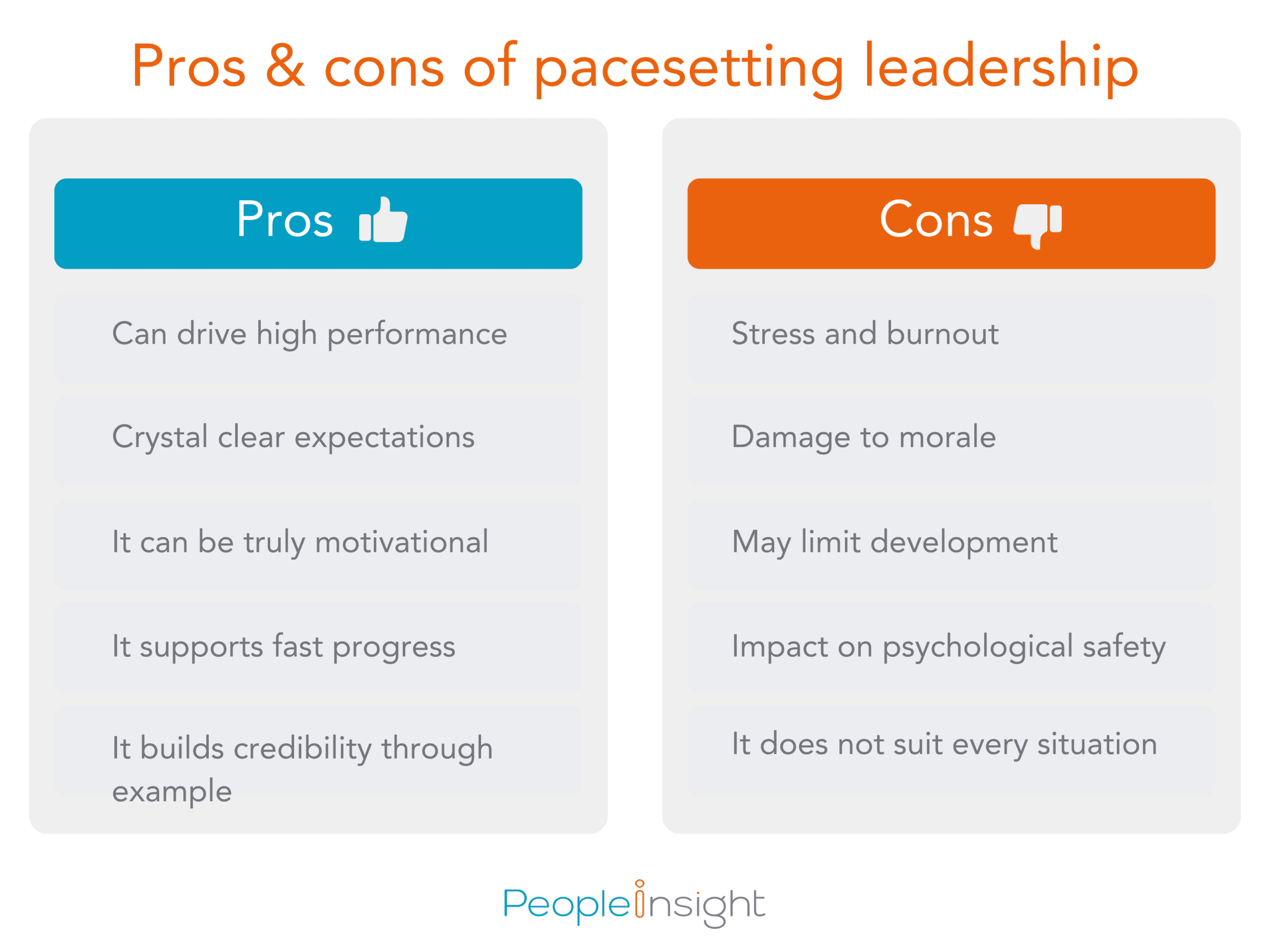
    Pros and cons of pacesetting leadership

    1. It drives high performance

    Pacesetting leadership gives teams a clear sense of what excellence looks like. When employees are skilled and motivated, this can help them stretch themselves and deliver stronger results.

    2. It creates clear expectations

    There is usually little ambiguity with a pacesetting leader. People know the standard expected, the pace required and the level of quality the leader wants to see.

    3. It can motivate ambitious employees

    For self-driven employees, pacesetting leadership can feel energising. They may appreciate the challenge, the pace and the chance to work with a leader who pushes for strong outcomes.

    4. It supports fast progress

    Because pacesetting leaders often make quick decisions and remove delays, this style can be useful when teams need to move fast, hit a deadline or deliver a specific outcome.

    5. It builds credibility through example

    Pacesetting leaders do not usually ask others to do what they would not do themselves. Their willingness to work hard and model high standards can build respect, especially when employees see that the leader is committed too.

    5 cons of pacesetting leadership to watch out for

    Pacesetting leadership can be effective, but it can also become damaging if it is overused or applied to the wrong team.

    1. It can create stress and burnout

    Constantly pushing for more can leave employees feeling under pressure, especially if workloads are already high. Over time, this can increase stress, reduce wellbeing and make performance less sustainable.

    2. It can damage morale

    If a leader focuses heavily on what needs to improve but rarely recognises what people are doing well, employees may start to feel undervalued. High standards need to be balanced with appreciation.

    3. It may limit development

    Pacesetting leaders often move quickly, which can mean they step in rather than coach. This may solve the immediate problem, but it can stop employees building confidence and capability over time.

    4. It can reduce psychological safety

    If employees feel they are expected to get everything right first time, they may become less willing to ask questions, admit mistakes or share concerns. That can weaken trust and reduce honest feedback.

    5. It does not suit every situation

    Pacesetting leadership is not always the right tool. New starters, inexperienced teams or employees facing uncertainty may need more coaching, clarity and reassurance before they can perform at their best.

    What pacesetting leaders hear in 360 feedback

    In 360 feedback, pacesetting leaders often receive strong recognition for their drive, expertise and commitment. But they may also hear that their pace is difficult to sustain.

    Strengths
    • “You set a really high standard and inspire us to do our best work.”
    • “You lead from the front and never ask us to do anything you would not do yourself.”
    • “You keep the team focused, ambitious and moving quickly.”
    Areas for improvement
    • “Sometimes it feels like nothing is ever quite good enough.”
    • “We need more support and recognition, not just higher expectations.”
    • “The pace can feel intense, and it is not always clear when we are allowed to slow down or ask for help.”

    This kind of employee feedback can be incredibly useful. It helps leaders understand whether their high standards are creating motivation, pressure or both.

    How to manage effectively as a pacesetting leader

    If pacesetting leadership is your natural style, the goal is not to lower your standards. It is to make those standards more sustainable for the people around you.

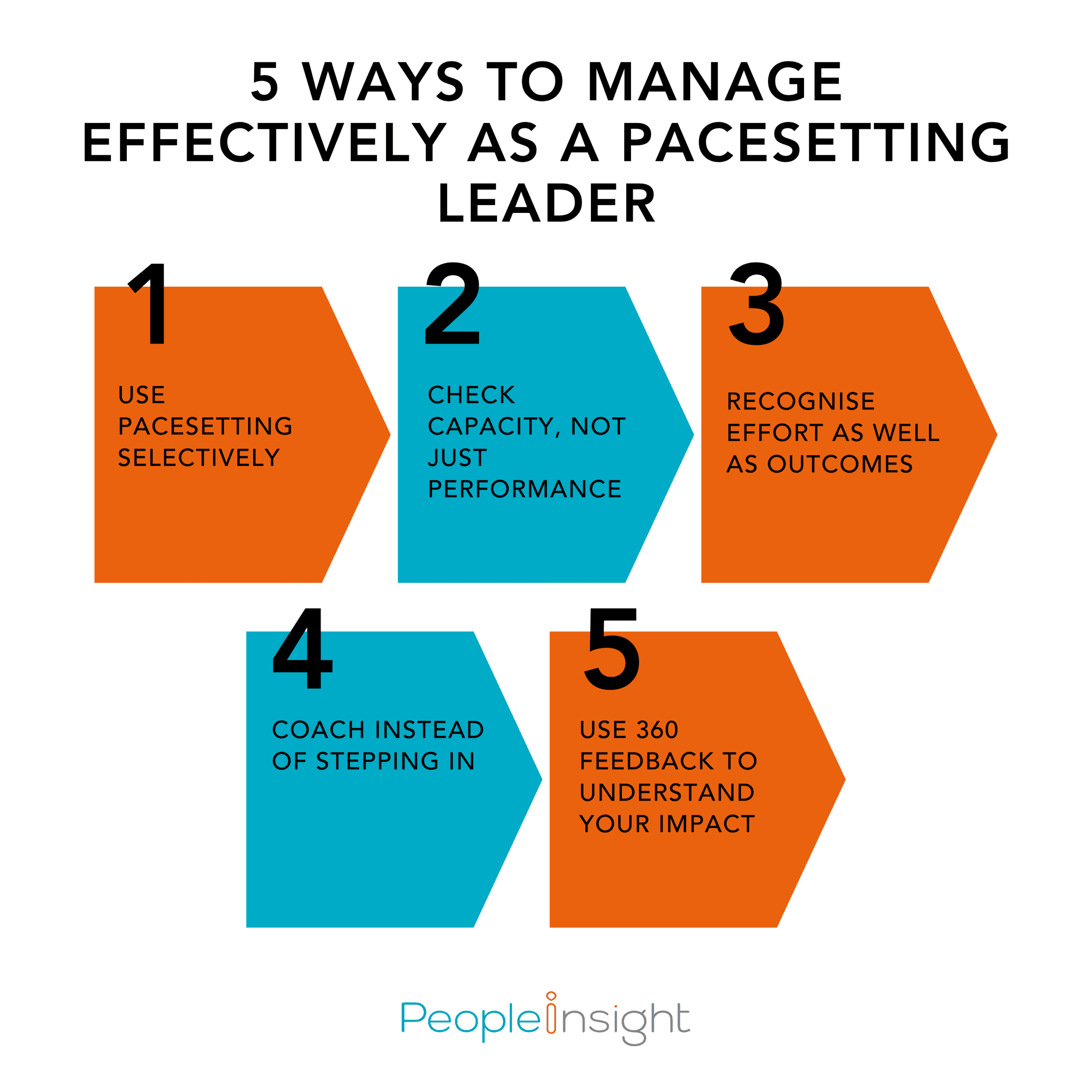
    5 Ways to manage effectively as a Pacesetting leader

    1. Use pacesetting selectively

    Pacesetting works best in short bursts, during moments when pace and quality really matter. Use it for urgent projects, ambitious goals or high-performing teams that are ready for challenge. Do not make it your only mode of leadership.

    2. Check capacity, not just performance

    Before pushing for more, check whether people have the time, skills and support to deliver. A team may look capable from the outside while quietly struggling with workload, confidence or competing priorities.

    3. Recognise effort as well as outcomes

    High standards land better when people feel seen. Make sure you acknowledge progress, effort and improvement, not just the final result. Recognition helps maintain morale when the pace is demanding.

    4. Coach instead of stepping in

    When work does not meet the standard, resist the temptation to take over. Ask questions, explain what good looks like and give people the chance to improve. That builds capability rather than dependency.

    5. Use 360 feedback to understand your impact

    Pacesetting leaders can be so focused on delivery that they miss how their style feels to others. 360 feedback models help leaders see the gap between intention and impact, making it easier to keep the strengths of pacesetting while reducing the pressure it can create.

    Pacesetting leadership is not about being harsh, impatient or impossible to please. At its best, it is about modelling excellence and helping people see what they are capable of.

    But high standards need human understanding behind them. Without support, recognition and honest listening, pacesetting can quickly become exhausting. With the right balance, it can help teams achieve ambitious goals while still protecting trust, morale and long-term performance.

    Want to understand how your leadership style is experienced by your team? Get in touch with People Insight to learn more about our 360 feedback approach and how we help leaders turn feedback into meaningful development.

    FAQs about pacesetting leadership

    A quick run down on all you need to know

    What is pacesetting leadership?

    Pacesetting leadership is a leadership style where the leader sets high standards, leads by example and expects strong performance from the team. It can be effective with skilled, motivated employees, but it needs to be balanced with support and recognition.

    When does pacesetting leadership work best?

    Pacesetting leadership works best when employees are experienced, confident and self-motivated. It can be useful when a team needs to move quickly, improve quality or deliver an ambitious project.

    What are the disadvantages of pacesetting leadership?

    The main disadvantages of pacesetting leadership are stress, burnout, low morale and limited development. If the leader is always pushing for more, employees may feel pressured rather than motivated.

    Is pacesetting leadership a good leadership style?

    Pacesetting leadership can be a good leadership style when used carefully. It helps raise standards and drive performance, but it should not be the only style a leader uses. It works best when balanced with coaching, recognition and clear communication.

    How can pacesetting leaders improve?

    Pacesetting leaders can improve by checking their team’s capacity, recognising effort, coaching rather than taking over and using 360 feedback to understand how their leadership style affects others.