
















Our experienced team works alongside organisations to help them design, deliver and communicate their listening programmes. From survey distribution to strategic guidance, we’re here when you need us
A quick insight:A career development framework gives people clear pathways to grow their skills and progress their careers with confidence. By defining roles, expectations and development opportunities, it reduces uncertainty, supports meaningful conversations and strengthens retention. When frameworks are aligned to both individual aspirations and organisational needs, people feel more motivated, capable and connected to long-term success.
When people can’t see a future with their employer, they start to look elsewhere. And they’re doing just that — lack of career development is now one of the top reasons people quit their jobs. And our cross-sector benchmark data shows that only 57% of employees feel their career development aspirations are being met at their current company.
This doesn’t just hurt retention. It chips away at motivation, productivity and trust. On the flip side, when people can see a path ahead, they’re more likely to stay, do their best work and talk positively about their experience.
That’s where a career development framework comes in. It helps employees understand what’s possible, and gives managers the tools to support them in a way that actually makes a difference. It also gives organisations a better way to grow their talent from within — which is not only more cost-effective, but often more impactful than hiring externally.
Let’s talk about how to build a career development framework that actually works — and why it’s worth the time and investment.
Put simply, a career development framework maps out the skills, behaviours and expectations for different roles across your organisation. It shows employees what’s needed to grow in their current role or move into another one — whether that’s upwards, sideways or into something completely new.
It’s not a checklist or a policy document that lives in a folder. It should reflect your culture, your goals and how people actually work day to day. The most effective frameworks don’t just support HR processes … they become a live tool for managers and employees to talk about progression and performance in a clear, consistent way.
And when you plug it into an intuitive 360 feedback platform or actionable employee experience platform, it becomes even more powerful. It helps you collect actionable feedback, support meaningful conversations and give people insight into their development from different perspectives.
Why you need a career development framework
How can a career development framework actually benefit your organisation?
1. People want to grow — and they’re not waiting around
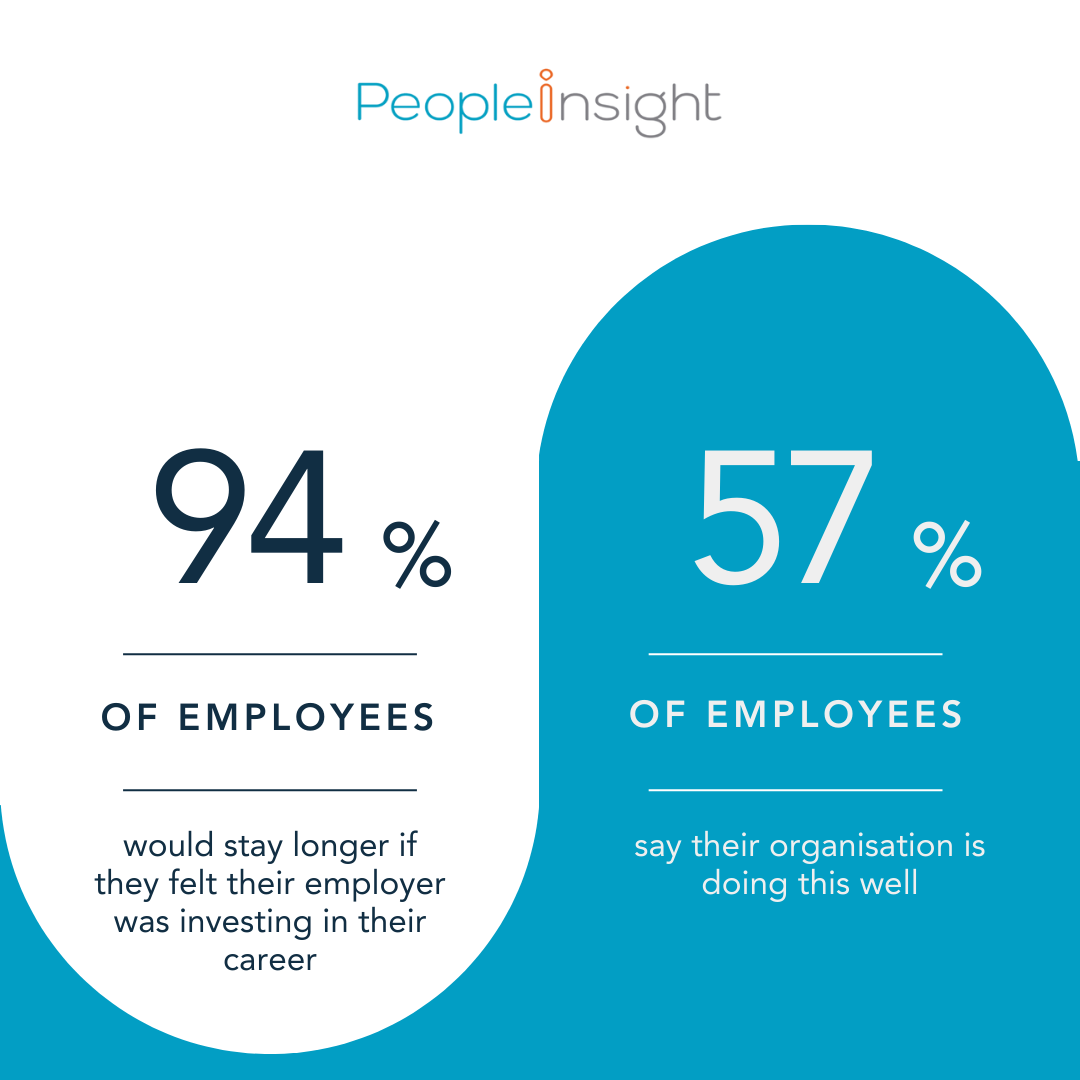
The numbers speak for themselves. LinkedInresearch shows that 94% of employees would stay longer if they felt their employer was investing in their career. But only 57% say their organisation is doing this well.
That’s a big disconnect. And it’s one that can be fixed. A clear, accessible career development framework helps bridge the gap between ambition and reality, making it easier for employees to understand where they’re going and what support is available.
2. It makes performance conversations more focused and fair
Without a shared understanding of what ‘good’ looks like, performance reviews can feel vague or inconsistent. A framework provides a common language for managers and employees to use so development conversations are based on clear expectations, not guesswork.
When combined with a 360 feedback tool, it helps surface different perspectives in a structured way, making the feedback more relevant and easier to act on.
Hiring externally can be expensive and slow. Internal hires are often quicker to onboard and more likely to stick around. According to Wharton, internal candidates often outperform external ones — but without a framework, people may not even realise those opportunities exist.
A career development framework helps you spot potential, support internal moves and plan for the future more effectively. It’s a smarter way to build long-term capability and confidence across the organisation.
How to create a career development framework that works
It’s not about putting a flashy template together or writing pages of HR jargon. A good framework is simple, useful and built around how your people actually grow and succeed.
Here’s how to get started:
1. Tie it to your values and goals
Start by looking at what matters to your organisation. What skills and behaviours do you value? What kind of growth do you want to support?
This helps make sure your framework reflects more than just job titles — it’s rooted in your purpose and culture. That way, progression feels relevant to both individual goals and the bigger picture.
2. Map out levels and paths clearly
For each role or function, define what’s expected at different levels and what growth might look like. This could include:
Core skills or technical knowledge
Behaviours or mindsets
What someone at that level is expected to deliver
Signs they’re ready to progress
Use clear, plain language. People shouldn’t need a dictionary or a manager to explain it.
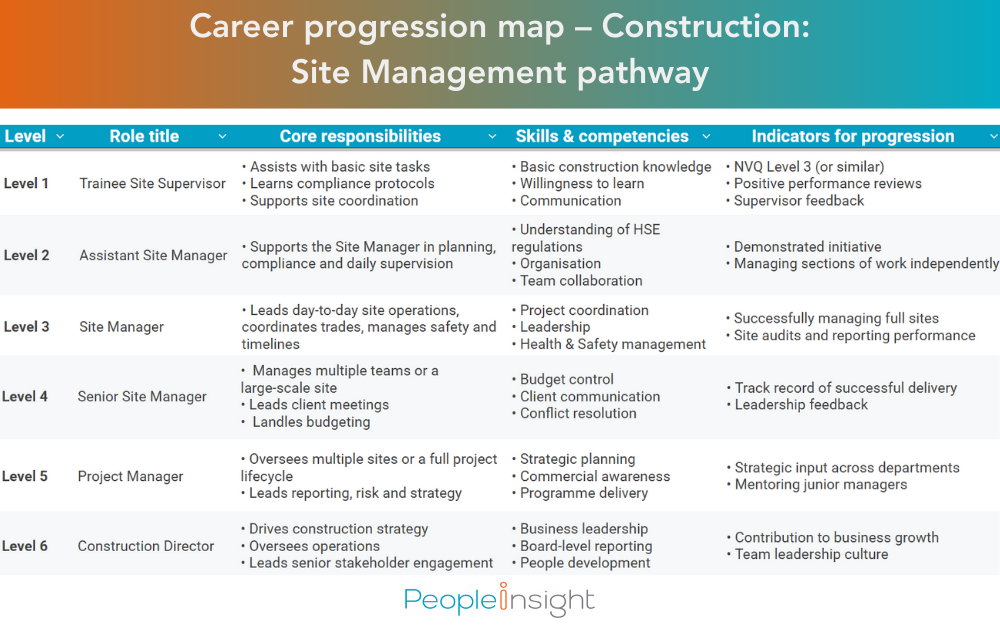
Looking for an example? Here’s a sample career progression map for a Site Management job family within the construction sector. This example shows a typical pathway from entry-level through to senior leadership, including the skills and expectations at each stage.
3. Involve employees in shaping it
If you want the framework to work, it can’t be created in isolation. Ask your employees what career development means to them and where they feel current processes fall short.
Use actionable surveys or other employee voice tools to get honest input. When people are part of the process, they’re more likely to trust and use the result.
4. Make it part of everyday conversations
The best frameworks don’t sit in a drawer. They show up in performance reviews, 1:1s, development plans and coaching sessions.
Connect the framework to tools you already use — like your intuitive survey platform or 360 feedback tool — so managers have everything in one place. That makes it easier to give meaningful feedback, spot development opportunities and follow up regularly.
5. Keep it relevant
Your business will change, and so will the roles within it. Make time to review and refresh your framework with input from across the organisation.
Use employee sentiment data to understand how the framework is landing: Do people feel it helps them grow? Is it being used consistently? Are some groups being left out?
Watch out for these common pitfalls
Not all career development frameworks are effective. Keep an eye out for these common pitfalls.
Some managers use it well — others don’t
Inconsistency can undermine trust in the framework. Make sure all managers know how to use it, and give them tools to make it part of regular development conversations.
It becomes too complicated
Avoid turning your framework into a mini HR manual. Keep it simple and useful — think guidance, not a script.
People don’t know it exists
If employees can’t find or understand your framework, it won’t help anyone. Make it visible, talk about it during onboarding, and refer to it often in career conversations.
Career development frameworks aren’t about fancy charts or policies. They’re about listening to your people and giving them something clear and useful to grow with. Done well, they support better conversations, stronger performance and a more confident, connected workforce.
And when your people feel like their growth matters, they’ll tell you — in your surveys, in your feedback channels, and in the way they show up every day.
Want to know what your employees really think about their development opportunities?Get in touch to see how an employee survey can help shape a career development framework that works for your people and your business.