

















Blogs:

What is an employee value proposition?

Let’s explore EVPs, why they’re important and how you should go about creating one

What is an employee value proposition

    A quick insight: An employee value proposition is the full package of value people receive in return for their contribution at work. It includes pay, benefits, development, culture and the everyday experience of being part of your organisation. A strong employee value proposition helps you attract the right talent, keep good people and build an experience that reflects what employees genuinely value.

    Note: This blog was updated April 2026 to reflect current benchmark data

    Attracting and retaining good people has never been just about salary.

    People want fair pay, yes. But they also care about growth, recognition, flexibility, leadership, wellbeing and whether the reality of working at an organisation matches the promises made during recruitment. That is why a clear employee value proposition matters.

    An employee value proposition, often shortened to EVP, explains what employees get in return for the time, energy, skill and commitment they give to your organisation. It brings together the practical and emotional reasons people choose to join, stay and do their best work.

    A strong employee value proposition can help you stand out in a crowded market. It can strengthen retention, support engagement and shape a more consistent employer brand. But for it to work, it has to be rooted in reality. It cannot just be a polished message on a careers page. It has to reflect what employees actually experience day to day.

    That is where employee listening becomes essential.

    At People Insight, we help organisations understand what their people value most, where expectations are being met and where the real gaps sit. Through employee surveys, pulse surveys, comments analysis and Prism’s ability to summarise themes at scale, organisations can build an employee value proposition based on evidence rather than assumption.

    Related: Non-financial employee rewards to keep employees motivated

    What is an employee value proposition?

    An employee value proposition is the unique mix of benefits, opportunities, support and experience that employees receive in exchange for their work.

    It includes tangible elements such as pay and benefits, but it also covers less tangible aspects of work, including career development, leadership, flexibility, organisational culture, recognition and purpose.

    A simple way to think about it is this: your employee value proposition answers the question, why would someone choose to work here and continue working here?

    The term is sometimes written as employer value proposition, but employee value proposition is usually the clearer term because it keeps the focus on what employees actually receive and experience.

    A strong employee value proposition should be:

    • clear
    • relevant
    • distinctive
    • believable
    • grounded in the real employee experience

    If it is too generic, it will not help you stand out. If it is disconnected from reality, employees will see through it quickly.

    Why is employee value proposition important?

    Your employee value proposition influences far more than recruitment messaging.

    It shapes how people feel about your organisation before they join, while they work for you and when they decide whether to stay. A well-developed employee value proposition can support:

    • stronger talent attraction
    • better retention
    • clearer employer brand positioning
    • higher engagement
    • more consistency between promise and experience
    • more focused people strategy

    In simple terms, a strong employee value proposition helps you attract people for the right reasons and keep them for the right reasons.

    Just as importantly, it gives leaders a clearer view of what needs to improve. If your EVP says you offer growth, flexibility and supportive leadership, employees need to feel those things in practice. If they do not, the gap between promise and reality will damage trust.

    That is why the best employee value propositions are built through listening, not guesswork.

    Employee value proposition vs employer brand: what is the difference?

    These terms are closely related, but they are not the same.

    Employee value proposition is the actual value, experience and benefits employees receive.

    Employer brand is how that value is communicated and perceived externally and internally.

    A simple distinction is:

    • your EVP is the substance
    • your employer brand is the story you tell about that substance

    If the story is stronger than the reality, it will not hold up for long. If the reality is strong but poorly communicated, you may struggle to attract the right people.

    The strongest organisations work on both.

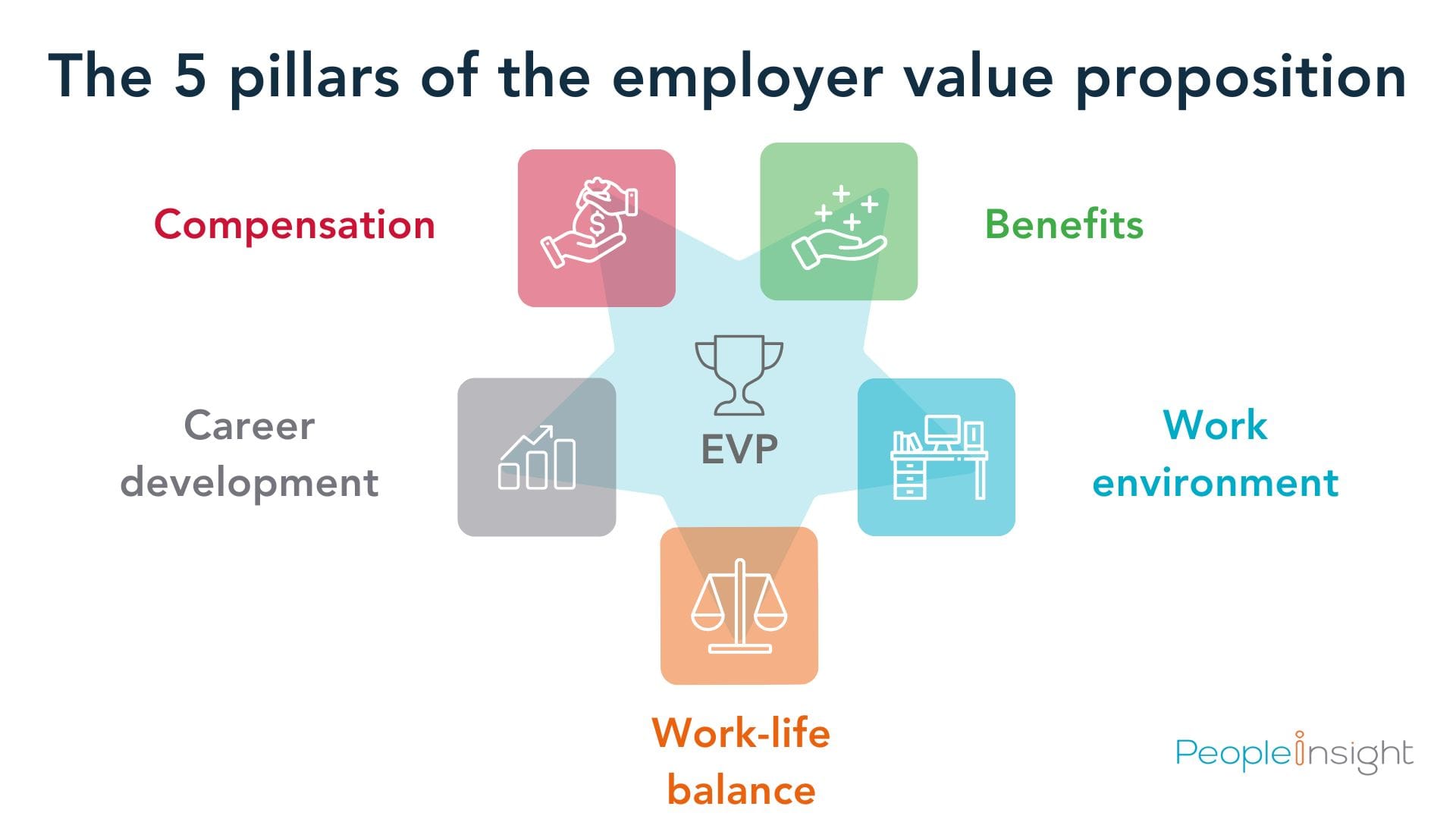
    The five pillars of an employee value proposition

    A strong employee value proposition is not just attractive on paper. It reflects the real experience of work and helps employees feel that what they give is matched by what they get in return.

    In most organisations, that means bringing together several core elements.

    pillars of the employer value proposition

    1. Fair and competitive compensation

    Pay still matters. A lot.

    Compensation is one of the clearest signals of how an organisation values its people. But employees do not only judge reward by the number on a payslip. They also notice whether pay feels fair, transparent and consistent.

    A strong EVP should therefore consider:

    • salary
    • bonuses or incentives
    • pension and financial benefits
    • fairness across roles and groups
    • transparency around pay decisions

    Reward on its own is not enough, but weak reward can undermine everything else.

    Global benchmark snapshot:

    Only 50% of employees across sectors satisfied with their pay

    2. Benefits that support real life

    Benefits become much more valuable when they reflect what employees genuinely need.

    That might include:

    • Mental health and wellbeing programmes, such as access to therapy or wellness apps
    • family-friendly policies
    • wellbeing provision
    • financial wellbeing support
    • Subsidised childcare or parental leave policies
    • Tuition reimbursement for further education
    • Access to fitness centres or wellness initiatives
    • Lifestyle benefits, such as discounts on travel, entertainment or shopping

    The key question is not simply what benefits you offer. It is whether those benefits feel meaningful to your workforce.

    Global benchmark snapshot:

    Only 54% of employees across sectors satisfied with the benefits they receive

    3. Career development and growth

    Many employees are looking for more than stability. They want progress.

    That can mean formal development, clearer progression, better line management, access to mentoring or opportunities to build new skills. If people cannot see a future with your organisation, your employee value proposition will feel weaker over time.

    Global benchmark snapshot:

    59% of employees feel their career development aspirations are being met at their current company

    4. Work environment

    The work environment encompasses everything from the physical workspace to the company culture and leadership style. Employees thrive in environments where they feel respected, supported and included.

    Key aspects include:

    • A culture of diversity, equity and inclusion
    • Transparent communication between leadership and employees
    • A safe and comfortable physical workspace, or high-quality remote work tools
    • Access to necessary resources and technology for productivity
    • Peer recognition programmes to celebrate achievements

    Global benchmark snapshot:

    74% of employees feeling satisfied with their physical work environment, and 72% saying they have the equipment and resources necessary to do their jobs properly

    5. Flexibility and work-life balance

    Maintaining a healthy balance between professional and personal life is incredibly important when it comes to employee wellbeing. Employers who prioritise work-life balance demonstrate that they value employees as whole individuals, not just worker bees.

    There are a lot of ways to improve work-life balance for employees, but popular methods include:

    • Flexible working hours to accommodate personal responsibilities
    • Remote work options or hybrid work models
    • Generous annual leave, including mental health days or “recharge” days
    • Policies to limit after-hours communication and promote downtime
    • Family-friendly policies, such as parental leave and caregiving support

    Global benchmark snapshot:

    74% of employees are able to strike the right balance between work and home life

    How to build an employee value proposition

    A strong employee value proposition should be shaped through evidence, not assumptions from the top.

    Here is a more practical way to approach it.

    1. Understand your current reality

    Before refining your EVP, understand what employees currently experience.

    This is where employee listening matters most. Use:

    • employee surveys
    • pulse surveys
    • onboarding feedback
    • exit feedback
    • focus groups
    • open comments

    The aim is to understand not just what leaders think the organisation offers, but what employees actually value and how consistently they experience it.

    2. Identify your strengths and gaps

    Once you have feedback, look for patterns.

    What do employees value most? Where are expectations being met? Where do they feel the organisation falls short? Which areas differ most by team, manager group, career stage or demographic?

    This is where surveys become more than measurement. They become a tool for shaping a stronger employee value proposition.

    3. Analyse comments, not just scores

    Scores are useful, but comments often tell you why people feel the way they do.

    At People Insight, this is one of the areas where Prism can add real value. Prism helps summarise comments at scale, surface recurring themes and provide extra context around the scores. That makes it easier to understand what employees mean when they talk about flexibility, development, culture or recognition, rather than leaving HR teams to manually sift through hundreds or thousands of responses.

    This is a much sharper route to understanding what employees truly value.

    4. Segment your EVP thinking

    A one-size-fits-all employee value proposition is rarely enough.

    Different employee groups may care about different things. Early-career employees may want development and progression. Parents and carers may prioritise flexibility. Managers may be looking for support, clarity and decision-making freedom.

    That does not mean creating a completely different EVP for every group. It means understanding where priorities vary and making sure your overall proposition reflects that reality.

    5. Align the EVP with your culture and strategy

    Your employee value proposition should reflect who you are as an organisation and where you are trying to go.

    If innovation is central to your strategy, do employees feel trusted to experiment and grow? If collaboration matters, do they experience strong communication across teams? If wellbeing is part of your message, do workloads and management practices support that?

    The best EVPs are aligned with organisational purpose, but they are also credible in the day-to-day experience of work.

    6. Turn insight into action

    This is the part too many organisations miss.

    If employee listening shows that development is weak, managers need support to improve it. If comments show that flexibility feels inconsistent, policies and behaviours need attention. If reward feels unfair, leaders need to look at the underlying causes.

    Sharper listening should lead to smarter action.

    That is why EVP work should not stop at messaging. It should feed into practical action planning across leadership, communication, management capability and employee experience.

    7. Keep it under review

    An employee value proposition is not static.

    Employee expectations change. Labour markets shift. Internal priorities evolve. Your EVP should be reviewed regularly so it continues to reflect what employees value now, not what mattered three years ago.

    How employee surveys strengthen your employee value proposition

    Employee surveys are one of the most effective ways to build an employee value proposition on real evidence.

    They help you understand:

    • what employees value most
    • where experience is strong
    • where expectations are not being met
    • how perceptions differ across the organisation
    • what should be prioritised first

    For example, survey data may show that employees value flexibility highly but experience inconsistency in how it is applied. Or it may show that leadership communication is undermining an otherwise strong development offer. Those are important EVP insights, because they reveal the gap between promise and practice.

    At People Insight, we help organisations use surveys not just to gather feedback, but to uncover what matters most and where action is needed. That is a much stronger foundation for EVP development than relying on generic benefits lists or leadership assumptions.

    Common mistakes when creating an employee value proposition

    There are a few common reasons employee value proposition work falls flat.

    Making it too generic

    If your EVP sounds like every other employer, it will not help you stand out.

    Building it from leadership assumptions

    What leaders think employees value is not always what employees actually value.

    Over-focusing on perks

    Employee perks can help, but they rarely compensate for weak leadership, poor progression or inconsistent culture.

    Treating it as a recruitment slogan

    If the EVP is only visible on the careers page and not felt internally, it will not be credible.

    Failing to act on feedback

    If employees give clear input but see no change, trust drops and the EVP becomes weaker, not stronger.

    Examples of what can be included in an employee value proposition

    An employee value proposition can include a wide range of elements, depending on your workforce and organisational context. These often include:

    • competitive salary and bonuses
    • pension and financial wellbeing support
    • healthcare and wellbeing benefits
    • flexible or hybrid working
    • paid leave and family-friendly policies
    • learning and development opportunities
    • career progression pathways
    • mentoring and leadership development
    • inclusive culture and strong leadership
    • recognition and appreciation
    • meaningful work and purpose
    • good tools, systems and working conditions

    The key is not to include everything possible. It is to focus on what matters most to your people and what your organisation can genuinely deliver well.

    Employee value proposition is strongest when it reflects lived experience

    A strong employee value proposition is not just a statement. It is the lived experience of working at your organisation.

    That is why the most effective EVP work starts with listening. It requires organisations to understand what employees value, where they are delivering well and where they need to improve. It means going beyond assumptions, beyond surface-level messaging and beyond generic lists of perks.

    At People Insight, we help organisations do exactly that.

    Through employee surveys, pulse surveys and comments analysis, we help you understand what your people value most. With Prism, you can summarise comments at scale, uncover deeper context and turn employee voice into clearer priorities. And with our wider consultancy support, you can move from insight to action with more confidence.

    That is what sharper listening and smarter action looks like in practice.


    Want to build an employee value proposition based on real employee insight? Get in touch to learn how People Insight can help you use employee surveys, comments analysis and Prism to shape a stronger, more credible EVP.

    FAQs about employee value proposition

    A quick run down on all you need to know

    What is an employee value proposition?

    An employee value proposition is the mix of benefits, opportunities, support and experience an employee receives in return for their work. It includes pay, benefits, development, culture, flexibility and the wider experience of being part of an organisation.

    What does EVP stand for?

    EVP stands for employee value proposition.

    What is the difference between employee value proposition and employer value proposition?

    The terms are often used interchangeably. Employee value proposition is usually the clearer phrase because it focuses on the value employees receive and experience.

    Why is employee value proposition important?

    Employee value proposition matters because it shapes attraction, retention, engagement and employer reputation. A strong EVP helps organisations stand out and gives employees clearer reasons to join and stay.

    What should an employee value proposition include?

    A strong employee value proposition usually includes compensation, benefits, career development, work environment, leadership, flexibility, work-life balance and purpose.

    How do you create an employee value proposition?

    You create an employee value proposition by understanding what employees value, identifying your strengths and gaps, analysing feedback and aligning your proposition with real employee experience. Employee surveys and comments analysis are especially useful here.

    How do employee surveys help with EVP?

    Employee surveys help organisations understand what employees value most, where experience is strongest and where there are gaps between what is promised and what is delivered. That makes EVP work more evidence-based and actionable.

    Can EVP be different for different employee groups?

    Yes. Different employee groups often prioritise different aspects of work. A strong overall EVP should still feel consistent, but it should account for the fact that needs vary by role, career stage and life stage.

    What is the difference between EVP and employer brand?

    EVP is the substance of what employees receive and experience. Employer brand is how that is communicated and perceived.

    How can People Insight help improve employee value proposition?

    People Insight helps organisations build a stronger EVP through employee surveys, pulse surveys, comments analysis and Prism. That helps organisations understand what employees value, where experience gaps sit and what actions are most likely to improve the employee experience.