

















Blogs:

Are employees with caring responsibilities being heard at work?

Here’s how organisations can understand, recognise and support working carers more effectively

Are employees with caring responsibilities being heard at work

    A quick insight: Caring responsibilities are just a part of everyday life for many employees, but they are not always visible in survey data, manager conversations or policy decisions. A stronger employee listening strategy helps organisations understand where working carers need flexibility, support and recognition, so action feels practical, inclusive and grounded in real experience.

    Employee listening has an important role to play in understanding how caring responsibilities shape people’s working lives.

    Carers Week 2026 takes place from 8 to 14 June, with this year’s theme focused on Building Carer Friendly Communities (you can find out more about the campaign on the Carers Week website). It is a truly important theme for employers because, for many people, caring responsibilities do not sit neatly outside work. They shape working hours, energy levels, wellbeing, career decisions, manager relationships and the ability to stay engaged. Yet in many organisations, working carers remain partly hidden.

    Some employees will openly talk about their caring responsibilities. Others may not feel comfortable doing so. Some may not even use the word “carer” to describe themselves, especially if they are supporting a parent, partner, child, friend or relative alongside their job.

    That creates a challenge for HR and employee experience teams.

    If working carers are not being heard clearly, organisations may underestimate the pressure people are carrying. They may design policies that look good on paper but do not work in practice. They may miss the connection between caring responsibilities, flexibility, workload, employee wellbeing and retention.

    Caring responsibilities should be considered in your employee listening strategy

    Caring responsibilities can affect almost every part of the employee experience.

    They can influence whether someone feels able to work flexibly, speak honestly with their manager, progress in their career, attend meetings, take on new opportunities or recover properly outside work. For some employees, caring is a temporary pressure. For others, it is a long-term part of daily life.

    The risk is that caring responsibilities become invisible unless organisations ask the right questions.

    A general employee engagement survey might show lower scores around workload, wellbeing, flexibility or manager support, but unless the organisation can understand what sits behind those scores, the experience of working carers may be missed.

    That does not mean every survey needs a long section on caring. It means organisations need to think carefully about whether their listening strategy gives people safe, appropriate ways to share what is affecting their experience.

    That could include:

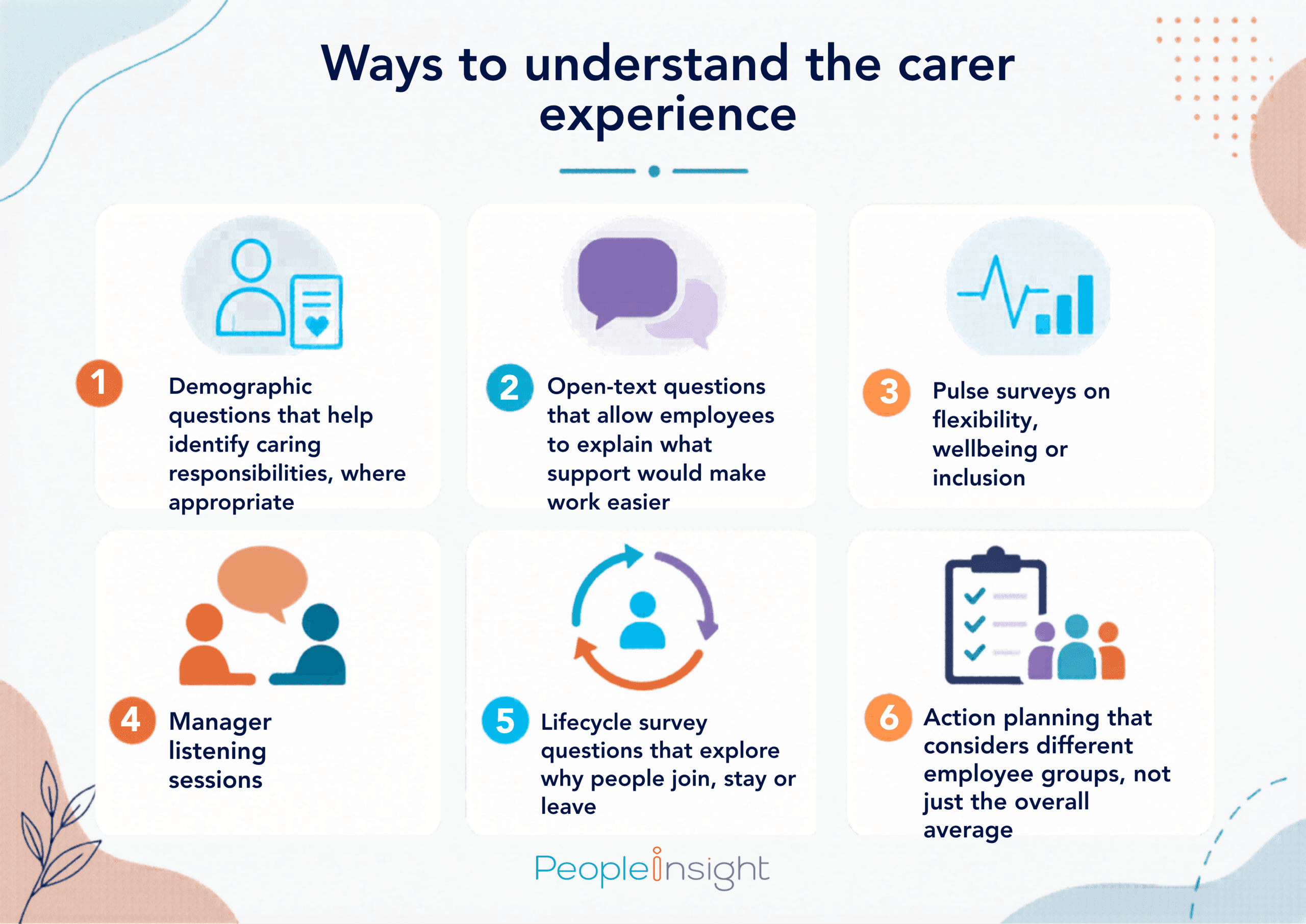
    Ways to understand the carer experience

    • demographic questions that help identify caring responsibilities, where appropriate
    • open-text questions that allow employees to explain what support would make work easier
    • pulse surveys on flexibility, wellbeing or inclusion
    • manager listening sessions
    • lifecycle survey questions that explore why people join, stay or leave
    • action planning that considers different employee groups, not just the overall average

    People Insight’s 2025 benchmark data shows engagement has improved from 75% in 2024 to 77% in 2025, while purpose has risen from 64% to 69%. That is encouraging. But strong overall engagement can still hide uneven experiences for specific groups.

    Working carers may be committed to the organisation’s purpose while still struggling with the practical realities of work. They may want to stay and contribute, but need more flexibility, clearer support or better manager understanding to do so sustainably.

    The hidden nature of caring responsibilities at work

    One of the biggest challenges with caring responsibilities is that they are not always visible.

    Unlike some workplace needs, caring responsibilities can change quickly. An employee might suddenly need to support a parent after a diagnosis. A child’s needs may shift. A partner’s health may deteriorate. A previously manageable arrangement may become harder because of workload, commuting, rota changes or financial pressure.

    Employees may also worry about how they will be perceived.

    Will they be seen as less committed? Will they be passed over for opportunities? Will their manager understand? Will asking for flexibility create resentment in the team?

    Questions and concerns such as these shape whether people speak up.

    A good employee listening strategy gives organisations a clearer view of what employees are experiencing without forcing people to disclose more than they are comfortable sharing. It helps identify patterns, pressure points and gaps in support.

    For working carers, that might mean understanding whether:

    • people feel able to discuss caring responsibilities with their manager
    • flexible or hybrid working is accessible in practice, not just in policy
    • workload expectations allow for real life outside work
    • carers feel included in development and progression opportunities
    • support is consistent across teams and departments
    • employees know what help is available

    This is where sharper listening really matters. Not just asking broad questions, but designing listening in a way that helps uncover the realities people may otherwise keep quiet.

    Carer-friendly communities start inside the workplace

    The Carers Week 2026 theme of Building Carer Friendly Communities is a useful prompt for employers because workplaces are communities too.

    A carer-friendly workplace is not only one with a policy tucked away on the intranet. It is one where working carers are recognised, understood and supported through everyday decisions.

    That includes how managers respond when someone asks for flexibility. How teams plan workload. How leaders talk about wellbeing. How policies are communicated. How confidential employees feel when sharing personal circumstances. How fairly opportunities are offered to people who cannot always work in the most visible or traditional ways.

    In other words, carer-friendly workplaces are built through culture, not just policy.

    And culture is exactly where employee listening can help.

    When organisations listen properly, they can move beyond assumptions. They can understand whether support is reaching people, whether managers feel equipped and whether employees with caring responsibilities feel able to thrive.

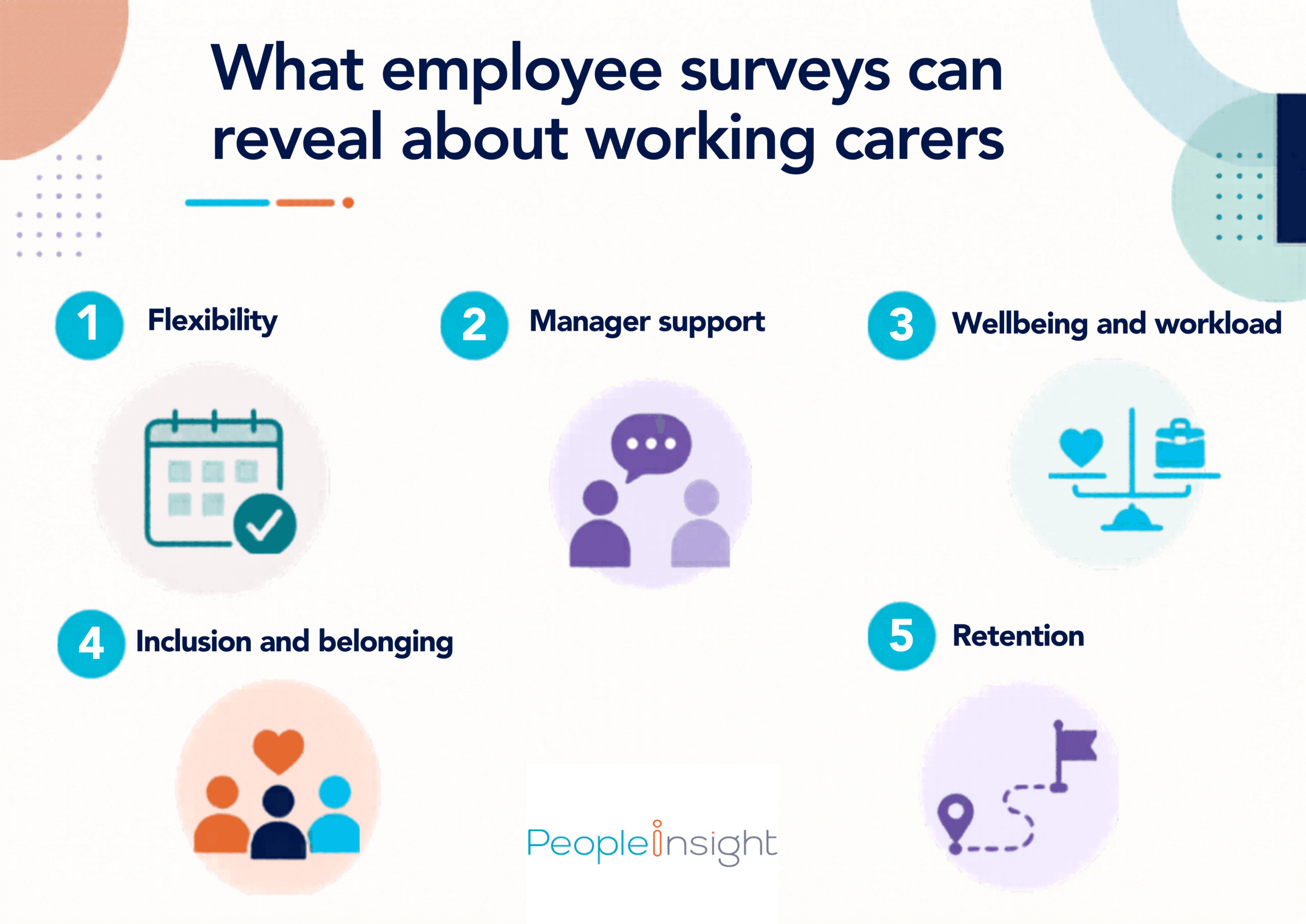
    What employee surveys can reveal about working carers

    An employee engagement survey can help organisations understand how caring responsibilities connect with wider employee experience.

    For example, caring responsibilities may show up in survey themes such as:

    What employee surveys can reveal about working carers

    Flexibility

    Working carers often need flexibility that is practical, trusted and responsive. Survey data can show whether employees feel they have enough flexibility to manage work and life, and whether that experience varies across teams, roles or locations.

    Manager support

    Managers play a huge role in whether working carers feel safe, understood and supported. A strong listening strategy can show whether managers are having the right conversations, applying policies fairly and creating trust within their teams.

    Wellbeing and workload

    Caring responsibilities can intensify the impact of heavy workloads. If employees are already stretched, caring outside work can leave little room for recovery. Survey results can help identify where workload pressure, wellbeing and support need closer attention.

    Inclusion and belonging

    Working carers need to feel they belong without having to hide part of their life. Listening data can reveal whether employees feel respected, understood and included, especially when combined with careful demographic analysis.

    Retention

    Some working carers may quietly reduce their ambition, step back from progression or leave altogether if they cannot make work fit around caring. Lifecycle surveys can help organisations understand whether caring responsibilities are influencing decisions to stay or go.

    The action gap: listening only works if carers see change

    Asking employees about caring responsibilities is only useful if organisations are ready to act on what they hear.

    This is the difficult part.

    People Insight benchmark data shows that only 53% of employees believe action will follow surveys. That is a major warning sign for any organisation asking people to share honest feedback.

    For working carers, this is especially important. If employees disclose caring-related challenges and nothing changes, trust can be damaged. People may become less likely to speak up in future, particularly if they already felt exposed by sharing personal circumstances.

    That is why employee listening needs to connect directly to action planning.

    This does not mean every piece of feedback will lead to a major policy change. Sometimes meaningful action is more practical:

    • clearer communication about existing carer support
    • manager guidance on how to talk about caring responsibilities
    • more consistent flexible working practices
    • better signposting to employee assistance or wellbeing support
    • reviewing meeting norms and core hours
    • checking whether carers are represented in inclusion work
    • creating employee networks or listening groups
    • improving how workload is discussed and planned

    The key is visibility. Employees need to see that their feedback has been understood and that action is being taken.

    How Prism can help organisations understand caring responsibilities at scale

    For larger and more complex organisations, the challenge is not just collecting feedback. It is making sense of it quickly enough to act.

    This is where Prism can support the listening process.

    Prism helps organisations interpret employee feedback, identify important themes and translate insight into practical next steps. For topics like caring responsibilities, this can be especially useful because the most important signals may sit in open comments.

    Employees might not use the same language. One person may talk about caring for an elderly parent. Another may mention school runs, hospital appointments, flexible hours, fatigue, stress or the difficulty of managing home responsibilities.

    Taken individually, these comments may seem separate. Analysed together, they can reveal a much clearer pattern.

    Prism supports this process by helping leaders and managers understand what to focus on, without replacing human judgement. That distinction is important. Caring responsibilities are personal, sensitive and often complex. AI can help surface themes, but organisations still need empathy, context and careful decision-making.

    Questions to ask during Carers Week

    Carers Week is a useful moment to check whether your organisation is really hearing working carers.

    Here are some practical questions to consider.

    Are caring responsibilities visible in your data?

    Do you have a safe and appropriate way to understand whether employees have caring responsibilities and how this affects their experience?

    Do managers feel confident supporting working carers?

    Are managers equipped to have sensitive conversations, apply policy fairly and support flexibility without making employees feel like a burden?

    Does flexible working work in practice?

    Is flexibility genuinely available across different teams and roles, or does the experience depend heavily on individual managers?

    Are carers included in career and development conversations?

    Do employees with caring responsibilities feel they can still progress, contribute and take on opportunities?

    Are you acting on what carers tell you?

    Can employees see evidence that feedback leads to meaningful improvement?

    Building a listening strategy that supports working carers

    A stronger approach to working carers does not need to start with a huge programme of work.

    It can start with better listening.

    That means asking better questions, looking carefully at the data and creating safe spaces for employees to share what is really affecting their experience. It also means connecting insight to action, so carers see that their voice is not just collected but understood.

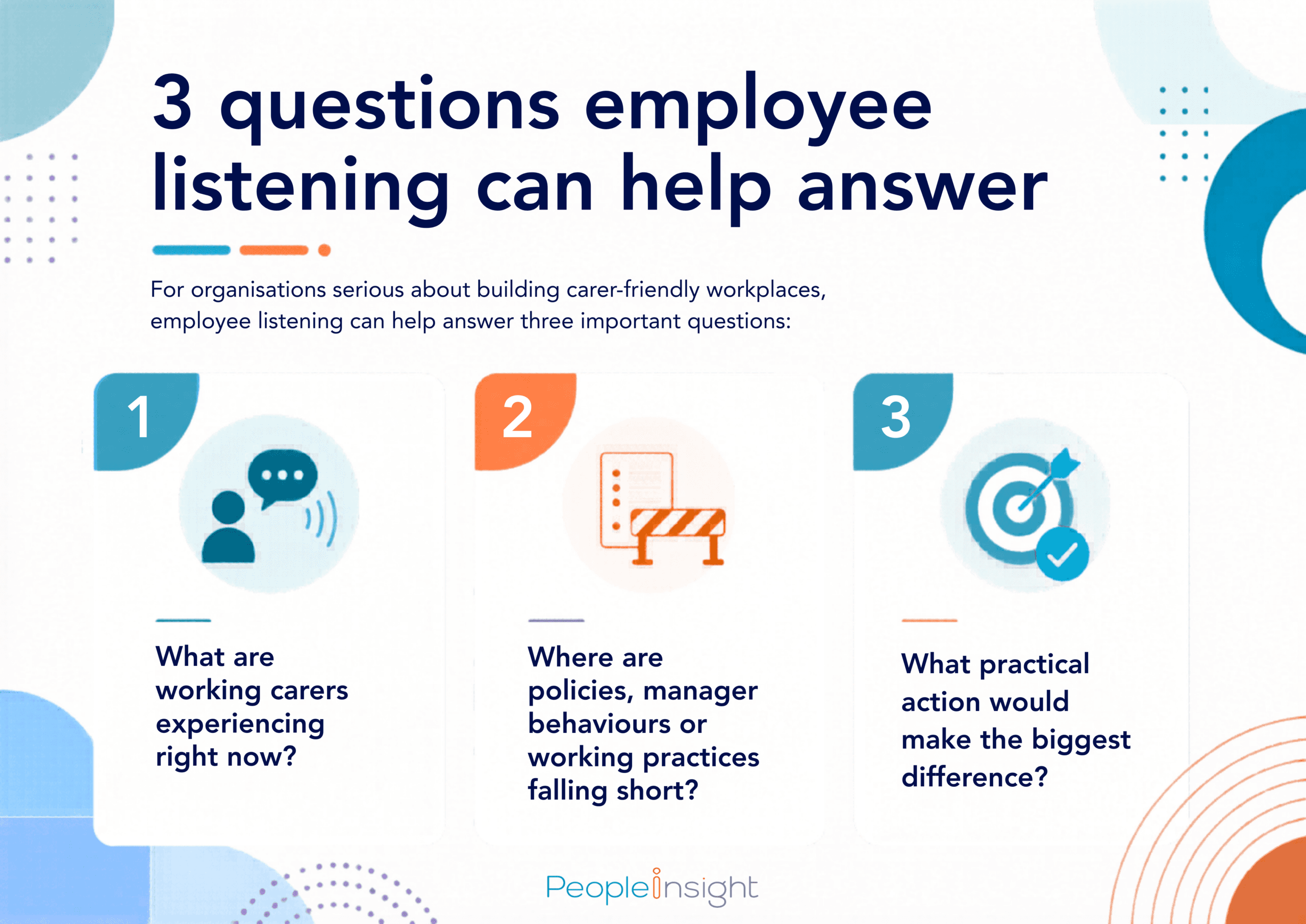
    For organisations serious about building carer-friendly workplaces, employee listening can help answer three important questions:

    3 questions employee listening can help answer

    • What are working carers experiencing right now?
    • Where are policies, manager behaviours or working practices falling short?
    • What practical action would make the biggest difference?

    When organisations answer those questions well, they move closer to the spirit of Carers Week 2026. Not just recognising carers for one week of the year, but building workplaces where caring responsibilities are understood as part of real working life.

    How People Insight can help

    People Insight helps organisations build employee listening strategies that uncover what people are really experiencing, from engagement and wellbeing to inclusion, flexibility and action planning.

    Our employee survey platform combines flexible survey design, clear reporting, meaningful benchmarking and Prism-powered analysis, supported by expert consultants who help turn feedback into practical action.

    If you want to understand whether working carers are being heard in your organisation, get in touch with People Insight to learn how we can help you listen more clearly and act with confidence.

    FAQs about carers in the workplace

    How can employee listening support working carers?

    Employee listening can help working carers by giving organisations a clearer view of their challenges, needs and experiences. Surveys, open comments, pulse checks and manager conversations can reveal whether carers feel supported, whether policies work in practice and where action is needed.

    What should organisations do during Carers Week?

    During Carers Week, organisations can review how well they support working carers, promote existing resources, invite feedback, share manager guidance and check whether caring responsibilities are reflected in their employee listening strategy.

    How can employers build a carer-friendly workplace?

    Employers can build a carer-friendly workplace by recognising caring responsibilities, offering practical flexibility, training managers, communicating support clearly, listening to carers’ experiences and taking visible action based on feedback.