















A quick insight: Change readiness is your organisation’s confidence, capacity and willingness to adapt to change. A strong change readiness assessment helps you understand how employees feel, where risks lie and how well leaders are trusted to deliver this change. In this guide, we explore how to assess it, remove barriers and build sustainable momentum.
Successful change does not start with planning or strategy. As with most things, it starts with people. When employees trust leadership, feel informed and believe the outcome is worth the effort, change gains traction. When employees feel ignored, overloaded or anxious, even the best-designed programme can stall before it’s even truly begun.
At People Insight, we work with organisations navigating restructures, digital transformation, cultural shifts and new leadership strategies. The difference between momentum and resistance often comes down to one critical question: are your people ready?

If they’re not, we’ll help you get there.
This guide combines practical assessment steps, behavioural signals to watch for and insights from our benchmark data to help you build a confident launchpad for change.
Related: 7 Change management principles for smooth transitions
Change readiness is the degree to which employees, managers and systems feel prepared to accept, adopt and sustain any form of organisational change. It is influenced by understanding, belief, psychological safety and resource availability.
A change-ready organisation is one where employees:
In practical terms, a workforce is change-ready when employees are asking informed questions rather than expressing vague anxiety and when managers feel equipped to lead conversations.
Even well-designed initiatives can fail when readiness is low. The thing is, employees do not resist change itself. What they’re resisting is uncertainty, workload shock or leaders they do not fully trust.
Our benchmark data shows that while 68% of employees say senior leaders make the effort to listen, only 59% believe action will be taken following a survey. This gap signals a confidence deficit which, left unchecked, becomes a major barrier to change.
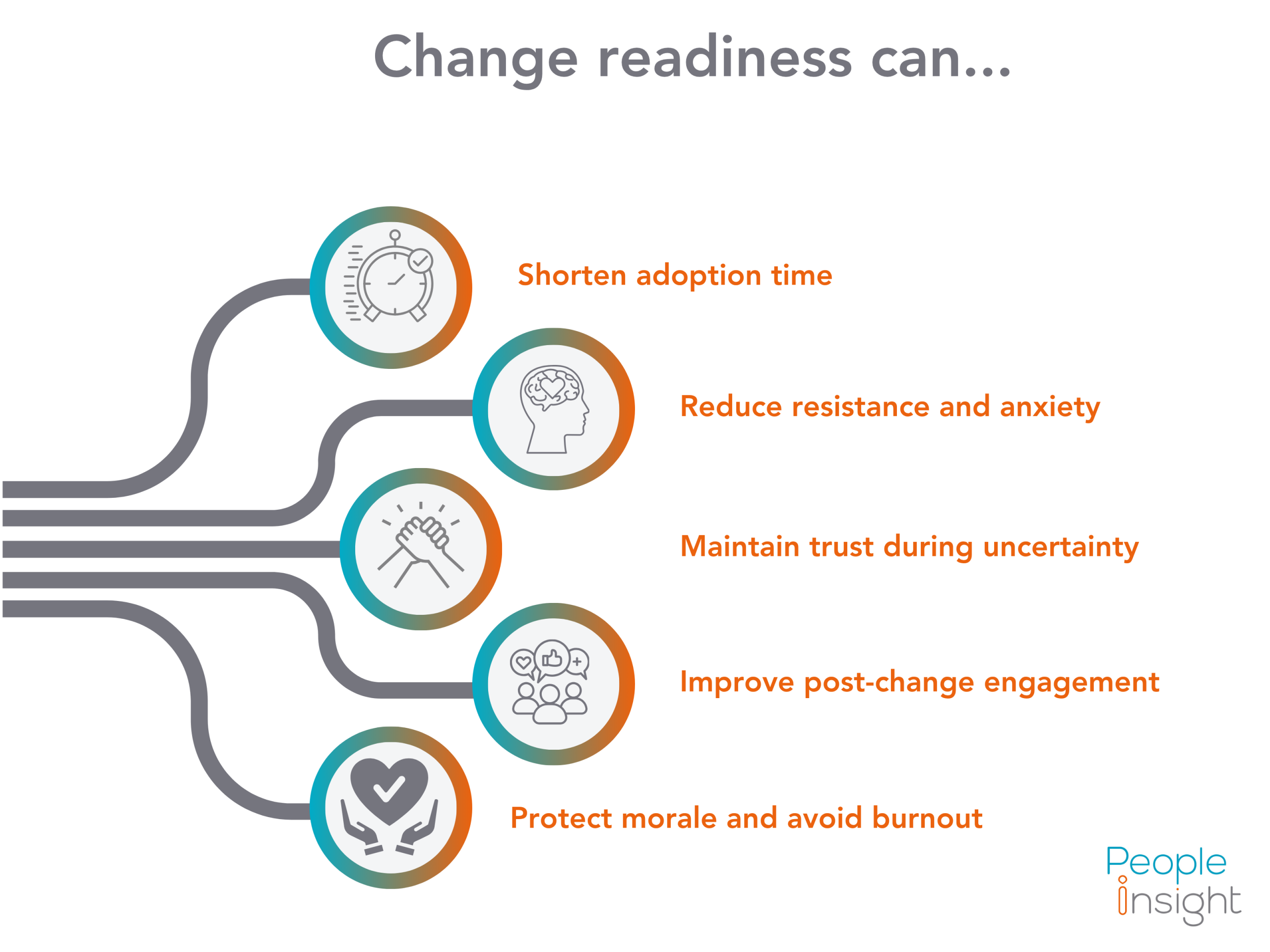
When leaders and HR are more proactive and thoughtful with regard to change, everything improves. When organisations assess and build readiness, they:

This leads to smoother implementation and stronger long-term performance.
Ready organisations behave differently.
Instead of silence in town halls, there are clarifying questions.
Instead of whispered concerns, employees test assumptions openly.
Managers anticipate hotspots instead of being surprised by resistance.
Signs of readiness include:

On the other hand, if employees say, “I don’t know what this means for me,” it’s a clear indication that readiness is not yet where it needs to be.
A change readiness assessment helps you diagnose where support is needed before rollout. It typically evaluates:
Dimension | What it asks |
| Awareness | Do employees understand what is changing and why? |
| Confidence | Do they trust leadership to deliver the change well? |
| Capacity | Do they feel they have time and resources to adapt? |
| Support | Do they know who will help them and how? |
| Emotion | Do they feel optimistic, cautious or resistant? |
The reality is, even high-performing teams can struggle with change if the conditions around them make it hard to engage or believe. Readiness isn’t only about process; it’s about psychology, communication and trust.
Here are the five most common barriers we see and how they show up in real workplaces:
When communication around change is vague or inconsistent, employees start filling in the gaps themselves. Assumptions spread quickly, especially when updates are slow. Instead of focusing on what needs to be done, people focus on what might go wrong. Clear, consistent messaging from leaders is so important to counter this. If employees cannot easily explain what is changing and why, the story still needs work.
After repeated rounds of reorganisation, new systems or shifting priorities, employees can start to disengage. They stop investing energy because they expect the next change to arrive before the current one settles. In this state, even small adjustments can feel exhausting. Building in pauses, celebrating progress and spacing initiatives out can help teams recover their capacity to adapt.
Employees take cues from what leaders do, not what they say. When leaders seem distant, distracted or overly formal during change, confidence in the direction drops. Visibility means being present in real conversations, answering questions and acknowledging uncertainty honestly. Leaders who show up create trust, and trust builds readiness.
If employees fear that raising a concern will be seen as resistance, they stay silent. This silence can be misread as agreement, when in fact it signals doubt or frustration. Creating open forums, small group discussions or anonymous feedback channels helps employees surface issues before they become barriers. Psychological safety is the difference between quiet compliance and genuine engagement.
One of the fastest ways for change to lose momentum is when people cannot see how it affects their day-to-day work. Without clarity, rumours and anxiety take over. Employees want to know, “What does this mean for me?” Managers play a critical role in bridging this gap. They need clear talking points that connect the wider change to individual roles, showing that leadership understands the human side of transformation.
You cannot build readiness with a single email or launch meeting. It is something you develop intentionally, step by step, through communication, trust and visibility. Here’s what that looks like in practice:
Before any announcement, leaders must agree on the purpose, language and expected outcomes of the change. Conflicting narratives create doubt and confusion. When every leader tells the same story, employees feel confident that the organisation knows where it is going. Regular internal check-ins between sponsors, HR and communications teams keep that alignment strong throughout the change process.
Employees are more likely to support change when they understand the reason behind it. Start with the story. Explain what problem the change solves, what benefits it brings and what success looks like. Once the purpose is clear, the practical details make sense. For example, rather than saying “we’re restructuring teams,” say “we’re improving collaboration so projects move faster and workloads are shared more evenly.”
Before launching anything, gauge how employees feel about the upcoming change. A short pulse survey can reveal whether people understand the plan, trust leadership and feel equipped to adapt. Tools like Prism can analyse open comments to pinpoint emerging concerns or hotspots, helping leaders act before resistance builds. Treat these insights as your early warning system, not a box-ticking exercise.
When people have a voice in shaping the change, they are more likely to embrace it. Create opportunities for employees to ask questions, offer ideas and highlight practical challenges. This could be through listening sessions, feedback workshops or short digital polls. Dialogue builds ownership and helps leadership refine plans based on real-world experience rather than assumptions.
Managers are the bridge between strategy and daily experience. They set the emotional tone for how change feels. Provide them with briefing packs, FAQs and coaching support so they can host open discussions with their teams. Encourage honesty. If they do not know an answer, they can acknowledge it and commit to finding out. Employees value transparency far more than rehearsed optimism.
Change champions act as trusted peers who help colleagues make sense of what is happening. They can share updates, model positive behaviours and feed honest feedback back to leadership. This peer-to-peer advocacy builds confidence because it comes from within the team, not just from the top.
Employees need to see that their input leads to action. Regular updates show that feedback has been heard and progress is real. Share short “you said, we did” messages or dashboard summaries at key milestones. Visible follow-through turns words into credibility and keeps belief alive long after the launch moment.
Building change readiness is a continuous rhythm. Communicate, listen, act, repeat. When employees see that cycle in motion, trust and confidence grow with each step.
A change readiness assessment helps you see where resistance may emerge before it becomes costly. Think of it as a temperature check across four lenses: people, process, technology and evidence.
People: Do employees understand the purpose and impact of the change? Can they explain the benefits in practical terms? Do managers feel equipped to support conversations? Are sponsors visible and trusted or distant and formal?
Process: Are workflows, roles and responsibilities clearly mapped in relation to the change? Can people tell how handovers will work? Are policies updated or still in draft, leaving room for confusion?
Technology: Is the platform, tool or system stable enough for testing and adoption? Have pilot users ironed out usability issues? Is there a fallback plan if something goes wrong during rollout?
Evidence: Do you have baseline metrics ready to track adoption? Is there a clear plan for week one, week four and quarter one reflection? How will sentiment and performance data feed into decisions?
To bring this to life, imagine launching a new internal service portal. A people-focused readiness check might reveal that IT teams understand it, but customer-facing staff worry about losing control. A process check might show that escalation routes are unclear. A technology lens could expose slow login times. Evidence planning might show a lack of baseline measures for response time.
Capture your assessment using a Red-Amber-Green approach. Weight manager readiness more heavily, as research consistently highlights their influence. Prosci’s longitudinal research links strong change management with up to seven times higher success, built on sponsor visibility, manager capability and structured communications.
Managers carry the weight of change. Equip them before you brief the wider group. Give them a manager pack. It should include FAQs, impact by role, timelines, training links and a route for escalation. Coach them to host local Q&A, not just repeat a broadcast.
CIPD guidance stresses that involvement and communication through the line are decisive. In practice this means weekly manager huddles during rollout, a single dashboard of issues and a rapid path to decisions. Treat managers as co-designers, not a last-mile channel.
Agentic AI in Prism helps organisations move from uncertainty to action by analysing thousands of survey comments in seconds. Insight Agent detects emotional sentiment and identifies risk themes such as workload pressure or mistrust in leadership. Navigator Agent then suggests next-step actions for managers, helping create practical, relevant planning while preserving human judgment.
Rather than delaying action due to analysis overload, agentic AI provides a rapid route to clarity.
| Scenario | Readiness Intervention | Outcome |
| University restructuring departments | Assessment revealed identity loss concerns | Leaders reframed narrative around academic progression |
| Financial services moving to hybrid working | Pulse survey showed unclear expectations | Managers received conversation packs |
| Healthcare launching digital system | Low digital confidence detected early | Digital champions and hands-on training introduced |
We help organisations:
Change readiness is about confidence, clarity and fairness. When people understand the purpose, trust leadership and feel supported, change becomes a shared journey.
Want to know how ready your organisation is for change? Get in touch to run a change management survey to build meaningful change with confidence.
How often should we assess readiness?
Before major change and again during rollout to track progress.
Can readiness improve over time?
Yes. As clarity and support increase, confidence follows.
How do we spot early resistance?
Listen for emotional language, silence or confusion in responses.
How do we involve managers effectively?
Brief them before announcements and support them with structured guidance.