

















Blogs:

Survey comments: how to turn employee feedback into clear actions

A practical guide on how to turn free text into themes, priorities and two or three actions your managers can start this month

Turning survey comments into clear actions with AI

    A quick insight: Survey comments are the open-text responses employees leave in surveys. They add context, nuance and emotion to the numbers, helping organisations understand what sits behind the scores. When analysed well, survey comments support sharper listening and smarter action by turning free text into clear priorities and practical next steps.

    Survey comments are often the richest part of any employee survey.

    Scores can tell you where something is strong, weak or changing which is, of course, incredibly useful. But survey comments help explain why. They show how employees are experiencing work in their own words, which is why they are so valuable when you want to understand engagement, workload, leadership, communication or culture more clearly. 

    But survey comments can also be difficult to use well, especially at scale. Long comment lists can be repetitive, emotionally charged or hard to interpret consistently. If you sample too lightly, you risk missing important patterns. If you try to read everything manually, progress can slow to a halt.

    That is why a solid process is so important.

    At People Insight, we see survey comments as a key part of Sharper listening. Smarter action. It is our approach to insightful, proactive employee listening and turning that insight into meaningful action. Listening becomes sharper when qualitative feedback is grouped into clear, recognisable themes. Action becomes smarter when those themes are linked to priorities managers can actually use.

    If you want to use survey comments properly, they need to sit within wider employee listening strategies that help organisations gather, interpret and act on feedback consistently.

    Let’s start off with a brief insight into why survey comments are so important, followed by challenges involved and how you can analyse them optimally.

    Related: AI and employee engagement: 7 game-changing integrations 

    Why survey comments matter

    Survey comments matter bring lived experience into view.

    Numbers can point you in the right direction, but they do not always tell the full story. A low score for workload, for example, might reflect long meetings, clashing deadlines, unclear priorities or under-resourcing. Survey comments help you see which of those issues employees are actually talking about.

    That makes survey comments especially useful for:

    • adding context to survey scores
    • spotting repeated themes
    • understanding what sits behind low-scoring items
    • identifying differences between groups or teams
    • shaping more relevant action planning

    Survey comments also help organisations avoid over-simplifying the data. They bring texture and specificity to the employee experience, which makes action more grounded and more credible.

    The challenge with survey comments at scale

    Survey comments are valuable, but they are not always easy to work with.

    Especially in larger organisations, survey comments can quickly become overwhelming. You may be dealing with:

    • repeated themes phrased in different ways
    • sarcastic or emotionally charged wording
    • highly specific comments that are not representative
    • large volumes of text across multiple teams or business areas
    • pressure to move quickly from feedback to action

    This is one of the biggest challenges with survey comments. If you only skim a few pages, you risk a narrow or distorted view. If you try to review everything manually, momentum can disappear. What helps is a light but disciplined structure.

    Related: Marrying data competency with real human conversations

    How to analyse survey comments effectively

    The goal with survey comments is not to analyse every line in isolation. It is to identify patterns you can trust and use.

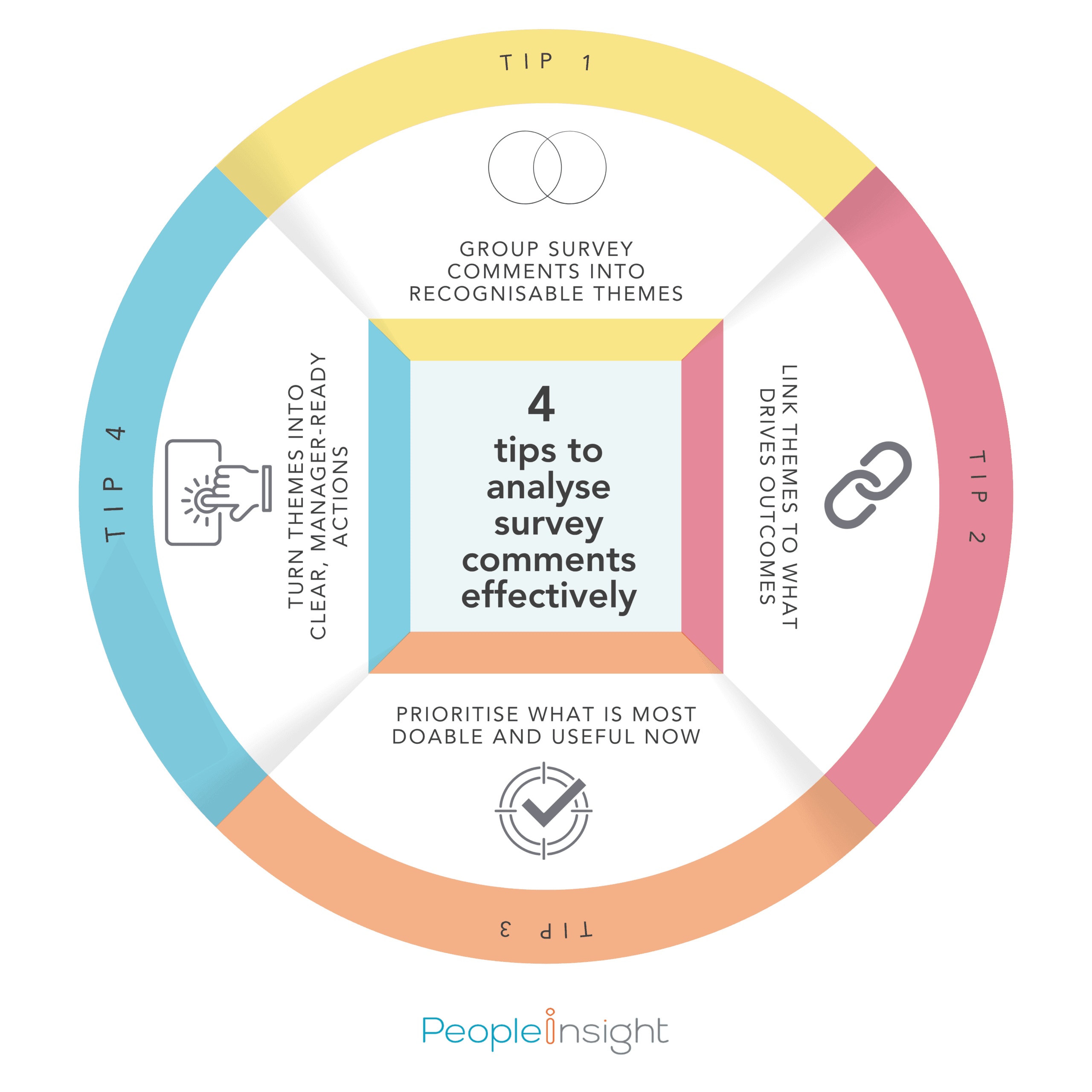
    A practical process usually includes four steps.

    How to analyse survey comments effectively

    1. Group survey comments into recognisable themes

    Start by clustering survey comments into themes employees and managers will recognise in day-to-day work.

    That might include themes like:

    • workload
    • recognition
    • tools and systems
    • ways of working
    • leadership visibility
    • communication
    • development

    It is usually best to keep the number of themes small and clear rather than creating too many labels. Fewer, more recognisable themes make it easier for managers to talk about what employees are actually experiencing.

    2. Link themes to what drives outcomes

    Not every theme matters equally.

    Once survey comments have been grouped into themes, the next step is to connect those themes to outcomes you care about, such as engagement, retention, wellbeing or confidence in leadership.

    This is where qualitative and quantitative data start to work together. If survey comments repeatedly mention meetings, deadline pressure or lack of focus time, it is worth checking whether related survey items around workload, work-life balance or autonomy are also under pressure.

    That helps you move from “employees are mentioning this a lot” to “this is likely to be affecting something important.”

    3. Prioritise what is most doable and useful now

    Survey comments can surface many valid issues, but managers do not need a list of twenty things to fix.

    They need a short, realistic set of actions they can start with. In most cases, two or three actions per team is enough to create momentum without overwhelming managers or employees.

    A practical priority filter can be:

    • high impact and feasible now
    • high impact but longer term
    • lower impact or lower urgency

    This helps organisations avoid overwhelm and keep progress visible.

    4. Turn themes into clear, manager-ready actions

    The final step is to move from analysis to action.

    That means translating survey comments into language managers can actually use. Instead of handing over a long list of excerpts, the aim is to give managers:

    • a short summary of what employees are saying
    • the priority themes for their team
    • two or three actions to start with
    • clear language for how to talk about this with employees
    • a review point to check whether the actions are helping

    For example, comments about long meetings, clashing deadlines and unclear priorities can be grouped into broader themes such as workload and meeting habits, then translated into three clear steps a manager can begin immediately.

    A clear post-survey action plan helps this process feel more structured and more visible.

    How Prism helps with survey comments

    This is where Prism becomes especially useful.

    Survey comments are often the richest source of context in an employee survey, but they are also the hardest part to work through quickly and consistently. Prism helps by making that process more manageable.

    Prism can:

    • group survey comments into useful themes
    • highlight patterns in sentiment
    • summarise comments at scale
    • add context to the numbers
    • help surface likely priorities and next steps

    That means teams can move from raw comment data to a more focused understanding of what needs attention, without losing the value of the qualitative feedback.

    Prism helps organisations analyse survey comments faster, more consistently and with clearer links to practical action. It can do the heavy lifting on grouping comments, identifying patterns and surfacing likely priorities, while managers and leaders stay focused on interpretation, prioritisation and conversation.

    Where additional support is helpful, our Consultants and coaches can also review outputs, tailor the plan to your context and help leaders feel more confident in the conversations that follow.

    How to share survey comments back with employees

    Employees do not need every comment repeated back to them. They do need to know they were heard.

    A good update usually includes:

    • a short summary of what was heard
    • the main themes employees raised
    • two or three actions that will happen next
    • a timeline for review
    • a thank you for the honesty and detail employees shared

    Keep updates brief and concrete. Summarise what was heard in plain English, list two or three actions and give a date for the next check-in.

    This is also where strong survey communications can help teams keep the message clear and credible.

    Common mistakes to avoid with survey comments

    There are a few common pitfalls when working with survey comments:

    • overreacting to one particularly sharp or emotional comment
    • ignoring repeated themes because they seem too familiar
    • treating all comments as equally representative
    • failing to segment results where anonymity allows
    • sitting on the results for too long
    • giving managers too much information and not enough clarity

    These mistakes are common because survey comments can feel urgent and emotionally charged, but reacting too quickly or too narrowly often weakens the quality of the response.

    What good looks like in practice

    A strong approach to survey comments usually looks like this:

    • comments are grouped into a small number of clear themes
    • those themes are linked back to relevant survey data
    • managers receive a short, useful summary rather than a wall of text
    • actions are realistic and time-bound
    • employees are told what was heard and what will happen next
    • progress is reviewed and communicated visibly

    This kind of process makes survey comments much easier to use well.

    It also helps build belief. When employees can see that their comments shaped real decisions, participation and trust tend to grow.

    A good employee survey platform should support exactly this kind of process: clear interpretation, practical outputs and a realistic route from feedback to action.

    Improve the way you use survey comments with People Insight

    Survey comments can be one of the most valuable parts of any employee survey. They bring the lived experience into view, explain what sits behind the numbers and help organisations focus on what matters most.

    But that only works when the process is clear enough to turn qualitative feedback into practical action.

    At People Insight, we help organisations do exactly that through stronger survey design, Prism-powered analysis and clearer action planning. We help teams move from survey comments to priorities managers can actually use, and from feedback to visible progress.

    Ready to get more value from your survey comments? Talk to us about an employee survey with Prism-powered support and a clearer route from feedback to action.

    FAQs about survey comments

    A quick run down on all you need to know

    What are survey comments?

    Survey comments are the open-text responses employees leave in surveys. They help explain what sits behind the scores and add context to the employee experience.

    Why are survey comments important?

    Survey comments are important because they show how employees are experiencing work in their own words. They help organisations understand why scores look the way they do and what action may be needed.

    How do you analyse survey comments?

    A good approach is to group comments into themes, connect those themes to key outcomes or drivers, prioritise what matters most and translate that into realistic actions managers can take.

    What is the best way to use survey comments?

    The best way to use survey comments is to identify repeated patterns, link them to relevant data, turn them into practical actions and then communicate clearly with employees about what will happen next.

    How does Prism help with survey comments?

    Prism helps by summarising survey comments at scale, grouping them into themes, surfacing patterns and providing clearer context so teams can identify practical next steps more quickly.

    How many actions should come from survey comments?

    In most cases, managers should focus on two or three clear, realistic actions rather than trying to respond to everything at once.

    What mistakes should you avoid with survey comments?

    Common mistakes include overreacting to one standout comment, failing to look for wider patterns, giving managers too much raw information and not communicating progress back to employees.

    How can People Insight help with survey comments?

    People Insight helps organisations analyse survey comments more clearly through stronger survey design, Prism-powered insight and practical support that turns open-text feedback into meaningful action.