Increase profitability by 23%
 Boost productivity by 21%
 Increase profitability by 23%
Boost productivity by 21%
Increase profitability by 23%
Boost productivity by 21%
A quick insight: 360 feedback for managers brings structured insight from multiple perspectives to support better leadership growth. It gives leaders clarity on their strengths and development areas and encourages more open conversations about performance and impact. This post explains how it works, why it matters, the benefits it delivers and practical tips for using it effectively with managers.
It’s hardly a well-guarded secret that feedback is essential for both personal and organisational growth. And while it might feel fairly natural to give feedback to your peers or those within your own team, sharing feedback with a manager can feel, to put it mildly, a little bit daunting.
Still, 360 feedback for managers is a valuable tool when used well. When supported by a clear process and the right platform, it can help organisations gather balanced, structured feedback from multiple perspectives and turn it into practical development conversations. Managers gain insight into their strengths and blind spots, while organisations benefit from a healthier, more productive working environment and stronger leadership capability across teams.
Of course, knowing that feedback matters and knowing how to give it are two different things. If 360 feedback is new to you, a little guidance can really help. That is why well designed 360 feedback platforms combine clear reporting with practical support, helping managers and employees approach feedback with confidence rather than apprehension.
Let’s look at why 360 feedback is so important for management and what to consider when giving feedback to your boss. We will also explore 20 practical examples of manager feedback and how they can be used constructively.
But before we really get into things, we have a useful and completely free downloadable guide for you. Our free guide is designed to help you feel more confident before giving feedback, with practical examples, wording tips and guidance on how to prepare.
Related: What is 360 feedback?
Before we go on to examples, let’s look at how 360 degree feedback differs from a mroe traditional appraisal.
Traditional appraisals usually involve feedback from one person, a line manager, shared at set points during the year. They are useful for reviewing objectives, but they often miss how someone’s behaviour affects others day to day.
A 360 appraisal, on the other hand, gathers insight from the people who regularly work with a manager. Those who collaborate with them, rely on their decisions and experience their leadership style first hand. This creates a broader and more realistic picture of how that manager shows up at work.
For employees, this matters because 360 feedback creates a structured way for your voice to be heard. Instead of raising feedback in isolation, your experience becomes part of a wider pattern that is easier for managers to recognise and act on.
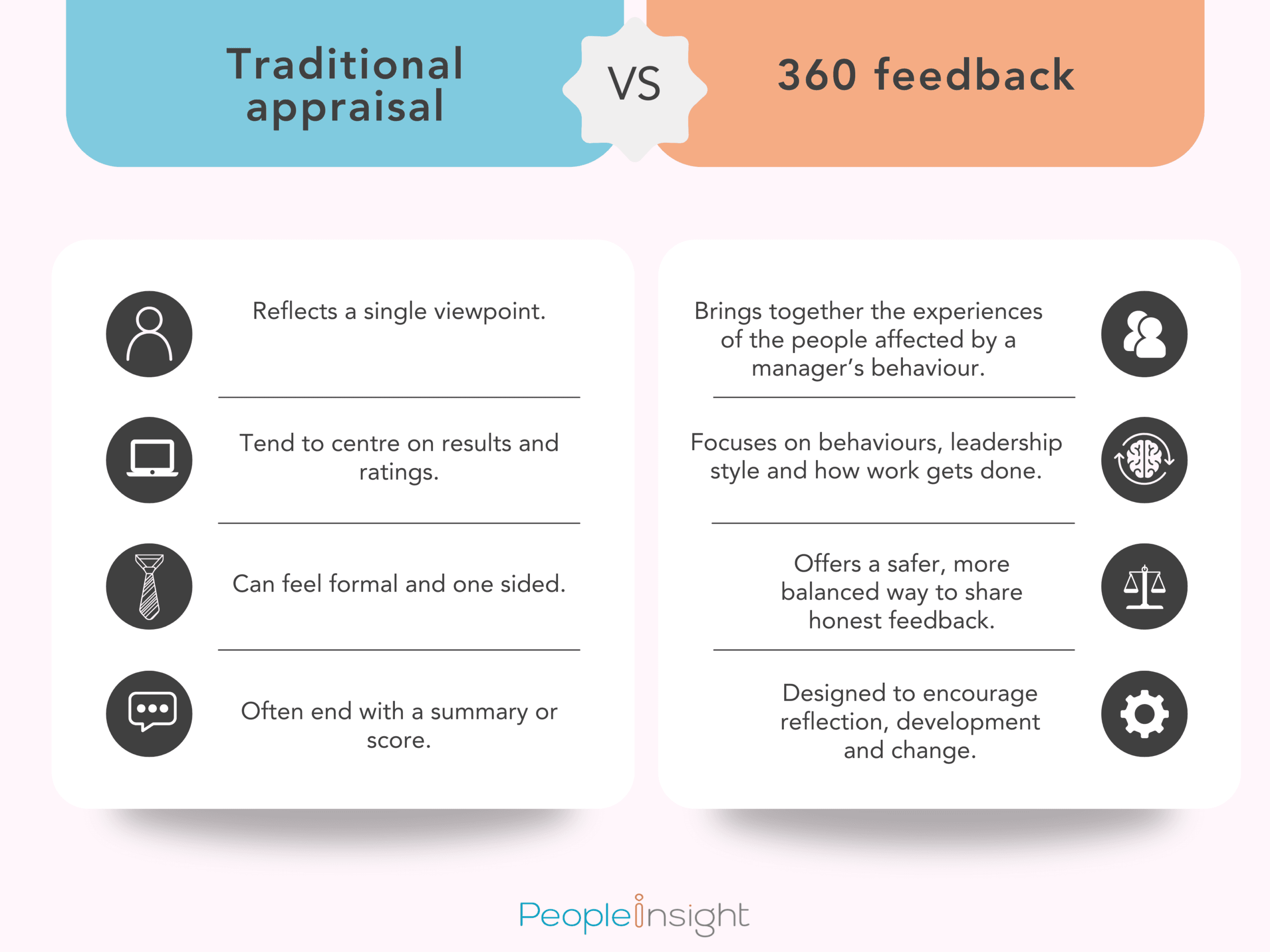
Whose perspective counts
Traditional appraisal reflects a single viewpoint.
360 feedback brings together the experiences of the people affected by a manager’s behaviour.
What the focus is
Appraisals tend to centre on results and ratings.
360 feedback focuses on behaviours, leadership style and how work gets done.
How it feels for employees
Appraisals can feel formal and one sided.
360 feedback offers a safer, more balanced way to share honest feedback.
What happens after
Appraisals often end with a summary or score.
360 feedback is designed to encourage reflection, development and change.
For employees, the real value of 360 degree feedback is knowing that what you say sits within a bigger picture. When supported by the right platform and follow up, it becomes a genuine opportunity to influence how managers lead, communicate and support their teams, rather than a one off comment that goes nowhere.
360 feedback for managers gives employees a voice. It allows employees, at all levels, to share their insights and observations about their boss’s leadership. This approach ensures that managers receive a balanced view of their performance, highlighting strengths while also pointing out areas that may need attention or refinement. When done right, it can lead to enhanced communication, stronger working relationships and a more cohesive team.
Check out our free comprehensive guide on 360 feedback
Giving 360 degree feedback to a manager can feel risky. A well run 360 process is designed to reduce that risk by focusing on shared patterns rather than individual comments, and by supporting managers to listen rather than defend.
Before diving into the examples, we’d like to share some key principles when giving feedback to your boss:
Read More: What are the advantages of 360 feedback?
Here are 20 examples of how to give feedback to your boss, divided into positive feedback and constructive feedback.
1. “I appreciate how you always listen to our ideas and encourage open communication within the team. It makes us feel valued and respected.”
Highlighting this behaviour reinforces its positive impact on team morale.
2. “Your ability to stay calm under pressure sets a great example for the rest of us. It helps keep the team focused during challenging times.”
Praising their composure can reinforce the importance of emotional intelligence.
3. “The way you break down complex projects into manageable tasks is incredibly helpful. It keeps everyone on track and makes the workload feel more manageable.”
This feedback acknowledges effective project management skills.
4. “I’ve noticed that you consistently acknowledge team members’ hard work. It’s motivating to know that our efforts don’t go unnoticed.”
Recognising their appreciation for others encourages continued positive reinforcement.
5. “Your willingness to delegate tasks shows trust in your team. It empowers us to take ownership and perform to the best of our abilities.”
Highlighting trust can encourage continued delegation, which fosters growth and development within the team.
6. “Your promptness in addressing concerns is commendable. It shows that you care about the team’s well-being and the quality of our work.”
Praising responsiveness reinforces the importance of swift action.
7. “I appreciate your transparency when it comes to company decisions. It helps us understand the bigger picture and how our work contributes to overall goals.”
Transparency is vital for team alignment and motivation.
8. “Your openness to feedback, even from those of us who are less experienced, is inspiring. It creates an environment where everyone feels comfortable sharing their thoughts.”
Encouraging a feedback-friendly culture is beneficial for continuous improvement.
9. “The regular team-building activities you organise have significantly improved our team cohesion. It’s clear you value our collaboration.”
This feedback highlights the importance of team bonding for a harmonious work environment.
10. “You’ve done an excellent job of setting clear expectations for our projects. It’s made it much easier to prioritise and manage our workload effectively.”
Acknowledging clarity in communication reinforces the need for well-defined goals.
1. “While I appreciate your drive for results, sometimes the urgency can feel overwhelming. It might be helpful to discuss timelines more collaboratively with the team.”
Suggests a more balanced approach to deadlines, promoting team input.
2. “I’ve noticed that sometimes, in meetings, quieter team members struggle to get a word in. It might be beneficial to actively invite input from everyone.”
Encourages inclusivity in discussions, which can lead to better decision-making.
3. “While your feedback on our work is always insightful, it would be even more helpful if it were more timely, allowing us to make adjustments sooner.”
Timeliness is key in feedback, and this suggestion promotes a more proactive approach.
4. “I think it would be beneficial if we could receive more regular updates on project progress. It would help us stay aligned and adjust our work as needed.”
Regular communication can prevent misunderstandings and ensure everyone is on the same page.
5. “Sometimes, it feels like certain team members’ contributions are not acknowledged as much as others. Perhaps ensuring everyone’s efforts are recognised could boost overall morale.”
Suggests more equitable recognition of team efforts to maintain morale.
6. “I’ve observed that during busy periods, there’s a tendency for some tasks to be delegated without clear instructions. More detailed guidance could help us avoid confusion and work more efficiently.”
Clear instructions are crucial for effective delegation.
7. “It might be helpful to have more one-on-one check-ins. They could provide an opportunity to discuss challenges and achievements in more detail.”
One-on-one meetings can offer a more personalised approach to management.
8. “I think we could benefit from more strategic planning sessions. They would allow us to better align our work with the company’s long-term goals.”
Strategic planning helps ensure that day-to-day work is contributing to broader objectives.
9. “While your enthusiasm is infectious, sometimes it feels like we’re taking on too many initiatives at once. Prioritising a few key projects could help us deliver better results.”
Focus is essential for delivering high-quality outcomes.
10. “I’ve noticed that in high-stress situations, communication can become quite abrupt. A calmer approach could help maintain a more positive team atmosphere during those times.”
Suggests maintaining composure in stressful moments to preserve team morale.
360 feedback for managers is most effective when participants understand the purpose, feedback is confidential and managers are supported to reflect and act on what they hear.
Providing feedback for managers is an important element of professional development that benefits both the manager and the team. Whether offering praise or constructive criticism, the key is to be honest, specific and considerate. By doing so, you contribute to a culture of continuous improvement and mutual respect, which ultimately leads to a more successful and happier workplace for everyone.
If your organisation wants to introduce 360 feedback in a fair, structured and supportive way, a dedicated 360 feedback platform can help turn insight into meaningful development. Get in touch with us today. And don’t forget to download our free guide above for further insights!